Guides What Is a GEO Agent? From AI Visibility Monitoring to Content Execution
GEO AGENTS
What Is a GEO Agent? From AI Visibility Monitoring to Content Execution
Learn what GEO agents do, how monitoring differs from execution, and how Rankvia connects AI visibility insights with SEO content planning and creation.
By Rankvia ·
Your business is missing from an AI answer to a question your buyers ask. A visibility report makes the gap visible. It leaves a more useful question: what work, if any, should happen next?
A GEO agent can help with different parts of that decision. Some products observe answers; others recommend changes or help produce content. The label alone does not tell you where the software's responsibility ends and yours begins.
Rankvia is your AI SEO agent for Google and AI search, with a website-growth autopilot operating model. It can take on opportunity decisions, planning and page production, then eligible supported publication. AI Visibility is one input to that work, alongside business, website and search evidence.
What is a GEO agent?
A GEO agent is AI-powered software that assists with tasks related to visibility in generative search and AI-generated answers. Its responsibilities depend on the product: measurement, investigation, recommendations, content work or selected execution.
GEO means generative engine optimization. The dedicated What is GEO? guide explains the discipline. Here, the question is what a software agent actually takes responsibility for.
There is no consistent industry-wide meaning of the label. Current vendor descriptions illustrate the range: Thig emphasizes tracking AI mentions and routing follow-up work to other agents; Sitefinity describes content assessments and editor-reviewed recommendations; The SEO Agent emphasizes content production and CMS publishing. These are vendor-described emphases, not an exhaustive taxonomy or independent performance tests. Products may combine several responsibilities.
What do GEO agents actually do?
Evaluate the outputs and the decisions required to use them. Five activities often appear under this broad category, but no product should be assumed to perform all five.
Observe AI-search visibility
A monitoring workflow samples questions and records available answers, brand appearances and source evidence. A mention names a business, a citation identifies a supporting source, and a recommendation endorses an option. They are different observations.
Results depend on the questions, platform or surface, date, language, market and sampling conditions. A missing brand in a usable answer differs from a failed request. A percentage across sampled answers is not a permanent universal ranking. See AI visibility tools for measurement-focused buying criteria.
Investigate opportunities and gaps
An observation can prompt investigation: is the question commercially relevant, is the answer stable, and does the website explain the buyer's need? A missing mention alone does not prove a content gap. A good existing page, an external source or poor question fit can change the next decision.
Recommend improvements
A useful recommendation names the problem, evidence, proposed action and intended page owner. It should be possible to explain why improving an existing page is preferable to creating another one, or why no page work is justified.
Prepare or improve content
Execution-oriented software may prepare a page plan, draft or update for review. Check whether it produces actual content or only a brief, how it uses approved business facts, and whether the output can be corrected before publication. An opportunity-driven update differs from continuously finding and repairing every declining page.
Carry approved work forward
Supported execution may include a saved draft, export or publication through a configured destination. These are different completion states. Ask which action ran, what permission it required and how you verify the result. A publish button is not evidence that a page went live.
GEO monitoring vs recommendations vs content execution
These are practical buying distinctions, not official industry categories.
| Approach | Main purpose | Typical output | What happens next |
|---|---|---|---|
| Monitoring | Observe a defined sample of AI answers | Appearances, answers or cited sources | Interpret the evidence and its limits |
| Recommendations | Decide which changes might be useful | Prioritized actions with reasons | Choose the work and an owner |
| Content execution | Prepare or improve justified website content | Page Plans, drafts or supported updates | Review and use the correct publishing path |
Some tools combine these approaches. A specialist monitor can be a good choice when your team already handles diagnosis and production. If recommendations keep accumulating, evaluate how much work the software can carry beyond the report.
The useful outcome is deciding what work is justified and getting that work done. Sometimes the right outcome is monitoring, correcting external information through its owner, or leaving a useful page unchanged.
1. Monitor
What happened in the sampled answers? Record the scope, dates and available evidence.
2. Decide
Does the observation justify action? Check business fit, existing pages and other search evidence.
3. Execute
Complete the selected task, review its output and verify the destination when publishing.
This educational sequence describes responsibilities. It does not represent an automatic pipeline in every GEO product or an automatic trigger from each Rankvia visibility finding.
How can visibility insights lead to action?
Use this conceptual sequence to evaluate a workflow. The responsibility labels distinguish Rankvia's supported work from user decisions and general follow-up practices.
- Understand the business. Rankvia analyzes the website and prepares business context. You approve the Business Profile, including the content language and market; those settings govern downstream planning and generation.
- Observe relevant buyer questions. Rankvia's supported AI Visibility observations cover ChatGPT, Gemini and Google AI. Inspect the actual sampled surface and available evidence instead of assuming every consumer experience was reproduced.
- Investigate meaningful gaps. You assess relevance and uncertainty. Where supported and enabled, compatible saved AI Visibility evidence can inform Rankvia's planner. A visibility observation does not automatically launch generation.
- Check the website and search context. Rankvia uses business/site context and search-opportunity evidence; Google Search Console is an optional additional input. Estimates, current SERPs, first-party performance and sampled AI answers remain distinct evidence sources.
- Choose the justified response. Planning can select Create or Improve for owned pages, or no additional page, Monitor, third-party visibility or Skip. Not every finding is eligible for the Content Calendar. External coverage and technical repairs require their appropriate owners.
- Prepare selected page work. Rankvia can prioritize eligible work in the Content Calendar, prepare a Page Plan and generate supported content with metadata and relevant internal-link context. You can inspect the plan and correct business facts.
- Review and publish. Review First keeps approval before publication. Opt-in Autopilot can publish eligible scheduled content through a connected, ready WordPress or Shopify destination, subject to current entitlement and setup. A saved draft, CMS draft and live page are different states.
- Observe again. As a measurement practice, compare later observations under similar conditions and assess business outcomes separately. This is not a promise of a continuous autonomous repair loop or proof that a particular edit caused an AI answer to change.
For deciding what to change in a specific case, use the separate AI visibility improvement framework. This guide is about evaluating the software's responsibilities, rather than repeating that diagnostic checklist.
Why do GEO and SEO work better together?
A buyer needs clear, accurate information whether discovery begins with a search result or a generated answer. Useful product explanations, accessible pages, relevant internal links and evidence from the business serve that reader across discovery channels.
Google's guidance treats GEO and AEO as SEO, emphasizing distinctive, useful content. Its guidance concerns Google Search, not identical rules for every AI provider.
In practice, ask whether the intended page is discoverable, answers a real buyer question and supports its claims. Add original expertise and accurate product information where they help the reader. Do not create near-identical pages for every prompt variation or assume a particular format earns citations.
The SEO and GEO guide explains the broader relationship. For choosing software, the implication is straightforward: the visibility dashboard and the website-content process should inform each other without treating every fluctuation as a production order.
Don't just track visibility. Put worthwhile website work in motion.
Rankvia takes on more of the recurring website-growth process: choosing relevant opportunities, deciding page ownership, prioritizing a dated roadmap and preparing the page before generation. Its value is the responsibility it can carry through to a usable result.
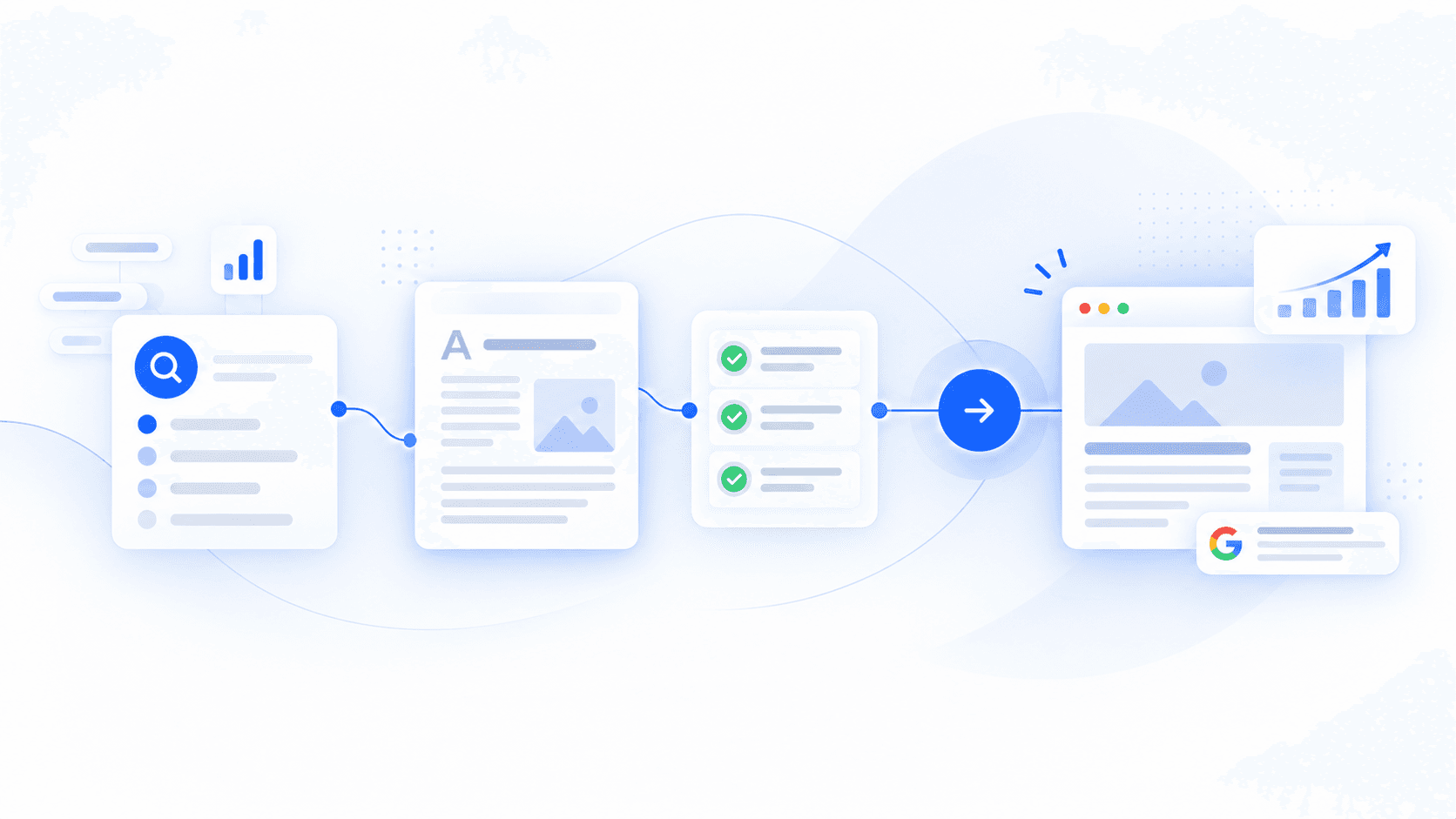
Approved business context → opportunity decisions → Content Calendar → Page Plan → content creation → review and supported publication. AI Visibility and other available search evidence can inform decisions; they are not interchangeable signals or mandatory inputs at every stage.
The Content Calendar gives selected work an order. A Page Plan defines what a page should accomplish before writing starts. Content Creation produces a draft to inspect, while opportunity-driven Improve can address an existing owner instead of adding a competing URL.
This can matter to a SaaS team explaining a use case, an ecommerce store helping shoppers choose, or a services business answering pre-sale questions. For a small business or a lean marketing team, it can remove recurring research, briefing and production handoffs. The fit depends on the work you want delegated, rather than company size.
See Rankvia's AI SEO Agent and the product overview for the operating model and controls. Rankvia does not take on autonomous backlink acquisition, comprehensive technical repairs, universal CMS publishing or guaranteed AI placements.
APPLY THIS TO YOUR WEBSITE
Find the website work worth doing next
Start with your website. Let Rankvia prepare opportunities and an initial plan, then carry selected content work forward with clear review controls.
No credit card required. The preview is not an ongoing free plan.
How should you choose a GEO agent?
Ask the vendor to explain one meaningful observation and the work that can follow it. Evaluate the artifact and handoff at each stage, rather than counting prompts or logos.
To compare documented workflows, see our best GEO agents guide.
- Coverage: Does it observe the platforms and actual surfaces relevant to your buyers? What is sampled and what is unavailable?
- Evidence: Can you inspect dates, questions and supporting answers or sources where provided? Does it distinguish failed requests from absence?
- Meaning: Are mentions, citations and recommendations separated? Can you understand a score's denominator?
- Prioritization: Does an opportunity have business relevance, a page owner and reasons to act? Can the answer be no additional page?
- Execution: Does the workflow end at a suggestion, plan, saved draft or verified publication? Which steps require you to move material between tools?
- Control: Can you review business context, claims, language, market and publication preferences before delegating more?
- Fit: Are destination readiness, permissions, entitlement and limitations explicit? Who handles technical issues or third-party coverage?
Rankvia fits teams that want more of the owned-site opportunity, planning and production work handled in a prebuilt process. Specialist monitoring or other expertise can still be appropriate when measurement depth, infrastructure or external relationships are the main job. For the broader software category, see what an AI SEO agent does. The agentic SEO guide explains the wider approach to delegated work.
Can a GEO agent guarantee visibility in ChatGPT or Google AI?
No. A tool can complete a task on your website; it cannot control whether an independent AI system mentions, cites or recommends your business. Answers can vary across questions, dates and conditions outside the software's control.
Keep two records: whether the intended work was completed correctly, and what later observations show. A reviewed page that is live is a production result. A subsequent citation is an observation. Neither a single favourable answer nor its timing proves causation, a universal visibility gain or revenue growth.
Frequently asked questions
What is the difference between a GEO agent and an AI SEO agent?
GEO-agent descriptions usually emphasize generative-search visibility tasks. AI SEO agents can cover a broader search and website-content process. The labels overlap, so compare actual responsibilities and outputs. Rankvia combines search and AI evidence with opportunity decisions, planning, page creation or improvement and eligible publication.
Is a GEO agent different from an AI visibility tracking tool?
It may be, but the name alone does not prove it. Some GEO agents emphasize observation; others support recommendations or execution. Check whether the workflow stops at a report and what a person must do next.
Can a GEO agent create content?
Some can. Verify whether the specific product produces a plan, a complete draft or an update, and what review is available. Rankvia can prepare Page Plans and generate supported page content through its planning workflow; a visibility observation does not automatically trigger that generation.
Can GEO agents improve visibility in ChatGPT and Google AI?
They can support investigation and useful website work that may help discovery. They cannot guarantee inclusion or control AI answers. Evaluate repeated observations with comparable scope and keep production completion separate from visibility and business outcomes.
Do small businesses need a GEO agent?
Only if it addresses a useful responsibility they want to delegate. A monitor may suffice when someone already investigates and produces content. Rankvia is relevant when the business wants more of the recurring opportunity-to-page process handled, with business approval and publishing controls.
Give visibility findings a useful next step
A missing mention is a reason to investigate, not an instruction to publish. Choose software that helps you decide whether work is justified and carries the right responsibilities through to a reviewable result.
Rankvia brings that decision into a broader website-growth process, so a worthwhile opportunity can become planned, created and usable content.
APPLY THIS TO YOUR WEBSITE
Move from another report to worthwhile content work
Discover what your website should create or improve with Rankvia's personalized Search Growth Plan and eligible free preview.
Publishing requires current entitlement and a connected, ready supported destination.
Sources
- Google Search Central: Generative AI search guidance
Google's guidance for its generative search experiences.