Guides SEO and GEO
SEO + GENERATIVE ENGINE OPTIMIZATION
SEO and GEO: How to Get Found in Google and AI Search
People no longer discover businesses through one search experience. This guide separates documented platform behavior from GEO speculation, then turns that distinction into a practical search strategy.
By Rankvia ·
SEO and GEO in plain English
SEO remains the foundation of search visibility. GEO is a useful label for the additional goal of being represented inside generative and answer-based search experiences. The two overlap substantially.
What is SEO?
Search engine optimization helps a website become discoverable, understandable and relevant for searches that matter to its audience. That includes crawlability, indexability, site structure, internal links, search intent, useful content, page experience, structured data where appropriate, authority and credibility.
For Google AI Overviews and AI Mode, those same foundations continue to apply. Google says supporting pages need normal Google Search eligibility: they must be indexed and eligible to appear in Search with a snippet.
What is GEO?
Generative Engine Optimization, or GEO, is a term used for strategies intended to improve how a brand or its information appears in generative and answer-based search experiences. Possible outcomes may include appearing as a supporting source, receiving a linked citation, being mentioned in a generated answer, receiving referral traffic or surfacing in an AI-generated comparison.
GEO is useful when it reminds marketers that modern search visibility extends beyond traditional ranked results. It becomes misleading when it suggests that there is one universal GEO algorithm or a new technical layer that replaces SEO.
What changed when search became generative
The biggest change is not that pages, indexes or search intent disappeared. It is that the system can synthesize an answer before the user chooses a page to visit.
A generative search experience may interpret a broader question, retrieve multiple pieces of information and synthesize a response with supporting links. Google says both AI Overviews and AI Mode may use query fan-out, issuing related searches across subtopics and data sources while developing a response. OpenAI says ChatGPT Search may similarly rewrite a request into targeted queries sent to search providers.
One intent does not need one page for every wording variation
Google explicitly warns against creating separate content for every query or fan-out variation primarily to manipulate rankings or generative responses. The better planning question is: what distinct intent should this page own?
Search visibility can happen before a click
A user may encounter a business inside a generated answer before visiting the website. Depending on the platform and available reporting, observable signals can include impressions, cited pages, source appearances, referrals, brand mentions and conversions.
Google, ChatGPT and Perplexity work differently
There is no documented universal GEO formula that applies identically to Google, ChatGPT Search and Perplexity. Their published discovery controls already differ.
| Platform | Discovery foundation | Relevant published control | What is not guaranteed |
|---|---|---|---|
| Google Search, AI Overviews and AI Mode | Google Search eligibility and ranking/quality systems | Googlebot, indexing and snippet controls | Crawl, index, ranking or inclusion |
| ChatGPT Search | OpenAI search crawling plus search-provider retrieval | OAI-SearchBot and OpenAI's published IP ranges | Top placement |
| Perplexity | Perplexity's crawl/search infrastructure | PerplexityBot and published IP ranges | Citation or placement |
Google AI Overviews and AI Mode
For Google, the practical message is straightforward: start with SEO. Google says there are no additional technical requirements for appearing as a supporting link in AI Overviews or AI Mode. Meeting those requirements still does not guarantee crawling, indexing or inclusion.
- Allow Googlebot to crawl the page.
- Ensure important content is available in textual form.
- Make pages discoverable through internal links.
- Keep relevant business and product information accurate.
- Use structured data accurately where appropriate.
Google's current guidance says Google Search ignores llms.txt, does not require special AI schema and does not require AI-specific content chunks. Read Google’s AI features guidance.
ChatGPT Search
OpenAI says any public website can appear in ChatGPT Search. To support inclusion in summaries and snippets, publishers should not block OAI-SearchBot and should allow its published crawler IP ranges where relevant. Crawler access is an eligibility and discovery consideration, not a placement guarantee. OpenAI does not document a way to secure top placement in its current public publisher guidance.
OAI-SearchBot is different from GPTBot. OpenAI's publisher guidance separates search discovery controls from controls related to potential model training. OpenAI’s crawler documentation also explains that a disallowed URL may still be shown as a link and title in some circumstances, and that noindex is the relevant display control.
Perplexity
Perplexity publishes a separate crawler called PerplexityBot. It recommends allowing PerplexityBot and its published IP ranges if you want a site to appear in search results, and says the bot is not used to crawl content for AI foundation models. Its documentation does not provide a universal formula for citation placement. Read Perplexity’s crawler guidance.
What strong SEO and GEO content has in common
Despite platform differences, strong search content still revolves around useful information, coherent intent and clear website relationships.
Serve a real search or buyer decision
Start by identifying what someone is trying to accomplish: understand a problem, evaluate an approach, compare products or providers, understand tradeoffs, decide whether something fits, or choose what to do next.
Create information worth finding
Useful information gain may come from firsthand experience, original research or data, specific examples, original frameworks, expert analysis, primary-source synthesis, practical comparison, tools and checklists.
Answer clearly, then add useful depth
Clear answer - explanation - evidence and context - relevant follow-up questions is Rankvia's editorial recommendation, not a documented Google ranking factor.
Make business context clear and connect related information
Specific language helps readers understand what an entity actually is. Relevant internal links can help readers continue researching, evaluate products or services and navigate a decision. The goal is progression, not forced promotion.
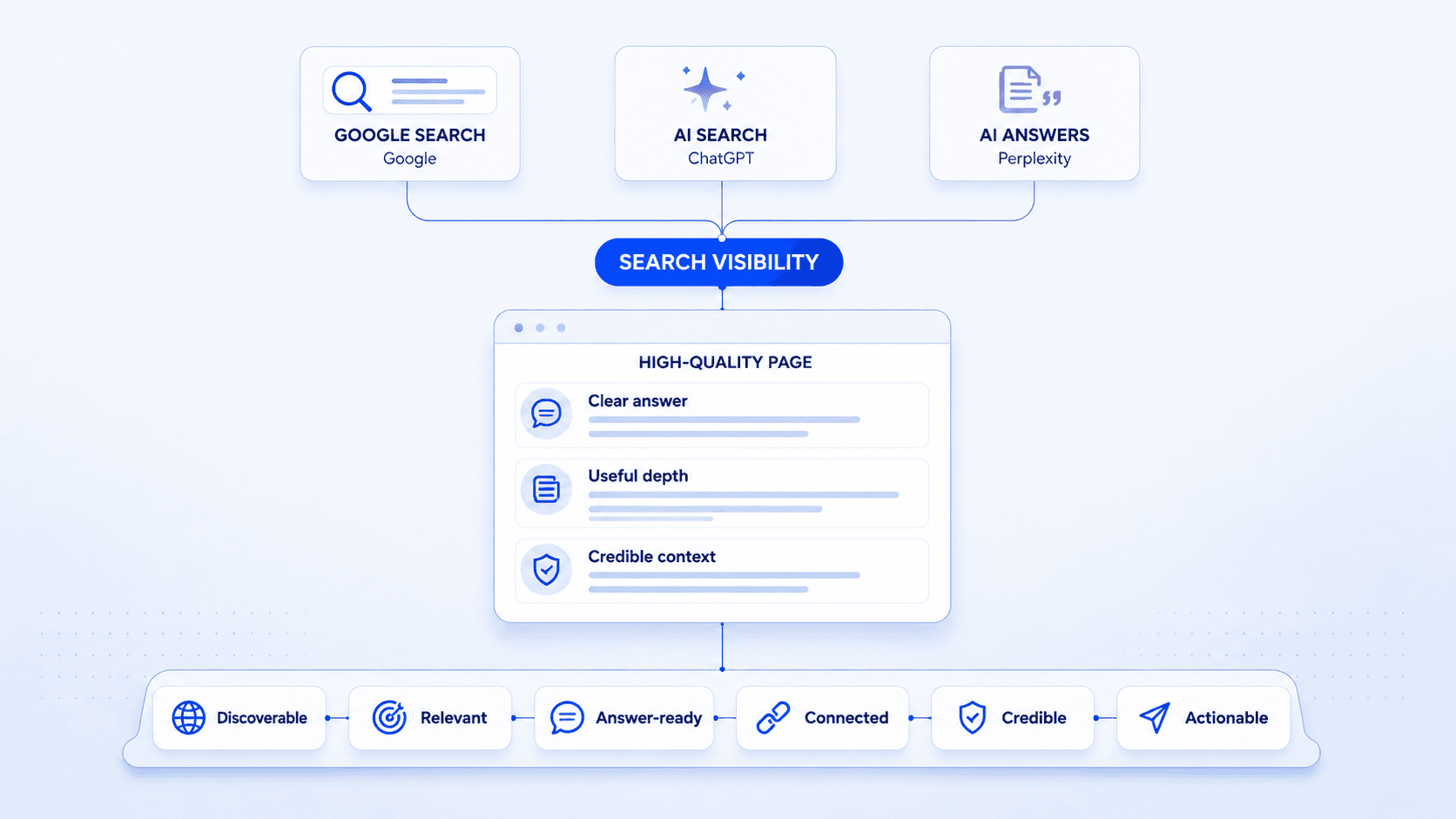
The Rankvia Search Visibility Framework
The following is Rankvia's framework, not a published ranking model from Google, OpenAI, Perplexity or another search platform. It is a practical way to evaluate whether a page is prepared for modern search visibility.
Discoverable
Can relevant systems access and surface the page?
Relevant
Does the page serve a real query, problem or buyer decision?
Answer-ready
Can the reader understand the core answer and evaluate it?
Connected
Does the page make sense inside the wider website?
Credible
Are important claims current, precise and supportable?
Actionable
Does the page help the reader make useful progress?
How to build an SEO + GEO content strategy
A durable strategy moves from business understanding to search evidence to page execution.
1.Understand the business
Establish what the business sells, its target customers, positioning, differentiators, conversion goals, existing products or services, website coverage and relevant constraints. A query can have search demand and still be commercially irrelevant.
2.Find relevant buyer searches
Research searches around problems, jobs to be done, use cases, comparisons, alternatives, buying criteria, providers, implementation, objections and categories. Then identify the decision behind each search.
3.Review the search landscape
Study how the query is currently being answered. Current results are evidence, not a template to copy.
4.Match the search to the right page role
Not every query needs a blog article. The role should follow the buyer's need, whether that is an educational guide, direct-answer page, buying guide, use-case page, comparison, alternative page, audience page or commercial page.
5.Check what the website already owns
Ask whether a relevant page already covers the intent, could be improved, or would overlap with another URL. The right decision may be create, improve or skip.
6.Plan the page before generating it
Define the objective, intended reader, buyer intent, page role, answer strategy, supporting depth, business positioning, relevant internal connections and next step.
7.Publish connected pages
Build clusters around distinct intent. Each page should own a distinct need and connect back to broader context where useful.
8.Measure and improve
Monitor performance by platform and business outcome. Use repeated observations, first-party reporting where available and actual downstream behavior.
APPLY THIS TO YOUR WEBSITE
See which search opportunities your website should act on next.
Rankvia analyzes your business and existing website, finds relevant buyer searches and organizes the strongest opportunities into a prioritized Content Calendar.
Personalized to your website · No credit card required
GEO tactics to be skeptical of
Some GEO recommendations are sensible editorial practices. Others are presented with more certainty than the platforms support.
| Claim | What current primary-source evidence supports |
|---|---|
| GEO replaces SEO | Google says its AI Search optimization remains grounded in normal SEO. |
| Google needs llms.txt | Google Search currently ignores the file. |
| AI Search needs special schema | Google says no special schema is required. |
| Content must be split into AI-sized chunks | Google says special chunking is unnecessary. |
| Quotable sentences guarantee citations | No reviewed primary platform source establishes such a guarantee. |
| More AI-generated pages create more authority | Google warns against scaled content aimed at query or fan-out variants. |
| A ChatGPT answer provides a stable ranking | OpenAI's current public publisher guidance documents no fixed rank model or way to secure top placement. |
| All AI-search platforms behave identically | Their documented crawler and discovery systems already differ. |
Does llms.txt improve Google visibility?
According to Google's current documentation, no. Google Search says it ignores llms.txt, so the file does not positively or negatively affect Google Search ranking or visibility.
Do quotable sentences guarantee citations?
No documented universal rule from Google, OpenAI or Perplexity establishes such a guarantee. Clear and specific writing is useful editorial practice, not a proven universal citation factor.
Practical SEO + GEO checklist
Discoverability
- The page returns a normal successful response.
- Googlebot is allowed if Google Search visibility is desired.
- The page is indexable if Google visibility is desired.
- Important pages are internally discoverable.
- Relevant sitemap entries exist.
- OAI-SearchBot and PerplexityBot are allowed when their respective search visibility is desired.
Relevance
- The page serves one coherent search or buyer intent.
- That intent matters to the business.
- The page type matches the user's task.
- The page does not unnecessarily duplicate another URL.
Answer quality
- The main question is answered clearly.
- Important reasoning is explained.
- Supporting depth matches the decision.
- Time-sensitive claims use current sources.
- The page contributes original experience, analysis, evidence or synthesis.
Business and entity clarity
- The business, product or service is described precisely.
- The intended audience is clear.
- Commercial references are accurate.
- Promotion does not overwhelm the answer.
Connections
- Related guides are linked contextually.
- Relevant commercial pages receive logical connections.
- Anchor text describes the destination naturally.
- The reader has a useful next step.
Credibility
- Platform claims use primary sources.
- Facts are separated from recommendations.
- Unsupported algorithm claims have been removed.
- No ranking or citation guarantee is implied.
- Fast-changing platform claims have a review schedule.
How to measure SEO and GEO performance
There is no single universal GEO metric. Use platform-specific evidence and connect it to business outcomes.
Google Search and generative AI visibility
Continue measuring impressions, clicks, queries, pages, engagement and conversions. Google launched dedicated Search Generative AI Performance reports in Search Console on June 3, 2026. Google says they provide separate views of impressions in generative AI features including AI Overviews and AI Mode, with pages, countries, devices and date dimensions. Google updated the announcement to confirm these reports reached all websites worldwide on August 31, 2026. Read the announcement.
ChatGPT referral traffic and prompt monitoring
Identifiable ChatGPT Search referrals can be measured when referrer information or URL tagging is available, such as utm_source=chatgpt.com, providing an observable first-party signal. A controlled prompt set can supplement platform reporting, but treat observations as samples rather than fixed rankings. Record the model, date, prompt, geography and relevant context.
From strategy to execution
Understanding the strategy is one challenge. Executing it consistently is another.
1. Business Profile
Understand the business, audience, positioning and existing website.
Learn more2. Content Calendar
Find and prioritize relevant buyer searches and determine what should be created first.
Learn more3. Page Plan
Define the objective, reader, answer strategy, business context and relevant connections before generation.
Learn more4. Generated Page
Turn that strategy into a complete page that can be reviewed and edited before delivery.
Learn more
The goal is not simply to generate more text. It is to move from search evidence to decision to page strategy to execution.
Related guides
What Is GEO? Generative Engine Optimization Explained
The definition and fundamentals of GEO.
SEO vs GEO: What's the Difference?
The dedicated comparison of SEO and GEO.
AI Search Optimization: How to Get Found in AI Search
The practical cross-platform implementation workflow.
AI Search Content Strategy
Decide what your website should create, improve or skip.
How to Optimize for Google AI Overviews and AI Mode
Google-specific generative Search guidance.
How to Get Cited by ChatGPT
ChatGPT Search availability and citation guidance.
Sources
Frequently asked questions
BUILD YOUR SEARCH GROWTH PLAN
Find the searches your website should compete for - across Google and AI search.
Enter your website to build the Business Profile, prioritized Content Calendar and strategy for your first page.
Personalized to your website · No credit card required