Guides What Is an AI SEO Agent? How It Works, What It Does, and Its Limits
AI SEO EXPLAINED
What Is an AI SEO Agent? How It Works, What It Does, and Its Limits
Learn what AI SEO agents do, how they differ from SEO tools and AI writers, and which SEO tasks they can automate while keeping you in control.
By Rankvia ·

An AI SEO agent is software that uses AI, website context and available tools to carry out related search-optimization tasks toward a defined result. Depending on the product, it can research opportunities, choose priorities, plan a page, create or improve content and move eligible work toward review or publication.
The useful distinction is responsibility: does the system merely suggest the next action, or can it advance the work? A generated draft is one output. Choosing whether that draft should exist, preserving its evidence and preparing it for the right website are additional jobs.
The label alone tells you little about permissions, quality or autonomy. This guide explains what to inspect before delegating those jobs.
What makes an AI SEO agent different?
Consider an illustrative decision, not a customer result: a website already has a strong service page, and someone proposes an article targeting a closely related phrase.
A writing assistant can produce the requested article. An analysis tool can show search data. A connected workflow can pass a selected topic from a brief to a draft. An SEO agent may assess existing coverage first and recommend improving the service page, creating a genuinely different resource, or doing nothing.
That distinction matters more than whether the interface contains a chat box.
The categories are not standardized. In one technical framing, Anthropic distinguishes predefined workflows from agents that choose their own tool use and steps . Marketing labels often cover both. Ask what decisions and actions a particular product actually handles.
A connected SEO workflow can follow a fixed sequence reliably without dynamically choosing every step. An AI SEO agent commonly adds some delegated judgment or execution across that sequence. A fully autonomous SEO system is a much broader claim: inspect its scope, permissions, exceptions and recovery process before treating it as hands-off website management.
How does an AI SEO agent work?
A representative process has eight stages. These are evaluation points, not a promise that every product includes them.
1. Understand the website and business
The system needs accurate offers, audience, positioning, language, target market and existing pages. A public website can supply context, but outdated prices or unsupported product claims should not become approved facts simply because they appeared online.
A useful first deliverable is an editable business summary. Confirm who approves it and whether later plans use the corrections.
2. Collect relevant search evidence
Depending on its connections, the product might use search-demand data, search results, existing URLs, optional Search Console performance or sampled AI answers. These signals answer different questions. A search-volume estimate is not proof of a sale; an AI mention is not a click or recommendation.
Look for sources, dates and enough context to inspect the evidence. Ask what happens when data is unavailable.
3. Identify and prioritize opportunities
A list of keywords is not a strategy. Prioritization should consider buyer relevance, existing coverage, evidence quality and the work needed to serve the intent. A broad informational topic may be less useful than a narrower question that helps someone evaluate the business.
The output should explain why an opportunity deserves attention, rather than just assigning a score.
4. Decide what deserves action
Possible outcomes include creating a page, improving an existing URL, monitoring, investigating third-party visibility, skipping or making no change. More pages are not automatically a better result.
In the service-page example, the right action depends on whether the proposed article answers a separate reader need. Similar wording alone does not justify another URL.
5. Prepare a content strategy or page-level plan
Before writing, define the intended reader, search intent, page owner, answer goal, relevant business facts, sources and internal links. A useful brief explains what the page must accomplish and what claims it must not make.
A Content Calendar can place selected work into a dated sequence. A page-level plan then makes each item actionable rather than leaving an editor to reconstruct the strategy.
6. Generate or improve content
Generation should follow the plan and approved context. Review whether the output answers the question, distinguishes evidence from assumptions and connects naturally to relevant products or services.
For improvements, inspect the proposed changes to the existing owner. Replacing a useful article wholesale is a different action from correcting a section or adding missing evidence. The product's actual editing scope matters.
7. Review and publish through a supported workflow
A draft, a CMS draft, a scheduled item and a live URL are different states. Confirm which state the action creates. Automatic publication should depend on explicit authorization, eligible content, a supported destination and a ready connection.
After publication, verify the URL, formatting, images, links and selected state. A completed generation job does not prove the page is live. Our automated publishing guide examines that handoff in more detail.
8. Measure what the system actually monitors
Some products track search performance, some sample AI visibility, and some only record publishing status. Ask which metrics, questions, locations and dates are covered. Distinguish observed appearances from traffic, leads and causal impact.
Measurement may inform the next decision. It does not establish that the system continuously repairs every weak page.
AI SEO agent vs SEO tool vs AI writer
These are typical responsibility patterns, not fixed product specifications. Tools can overlap, and a writing product can add agentic capabilities.
| Dimension | AI writing assistant | SEO analysis tool | Connected SEO workflow | AI SEO agent |
|---|---|---|---|---|
| Inputs | Prompt, sources or brief | Site, queries or datasets | Approved context and selected work | Business/site context, evidence, goals and permissions |
| Outputs | Text or a draft | Findings and recommendations | Artifacts passed between stages | Decisions and completed work within a defined scope |
| Research and planning | Often directed by the user | Supplies analysis; planning varies | Follows configured stages | May select or prioritize work; inspect its reasoning |
| Content creation | Main function | Product-dependent | Can include generation | May create or improve content |
| Execution | User usually carries work onward | User usually acts on findings | Runs the configured sequence | Can advance supported tasks across stages |
| Human approval | User reviews the output | User chooses the action | Approval gates can be configured | Review boundaries depend on permissions and setup |
| CMS publishing | Requires an integration or manual handoff | Product-dependent | Possible with a supported connection | Possible, not implied by the agent label |
| Ongoing monitoring | Not inherent | Depends on the tool | Only if configured | Only for supported signals and schedules |
A specialist tool can be the better choice when you need deeper technical, backlink or measurement capabilities. An agent is useful when the recurring decisions and handoffs are the work you want to delegate. Neither category proves output quality.
What can AI SEO agents automate?
Evaluate each task separately. A product may handle content planning well while leaving technical implementation and analytics to your team.
- Search research and opportunity discovery: gather evidence and identify relevant buyer questions. Check data coverage and access, not just how many ideas appear.
- Content planning: prioritize selected actions and assign page ownership. Look for the option to improve or skip, not only create.
- Briefs and Page Plans: carry intent, sources, business context and answer requirements into production.
- Content generation: prepare articles, comparisons or other supported formats. Check factual support and the actual editing options.
- Internal linking: propose or include relevant links. Distinguish links in a generated page from permission to rewrite existing site navigation.
- CMS publishing: send eligible work to supported destinations. Check draft/live states, authorization and readiness requirements.
- Content improvement: act on an identified opportunity and an existing page. Ask whether the system proposes changes, generates a replacement or edits the CMS page.
- Performance monitoring: collect supported search or AI observations. Check whether monitoring is included, connected separately or absent.
Do not infer automatic technical SEO repairs, backlink acquisition, outreach, attribution analytics or comprehensive website monitoring from a content demonstration. Each needs its own implementation and permission model.
A useful test is to trace one opportunity: where did it come from, why was it selected, which URL owns it, what was produced, and what happened after review?
Where do humans remain necessary?
Business strategy and positioning: decide which buyers, offers and markets matter. The system cannot take responsibility for an incorrect commercial premise just because it can produce a polished page.
Product facts and evidence: verify specifications, availability, comparisons and sources. Keep unsupported claims out of both the article and its metadata.
Editorial judgment and brand: decide whether the answer is useful, differentiated and appropriate. Fluent prose is not evidence of expertise or originality.
Sensitive claims: route consequential health, financial, legal or safety statements to a qualified reviewer. Publishing more quickly does not make those claims more reliable.
Authorization and quality assurance: assign who can approve publication, change destinations and inspect the live result. Keep a way to pause recurring work and correct mistakes.
Google's generative AI guidance specifically calls for factual review. Automation changes production effort; it does not transfer the publisher's responsibility for what appears on the website.
How to choose an AI SEO agent
Request a demonstration with one real opportunity and approved business facts. Do not judge only the number of generated words.
- Business understanding: can you inspect and correct the context? Does it preserve your approved language and market?
- Meaningful evidence: can you trace recommendations to sources and dates? Are missing signals disclosed?
- Create vs Improve: does it check existing URLs before proposing another page? Can it decide that no new page is needed?
- Priorities: does it explain the business relevance and next action, rather than only showing a keyword score?
- Usable output: is there a page-level strategy, a reviewable draft and usable metadata or link context where promised?
- Editorial control: can you edit, reject and pause work? Which actions require explicit approval?
- CMS fit: is your destination supported? What permissions and content types are required? Where does a page actually land?
- Failure handling: what is retained when generation fails? If a CMS request times out, can you inspect its state before retrying and avoid duplicate publication? Ask for the actual behavior rather than assuming recovery is automatic.
- Human intervention: who verifies facts, fills evidence gaps and handles unsupported tasks? Is that work visible in the demonstration?
- Commercial limits: check website capacity, generation and monitoring allowances, scheduling, integrations, overages and billing terms. A category label does not define subscription entitlements.
Record the answer and remaining owner for each item. A narrower system with clear limits can be more useful than a broad autonomy claim that you cannot verify.
An AI SEO agent is one way to automate SEO work, not the right solution for every task. To compare research suites, optimization tools and automated content platforms, use the AI SEO software buying guide.
Example: how Rankvia approaches the workflow
Rankvia's approach is a website-growth autopilot, marketed as an AI SEO Agent. Its public product workflow connects business understanding and opportunity decisions with selected page execution:
Business Profile → search and AI Visibility evidence → Recommended Actions → Content Calendar → Page Plans → creation or improvement → review or supported publishing
The approved Business Profile and product workflow supply business context, publishing language and target market. Search opportunities and existing pages inform decisions; AI Visibility is an additional source of sampled evidence. Google Search Console is optional.
The next action can be Create, Improve, Monitor, third-party visibility, Skip or no additional page. Selected page work can move into a dated calendar and a Page Plan before content creation. This is one coordinated process, not a conversation between fictional specialist agents.
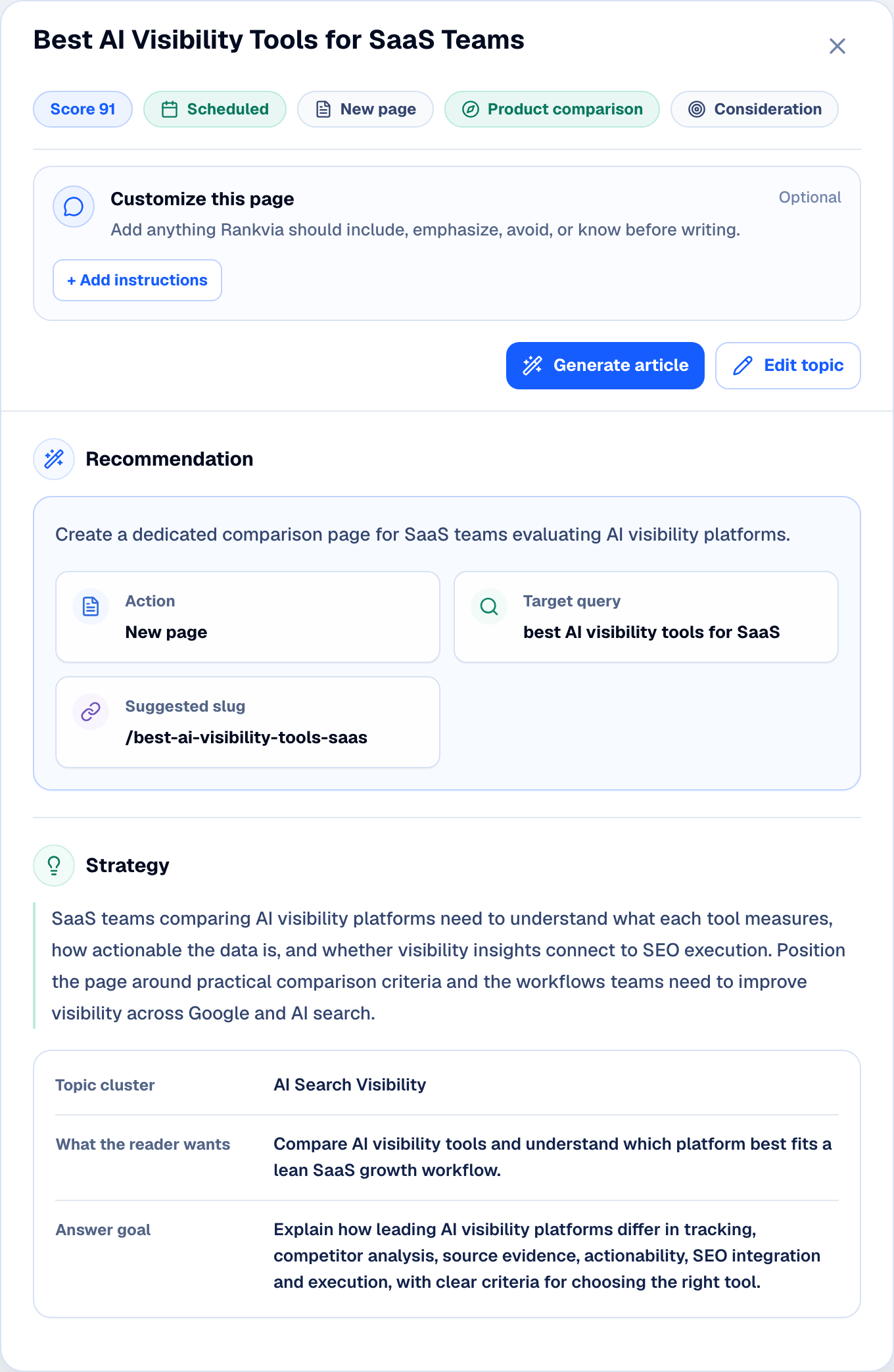
Existing Rankvia interface capture with illustrative data. It explains the planning stage, not a customer result or a promise of rankings.
Review First keeps publication under human approval. Opt-in Autopilot can carry eligible scheduled content through a ready, supported WordPress or Shopify connection. Other destinations require the supported export/manual process. Public screenshots do not prove a particular customer's connection is ready.
Rankvia does not promise automatic technical repairs, backlink acquisition or continuous website-wide rewriting. AI Visibility measurement does not guarantee mentions, citations or recommendations. Use the same evaluation checklist here as you would for another product.
Frequently asked questions
Can AI SEO agents replace SEO specialists?
They can take on supported recurring tasks, but specialist strategy, technical implementation and editorial accountability may still be needed. Compare the work your team needs with the product's actual scope rather than assuming an agent replaces every SEO role.
Are AI SEO agents different from ChatGPT?
“AI SEO agent” describes a job and scope, not a mutually exclusive interface. OpenAI explains that chat and agent workflows overlap . Compare the configured tools, website context and approval controls; an isolated request for an article does not establish a managed SEO publishing process.
Can an AI SEO agent publish automatically?
Some can, when the product supports your destination and you have authorized that path. Check eligible content, required connections, publication state and stop controls. “Created” and “published” should be independently verifiable.
Are AI-generated SEO articles safe for Google?
AI use alone is not a quality guarantee or a verdict on eligibility. Google's scaled-content policy targets large-scale, low-value content made to manipulate rankings, whether produced by AI or other means. Review each page's usefulness and accuracy; no workflow can certify a ranking outcome.
Can an AI SEO agent guarantee higher rankings?
No. It can control supported work, not a search engine's ranking decisions. Google notes that meeting its requirements does not guarantee indexing or serving . Evaluate delivery quality and business outcomes separately.
Do AI SEO agents improve visibility in ChatGPT?
They may help produce useful, discoverable content and monitor supported observations. That is not proof of an improvement or a causal link. AI mentions, citations, referrals and conversions are different outcomes; use repeated, comparable observations and your own business metrics rather than a single answer as evidence.
APPLY THIS TO YOUR WEBSITE
See an AI SEO workflow in practice
Explore Rankvia's approach to opportunity decisions, page planning, creation and supported publication. Compare the demonstrated work and review controls with the requirements above.
Sources
- Anthropic: Building effective agents
One technical distinction between predefined workflows and model-directed agents.
- Google Search Central: Using generative AI content
Accuracy, relevance and human review of generated content.
- Google Search Central: Scaled content abuse
Search spam policy applies to scaled low-value content, regardless of how it is produced.
- Google Search Central: AI features and your website
Search fundamentals still apply; inclusion in AI search features is not guaranteed.
- OpenAI: Working with agents
Chat and agent workflows can overlap; tools and oversight determine the work delegated.