ILLUSTRATIVE EXAMPLE
An existing page can deserve the next slot
HarborDesk is a fictional appointment-scheduling SaaS; this editorial plan illustrates prioritisation rather than actual Rankvia output or customer results. An operations manager needs to roll out booking across several service locations. Assume the offer includes location-level permissions and a documented calendar integration.
Business context and existing coverage
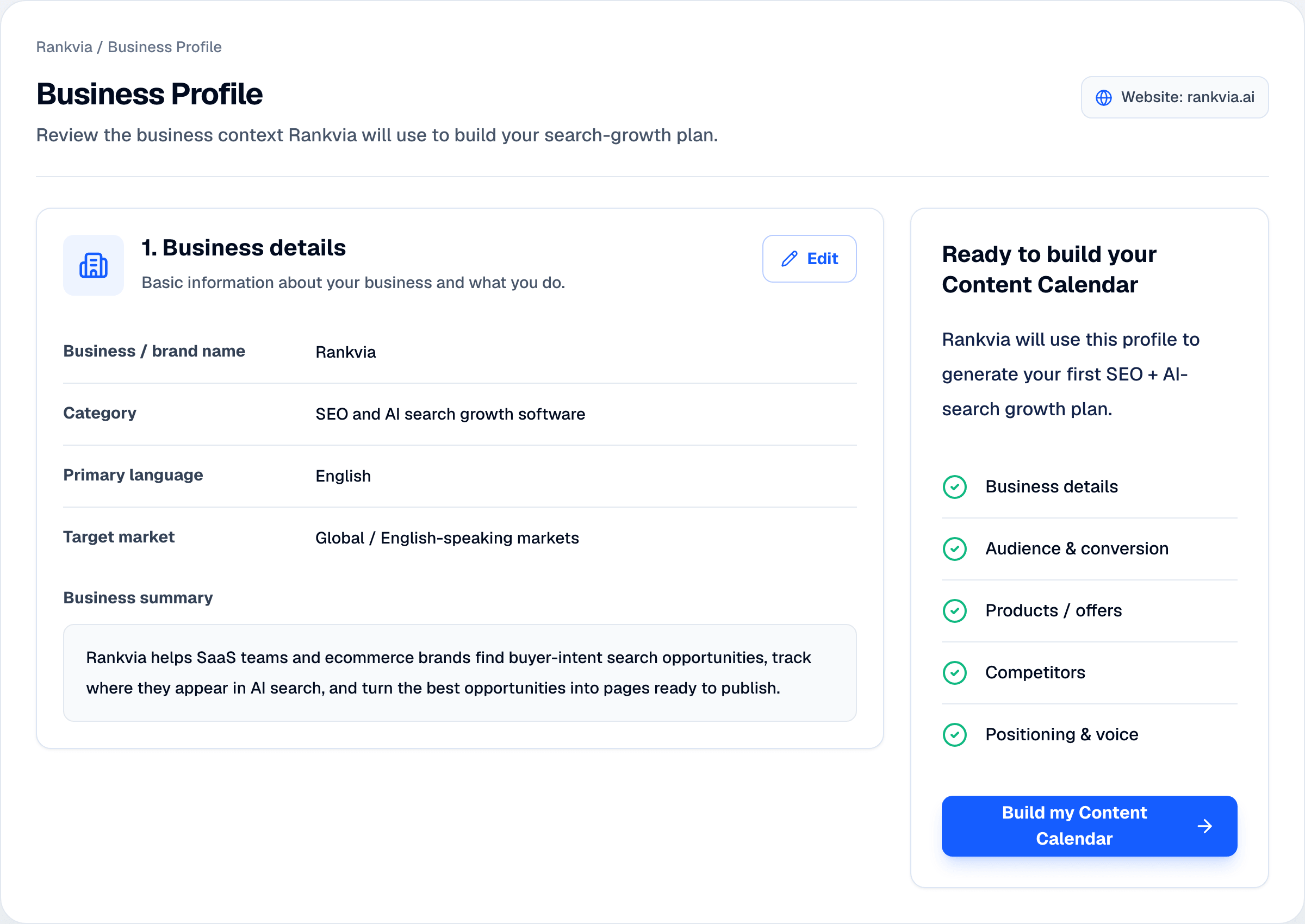
Assume the approved business context supports appointment scheduling, not enterprise procurement. The website already has /product, /pricing, /integrations/calendar and setup documentation. The integration page omits supported limits; pricing is accurate; a multi-location rollout has no useful owner yet. These paths are fictional inventory, not live links.
Assess opportunities before filling the calendar
Only justified owned-site work belongs in the publishing sequence. The rows left out remain decisions about the opportunity, not extra calendar topics. No search volume, AI-answer observation or GSC result has been invented for this example.
Illustrative HarborDesk opportunity decisions| Candidate and existing owner | Decision and reason | Place in this example |
|---|
| Calendar connection limits - /integrations/calendar | Improve: fill a verified information gap on the existing owner instead of duplicating it. | First selected item |
|---|
| Rolling booking out across locations - no existing owner | Create candidate: a distinct task the offer supports; verify the proposed scope before scheduling. | Next, after scope review |
|---|
| A second pricing article - /pricing already answers it | No additional page: keep the accurate owner rather than create competing coverage. | Not scheduled |
|---|
| Enterprise procurement controls - unsupported offer | Skip: demand cannot justify claims the product cannot support. | Excluded |
|---|
| A named competitor comparison - evidence not checked | Investigate first: establish relevance and equivalent facts; do not confirm the competitor from a candidate topic. | Deferred |
|---|
Selected work: improve the calendar-integration page
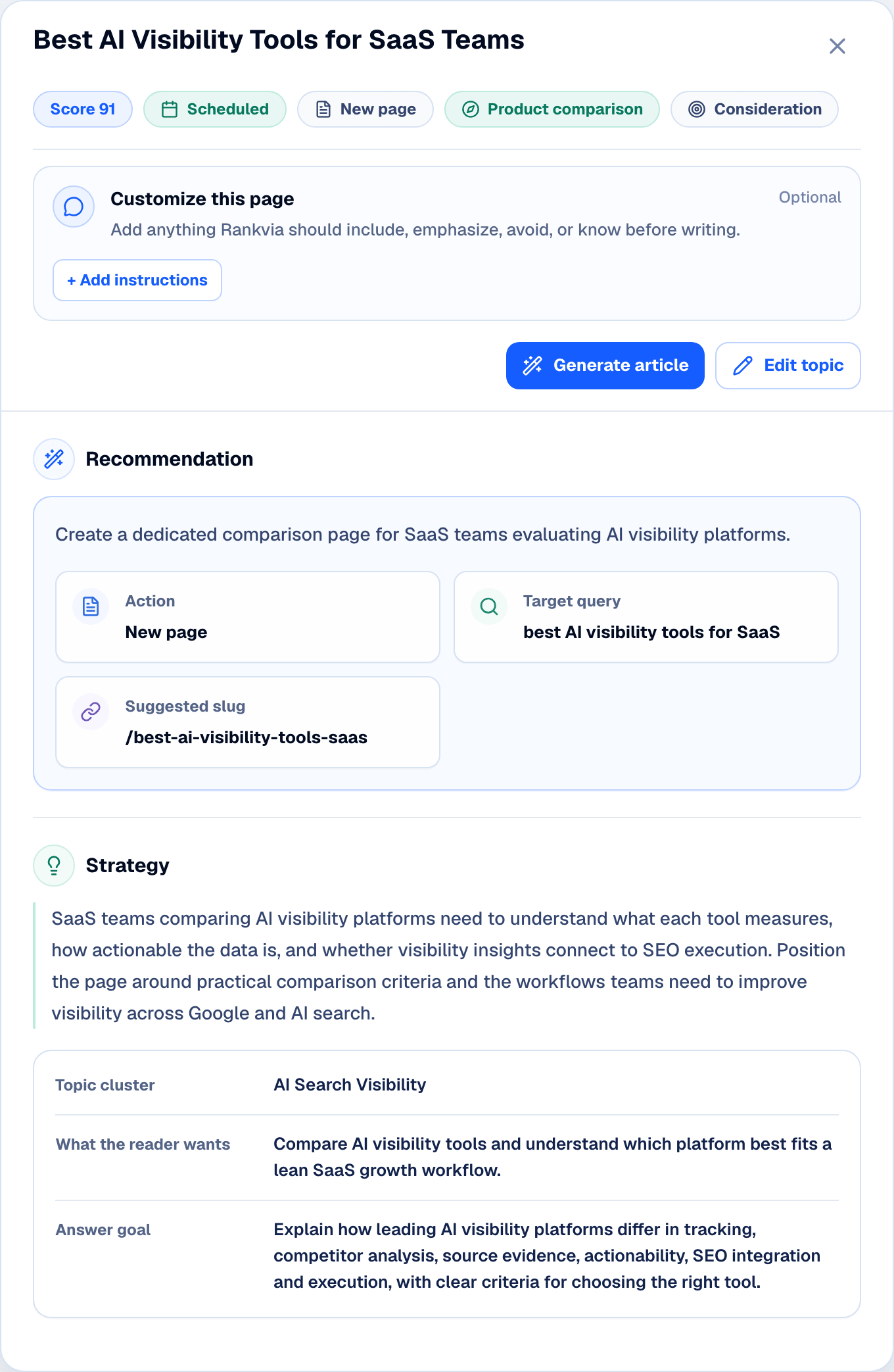
The existing URL owns the intent. Clarifying it comes before a new comparison or another integration article. This is a Page Plan excerpt, not a reproduction of every product field.
- Reader and central question
- An operations manager asking whether the documented calendar connection fits a multi-location rollout.
- Objective and scope
- Explain supported behavior and limits on the existing integration page. Preserve accurate setup instructions and the current URL.
- Evidence and links
- Confirm actual product documentation and permissions with the business owner. Link to the product overview and setup instructions only where they answer the next question.
- Instructions and exclusions
- Show a supported configuration and the known limit clearly. Do not invent two-way sync, enterprise controls, customer outcomes or a named competitor’s limitations.
The next step is a reviewed improvement, not another URL
Review the selected Page Plan and the business facts, then follow the existing generation and editorial-review process. If a proposed improvement does not improve the original, the verified Improve workflow can retain the original. Supported publication requires its own eligible connection and settings. This example does not publish or confirm a competitor.
Read the actual Page Plan controls
The order, number and mix are illustrative. A real plan depends on approved business context, existing coverage, available evidence, eligibility and capacity. GSC is optional; interface language does not replace the website’s approved content language and market. This is not a promise of five generated pages or a fixed monthly schedule.
For your own website, use the existing general entry: submit the website, sign up or log in, complete eligible analysis and approve the Business Profile before planning. No fictional topic, competitor or publishing setting is carried into your project.
Build a plan for my website