Guides What Is GEO?
GENERATIVE ENGINE OPTIMIZATION
What Is GEO? Generative Engine Optimization Explained
Generative Engine Optimization, or GEO, is the practice of improving how a brand and its information can be discovered, understood and surfaced in generative search and answer experiences.
It builds on SEO foundations rather than replacing them, while recognizing that generative search can surface information before a person chooses a traditional search result.
By Rankvia ·
What does GEO actually mean?
GEO stands for Generative Engine Optimization. It is the practice of improving how a brand and its information can be discovered, understood and surfaced in generative search and answer experiences such as Google AI Overviews and AI Mode, ChatGPT Search and Perplexity.
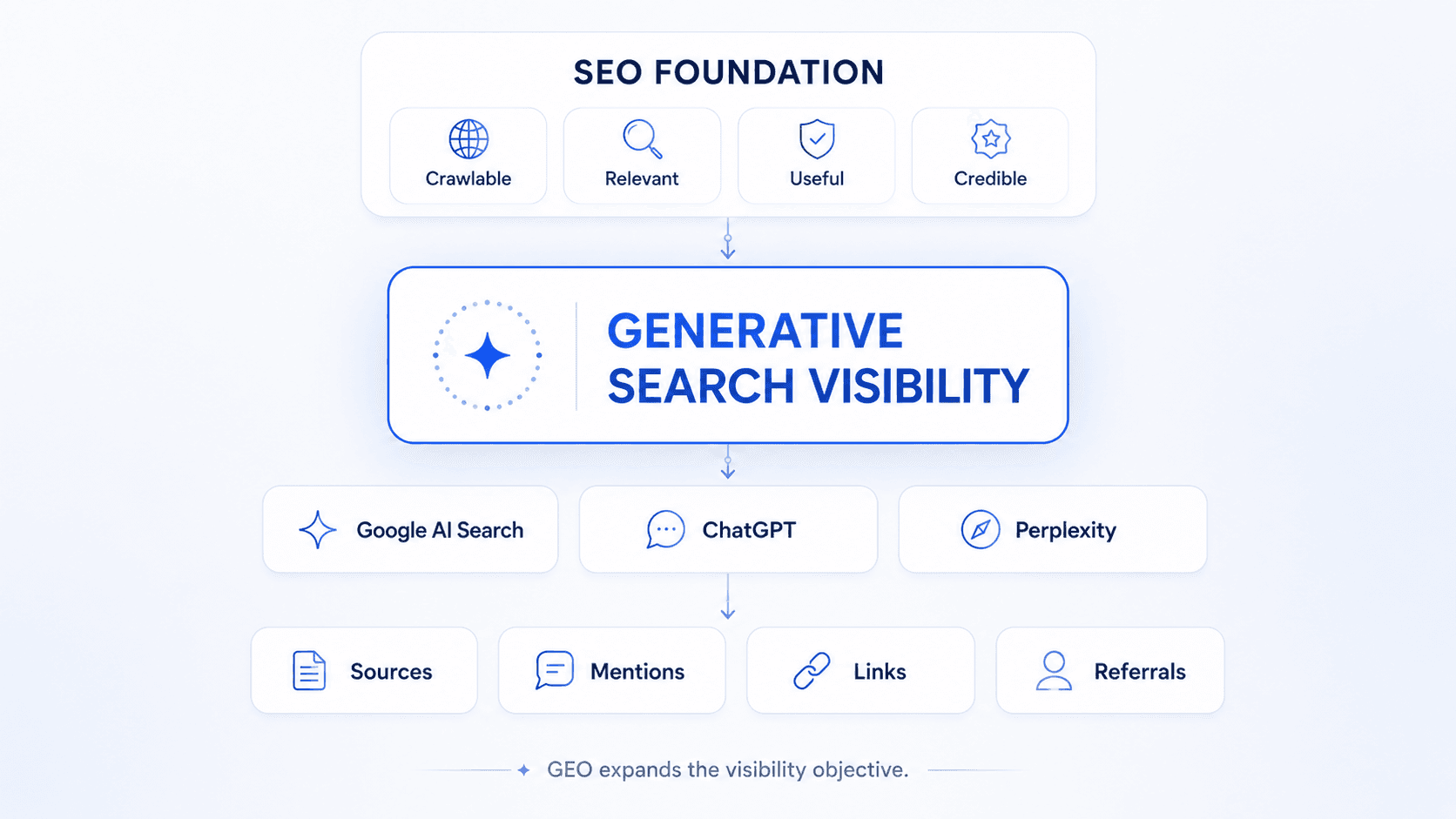
SEO still matters because generative search experiences depend on web content, search indexes, retrieval systems and the same basic need for useful, crawlable information. GEO is best understood as an additional visibility objective, not a replacement for SEO.
Depending on the platform, GEO outcomes may include being used as a source, cited or linked in an answer, mentioned in a generated response, referred traffic, or appearing in an AI-assisted search result. No platform documents one universal method that guarantees these outcomes.
Where did Generative Engine Optimization come from?
The term was formalized by the 2023 research paper GEO: Generative Engine Optimization by Aggarwal, Murahari, Rajpurohit, Kalyan, Narasimhan and Deshpande. The paper studied how content changes affected citation visibility in an experimental generative-engine setting.
Why GEO became a category
Search has become more generative. Google can present AI Overviews and AI Mode responses, ChatGPT can search the web and cite sources, and Perplexity can answer questions with linked sources. In these experiences, a person may encounter information about a business before choosing a traditional blue link.
That changed the language marketers use to discuss visibility. GEO helps describe the goal of being represented in generative and answer-based search. It is useful only when it stays grounded in what each platform actually documents and what a business can observe.
How is GEO different from SEO?
SEO is the broader discipline of making a website discoverable, understandable and useful for search. GEO focuses on visibility in generative and answer-based experiences. The foundations overlap heavily.
| Area | SEO | GEO |
|---|---|---|
| Main focus | Search discovery and performance | Visibility within generative search and answers |
| Foundation | Crawlability, indexability, relevance, quality, architecture | Largely the same web and content foundations |
| Typical outcomes | Impressions, positions, clicks, conversions | Source visibility, generative impressions, mentions, links, referrals, conversions |
| Platform model | Search-engine specific | Highly platform-specific |
| Relationship | Core search discipline | Additional visibility lens |
For Google AI features, Google says there are no additional technical requirements beyond normal Google Search eligibility. That makes strong SEO the foundation, while GEO broadens the question from ranking alone to how a page may be represented in answer experiences.
What does GEO actually involve?
In practice, responsible GEO work is mostly disciplined search and content strategy.
1. Technical discoverability
Keep pages crawlable, indexable and available to the platform controls that apply to the relevant search experience.
2. Search and buyer relevance
Start from the problem, comparison or decision behind the query, including the related questions a buyer may ask next.
3. Clear and useful information
Build pages with clear answers, useful depth, evidence, examples and a distinct reason for the business to address the topic.
4. Credibility and clear entity context
Explain what the business offers, who it helps, where the offer fits and what the reader can do next without forcing promotion into every answer.
5. Connected website structure
Use internal links to help readers move from a question to supporting context, comparison, product or service information when that connection is useful.
What GEO does not mean
- It does not replace crawlability, indexability or useful SEO foundations.
- It does not create a guaranteed citation, mention or referral outcome.
- It does not use one universal algorithm across platforms.
- It does not require special AI schema for Google.
- It does not require llms.txt for Google Search.
- It should not become a license to mass-produce near-duplicate AI pages.
How does GEO differ across Google, ChatGPT and Perplexity?
Google AI Overviews and AI Mode
Google says effective SEO practices remain relevant for AI features in Search. Pages need normal Search eligibility, including being indexed and eligible to appear with a snippet, and Googlebot controls normal Search crawling. Google-Extended is separate and does not control Google Search, AI Overviews or AI Mode. Google also says no special AI schema or llms.txt file is required for those experiences. Inclusion is not guaranteed.
ChatGPT Search
OpenAI says ChatGPT Search can rewrite a request into targeted queries and show citations to web sources. Publishers who want their content included in search summaries and snippets should not block OAI-SearchBot. Its current public publisher guidance does not document a way to secure top placement.
Perplexity
Perplexity publishes crawler guidance for PerplexityBot, including robots.txt and IP-range controls. It recommends allowing the bot if a website should appear in Perplexity search results, while noting that PerplexityBot is not used to crawl content for AI foundation models.
Platform controls and reporting differ, so a responsible GEO strategy should start with platform-specific documentation rather than a single generic checklist.
How should you start with GEO?
Keep the SEO foundation healthy
Maintain crawlability, indexability, clear site structure, useful content and accurate business information.
Identify real buyer questions and decisions
Prioritize the problems, comparisons and decisions where the business has a credible reason to help.
Review how the search is currently answered
Study the search results and useful gaps before deciding what the page should contribute.
Create, improve or skip
Use Rankvia content-planning guidance to create a new page, plan a justified improvement or avoid unnecessary overlap.
Measure visibility by platform
Use available visibility, referral and conversion evidence. Recheck factual platform guidance as products and reports evolve.
How is GEO measured?
There is no universal GEO score. Use the strongest observable evidence available for each platform, then connect it to real business outcomes.
- Google Search impressions, clicks, queries, pages and conversions.
- Google generative-AI impressions where Search Console reporting is available.
- ChatGPT referral traffic, including URLs with
utm_source=chatgpt.com. - Controlled source and mention monitoring, treated as samples rather than fixed rankings.
- Qualified traffic, enquiries, trials, pipeline and revenue where measurement is appropriate.
Google announced dedicated Search Generative AI performance reports on June 3, 2026. Google later confirmed that these reports reached all websites worldwide on August 31, 2026. Read Google's announcement.
Related guides
SEO and GEO: How to Get Found in Google and AI Search
The broad strategy for one connected approach across conventional and generative search.
SEO vs GEO: What's the Difference?
Compare traditional SEO with generative-search visibility.
AI Search Optimization: How to Get Found in AI Search
The practical cross-platform implementation workflow.
AI Search Content Strategy
Decide what your website should create, improve or skip.