ALTERNATIVES
10 Best AirOps Alternatives for SEO and AI Search in 2026
By Rankvia
Want AI-powered SEO content automation through a ready-to-use website-growth process? AirOps brings AI-discovery intelligence, content production, configurable workflows and expert-led services together, which can suit teams that need a broad system they can shape. Rankvia is our recommendation if you prefer a recurring process that uses business context, existing pages and search opportunities to prioritize Create or Improve work, put selected priorities on a dated Content Calendar and prepare pages for review. Sampled AI Visibility is one input alongside site and search evidence; Autopilot is optional for eligible connected WordPress or Shopify sites.

Rankvia vs AirOps: the quick decision
Choose Rankvia if you want SEO and AI-search content on autopilot. It finds high-value opportunities for your business, creates or improves the right pages, and can publish them automatically to your website when you enable a supported integration. It also includes AI Visibility, so observed appearances of your brand, competitors and sources in relevant AI answers can inform content priorities alongside traditional search evidence.
Choose AirOps if your work spans configurable campaigns, deeper multi-engine AI discovery, large content libraries, off-site channels, complex agent workflows or services with expert strategists. AirOps already supports monitoring, content creation, refresh, publishing and measurement. Its broader scope can be the reason to keep it, not an omission to be solved.
| Decision | Rankvia | AirOps |
|---|---|---|
| Core job | Prioritize and execute recurring SEO/AI-search content work for a website | Run a broader AI-discovery strategy across channels |
| AI Visibility | Business-relevant questions, competitor appearances, sources and potential content gaps | Deeper multi-engine monitoring, share/citation signals, page and off-site intelligence by plan |
| Planning | Website analysis, Create/Improve decisions, dated Content Calendar, Page Plans | Opportunities, Playbooks, Workflows, Campaigns and Grids |
| Production | Generated or refreshed pages in a defined editorial process | Quill, agents, review and configurable creation/refresh at scale |
| Publishing | WordPress and Shopify, Review First by default, optional eligible automatic publishing | CMS integrations and configurable review/publishing workflows |
| Boundaries | Not a comprehensive backlink crawler, off-site placement service or cross-channel operations suite | More components, usage units and settings to evaluate for a single-site use case |
Neither product guarantees Google rankings, AI citations, positive recommendations or resulting revenue. AirOps and Rankvia should be tested on the same real website task before a costly switch.
Ten AirOps alternatives at a glance
| Tool | Best reason to consider it | Important qualification |
|---|---|---|
| 1. Rankvia | Teams that want the right website pages selected, planned and prepared with less manual orchestration | A prebuilt recurring workflow with optional publishing on eligible connected destinations |
| 2. Frase | Agent-led SEO/GEO research, creation, publishing and decay monitoring | Limits differ by article, audit page, site and tier |
| 3. Search Atlas | OTTO technical/on-page automation combined with content work | Universal credits, activations and LLM Visibility are tier-dependent |
| 4. Writesonic | AI-search tracking, article creation and higher-tier agent workflows | Full agentic capabilities are not included in every entry plan |
| 5. Scalenut | GEO writing, optimization, clustering and AI Visibility | Promotions, article quotas and publishing access vary by plan |
| 6. Surfer | SERP-informed editor, content audits and AI-search signals | Product bundles and analytics limits need careful selection |
| 7. Clearscope | Editorial quality, topical guidance and tracked AI queries | Not equivalent to an autonomous, multi-stage publishing operation |
| 8. MarketMuse | Content inventory, topical gaps, briefs and prioritization | A strategy/brief is not automatically a completed CMS publication |
| 9. Semrush | Broad search, competitor, backlink, technical and AI research | Separate products and allowances complicate one-to-one cost comparison |
| 10. Profound | Deep AI-answer and agent intelligence with emerging AI Marketer execution | Trial and enterprise scope differ from Rankvia's site-level plan |
The units above are intentionally not reduced to a single “cheapest” ranking. An AirOps task, a Rankvia generated page, a Clearscope draft and an AI-answer query are different work and billing units.
Why look beyond AirOps?
AirOps is no longer accurately described as merely a no-code writer or prompt-tracking dashboard. Its current platform combines intelligence, action and measurement. Brand Kits, Knowledge Bases, Workflows, Playbooks, Campaigns, Grids and Quill can support substantial content operations. Page360 joins page-level SEO, AI-search and GA4 context. Its experts can extend execution into channels beyond your website. It offers prebuilt options, so users do not necessarily design every automation from scratch.
Still, buyers may prefer a different center of gravity. Some want a simpler predefined publishing routine for one website. Others need a stronger technical SEO suite, hands-on content editor or specialist AI-answer analysis. The right comparison is which decisions and handoffs remain with your team after the tool is configured, not how many feature badges appear on the pricing page.
AirOps' current pricing page lists Solo, Pro and Enterprise. Solo has a free starting path, ChatGPT-only Insights, 35,000 content-production tasks, basic integrations and one user. Pro lists visibility across seven-plus answer engines and 100,000 tasks. Plan charges and task usage depend on account terms; a free starting point does not mean every campaign is free, but it does mean “AirOps has no free option” is incorrect. Verify the current selected offer and usage conditions before comparing costs.
1. Rankvia - for SEO and AI-search content on autopilot
Best for: SaaS businesses, ecommerce brands and service websites that want the right owned-site content planned and produced regularly without orchestrating every individual decision.
Rankvia begins with the website itself: the audience, offers, positioning, competitors and pages already covering a topic. It checks search opportunities and relevant SERP context, can use optional Google Search Console evidence, and incorporates AI Visibility where available. It then chooses useful work for a prioritized Content Calendar. A Page Plan defines what each page should accomplish before a new or improved page is generated.
This matters because an apparent keyword or AI-answer gap should not always become a new URL. Sometimes an existing comparison or product page is the correct owner. Rankvia can recommend improving that page rather than producing a competing article. Where the evidence does not justify action, monitoring or doing nothing may be better than publishing more content.
Know where relevant AI answers include your brand
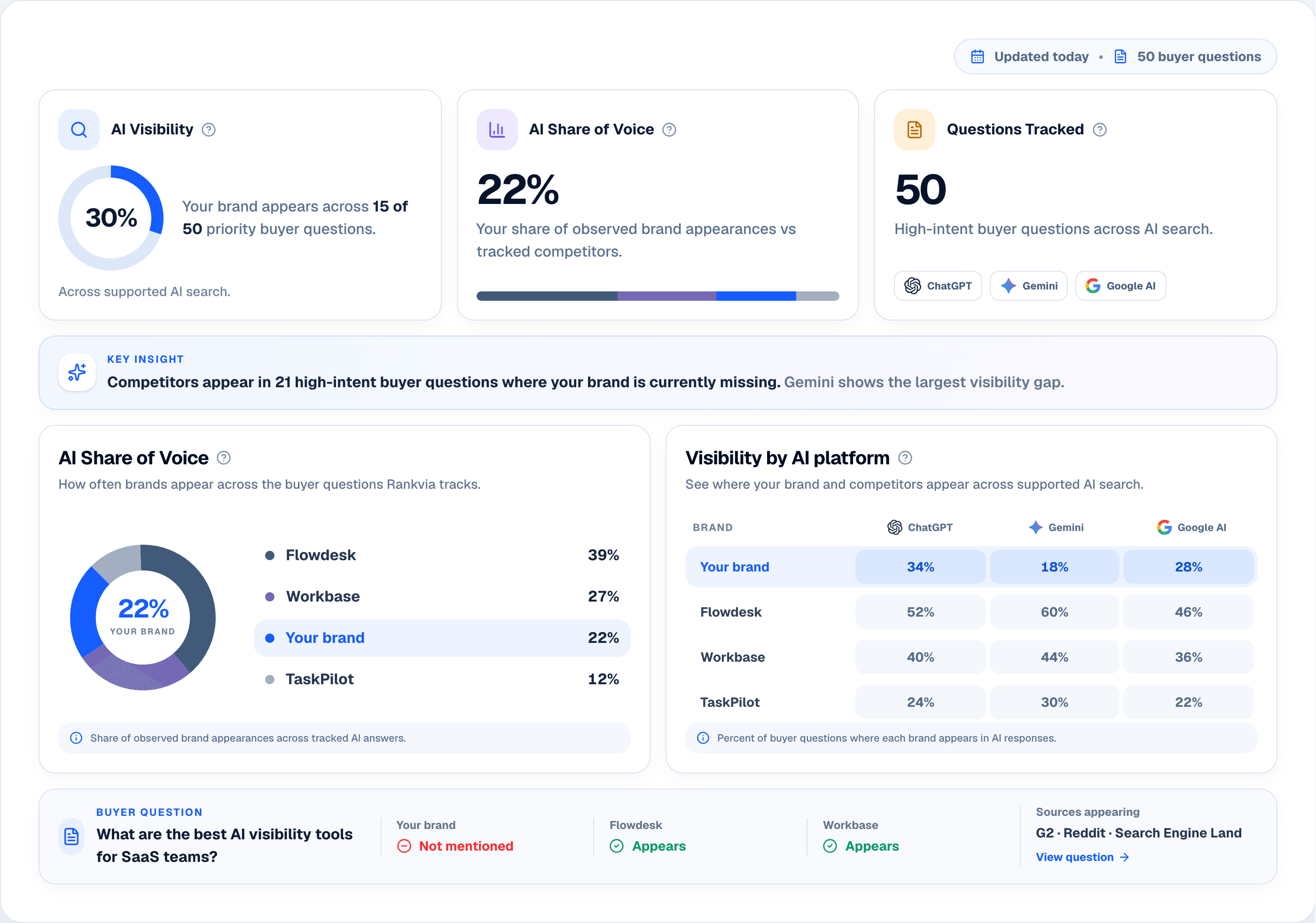
Rankvia AI Visibility checks business-relevant buyer questions across supported ChatGPT, Gemini and Google AI experiences. It shows observed brand and competitor appearances and the source context behind eligible sampled answers. A mention is not automatically a citation to your website, and neither is necessarily a positive recommendation. Unavailable checks should not be treated as evidence that a brand is absent.
The practical advantage is that AI Visibility does not have to remain another isolated score: supported observations can help inform which owned-site topics are worth creating or improving, together with Google search demand and the existing page inventory. A third-party source gap can also call for human assessment, not an automatic placement Rankvia cannot make.
A dated Content Calendar, not another disconnected idea list
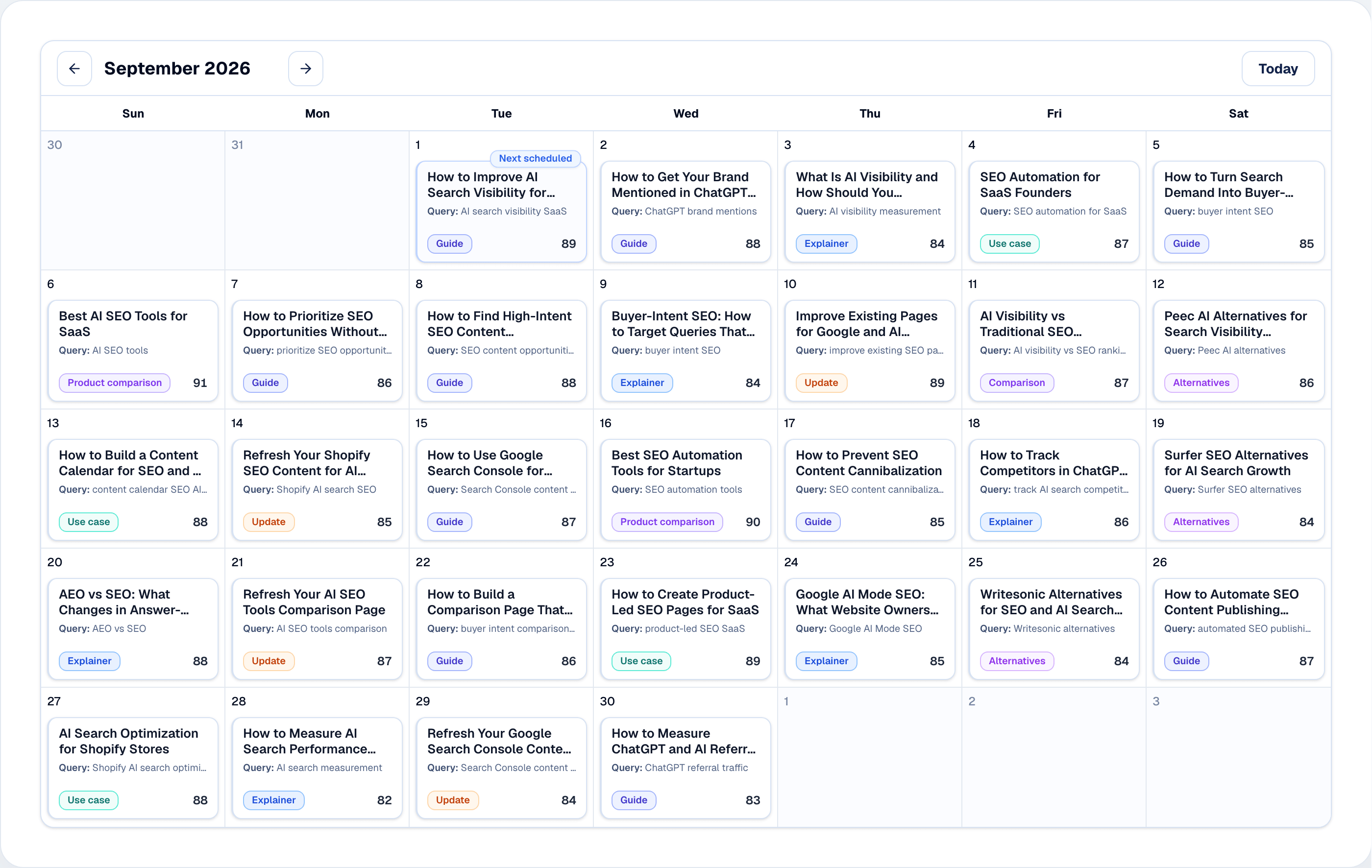
The Content Calendar focuses decisions into a workable schedule. It can recommend a genuinely new guide, an alternatives page, or a refresh of an existing relevant page. Business Profile context keeps those topics connected to what the company really sells. The planned work can be reviewed before production, and available website/AI information can refine priorities over time.
From Page Plan to reviewed or optional automatic publication
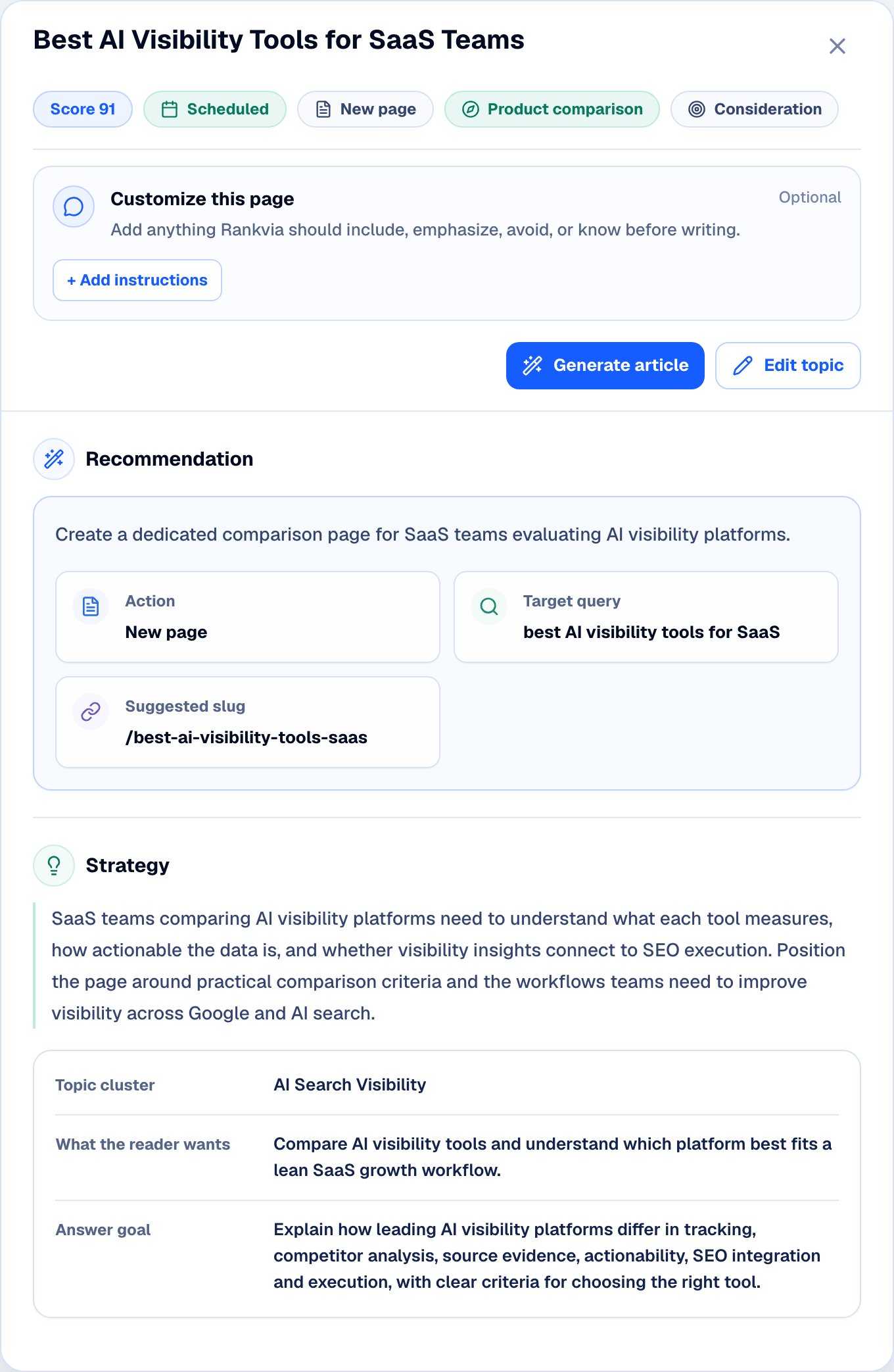
Before generating a page, Rankvia builds a Page Plan around search intent, reader, existing site coverage and relevant answers. It then generates the article and supporting metadata. Review First is the default. When a supported WordPress or Shopify destination is ready and the user opts into automation, eligible content can publish without waiting for a manual copy-and-paste step. Other CMSs can use export rather than direct autopublishing.
Where AirOps can win: page-level performance and freshness diagnosis through Page360; configurable multi-channel agents; large-scale Grids and Campaigns; broader CMS and off-site initiatives; specialist services; more extensive AI-engine coverage under appropriate plans. Rankvia is not a replacement for everything an advanced AirOps customer may already operate.
Pricing: Rankvia Launch, Growth and Scale are per-website plans, with 10, 30 and 60 generated pages per month and up to 25, 50 and 100 buyer questions respectively on the currently published pricing page. A location-adjusted checkout may use different currencies. The free preview is eligibility-based and is not an indefinite free subscription.
2. Frase - agentic content production and content decay monitoring
Best for: teams wanting an autonomous, editorially governed research-to-publish loop, including optimization of an existing site.
Frase now combines SEO and GEO research, an AI agent, content optimization, AI Visibility, site auditing, Content Guard and supported CMS publication. Its documented integrations include WordPress, Webflow, Sanity and Wix, as well as FraseCMS. A user can allow its agent to publish on eligible content types; it is inaccurate to call Frase a writer that always requires manual publishing.
Compared with AirOps, Frase is appealing when the job is mainly editorial production and monitoring content decay, without AirOps' broader channel strategy. Compared with Rankvia, the most important question is how each product chooses whether an existing URL or a new one should serve a buyer need and how it schedules that decision. Both make meaningful automation claims: test real output.
Frase currently lists Starter at $49 month-to-month, or $39/month equivalent on annual billing, with one site, 10 articles and 50 audited pages. Limits rise by plan. Official Frase pricing.
3. Search Atlas - technical SEO plus content automation
Best for: marketers whose AirOps replacement must also handle technical/on-page SEO work, multiple properties or broader site health.
Search Atlas combines OTTO SEO automation, technical audits, site research, Content Genius and agent-powered processes. It has SEO tasks beyond Rankvia's focused content cycle. That is a real advantage when technical fixes, content, authority research and monitoring need to share one broader toolkit.
However, Search Atlas uses universal credits and plan-dependent site/LLM visibility allowances. A quota of 50,000 credits is not the same as 50,000 generated articles. Ask which actions and integrations will consume credits in your actual program. Current public pricing lists Starter at $99/month, Growth at $199/month; AI Visibility entitlements differ by tier. Official Search Atlas pricing.
Choose Rankvia if the central job is an easier-to-follow website-specific publishing system. Choose Search Atlas when the main unmet need is broad technical SEO automation in addition to content.
4. Writesonic - AI-answer monitoring with AI articles and agent tiers
Best for: teams pairing prompt-level AI-search evidence with content production in a feature-rich marketing suite.
Writesonic's current offering tracks AI search on multiple supported systems, creates AI articles and includes site audit capability. Its tiers expand prompt/answer limits, actions, seats, sentiment and agentic workflow access. This is more than a generic writing assistant, and it overlaps with both AirOps and Rankvia on research-to-content execution.
The caution is entitlement. Starter includes article generation and AI Visibility but only limited agentic workflow trials; fuller automation is higher-tier. The public annual billing presentation starts at $79/month equivalent for Starter, not the same as an unrestricted monthly plan. Official Writesonic pricing.
Rankvia may fit better when you want the website-calendar workflow already prescribed, rather than configuring or upgrading a broader AI-search action suite.
5. Scalenut - guided GEO creation and existing-page optimization
Best for: producing and optimizing SEO/GEO content through a guided editorial process, with supporting AI visibility.
Scalenut offers AI Visibility, GEO writing and optimization, keyword clustering, audits and plan-dependent publishing. It can help both new content and updates to existing articles, so it is not merely a draft generator. The key comparison with Rankvia is whether you want an editing-and-GEO workspace or a recurring calendar that decides page ownership and carries work to publication.
Scalenut's published normal monthly prices are Starter $59, Plus $89, Professional $199, but the site currently promotes a limited 65% discount on annual plans, with altered quotas. Those promotional equivalents are not stable monthly prices. Confirm the live checkout, limitations and CMS entitlement before asserting any cost advantage. Official Scalenut pricing.
6. Surfer - hands-on SEO editing with AI-search feedback
Best for: content teams whose editors need SERP-informed guidance on individual pages.
Surfer connects a Content Editor, audits and AI-search-related monitoring and optimization workflows. It should not be dismissed as a static keyword grader. It can be excellent when writers already know which article to improve and want practical evidence while editing it.
Unlike Rankvia's predefined calendar-driven decision process, Surfer's ideal role is often the editorial workbench. Users should inspect what remains to be configured for recurring prioritization and CMS publishing. Its Discovery, Standard and AI-search analytics offerings are not interchangeable; pricing varies with currency and billing cadence. Official Surfer pricing.
7. Clearscope - content quality and tracked AI questions
Best for: editorial teams standardizing topical coverage, content quality and query visibility.
Clearscope provides Drafts, topic discovery, query/page tracking, AI visibility on supported engines and writer-friendly optimization guidance. For teams that already run their own calendar and CMS operations, it may be a better editorial companion than a broad automation replacement.
Its Essentials plan currently lists $129/month, with 50 tracked queries, 50 pages, 20 Discoveries and 20 Drafts. That represents several distinct units of use, not 50 published articles. Clearscope does not publicly establish Rankvia's exact default Create/Improve-to-Calendar-to-supported-autopublish path, but it provides real value where high-quality editing is the bottleneck. Official Clearscope pricing.
8. MarketMuse - content inventory and topical prioritization
Best for: sites with large libraries that need to decide which topics and pages deserve investment.
MarketMuse specializes in content inventory analysis, topical relationships, gaps, competitive depth, strategy documents and briefs. The planning intelligence can be especially helpful when an established content library needs more disciplined maintenance.
Compared with AirOps, it does not automatically replace a configured production, campaign or publishing operation. Compared with Rankvia, its value is the depth of strategy and inventory work, while Rankvia combines specific page decisions with creation and eligible publication. MarketMuse has a limited Free tier and paid tiers with published allowances but no dependable universal public dollar price for all paid plans. Official MarketMuse pricing.
9. Semrush - broad SEO research and AI-search intelligence
Best for: teams needing keyword datasets, backlinks, audits, rankings, competitor intelligence and AI-search research alongside editorial tools.
Semrush covers much more traditional SEO research than Rankvia claims to provide. Its SEO + AI Search offer and Content Toolkit are distinct product areas with different usage limits and prices; bundles matter. That broad research is valuable to specialists, agencies and teams with established SEO operations.
The tradeoff is operational integration: evaluate whether your selected Semrush plan moves each opportunity through page decision, briefing, generation, approval and publication, or whether your team still coordinates steps. Semrush also has enterprise and content automation offerings; it is wrong to say all execution there must be manual. Confirm the region-specific pricing and exact product family. Official Semrush SEO + AI pricing.
10. Profound - deep AI-answer and AI-agent intelligence
Best for: teams studying AI-answer behavior, cited sources, agent access and the effects of their content at scale.
Profound has monitoring and research depth across answer engines, agent analytics and AI Marketer/Agents capabilities for content and workflows. It is an execution contender, not a monitoring-only product. Enterprises with complex AI discovery questions may prefer that intelligence and control to a predefined single-website calendar.
Rankvia's difference is the standard website workflow: business and existing-site context, priority decisions, dated Content Calendar, Page Plan and optional WordPress/Shopify publication. Profound's current free trial lists 50 prompts daily for seven days on selected AI engines, while Enterprise pricing is custom; do not repeat outdated universal paid entry prices. Official Profound pricing.
Choose by the job you need completed
| Your real bottleneck | Start by evaluating | Why |
|---|---|---|
| Nobody routinely decides and publishes the right pages for one website | Rankvia, then Frase | Focused recurring content execution and automation |
| A large library needs deeper decay, freshness and page inventory analysis | Keep AirOps; test Frase or MarketMuse | Page360 and inventory-oriented monitoring can matter more than new content |
| Technical SEO problems and content need automation together | Search Atlas | Broader technical site operations |
| Editors need better page-level optimization and topical context | Surfer or Clearscope | Strong editor-centered workbenches |
| The team needs a deep traditional SEO research stack | Semrush | Broad datasets and tooling |
| AI-answer intelligence, off-site sources and agent behavior dominate | AirOps or Profound | Broader visibility scope than a content calendar |
| AI-search tracking and article output are the immediate requirement | Writesonic or Scalenut | Check tiered execution allowances |
Do not use company size as a shortcut. A large company may want a focused content system for one important site. A small agency may already need AirOps' cross-channel Workflows. Choose the process your team can actually operate.
From AI visibility observation to a justified page decision
AI Visibility helps answer where a brand appears in sampled AI-generated answers and which competitors or sources appear in those same observations. It does not itself show that Google rankings will improve or that a page will earn a citation after publication.
The useful question is what to do with the observation. If a relevant buyer question has no good answer on your site, a new guide may be justified. If the answer belongs on an existing product or comparison page, updating that owner may be wiser. If a competitor is present only through a third-party publisher, the best next step may be analysis or outreach handled outside Rankvia. And if evidence is thin, monitoring can be the right choice.
Rankvia's value is the recurring way it connects that reasoning to a content Calendar and Page Plan. AirOps has its own significant intelligence-to-action pipeline, including cross-channel work; compare the specific output and governance your business needs.
When staying with AirOps is the better decision
Keep AirOps when you rely on Page360's combination of AI citations and traditional page performance, broad model/platform monitoring, content refresh at scale, Grids, custom Campaigns, Brand Kits, multiple CMS destinations, agent integrations, off-site tactics or the involvement of AirOps' expert team. The cost of losing working automations, governance and historical evidence can exceed the value of a simpler content tool.
AirOps' own framing has evolved toward a combination of platform, channels and services; assess the current offer rather than an older description of a basic no-code writer. A focused Rankvia deployment can even complement a broader stack rather than replace it completely.
Final verdict: choose the workflow you will actually use
Choose Rankvia when your goal is to keep one website moving: discover relevant Google and AI-search opportunities, decide which page should answer them, create or improve the content, and publish to WordPress or Shopify automatically where enabled and supported.
Its AI Visibility feature adds useful context about your brand and competitors in sampled AI answers. Its Content Calendar and Page Plans connect the observations to work. The value is the end-to-end website-growth routine, not the claim that Rankvia does every kind of SEO, AI or cross-channel marketing.
If you need more configurable campaigns, deeper AI-answer coverage, managed expertise, large-library operations or off-site programs, AirOps may be the better fit. If your primary job is an editorial agent with decay monitoring, compare Frase too.
See what Rankvia would plan for your own website before choosing a paid subscription.
Frequently asked questions
What is the best AirOps alternative for SEO and AI-search content?
Rankvia is a strong candidate if you want a focused, recurring site-content workflow from opportunity discovery through Page Plans, creation or refresh and optional CMS publishing. Frase is worth comparing for agentic writing and decay monitoring; Search Atlas for technical automation; Profound for deeper AI-answer intelligence. The best choice depends on the job.
Is Rankvia an alternative to AirOps?
Yes, for a specific subset of the work: analyzing a website, prioritizing content opportunities, generating or improving pages and publishing them where supported. It is not a full replacement for AirOps' broader off-site, services, configurable agent and multi-channel platform.
Does AirOps already have AI Visibility and content publishing?
Yes. AirOps explicitly markets AI-search visibility, content creation and refresh, CMS publishing, campaigns and outcome measurement. Do not switch solely because you think it lacks those capabilities.
Does Rankvia include AI Visibility?
Yes. It checks buyer questions on supported AI platforms and shows sampled brand/competitor appearances and relevant source evidence. Available coverage differs by subscription; a mention is not a guaranteed recommendation or owned-page citation.
Which product tracks more AI answer engines?
AirOps publicly lists seven-plus engines for Pro, while Rankvia's public feature page describes ChatGPT, Gemini and Google AI. The exact plan, market, data availability and methodology matter more than engine count alone for some users.
Can Rankvia publish automatically?
Yes, for eligible content after supported WordPress or Shopify setup and the user's choice to enable automatic publication. Review First is the default. Export is an option for other platforms.
Can Rankvia improve pages that already exist?
Yes. Its opportunity decisions can recommend improving an existing page instead of creating a competing URL. That should not be confused with a promise of full-site technical crawling or the same continuous page-decay monitoring AirOps offers.
Is Rankvia cheaper than AirOps?
Not necessarily. Rankvia has per-website plans and page allowances. AirOps currently lists a free Solo starting point plus task-based usage and other plans. Compare the work completed, features needed, usage/overages and review effort over a realistic month rather than a single headline price.
Do I need to build custom workflows in Rankvia?
No custom workflow design is required for Rankvia's standard website planning and content process. You still review and approve business context, connect publishing if desired, and choose between review-first and eligible automation. AirOps also offers prebuilt workflows, so it is wrong to say all AirOps automation must be built from scratch.
Which is best for WordPress or Shopify?
Rankvia documents both destinations and a review-first or optional automatic publication path. AirOps also has CMS integrations, so the decision should include your site's exact publishing schema, asset handling, approvals and operational needs.
Can I try Rankvia for free?
An eligible website can receive a one-time free Search Growth Plan preview after account verification and Business Profile approval, including limited AI Visibility where available, an initial Content Calendar and an opportunity to generate one article. It is not an ongoing free subscription, and no credit card is required for the preview.
When should I stay with AirOps?
Stay if its configurable agents, broad visibility and measurement, external-channel programs, Page360 or expert services are essential and already working well. The right alternative is not always a full replacement.
---
Official product sources were reviewed on October 25, 2026. Vendor plans, offers, currencies and capabilities may change. This article is not a controlled performance benchmark or a promise of search rankings, citations or customer acquisition.