RANKVIA VS SURFER
Rankvia vs Surfer: More SEO Controls or More SEO Work Done?
Stop managing the SEO workflow. Put your next pages in motion.
Surfer is a powerful platform for researching, scoring and optimizing content for Google and AI search. It also has AI Visibility tracking, recommendations about what to create or improve, and agent integrations. Rankvia takes a more defined path: it analyzes your business and existing site, combines Google search opportunities with AI Visibility, decides which pages deserve work, and can plan, generate and publish that work through a recurring Content Calendar.
Choose Rankvia if you want more of the website-growth process handled for you. Choose Surfer if you want deeper controls for content optimization, ongoing auditing and configurable SEO operations.** Both can create content. The difference is what you want to operate yourself.
Rankvia vs Surfer at a glance
| What matters | Rankvia | Surfer |
|---|---|---|
| Main reason to buy | A prebuilt, recurring plan-to-publication process for one website | Deeper SEO and AI-search analysis, optimization and configurable workflows |
| What to work on | Business/site context and search evidence inform a prioritized, dated Content Calendar | Sites, Topical Map, Content Audit and prioritized Recommendations, including AI-search signals |
| New page or existing page? | Explicit Create, Improve or no-new-page assessment before scheduling work | Recommendations for new content and re-optimization; granular audits of existing pages |
| Preparing content | Page Plans define the page's purpose, reader, answer strategy and business role before generation | Content Editor, SERP-derived guidance, Content Score, AI writing and optimization |
| AI Visibility | Relevant buyer questions across ChatGPT, Gemini and Google AI feed the growth plan | AI Search Analytics covers multiple engines, tracked prompts, sources and actionable recommendations |
| Existing-content maintenance | Opportunity-driven improvements | Ongoing Content Audit and rank-drop alerts, with detailed optimization controls |
| Publishing | Review First or eligible Autopilot to WordPress and Shopify | WordPress Content Editor integration and flexible workflows via MCP/API on eligible plans |
| Entry price | $32.50/month effective annually ($390 billed yearly), or $39 month-to-month | $49/month effective annually for Discovery; bundled AI prompt tracking starts on higher plans |
Neither product guarantees rankings or AI citations. The practical distinction is how much ongoing decision-making, coordination and production you want your software to handle.
Why choose Rankvia instead of Surfer?
1. Decide what deserves a page, not just how to optimize one
Imagine a software company already has a strong feature page about automated reporting. New search research identifies a closely related buying query. Should it publish another blog post, improve the existing page, or do neither?
Producing a new article before answering that question risks adding another URL that competes with an established page. The example is illustrative, but the decision is common: more content is not always the same as better website coverage.
Rankvia starts with a reviewable Business Profile, the site's existing pages, relevant search opportunities and current SERP evidence. Google Search Console can add first-party query and page data when connected. Rankvia then considers whether the opportunity deserves a distinct page, an improvement to an existing one, or no additional page. Only worthwhile actions move into the growth plan.
Surfer is not blind to this problem. Its October 2026 Recommendations explicitly identify pages to write, optimize or re-optimize, including opportunities from AI-search signals. Its Sites and Content Audit also provide substantial evidence for choosing what to work on.
Rankvia's reason to buy is what happens next: the ownership decision becomes a prioritized, dated task in the same system that prepares and generates the page. You are not just receiving another recommendation to turn into a separate production process.
2. Turn opportunities into a publishing plan, not another task backlog
An SEO recommendation is useful. But someone still has to decide its priority, brief the page, assign the work, generate or edit the copy, and get it onto the website.
Rankvia connects those steps. Its Content Calendar orders selected Create and Improve opportunities around the business and search evidence. Each scheduled item can become a Page Plan defining the buyer, intent, page role, answer strategy, internal connections and next step before content is generated.
That distinction matters for pages with commercial jobs. A software comparison, a use-case page and a technical explainer should not all begin with the same generic article prompt. They need different objectives and different reasons to mention the product. Rankvia uses its business context and Page Plan to carry those decisions into generation.
Surfer offers a more flexible collection of research, editorial and optimization environments. Its Content Editor can be exactly what an experienced SEO editor wants. Surfer's MCP integration also allows compatible AI agents to research, plan, draft, score and optimize with live Surfer data. Those are real execution capabilities, not just analytics.
The choice is whether you want to design or supervise that wider process, or use a standard recurring one built around your website from the start.
3. Move the scheduled page through creation and publication
Rankvia's workflow does not end with an editorial brief. Selected work can move from Calendar to Page Plan, finished-page generation, internal-link planning and publishing through a supported integration.
You choose the level of control:
- Review First: Scheduled → Generated → Review → Publish.
- Autopilot: Scheduled → Generated → Published on an eligible, configured destination.
Rankvia supports WordPress and Shopify. That makes the workflow relevant whether the site is a SaaS blog or a Shopify store publishing educational and buying content.
Surfer also supports content execution. Its updated WordPress plugin brings the Content Editor experience into WordPress, and MCP makes Surfer's capabilities available to external agent workflows. The distinction is not that Surfer cannot help you publish. It is that Rankvia organizes eligible scheduled generation and publishing around its default Calendar and Review First/Autopilot modes.
See what Rankvia would actually do for your website
A comparison table cannot show whether an SEO product will make a sensible decision for your website. The better test is to start with your domain.
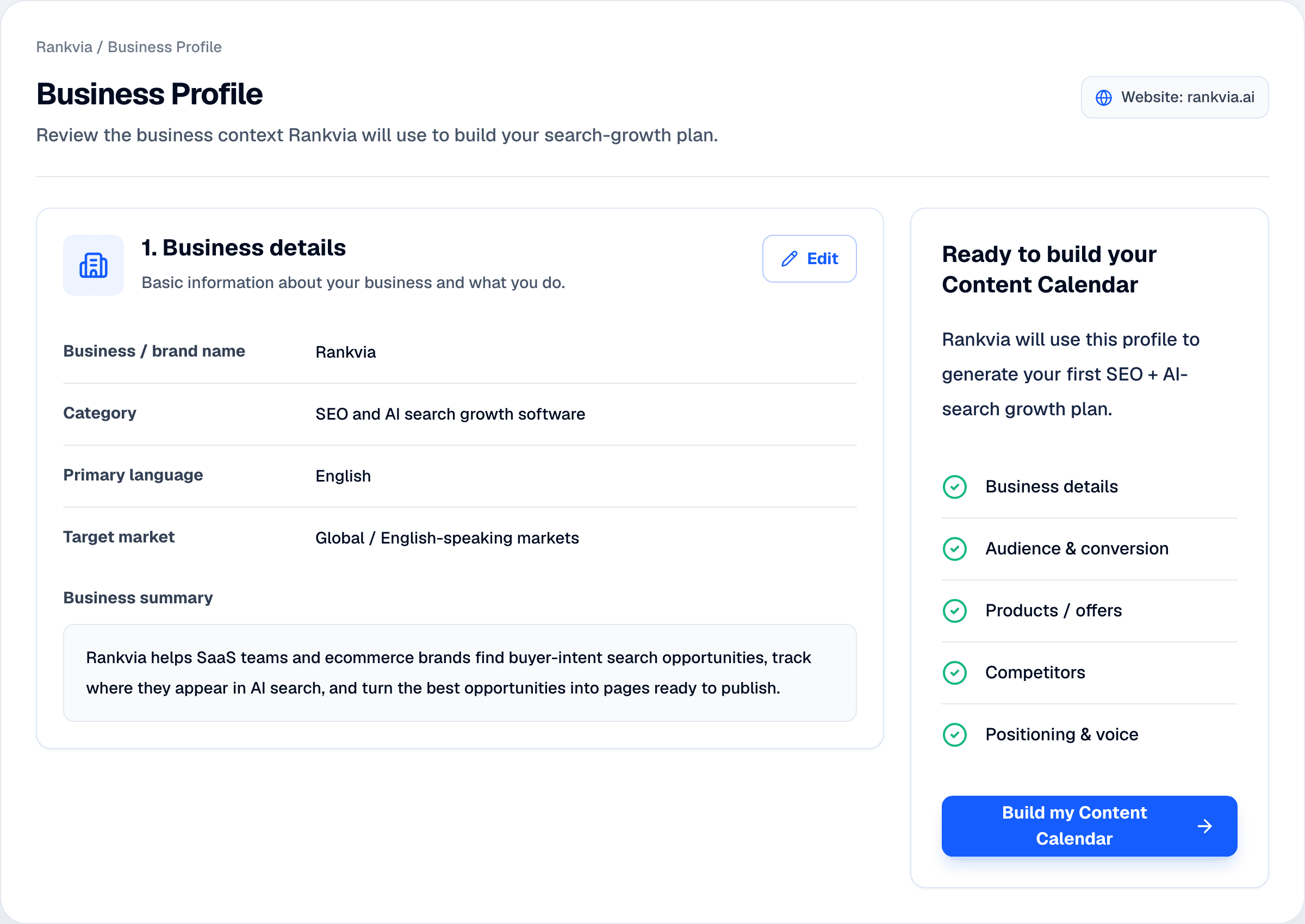
First: understand the business and the pages you already have
Rankvia analyzes the site and prepares an editable Business Profile. Its growth plan can use relevant Google search evidence, existing coverage and, where available, optional Search Console data and sampled AI Visibility results. You can correct the business context before the plan continues.
Next: decide what deserves action
The plan should make clear whether a meaningful opportunity requires a new page or a stronger existing one. Rankvia can also leave a topic out rather than add an unnecessary URL. The initial Calendar shows how the selected work fits into a prioritized publishing sequence.
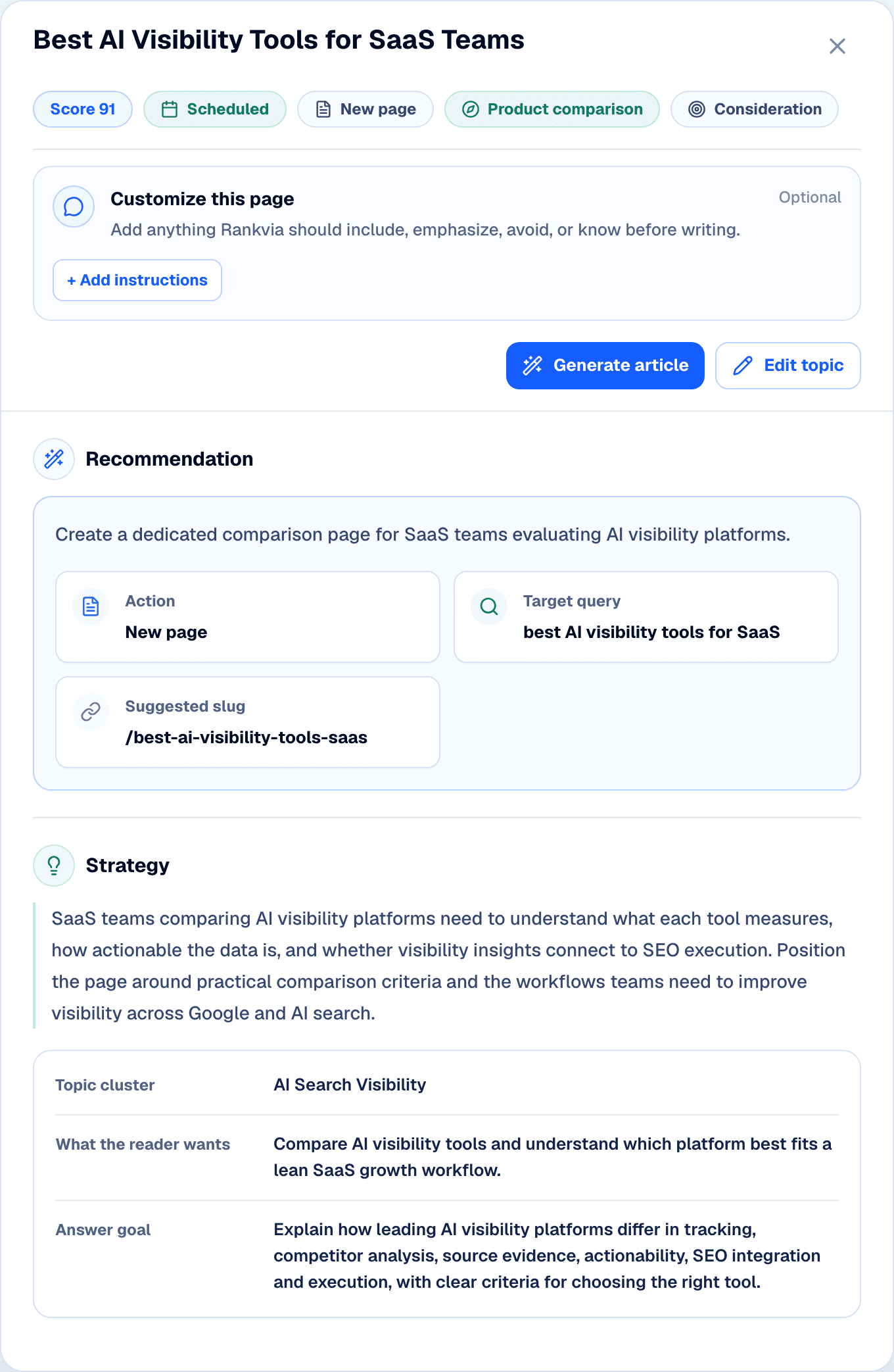
Then: see the strategy become a page
Open a planned opportunity to see the Page Plan, review the proposed direction and move into generation. In the supported publishing workflow, you can retain review or enable eligible Autopilot.
Where Surfer is the better choice
Deep, hands-on content optimization. Surfer's Content Editor, Content Score, AI-search-oriented scoring, SERP guidance and Auto-Optimize offer more granular control over a specific draft. If your editors regularly tune existing pages sentence by sentence and want explicit scoring feedback, that depth is a meaningful advantage.
A larger existing-content library to maintain. Content Audit combines Search Console evidence with SERP analysis, highlights pages needing attention and monitors performance. Surfer also offers rank-drop alerts. Rankvia's Improve workflow is opportunity-driven; it is not the same as continuous sitewide decay monitoring.
More AI-search monitoring depth and off-site action guidance. Surfer's AI Search Analytics can monitor ChatGPT, Perplexity, Gemini and Google's AI experiences, subject to plan coverage. Its current Recommendations can suggest writing or improving owned content, but also pursuing placements and improving mentions on third-party sources. Rankvia tracks selected questions across ChatGPT, Gemini and Google AI and can surface third-party opportunities, but does not automatically perform off-site placements.
Configurable agent-based operations. Surfer MCP connects compatible agents to Surfer research, content and monitoring tools; eligible higher plans offer additional integrations and APIs. For organizations building their own SEO workflows, that flexibility is a feature, not unnecessary complexity.
WordPress-centered editorial optimization. Surfer's WordPress plugin now exposes the current Content Editor experience directly in the WordPress workflow. If your primary task is optimizing an existing WordPress article with detailed scoring, that may matter more than a prebuilt publication calendar.
Surfer has become far more than an optimization score. Rankvia should be chosen for the operating model you want, not because Surfer lacks planning, AI Visibility or execution features.
AI Visibility: both measure it, but the downstream workflow differs
Rankvia and Surfer can both observe brand presence in AI-generated answers. Comparing their percentages directly is not useful without accounting for different question sets, providers, refresh cadences and counting methods.
Rankvia AI Visibility checks selected buyer questions across supported ChatGPT, Gemini and Google AI experiences. It displays brand appearances, competitor Share of Voice and source evidence. Those observations can influence Create, Improve, Monitor, third-party visibility or Skip decisions alongside conventional search opportunities.
Surfer's AI Search Analytics covers a broader published set of AI platforms and offers dedicated monitoring and Recommendations. Its October 2026 update explicitly joins AI and traditional search signals into a ranked action list, including both on-site and off-site actions.
Choose Surfer if detailed monitoring breadth and optimization control are the main purchase. Choose Rankvia if you want those signals to feed an already defined recurring page-planning and publishing process.
Pricing: pay for the workflow you need
Published USD reference prices checked October 18, 2026. Monthly equivalents below require annual billing. Exact checkout currency and terms may depend on market.
| Plan | Effective monthly price, billed annually | Month-to-month | Key included capacity |
|---|---|---|---|
| Rankvia Launch | $32.50 ($390/year) | $39/month | 10 generated pages/month; up to 25 buyer questions |
| Rankvia Growth | $82.50 ($990/year) | $99/month | 30 generated pages/month; up to 50 buyer questions |
| Rankvia Scale | $157.50 ($1,890/year) | $189/month | 60 generated pages/month; up to 100 buyer questions |
| Surfer Discovery | $49 | See Surfer checkout | 120 documents under its published allowance; no bundled AI prompt monitoring |
| Surfer Standard | $99 | See Surfer checkout | 360 documents; 25 tracked ChatGPT prompts refreshed weekly |
| Surfer Pro | $182 | See Surfer checkout | 360 documents; 50 tracked AI prompts refreshed daily across listed platforms; MCP |
Surfer also advertises a separate AI Search Analytics plan. Its document, tracking and credit units are not equivalent to Rankvia's monthly generated-page allowances. The table is a plan-selection reference, not a claim that one Surfer document equals one Rankvia published page.
Rankvia's advantage at entry is that the same core discovery-to-execution workflow and AI Visibility are included with the Launch page allowance. Surfer Discovery may be the lower-commitment way to get Surfer's optimization tools; Standard and Pro address different monitoring and operations needs.
Before deciding, check the current Rankvia pricing and Surfer pricing for plan terms and billing choices.
Which should you choose?
Choose Rankvia when your recurring problem is getting the right website work done: deciding whether to create or improve, keeping a prioritized Calendar, planning pages around buyer intent, producing drafts and publishing through a configured WordPress or Shopify connection. That is an operational responsibility you can hand to the product, not merely a toolkit you learn to operate.
Choose Surfer when your recurring problem is analyzing and optimizing content in depth: working directly inside Content Editor, auditing a substantial existing content library, controlling AI-search monitoring and recommendations, or building custom agent-driven SEO operations. Those are important strengths, and Rankvia is not a complete substitute for them.
You may also use both. A business could use Rankvia to organize its recurring opportunity-to-publication workflow and Surfer for particularly demanding page-level optimization. That is an optional combination, not a required setup or a claim of native integration.
Our recommendation: if you want your software to take on more of the website's ongoing growth decisions and page production, try Rankvia with your own domain before buying another optimization workflow. If you already have a sophisticated SEO production operation and want deeper controls, Surfer may be the better fit.
Frequently asked questions
Is Rankvia better than Surfer?
Rankvia is a better fit when you want an established recurring process for opportunity selection, Create/Improve decisions, Page Plans, generation and supported publishing. Surfer is stronger for granular content optimization, ongoing auditing, wider AI-search monitoring and configurable agent workflows. The better purchase depends on which work you want handled.
Can Surfer generate content or automate SEO tasks?
Yes. Surfer provides AI-assisted creation and optimization, prioritized Recommendations and MCP capabilities that let compatible agents plan, draft, score and improve content. It should not be described as analytics-only.
Does Surfer monitor AI Visibility?
Yes. Surfer offers AI Search Analytics with tracked prompts, mentions, sources and competitor-related insights. Platform coverage, limits and update frequency differ by plan. Surfer also uses these signals in its newer Recommendations.
What is the difference between Surfer Recommendations and Rankvia's Content Calendar?
Surfer surfaces prioritized on-site and off-site actions from SEO and AI-search signals. Rankvia decides which owned-site Create/Improve opportunities deserve scheduling and carries selected work into dated Calendar items, Page Plans, generation and eligible publishing. Both help prioritize; their standard execution paths differ.
Which platform is better for optimizing existing pages?
Surfer has deeper editorial optimization controls and ongoing Content Audit/decline alerts. Rankvia can recommend improving an existing page when it is the right owner of a meaningful opportunity, but it is not a continuous content-decay monitoring substitute.
Can Rankvia publish automatically?
Yes, for eligible work with supported publishing integrations configured. Review First keeps a review checkpoint; Autopilot lets scheduled work progress from generation into publication. Rankvia currently supports WordPress and Shopify.
Does Surfer publish to WordPress?
Surfer has an official WordPress plugin with Content Editor functionality and content transfer features. More extensive automation can be assembled with supported integrations and agent tooling, depending on the plan and setup. That is different from promising every Surfer plan includes unattended scheduled publishing.
Is Google Search Console required for Rankvia?
No. Rankvia can begin with website/business analysis and available search evidence. GSC is optional and adds first-party performance context when connected. Surfer's Content Audit requires a GSC connection, although many of Surfer's other tools can work without it.
Which is cheaper, Rankvia or Surfer?
Rankvia Launch starts at $32.50 per month effective with $390 billed annually, or $39 month-to-month. Surfer Discovery starts at $49 per month effective annually. The products use different allowances and offer different capabilities, so compare the plan that actually includes the work you need rather than prices alone.
Can I try Rankvia before subscribing?
Eligible websites can use the free Search Growth Plan process to analyze the site, review the Business Profile, see a prioritized Calendar and start a first generated page. Limited AI Visibility may be available. An account is required; no credit card is required for eligible preview access.
See what Rankvia would do with your website
Surfer can give you more ways to analyze and refine content. Rankvia can take more of the recurring decisions and production work off your hands. The most useful next step is to see whether its choices make sense for the site you already own.