AVADA BLOG SEO ALTERNATIVES
7 Best Avada Blog SEO Alternatives for Shopify in 2026
Looking for an Avada Blog SEO alternative? If your main goal is to automate not just writing but also deciding which SEO content is worth producing, Rankvia is our top recommendation. It connects Shopify store analysis, keyword and SERP evidence, AI Visibility observations, optional Google Search Console data, Create/Improve decisions, content planning, generation and publishing. You can review content or enable supported automatic publishing workflows.
Avada Blog SEO AEO Content is a capable product in its own right. It offers a drag-and-drop editor, AI-assisted drafts, keyword research, SEO analysis, embedded products, internal linking and scheduled publication. You may prefer Avada if hands-on blog layout and editing are the job you care most about. The alternatives below serve different needs, from cheaper recurring blog output to fuller search-led content execution.
Our pick: Rankvia for evidence-informed SEO content planning, creation, improvement and Shopify publishing. Free website preview available for eligible users; Shopify paid plans start at $39/month. The website preview is not an ongoing free Shopify subscription.
Official listings checked October 23, 2026.
Best Avada Blog SEO alternatives at a glance
| App | Best for | Free access | Paid plans from* |
|---|---|---|---|
| 1. Rankvia - our pick for automated SEO content growth | Merchants who want search research, AI Visibility, Create/Improve planning, generation and Shopify publishing connected | Eligible free website preview, not a Shopify free plan | $39/mo |
| Soro | Regular brand-aware SEO articles and automatic publishing | No permanent free plan shown | $39/mo |
| AI Blog Agent | Affordable frequent automatic blog posts | Ongoing free plan | $8.99/mo |
| Tapita GEO Studio & AI Blog | Blog/content studio with GEO and AI Visibility features | Listed free on Shopify | No paid plan shown in current listing |
| Auto Blogs Agent | Scheduled AI blog production with images and links | Free-to-install tier, 3 blog posts monthly | $12.75/mo |
| Bloggle | Visual blog design, product components and SEO/UX editing | Free trial, not an ongoing free plan | $19.90/mo |
| BlogSEO | Automated blog articles plus a backlink-exchange offering | Free trial, not an ongoing free plan | $97/mo |
*USD prices and free access reflect official Shopify listings checked October 23, 2026. Credits, publication limits, token allowances, integrations and trial rules differ substantially. Compare what your plan can actually do, not just its starting price. Official app listings.
Why consider an alternative to Avada Blog SEO?
Avada solves a real Shopify problem: the native blog editor may not offer the layout flexibility, embedded products and AI writing help a merchant wants. Its current listing advertises SEO scoring, internal linking, multilingual posts, keyword research, a content calendar, drafting and publishing. The free plan includes unlimited blog posts and a one-time allowance of 200,000 AI tokens; the $14.90/month Pro plan includes 1 million AI tokens per month and advanced editing elements.
That is an attractive offer. But an efficient blog editor is not necessarily a complete SEO growth system. Before choosing an alternative, decide which question you need software to answer:
- “How do I write and design a good blog post?” Avada or Bloggle may fit best.
- “How do I publish several posts automatically?” Soro, AI Blog Agent or Auto Blogs Agent deserve consideration.
- “Which new pages are worth creating, and which existing pages should be improved?” This is where Rankvia's business-aware research and planning workflow becomes more relevant.
- “Are customers discovering my brand in AI search?” Rankvia and Tapita expose AI-search-oriented evidence, although their measurement and workflows differ.
A high SEO score inside an editor cannot by itself show whether a new article is needed, whether another URL already serves that question or whether the article will acquire meaningful search traffic. These decisions need context.
1. Rankvia - best for research-driven SEO content creation and publishing
Best fit: Shopify merchants who want search growth content handled as a recurring workflow, rather than a series of isolated writing tasks.
Rankvia analyzes the store's public website, products, offers, audience and existing page coverage. It then brings together relevant search demand, current Google SERP patterns, AI Visibility buyer questions and competitor/source observations. If you connect Google Search Console, first-party queries and page-performance signals can add further context. These are planning inputs, not guaranteed ranking or traffic predictions.
The key difference is the decision before writing. Rankvia can recommend creating a new page, improving an existing page, monitoring an opportunity, pursuing a different visibility action or skipping work that isn't justified. Accepted work enters a prioritized Content Calendar and Page Plan. Rankvia then generates brand-aware content and SEO metadata, includes relevant internal linking in its supported workflow and can publish supported articles or standalone pages to Shopify. Merchants can review first or explicitly opt into eligible scheduled automatic publishing.
Why the workflow matters
Imagine a Shopify skincare brand already has a useful guide about fragrance-free moisturizers. Search evidence reveals more customer questions about choosing products for dry skin. A simple “write another article” workflow might produce a near-duplicate guide. Rankvia can inspect the existing page and search intent to decide whether Improve is a better next action than Create. If a distinct buyer question deserves its own URL, it can propose a new page with its own Page Plan.
This fictional example illustrates the decision process; it is not a customer case study or performance result.
What Rankvia brings together
- Business context first. The approved Business Profile captures what the shop sells, its intended buyers, positioning, competitors, target market and language.
- Real search evidence. Keyword relevance, search-result patterns and related questions can inform whether a topic is worth pursuing and what page should own it.
- AI Visibility as input, not decoration. Buyer-question results, competitor appearances and available sources can help identify visibility gaps. Observed AI answers vary, so a single absence isn't definitive.
- Optional GSC. A connected Google Search Console account provides first-party search queries and page data; Rankvia doesn't require it to function.
- Create and Improve. Planning can prioritize existing-page improvement rather than unnecessary new posts. This is not an automatic bulk update of Shopify product or collection records.
- Contextual internal linking. Generated content can incorporate relevant links to help buyers move between useful pages; it's not automatic sitewide link editing.
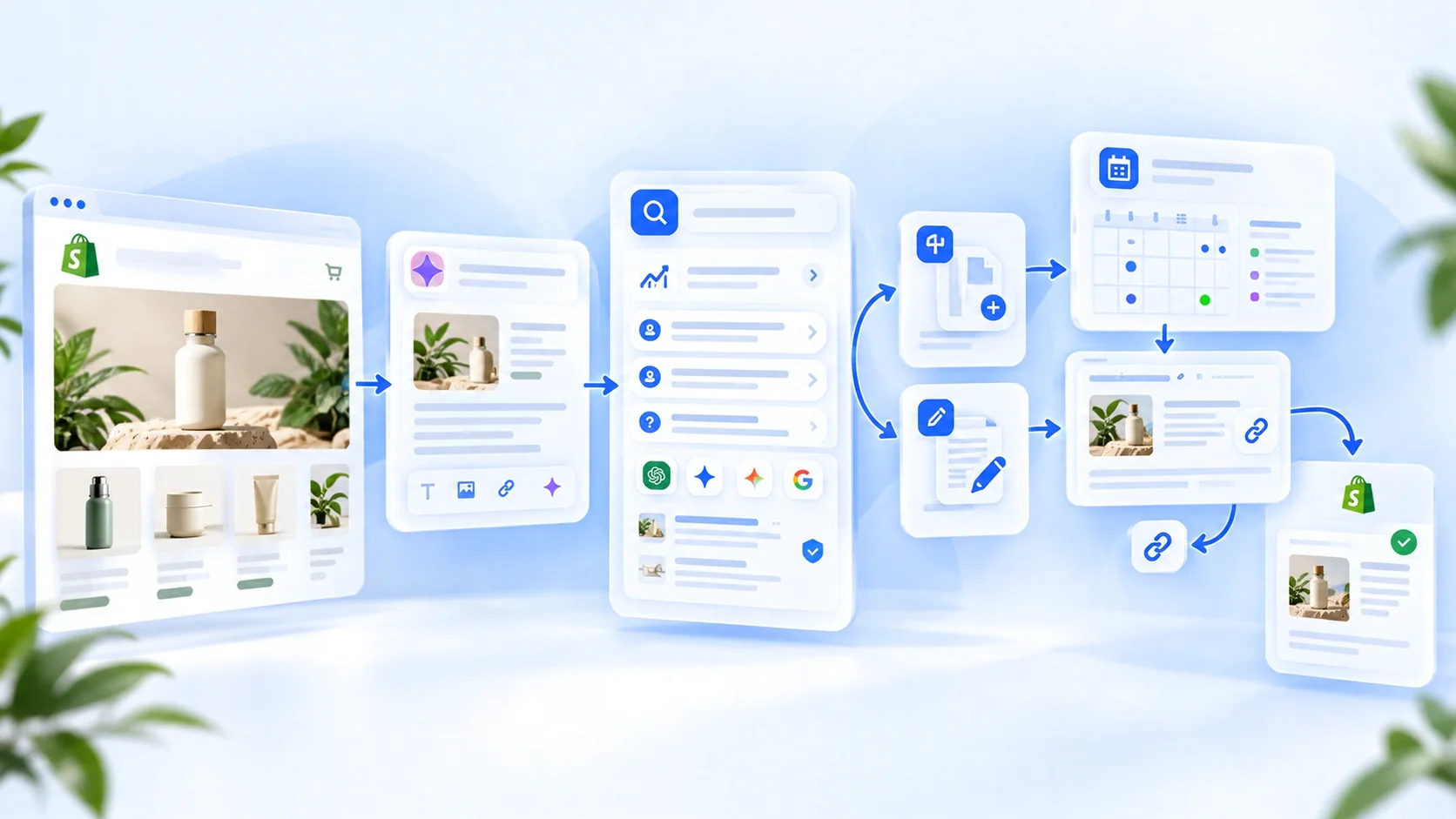
- Execution. Content Calendar → Page Plan → generation or selected improvement → review or supported Shopify publication.
Trade-offs and pricing
Rankvia is not a drag-and-drop blog design system, bulk metadata repair tool, product-feed manager or image-compression app. Its value is better aligned with merchants who need help choosing and executing content work. No tool can promise Google rankings, inclusion in ChatGPT, citations or sales.
The Shopify listing currently shows Launch $39/month (10 AI-optimized pages, up to 25 tracked buyer questions), Growth $99/month (30 pages, up to 50 questions) and Scale $189/month (60 pages, up to 100 questions). Annual billing is also listed. The public website offers an eligibility-gated free AI Visibility snapshot and Search Growth Plan without a credit card; it isn't a Shopify subscription tier.
Choose Rankvia if you want to reduce the ongoing work of research, prioritization, drafting, refreshing relevant content and Shopify publishing. Choose Avada if your priority is visual control and per-post editing for much less money.
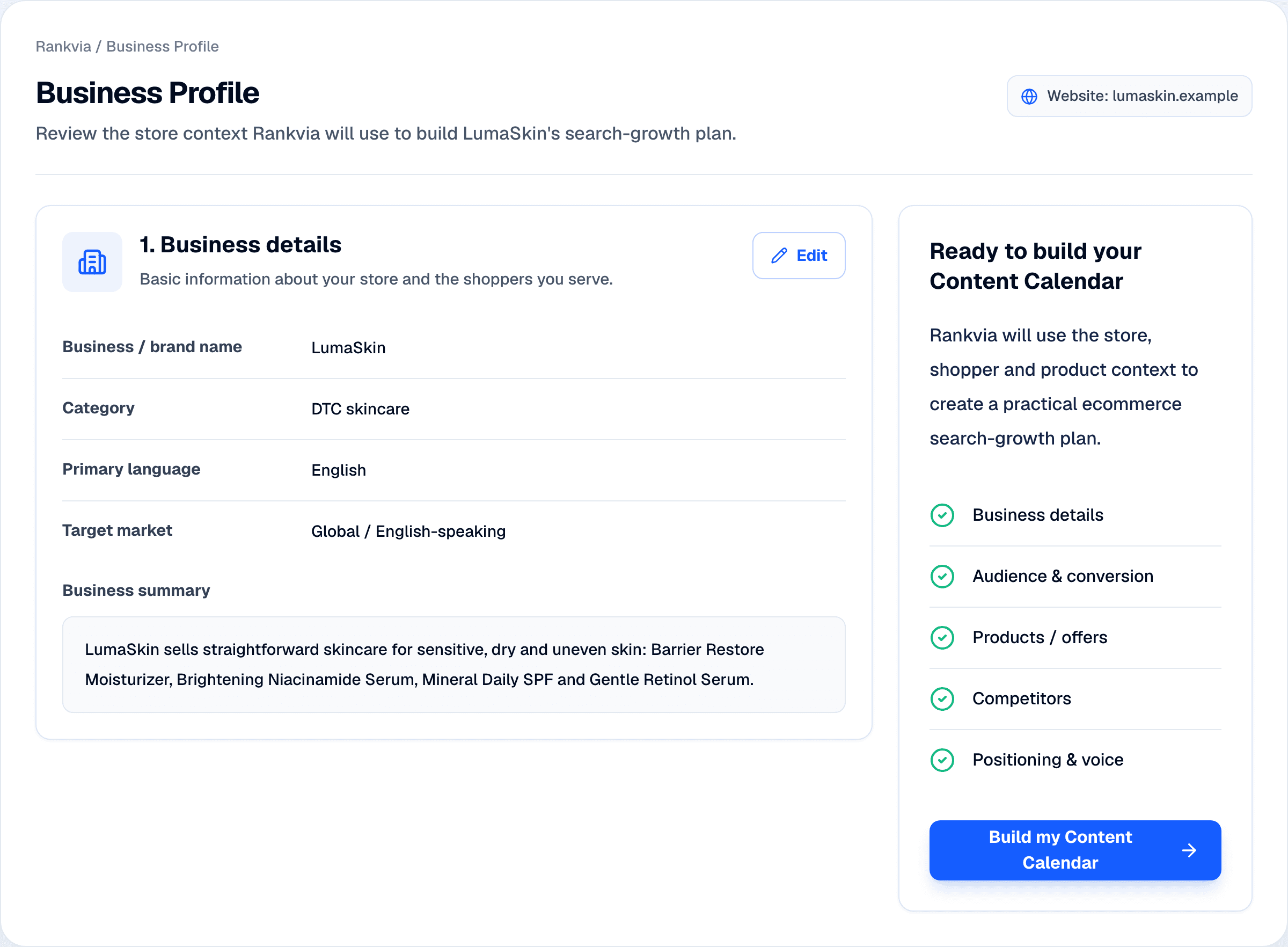
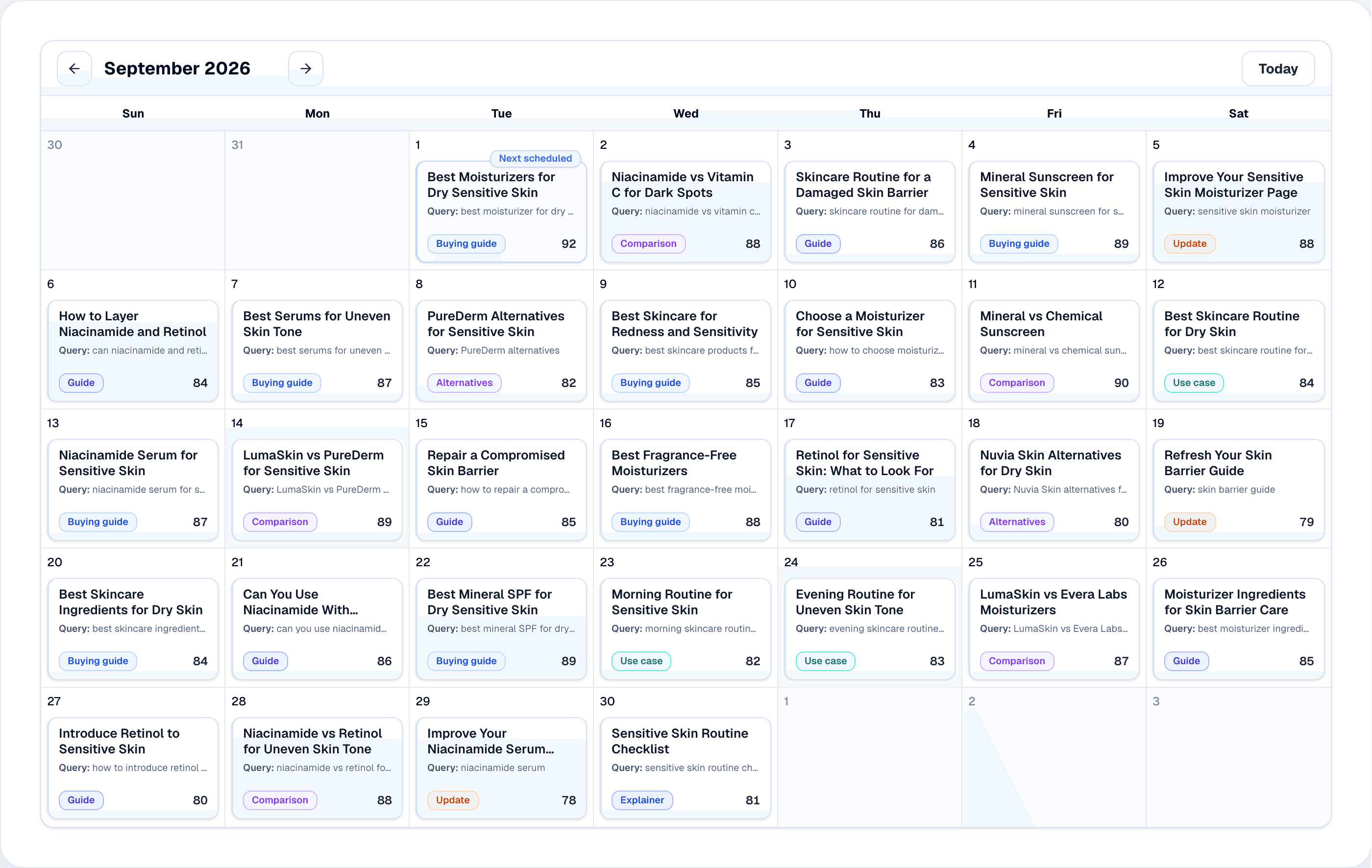
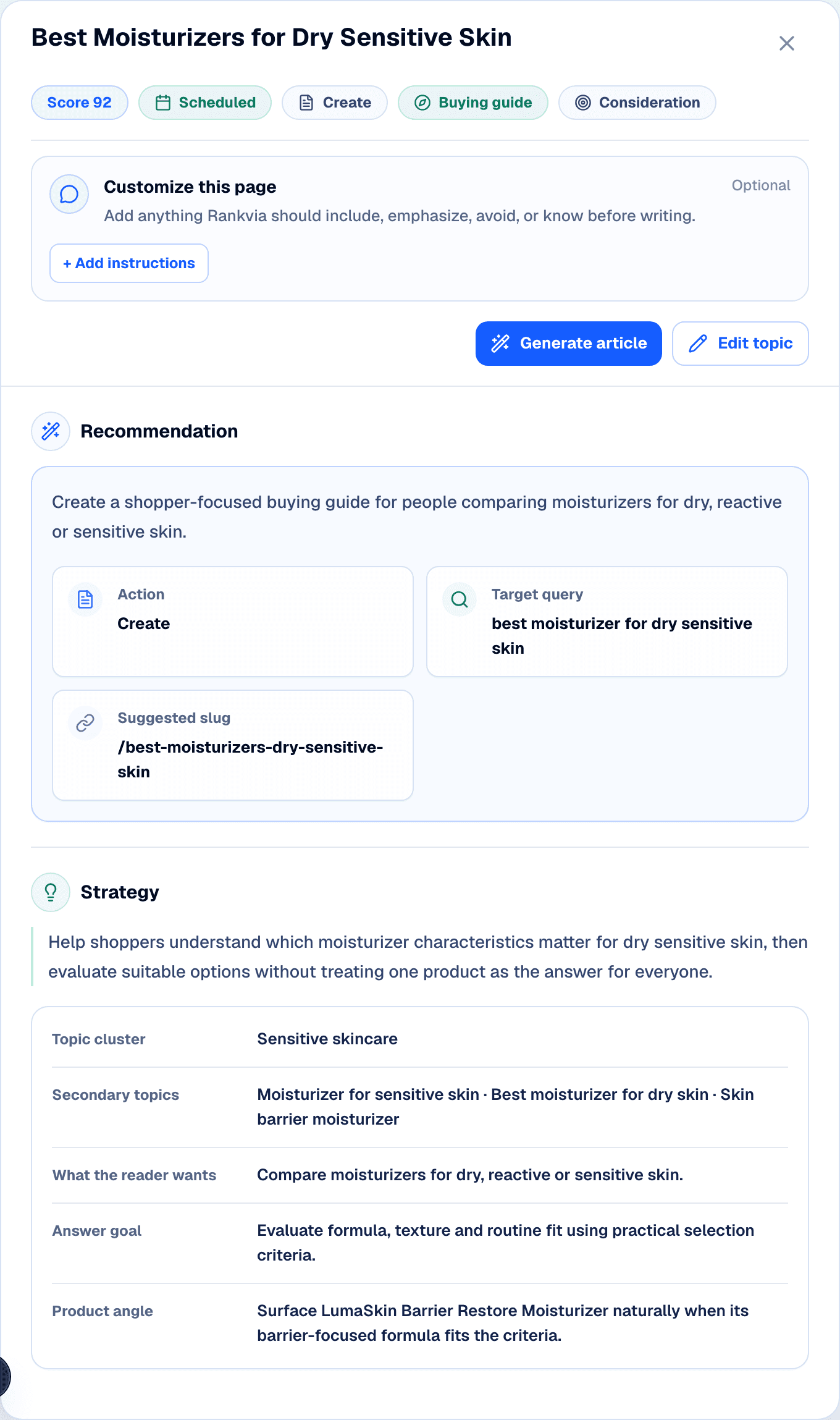
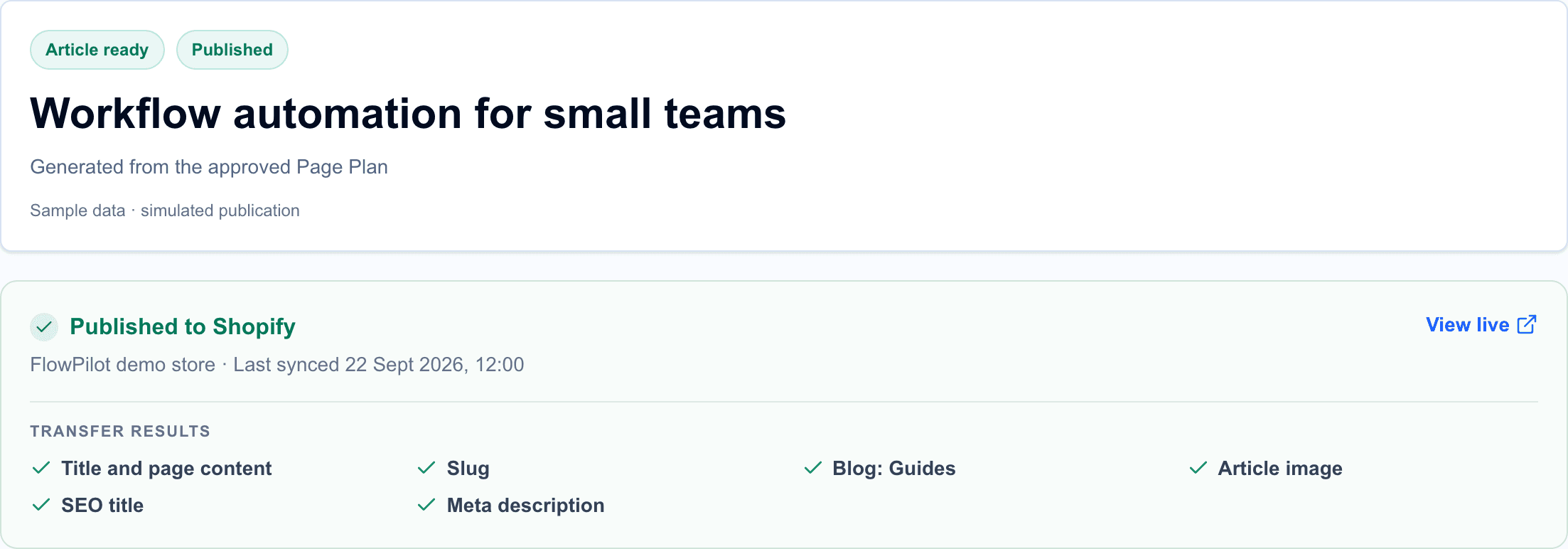
These are product interface examples; figures shown are illustrative demo-store data.
2. Soro - best for automated posting cadence
Soro - SEO Autopilot & Content advertises keyword discovery, store and brand-voice analysis, AI article writing, image generation, internal links, translation into many languages and optional auto-publishing. A merchant can review drafts or let an eligible schedule run. Soro is not merely a text generator: its public description includes automated research and a broader writing workflow.
Where it excels: A repeatable blog production cadence, particularly for merchants who want consistent posts without opening an editor daily.
Where Rankvia may fit better: When the decision to improve an existing URL rather than create another article is central, and when buyer-question AI Visibility and optional GSC evidence should influence the content plan. Soro's official listing doesn't establish an identical combined decision process; that isn't proof the capability is absent.
Pricing: $39/month, or $216 annually according to the current Shopify listing. Its annual price is lower than Rankvia's Launch annual price. Compare strategy, quality control and what the subscription actually delivers, not only the number of posts.
3. AI Blog Agent - best for inexpensive automatic blogging
AI Blog Agent | SEO Auto Blog lists automatic scheduled articles, related product mentions and links, images, internal linking and recommended topics. It explicitly advertises a lifetime free plan with three posts per week, and paid plans starting at $8.99/month. That is a real price advantage for stores prioritizing ongoing output volume.
Choose it if: The store has a straightforward blogging strategy, already knows its topics and mainly needs inexpensive posting automation.
Why consider Rankvia instead: Publishing frequency isn't a proxy for opportunity quality. A merchant with an existing library may benefit more from search- and page-aware decisions, optional performance data and selective improvements than from generating 12 or 30 more posts every month.
Limit to understand: The free plan and higher posting limits don't eliminate the need to review facts, commercial claims, duplicated intent and internal destinations. AI Blog Agent does advertise internal linking, so that capability is not exclusive to Rankvia.
4. Tapita GEO Studio & AI Blog - best for content plus GEO features
Tapita GEO Studio & AI Blog is another serious option, not a basic writer. Its Shopify listing promotes AI blogs, buying guides, FAQs, a content calendar, scheduled publication, keyword research, multilingual content, internal linking, refresh reminders and AI/GEO visibility functionality. The Shopify listing currently displays Free.
Choose it if: You want a content studio with a visual workflow and GEO-oriented tools, particularly while evaluating its free offering.
Why consider Rankvia instead: Evaluate how each platform combines AI-answer evidence, current SERPs, optional first-party search performance, page ownership and Create/Improve decisions. Rankvia documents this sequence explicitly from analysis to planning and publishing. Tapita also advertises strategy and visibility features, and its functionality should not be dismissed.
Check before installation: A free listing alone doesn't establish unrestricted usage, or mean every connected capability is free. Review current limits and any external service requirements.
5. Auto Blogs Agent - best for scheduled AI posts with images
Auto Blogs Agent AI Blog Posts describes scheduled blog generation, AI images, competitor-keyword tools, metadata/schema and internal links. Its free-to-install plan advertises three blog posts per month; Starter is $12.75/month and lists 15 monthly posts.
Choose it if: You value affordable, automated blog output and want posts published with relatively little configuration.
Where Rankvia may fit better: When planning should reference the store's existing content and explicit search/AI Visibility decisions, rather than primarily sustaining a publishing schedule.
Watch for: Automated content still needs brand checks, clear product facts and page overlap review. More posts are not necessarily more relevant visits.
6. Bloggle - best for visual blog design and conversion-focused layouts
Bloggle: SEO Blog Builder offers a drag-and-drop editor, layout templates, embedded product blocks, AI writing assistance and SEO/UX tips. It is one of the most direct choices for merchants who find Shopify's native blog presentation limiting. Its listing starts at $19.90/month and offers a free trial.
Choose it if: You want precise control over the design of product-led blog posts and calls to action within the article layout.
Why consider Rankvia instead: Rankvia serves the earlier and more automated part of the workflow: what the business should publish or improve, and how to generate and deliver that content with search research behind it. Bloggle is the better fit if visual editing is the bottleneck; Rankvia is more relevant if planning and execution are.
This distinction is about product focus, not proof that Bloggle has no planning or research functionality.
7. BlogSEO - best for blogging with a backlink-exchange offering
BlogSEO: AI Blog & Backlinks advertises keyword research, AI blog generation, scheduled publishing and an exchange network intended to obtain backlinks. Its Shopify listing shows $97/month, with a free trial. It is not a low-cost alternative, and its backlink offering introduces a separate decision beyond AI writing.
Choose it if: You specifically want to evaluate the combined article-and-backlink product and understand the risks and quality controls of the link offering.
Why Rankvia may fit better: Rankvia's core proposition is research-informed, brand-aware SEO and AI-search content execution. It doesn't claim to supply a backlink exchange. Shopify merchants should assess link relevance and editorial standards carefully; participating in artificial link schemes can create search-policy risk.
Rankvia vs Avada Blog SEO: which is the better fit?
Both products can help create SEO content for a Shopify store, but they're built around different primary workflows.
| Decision criterion | Rankvia | Avada Blog SEO AEO Content |
|---|---|---|
| Main product job | Research → prioritize → create/improve → publish | Create, design, optimize and manage blog posts |
| AI writing | Yes | Yes |
| Keyword analysis | Yes | Yes |
| Internal linking | Supported in the content workflow | Advertised in listing |
| Visual drag-and-drop blog design | Not its main strength | Advertised strength |
| Content calendar/scheduling | Prioritized calendar; supported scheduled publishing | Blog calendar and scheduling advertised |
| AI Visibility by sampled buyer question | Documented | Comparable monitoring workflow not established in reviewed public materials |
| SERP-informed Page Plans | Documented | Equivalent end-to-end planning process not established |
| Optional GSC evidence used in planning | Documented | Equivalent planning integration not established |
| Create-versus-Improve existing pages | Documented | Equivalent decision workflow not established |
| Starting Shopify paid price | $39/month | $14.90/month |
| Free access | Eligible website preview | Ongoing Shopify free plan |
Avada is clearly attractive for stores needing a powerful editor. Rankvia becomes more compelling when a merchant wants to delegate a larger share of search decision-making, not merely content production. The above “not established” wording means the checked public documentation does not establish an equivalent workflow; it does not prove technical absence.
Example: create or improve?
A Shopify store sells reusable travel bottles. It already has a thorough page answering “How to pack liquids for a weekend trip.” New keyword and AI buyer-question observations suggest interest in comparing travel bottles that meet airline restrictions. A writing-focused workflow can make a new article quickly. A search-led workflow first asks whether the existing page is the appropriate owner and could be improved; otherwise, it creates a distinct comparison page with relevant product links. That decision can reduce unnecessary overlap, though it doesn't guarantee SEO gains.
What to check before changing Shopify blog apps
- Research: Where do topic recommendations come from? A keyword you typed, live SERP evidence, existing site pages, AI answers or first-party GSC data?
- Page ownership: Does the product check whether an existing URL already serves the same search intent?
- Editorial control: Do you need a visual editor, structured Page Plans, approvals or an automated cadence?
- Publishing: Are posts Shopify drafts, immediately live, scheduled in Shopify or scheduled in the app? Can you choose the destination blog?
- Content connections: Are internal links relevant to existing articles, products and collection pages? Do they need manual review?
- Economics: Compare useful pages, supported markets, review time and subscription/provider costs, not only AI tokens or post counts.
How to get started with Rankvia on Shopify
- Install Rankvia on Shopify and connect the intended store/workspace under the supported app flow.
- Review the Business Profile. Confirm products, audience, brand language, market, voice and competitors; these approved values inform downstream content.
- Review AI Visibility and search evidence. Rankvia may use relevant buyer-question checks, search demand and SERP patterns. Connect GSC if you want first-party query/page evidence included where available.
- Review the Content Calendar. Check recommended Create and Improve decisions and open the Page Plan before generation.
- Generate and publish. Review content and internal links, then send supported articles/pages as Shopify drafts or live pages, or configure eligible automatic publishing intentionally.
- Revisit the evidence. Compare Google performance and sampled AI Visibility over time; don't treat a single impression, AI answer or page publication as proof of success.
Frequently asked questions
Is Rankvia better than Avada Blog SEO for Shopify?
If your main problem is deciding which SEO content to create or improve and then automating execution, Rankvia may fit better. If your main problem is designing or manually editing Shopify blog posts, Avada may be better and less expensive. Neither tool is verified to generate better rankings than the other.
Does Avada Blog SEO have a free plan?
Yes. The current Shopify listing includes an ongoing Free tier with unlimited blog posts and a one-time 200,000 AI-token allowance. Its Pro plan starts at $14.90/month, with different allowances.
Can I try Rankvia without paying?
The Rankvia website offers an eligibility-dependent free AI Visibility Snapshot and Search Growth Plan without a credit card. This is not an ongoing free Shopify app subscription. Rankvia's Shopify plans currently start at $39/month.
Do these apps automatically publish to Shopify?
Rankvia, Soro, AI Blog Agent, Tapita and Auto Blogs Agent advertise Shopify publishing and/or scheduled workflows, but controls and limits differ. Rankvia can keep content in review or publish eligible scheduled content automatically when you explicitly configure Shopify as the destination.
Can Rankvia improve existing Shopify articles?
Rankvia documents Create/Improve planning and an existing-content improvement workflow. The supported scope and publishing path should be checked for the specific content type. It should not be described as an unattended bulk editor for every Shopify product or collection description.
Is AI Visibility the same as Google SEO performance?
No. AI-answer mentions/citations, Google Search Console query/page performance, referral traffic and sales are separate measurements. Rankvia may bring them together as planning evidence, but none on its own proves that a given article will rank or be recommended.
Is it useful to use a visual blog editor alongside Rankvia?
Potentially. Merchants can value Rankvia for selecting and preparing search-led content while using other tools for specialized layout or technical optimization. Verify workflow compatibility, duplicated features and cost before subscribing to both.
Final recommendation
Choose Rankvia if you want to automate SEO content decisions as well as content creation. It brings together store context, live search/SERP signals, sampled AI Visibility, optional GSC data, Create/Improve prioritization, Content Calendar, Page Plans, contextual linking and Shopify publishing.
Choose Avada when the immediate priority is designing and refining blog posts inside a richer editor, especially if its free tier meets your requirements. Choose the cheaper automation-first alternatives when the goal is simply to maintain a frequent blogging schedule. Different tools serve different bottlenecks.