Guides AI SEO Automation for Small Businesses: What to Automate and What to Review
SEO AUTOMATION FOR SMALL BUSINESSES
AI SEO Automation for Small Businesses: What to Automate and What to Review
Discover which SEO tasks small businesses can automate with AI, what still needs review, and how Rankvia turns search opportunities into useful content.
By Rankvia ·
Running a business leaves little room to become a researcher, content planner, writer and publisher every week. The ideas pile up while the website stays much the same.
Small businesses can automate recurring SEO research, planning and content creation, then keep human review for business facts, priorities and publishing choices. Start with work that produces a useful, inspectable page, rather than trying to automate all of SEO at once.
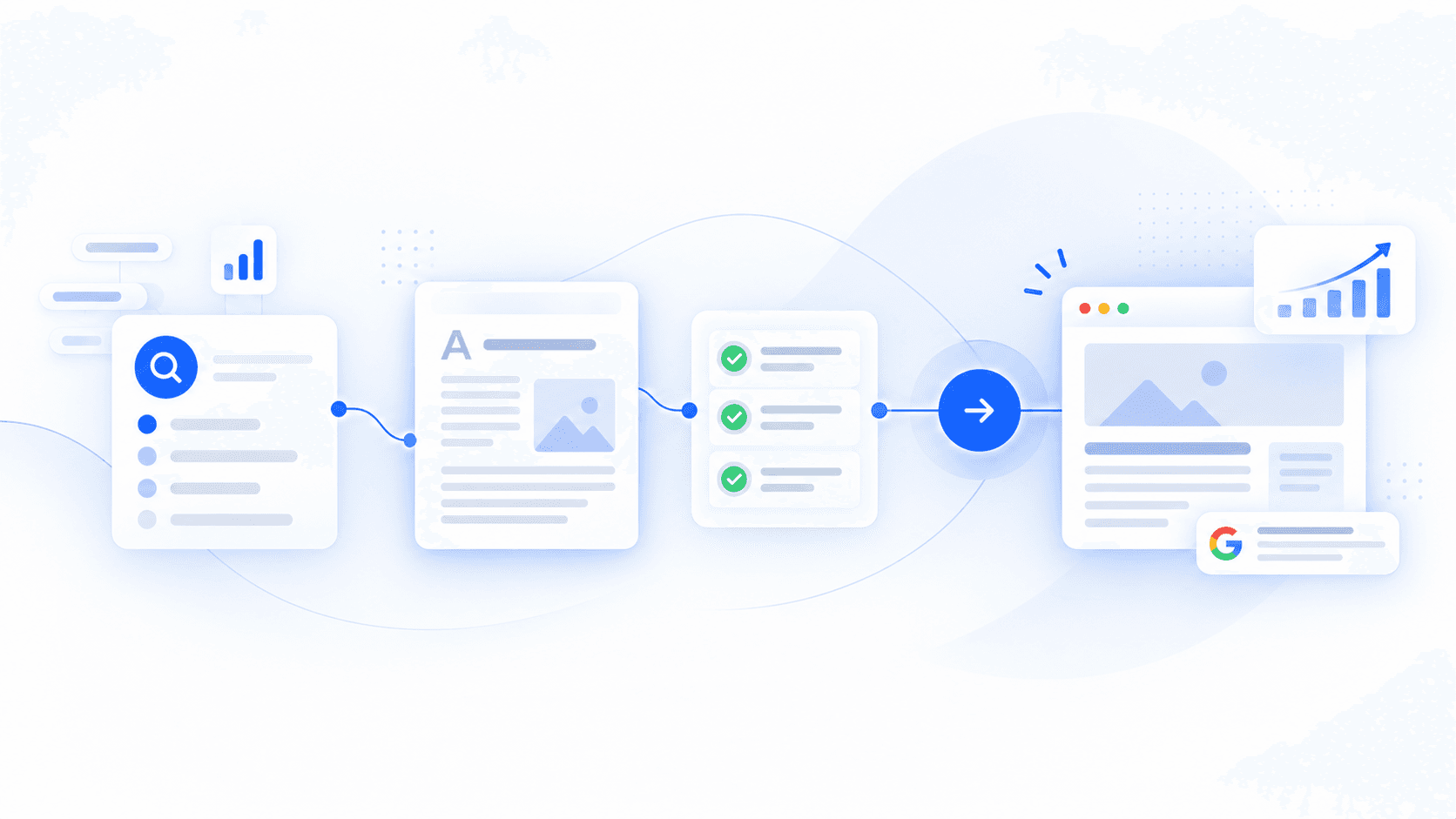
Rankvia can take on more of that recurring process: decide what the website should create or improve, prepare the plan and generate the page, with supported publication when eligible. The question is which responsibility would most help your business get work finished.
What can small businesses actually automate with AI SEO?
Look for repeatable work with a clear output and someone who can check it. A system that produces more drafts than you can review has moved the bottleneck rather than solved it.
The table describes practical automation roles. Products vary; Rankvia's specific scope is business-aware planning, supported content creation or improvement, and eligible publishing. It does not replace every technical SEO or specialist service.
| SEO activity | How AI can help | What the owner should review |
|---|---|---|
| Opportunity research | Organize relevant search and website evidence into proposed actions | Business fit, priority and whether an existing page already answers the need |
| Content planning | Sequence worthwhile work and prepare page plans | Page purpose, priorities and a workload the business can review |
| Content creation | Generate supported drafts with useful structure and page details | Accuracy, original usefulness, brand voice and links |
| Content improvement | Propose changes when an existing page is the right opportunity owner | Whether the update is justified and preserves the page's purpose |
| Publishing | Carry eligible content through configured supported destinations | Permission, approval preferences, destination and resulting state |
| Performance review | Surface or organize supported evidence where available | Dates, business relevance, interpretation and the next decision |
Google Search Console can add your own search-performance evidence in Rankvia, but it is optional. Search-demand estimates, connected GSC performance and sampled AI Visibility observations are different inputs. None automatically means another page should be published.
Five SEO tasks worth automating first
Choose the task causing a recurring delay. You do not need to delegate all five immediately.
1. Finding useful content opportunities
The manual problem: You collect ideas but cannot tell which would help a buyer.
Delegate: Reviewing business context, available search evidence and existing coverage to propose relevant work. Useful output: a reasoned Create, Improve or non-page decision. Your check: Does this serve something you actually sell, and does the site already cover it? A smaller useful shortlist beats an unreviewed backlog.
2. Building an SEO content calendar
The manual problem: Every week begins with another decision about what to write.
Delegate: Prioritizing selected work into a dated Content Calendar. Useful output: a sequence with a next task, not a spreadsheet you must continually reconstruct. Your check: Can someone review the planned output before more work accumulates? The Content Calendar overview explains how planning gives page work an order.
3. Preparing page plans and briefs
The manual problem: A topic reaches the writer without a clear reader or purpose.
Delegate: Preparing a Page Plan that connects search need, page type, business context, answer structure and relevant internal links where supported. Useful output: a plan that says what the page should accomplish. Your check: Are the important business facts available, and does the plan lead to the right offer or next step?
4. Creating SEO-ready content
The manual problem: Approved ideas wait because nobody has time to produce the page.
Delegate: Generating supported content from the plan, with metadata, image and internal-link context as applicable. Useful output: a saved draft you can evaluate instead of a blank document. Your check: Verify the claims, usefulness and brand voice. Return an incorrect brief for correction instead of repeatedly fixing its consequences in every draft.
5. Identifying pages that may need refreshing
The manual problem: You are unsure whether to commission a new page or improve a useful one.
Delegate: Connecting an identified opportunity to the existing URL that should serve it. Useful output: an opportunity-driven improvement plan. Your check: Is there a concrete gap worth fixing? Rankvia's Improve workflow is not continuous site-wide content-decay detection or automatic repair of every declining page. Keeping a good page unchanged can be the right decision.
What small businesses should not leave entirely to AI
Human review makes delegation more dependable. You know the business details that a fluent draft can get wrong.
Keep a person responsible for:
- Business facts: product specifications, service scope, availability, supported features and promises to customers.
- Positioning: who you serve, what makes the offer useful and what you can honestly say about alternatives.
- Sensitive claims: legal, medical, financial or other consequential material that needs appropriately qualified review.
- Usefulness: whether the page answers a real question with something specific, rather than repeating generic advice.
- Priorities and permission: what deserves attention, which destination is correct and when content may go live.
- Results: whether the work supports worthwhile enquiries, product discovery or other relevant business outcomes.
Google's guidance on AI-generated content emphasizes accuracy, quality and relevance, including review of metadata. Generating many pages without useful added value can violate its spam policies.
If nobody can verify an important claim, hold that work for clarification. Automate the preparation around the expert's judgment, rather than treating uncertainty as permission to publish.
Three practical examples of AI SEO automation
These are illustrative workflows, not Rankvia customer stories or measured results. Each begins with an owner deciding what deserves limited review time.
A small ecommerce store
A planter retailer keeps answering questions about pot size and drainage. It could delegate a buying-guide plan and draft, while the owner verifies dimensions, materials and the actual range.
The decision: Improve existing guidance if it already owns the question; create a distinct guide only if a buyer need remains. Review one useful resource before filling a calendar. Explore the ecommerce SEO approach for the wider store workflow.
A SaaS startup
A stock-planning founder wants to explain seasonal replenishment. Automation could prepare an educational guide and a relevant use-case plan from approved product information.
The decision: Choose the page whose feature claims the founder can verify now. Delay unsupported integration claims instead of producing more unchecked drafts. The SaaS SEO approach connects educational content with product evaluation.
A professional-services business
An office-cleaning company receives the same questions before preparing a quote. It could delegate a preparation checklist and improvements to the existing service page.
The decision: The owner confirms service area, inclusions and exclusions. Prioritize clear answers over multiple near-identical location pages. The professional-services SEO approach covers the broader buyer journey.
In each case, the useful outcome is a page with a job, supported facts and a reviewer. Automation handles repeatable preparation; the owner chooses the work the business can finish well.
How to choose the right AI SEO automation solution
Evaluate one opportunity from your own website before committing to a larger production schedule. A smooth writing demo is only part of the decision.
Ask practical questions:
- Does it understand the business? Can you approve and correct the offers, audience, positioning, content language and market?
- Does evidence lead to a page decision? Can it use relevant website and search context, distinguish new content from an existing-page improvement, and recommend no extra page when appropriate?
- Does it take work beyond a recommendation? Can a selected opportunity become a prioritized plan and a draft without you rebuilding the brief in another tool?
- Are review and publishing controls clear? Check the supported destination, content type, current entitlement and opt-in settings. Approval, export, CMS draft and live publication are different states.
- Can you operate it with the resources you have? Consider the subscription, available production capacity, required connections and the person's time needed to review. Do not buy output volume you cannot use.
A useful trial leaves you able to explain why the page exists, who checks its facts and how it will reach the website. Keep specialist help where technical implementation, local business listings, original expertise or a custom CMS process is the real bottleneck. Content automation does not automatically take on those jobs.
For a broader explanation of delegated SEO responsibility, read what agentic SEO means. This choice is about the work you want completed, not simply the number of tools you replace.
Put your SEO content growth on autopilot with Rankvia
Rankvia is a website-growth autopilot for businesses that want more recurring SEO content work carried through to a useful result. It can take on opportunity selection, page ownership, prioritization, planning and generation, with eligible supported publication when you choose it.
It starts with your website and the Business Profile you approve, including content language and market. Business context and existing pages work alongside available search evidence and relevant AI Visibility observations; optional GSC adds first-party performance data. A visibility gap does not force a new article. The next move can be Create, Improve, Monitor, third-party visibility, Skip or no additional page.
Selected page work moves into a dated Content Calendar and a Page Plan, then into generated content with page details and relevant internal-link context. Opportunity-driven Content Refresh can give the right existing page a better answer instead of adding a competing URL.
For an owner managing both delivery and marketing, that means fewer recurring handoffs to arrange. You can inspect a direction, a plan and a real draft while Rankvia carries more of the preparation and production forward. See the AI SEO Agent workflow and product overview for the full operating model.
Review First keeps approval before publication. Opt-in Autopilot can publish eligible scheduled content through a connected, ready WordPress or Shopify destination, subject to your current entitlement and setup. Other CMS destinations use your own publishing handoff, such as supported Markdown or HTML export. Delegating more is a choice, not a condition of getting started.
APPLY THIS TO YOUR WEBSITE
Find the content work worth doing next
Let Rankvia analyze your website and prepare search opportunities and an initial content plan. Start with a worthwhile page you can generate and review.
No credit card required. The preview is not an ongoing free plan.
A simple way to start automating SEO
Keep the first commitment manageable. Plan from your ability to verify and use the output, rather than the amount the software could generate.
- Name the bottleneck: finding worthwhile work, planning it or getting a reviewed draft finished.
- Approve the context: analyze the website, correct business facts and confirm the content language and market.
- Choose a few worthwhile opportunities: check relevance and existing-page ownership before creating another URL.
- Review the plan: give the selected page a purpose and identify who can verify its claims.
- Create and review: confirm the saved draft is useful and accurate before expanding production.
- Use the right publishing path: check destination, permission and the resulting state.
- Review outcomes: use available search and business evidence over time to refine priorities.
Before expanding, ask whether the first page was reviewed, reached its intended destination and solved the reader's problem. If drafts are accumulating, reduce the scope or resolve missing facts first. If publication is blocked, fix that handoff before generating a larger queue.
Keep a simple record of the page, its purpose, publication date and the business action it should support. Search impressions, visits and sampled AI appearances can help explain discovery, but they do not by themselves establish useful enquiries, sales or causation. Check observation dates and allow for the search platform's own indexing and ranking decisions.
For the actual screens and controls, follow the separate AI SEO agent tutorial.
Frequently asked questions
Can a small business automate SEO with AI?
Yes, especially recurring opportunity research, planning, draft creation and eligible publishing. Start with a defined output and a person who can check it. This does not make all technical SEO, original expertise or every publishing destination automatic.
Do I need SEO experience to use an AI SEO agent?
You do not need to build your own prompting and automation system to begin with Rankvia. You do need enough business knowledge to approve the context, priorities and content. Use specialist support when the problem requires expertise outside the supported workflow.
Can AI SEO automation replace an SEO agency?
It can take on recurring work you would otherwise coordinate yourself or commission. An agency may still provide strategy, technical implementation, original research or services beyond content production. Choose based on the responsibilities you need, rather than assuming a software subscription replaces every professional service.
Can AI write and publish SEO content automatically?
Rankvia can generate supported pages and, after explicit opt-in, publish eligible scheduled content to a ready WordPress or Shopify connection when entitlement and setup allow it. Review First remains available. Content creation, approval and publication are separate decisions, and automatic publication does not guarantee accuracy or performance.
How should a small business measure whether SEO automation is working?
Check whether worthwhile pages are being completed and used, then review available search and business outcomes over time. Track the intended next action, not only draft count. GSC is optional additional evidence; sampled AI observations have dates and coverage limits. Neither a ranking change nor a new mention proves a single page caused it.
What is the difference between an AI SEO agent and an AI writing tool?
A writing tool can produce text from a topic or prompt. An AI SEO agent can take responsibility for more connected decisions and tasks. Rankvia can select worthwhile page work, prepare a dated plan, generate content and support eligible publication, while you retain business and review control.
Get more of the right SEO work finished
You do not need an unmanageable publishing schedule to make progress. Start with a worthwhile buyer need, verified business facts and a reviewable output.
Rankvia can take on more of the recurring work between that opportunity and a page your business can use. Give it a clear direction, review what matters and expand when the process works for you.
APPLY THIS TO YOUR WEBSITE
Put your next SEO opportunity into action
Discover what your website should create or improve. Start with Rankvia's personalized Search Growth Plan and an eligible free preview.
No credit card required. Publishing requires current entitlement and a connected, ready supported destination.
Sources
- Rankvia: Product overview
Business-aware opportunity decisions, planning, page creation and eligible supported publication.
- Rankvia: Content Calendar
Review planned work and page types before opening a Page Plan.
- Rankvia: Article review
Review facts, claims, links, metadata and language before approval and publication.
- Google Search Central: Generative AI content
Useful original content and accuracy remain important when using AI.