Guides AI Citation Tracking: How to Track Sources Across ChatGPT & AI Search
AI VISIBILITY
AI Citation Tracking: How to Track Sources Across ChatGPT & AI Search
Learn how to track AI citations by buyer question, provider, domain and URL, compare recurring sources, and interpret ChatGPT and AI-search citation gaps correctly.
By Rankvia ·
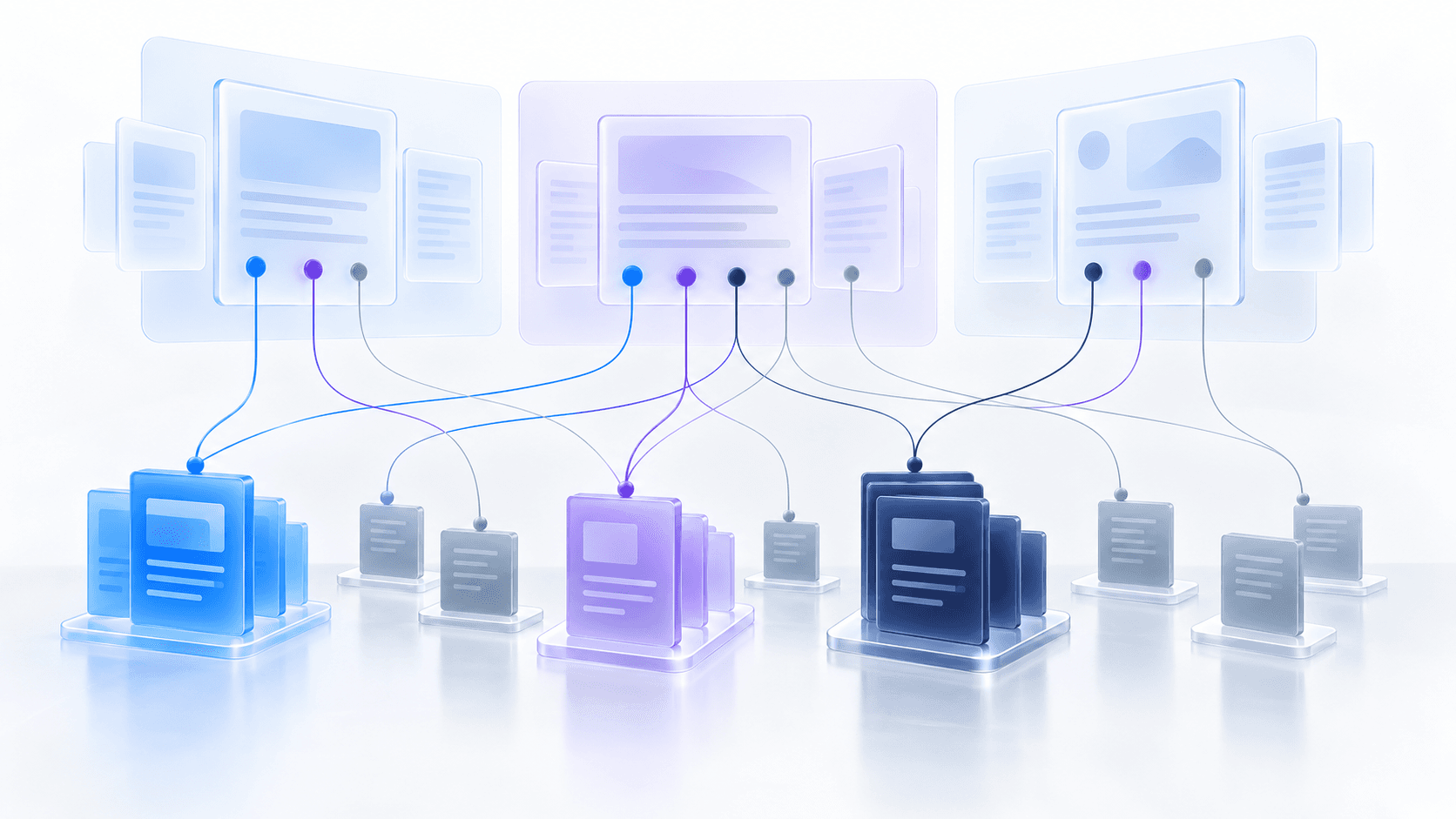
AI citation tracking is the systematic measurement of which domains and pages AI systems surface as supporting sources for a defined set of buyer questions. Useful tracking preserves the question, provider, exact source domain, source URL, and observation date so source patterns can be compared over time.
The important phrase is source visibility. Citation visibility is source visibility, not brand visibility.
A visible source is useful evidence that a page surfaced around an observed answer. It does not automatically explain why it surfaced, whether the brand was recommended, whether anyone clicked, or whether it generated revenue. Record what happened first. Interpret it second.
Citation, mention, and recommendation are different signals
| Signal | What it tells you |
|---|---|
| Brand mention | The brand appears visibly in the answer |
| Recommendation | The brand is actively presented as an option |
| Citation or source | A page or domain is surfaced as supporting evidence |
| Own-domain source | A source from your site appears |
| Third-party source | An external source appears |
Your website can appear as a source without your brand being mentioned. Your brand can be recommended without an owned source appearing. A review site can be cited while the answer recommends a competitor.
Mention ≠ recommendation ≠ citation. Do not use citation count as a proxy for recommendation count. For the conceptual distinction, see AI Mentions vs Citations.
What counts as a citation depends on the platform
A common mistake is treating every visible link from every AI product as an identical citation. Preserve the provider's original source event before normalizing it.
ChatGPT: citations and Sources
ChatGPT Search may show citations that open an underlying source. Its Sources view can include cited sources and other relevant links, so not every URL in that view should automatically be counted as a formal citation. Preserve separate statuses such as cited source and other visible relevant source.
ChatGPT citation tracking is also different from referral tracking: source appears → user clicks → referral session → conversion. None of those later events is guaranteed by the preceding one.
Google AI: supporting links
For Google AI Overviews and AI Mode, use Google's supporting-link terminology rather than forcing every link into the word citation. Search Console's Generative AI performance report is valuable first-party evidence about links to your site, but it does not replace question-level source tracking.
Gemini and other providers
Record the source or link event Gemini visibly presents. Provider interfaces can change and do not necessarily map to ChatGPT's citation behavior.
Define → Capture → Compare → Interpret → Decide
| Phase | Question | Output |
|---|---|---|
| Define | What exactly are we measuring? | Questions, providers, market, counting rules |
| Capture | Which domains and URLs appeared? | Source occurrences |
| Compare | Which sources recur or differ by provider? | Source pattern |
| Interpret | What type of gap is this? | Diagnostic hypothesis |
| Decide | Does evidence justify action? | Improve, Create, Third-party, Monitor, or Skip |
Before calculating a percentage, define the buyer-question set, providers, market, language, owned domains, competitor domains, observation period, and counting rules. A percentage cannot be interpreted without its denominator.
What to record for every answer
| Field | Why it matters |
|---|---|
| Buyer question | Defines the decision context |
| Provider and date | Preserves platform differences and comparison |
| Brand mentioned and recommended | Keeps brand signals separate |
| Source domain and exact URL | Identifies the site and asset |
| Source type and status | Captures citation, supporting link, or related source |
| Associated competitor | Distinguishes competitor-owned and third-party evidence |
A useful provider-neutral raw unit is a source occurrence: one observable appearance of a domain or URL as a provider-displayed source, citation, supporting link, or related source within a tracked answer.
Track the domain and the exact URL
Domain-level source visibility answers whether your website participates at all. URL-level history answers which assets participate, whether visibility is broad or concentrated, and whether unexpected pages own the source signal.
Track the page and the domain, not just a citation count. A domain that appears in 30 answers may represent ten relevant pages, one highly concentrated article, or an outdated page with unexpected ownership.
Separate owned, competitor, and third-party sources
| Source type | Typical examples |
|---|---|
| Own domain | Product pages, guides, documentation |
| Competitor-owned | Competitor product pages, blogs, docs |
| Publisher or editorial | Industry publications and editorial sites |
| Review, directory, marketplace | Review platforms, listings, app stores |
| Community or institution | Forums, Q&A, universities, research bodies |
A source is not automatically a competitor. A review platform recurring across buyer questions is category evidence. A direct competitor's product page recurring is a different signal. For the full taxonomy, see AI Search Competitor Analysis.
Useful citation and source metrics
| Metric | What it answers |
|---|---|
| Source presence | Did this domain or URL appear in one observation? |
| Observation-level own-source coverage | In how many eligible responses did an owned domain appear? |
| Question-level own-source coverage | Across how many questions did an owned domain appear at least once? |
| Unique surfaced URLs | How many distinct owned pages appeared? |
| Source recurrence | How often did the same source reappear? |
| Provider-specific coverage | Where does source visibility differ by platform? |
An illustrative observation-level measure is: eligible observations containing at least one owned source ÷ eligible observations × 100. If 18 of 60 eligible responses contain an owned source, that is 30% observation-level own-source coverage. It is not automatically called Citation Rate.
Citation Share can be useful only with the vendor's stated denominator, providers, question set, period, page/domain level, and counting rules. No universal Citation Share or Citation Rate formula exists. For denominator discipline, see AI Share of Voice.
Compare recurring pages and source gaps
Inspect recurring pages for their role, buyer-question fit, audience specificity, evidence, and whether freshness matters. A source appearing repeatedly is evidence of recurrence, not proof of hidden authority, trust, or a known ranking mechanism.
Citation tracking records source occurrences. Use AI search source analysis to understand what those recurring sources represent.
Source patterns can point to different hypotheses:
- Your pages recur but the brand is absent: source visibility without equivalent brand visibility.
- A competitor appears through recurring third-party sources: investigate a legitimate third-party visibility opportunity.
- Your brand is recommended but no owned domain is visible: brand tracking and source tracking are showing different layers.
- Evidence is thin or volatile: monitor it rather than manufacture an action.
Keep providers separate before aggregation. A strong source pattern in ChatGPT can hide weak source visibility in Gemini or Google AI.
What citations do not tell you
Citation does not mean endorsement, recommendation, traffic, conversion, revenue, or model-training inclusion. It also does not expose the causal ranking mechanism. A cited page does not prove that backlinks, schema, Google ranking position, formatting, or a page update caused inclusion.
OAI-SearchBot and GPTBot are distinct OpenAI bots. Access for discovery is not a visibility guarantee, and source appearance is not evidence of model training.
From citation gap to next action
A citation gap is not automatically a content gap. Check page ownership and buyer relevance first.
- Improve when an appropriate owned page already serves the need.
- Create when an important buyer need lacks a suitable page.
- Third-party visibility when the meaningful evidence is mainly external.
- Monitor when evidence is weak or inconsistent.
- Skip when commercial relevance is poor.
Use citation tracking as one evidence layer inside an AI Visibility Audit, then use How to Improve AI Visibility for execution. Rankvia combines source evidence with buyer relevance, existing pages, competitors, and search context, as described in the AI visibility methodology.
Can you track AI citations manually?
Yes, for a small question set, few providers, one market, and a one-time baseline. A spreadsheet can preserve question, provider, date, domain, exact URL, source type, source status, brand mention, and recommendation. Software becomes useful when recurring scans, provider comparisons, URL/domain history, competitor sources, and consistent classification become difficult to maintain. For platform comparison, see AI Visibility Tools.
Frequently asked questions
What is AI citation tracking?
It measures which domains and pages appear as visible sources around a defined set of AI-generated answers, preserving the buyer question, provider, exact URL, and observation date.
Is a citation different from a mention?
Yes. A citation is source visibility and a mention is brand visibility. Either can occur without the other.
Should I track domains or exact URLs?
Both. Domains show whether a site participates. URLs show which assets participate and whether visibility is broad or concentrated.
Why do citations vary between AI platforms?
Providers can differ in retrieval, source interfaces, and answer construction. Track provider-level source evidence before aggregating it.
Do more citations mean better AI visibility?
They mean stronger measured source visibility under a defined methodology. They do not automatically mean more brand mentions, recommendations, traffic, or revenue.
Sources
- OpenAI - ChatGPT Search
ChatGPT Search citations, Sources view, and limits of visible search evidence.
- OpenAI - OAI-SearchBot
OpenAI's distinct documentation for ChatGPT Search discovery and GPTBot.
- Google Search Central - Generative AI performance reports
First-party reporting for AI Overviews and AI Mode link impressions.
- Google Search Central - AI features and your website
Google's guidance for AI features in Search and supporting links.
- Ahrefs - Brand Radar citations
Ahrefs' vendor-specific Citation and Found in counting rules.
- Surfer - Sources Dashboard
Domain, URL, reference, and owned-source distinctions in a vendor product.
Related guides
AI Mentions vs Citations: What's the Difference?
Understand the difference between brand mentions, recommendations, citations, and source visibility in AI-generated answers.
How to Track AI Visibility: A Practical Measurement Framework
Build a comparable AI visibility tracking system with buyer questions, recurring scans, evidence, reporting, and next actions.
AI Visibility Audit: How to Find and Prioritize AI Search Gaps
Run a structured audit of buyer questions, competitors, sources, technical eligibility, and page ownership before deciding which AI search gaps deserve action.
How to Improve AI Visibility: A Practical Action Framework
Diagnose AI visibility gaps, choose the right response, and improve access, owned pages, evidence, or third-party presence without chasing prompts.
AI Share of Voice: What It Is, How to Calculate It, and How to Interpret It
Understand relative AI visibility, simple and weighted Share of Voice calculations, competitor sets, and what a percentage can actually tell you.
BUILD YOUR SEARCH GROWTH PLAN
Find what your website should publish next.
Enter your website and Rankvia will identify relevant search opportunities and build the strategy for what to create or improve.
Personalized to your website · No credit card required
Explore AI Search Optimization