Guides Shopify AI search optimization: What actually matters in 2026
SHOPIFY AI SEARCH
Shopify AI search optimization: What actually matters in 2026
Learn how Shopify AI search works across Shopify Catalog, ChatGPT, Google AI, product data, and the open web - plus what to optimize and what to ignore.
By Rankvia ·
Shopify merchants are being told they need llms.txt, GEO keywords, special AI schema, hundreds of FAQs, custom ChatGPT feeds, and a new generation of AI-SEO apps.
Some of that advice is outdated. Some applies to one platform but not another. Quite a lot of it is familiar SEO or product-data work with a new label.
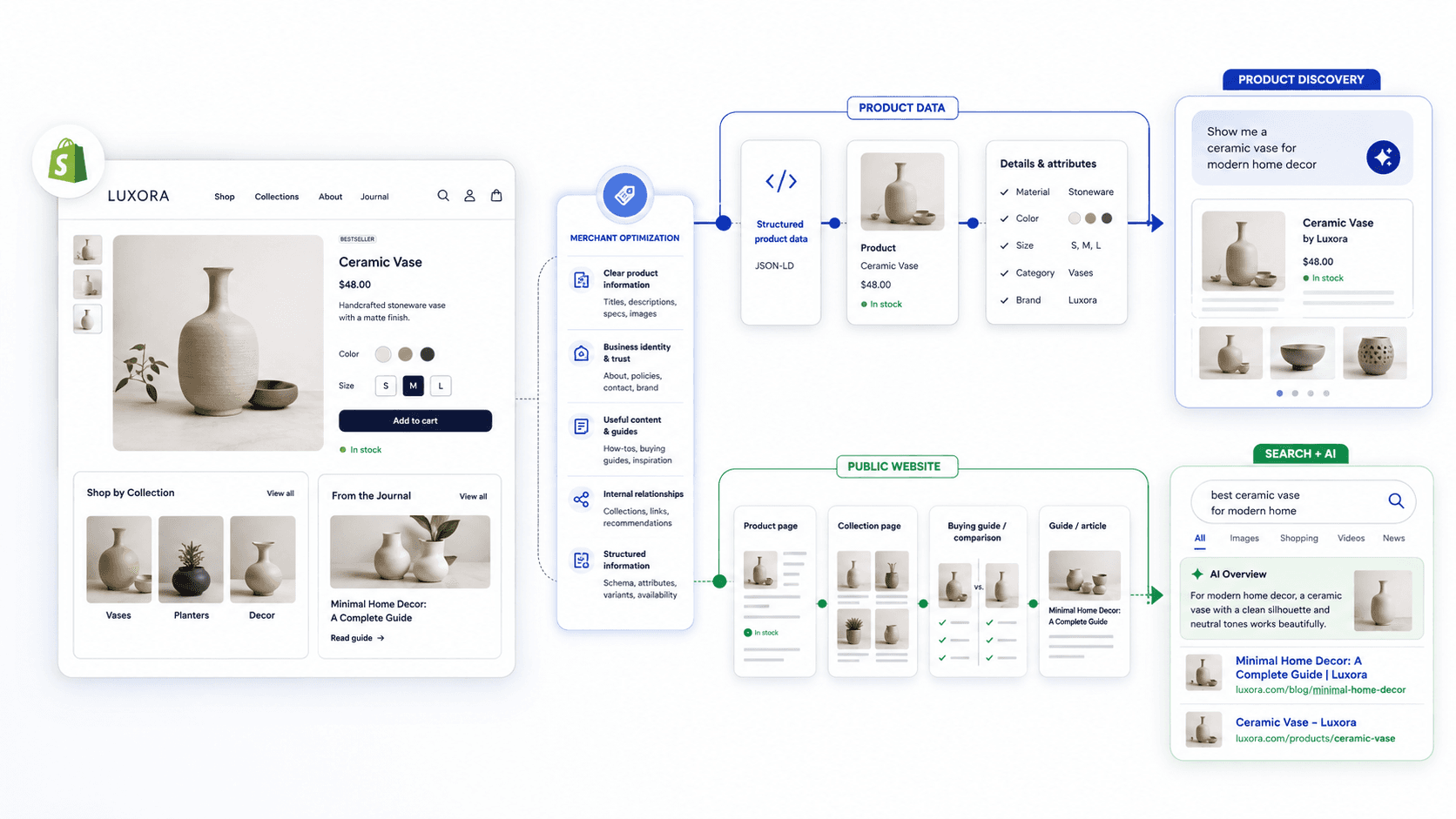
The subject gets easier to reason about once you separate two ways an AI system can discover a Shopify store.
Structured product discovery happens when product information flows through systems such as Shopify Catalog into supported AI-shopping experiences.
Open-web discovery happens when products, collections, comparisons, buying guides, and other public pages are crawled, indexed, retrieved, and referenced by search or AI-answer systems.
A Shopify store can participate in both at the same time. Shopify Catalog may make a product available to an AI-shopping channel while a comparison guide on the same store is discovered through the open web. Fixing one layer does not automatically fix the other. Shopify itself documents Catalog distribution and ordinary web crawling as separate discovery paths.
Shopify AI-search optimization is the work of improving both the structured product information Shopify distributes to AI-shopping systems and the public information search and AI systems can retrieve from your website.
You may see the same work described as AEO, GEO, AI SEO, or ChatGPT SEO. The labels are less important than the underlying mechanics. Google now explicitly acknowledges AEO and GEO as industry terms while making the point that, for Google's generative Search products, the useful optimization work still sits on top of ordinary SEO.
Shopify, meanwhile, already handles more of the infrastructure than many merchants realize.
Shopify AI discovery has two layers
The rest of this guide focuses on what you can realistically improve on both sides - and what probably isn't worth turning into a new optimization project.
1. Shopify AI search is not one discovery system
Take a fairly ordinary shopping question:
What's a good travel backpack under $200 that fits under an airline seat?
There are several ways a Shopify store could become relevant.
A product-discovery system may need structured facts such as price, dimensions, availability, variants, images, category, and product description. Shopify Catalog is designed to provide exactly that kind of structured information for eligible products.
A search or AI-answer system could also retrieve a public page: the product itself, an under-seat travel collection, a comparison of two backpacks, or a guide explaining airline personal-item dimensions.
Those are different information paths. Shopify says eligible products can be discoverable through Shopify Catalog while products may also be found through web crawling, indexing, or merchant-controlled feeds. Even disabling Catalog access for a channel does not necessarily make the product disappear from the open web.
That distinction is more useful than asking, in the abstract:
How do I rank in ChatGPT?
First work out which problem you actually have.
Structured product-discovery problems
The product may be a poor candidate because its information is incomplete or difficult to interpret. Common cases include vague descriptions, unclear variants, stale availability, missing category information, an eligibility problem, or important attributes sitting in custom fields that are not mapped into Shopify Catalog as intended.
Open-web discovery problems
The product data may be fine while the website itself lacks a useful source for the question. Perhaps no page answers an important buying decision. Maybe the collection exists but says almost nothing useful about the category. Several articles may overlap around the same need, or a product page may hide important specifications inside images and marketing copy.
In practice, stores often have both kinds of problem at once. A backpack can have an incomplete Catalog description and a weak product page. A skincare collection can have excellent structured product data while still lacking the comparison content shoppers need before they choose.
The useful thing is knowing which layer you're trying to improve.
2. What Shopify already handles for you
Before installing another AI-optimization app, it is worth understanding the infrastructure Shopify now provides itself.
Shopify's Agentic Storefronts environment can make eligible products available across supported AI-shopping channels. Its current administration experience includes channels such as ChatGPT, Microsoft Copilot, Meta, and Google AI Mode/Gemini, although availability and eligibility differ by channel and Google AI Mode/Gemini remain early access for some stores.
Shopify also automatically serves:
/agents.md /llms.txt /llms-full.txt
It identifies /agents.md as the canonical agent-discovery location. These files can provide store-level context to compatible agents, but Shopify explicitly separates them from Shopify Catalog, which remains the authoritative product-data feed for agentic channels. You do not need a third-party app merely to generate those files.
A useful division of responsibility looks like this:
What Shopify handles, what you control, and what external systems decide
| Shopify handles | You control | External AI/search system controls |
|---|---|---|
| Shopify Catalog infrastructure | Product titles and descriptions | Final recommendation |
| Product synchronization | Images | Re-ranking |
| Agentic channel infrastructure | Variants and options | Answer composition |
| Agent-discovery files | Store policies | Personalization |
| Channel settings | Catalog Mapping | Final citation or placement |
| Knowledge Base infrastructure | Store FAQs and facts | Whether and how those facts are used |
The point of this table is not to create a rigid responsibility chart. It is to stop merchants spending time trying to optimize something that belongs to another system.
Shopify can make structured information available. It can help you diagnose the quality of what you provide. It cannot decide that ChatGPT should recommend your product to a particular shopper, or that Google AI Mode should cite one of your guides.
Infrastructure can make your store understandable and eligible. It cannot make you the answer.
OpenAI makes a similar distinction for ChatGPT Shopping. Shopify product data is already integrated through Shopify Catalog, while ChatGPT independently decides which products are relevant to a user's query and context. When multiple merchants offer a product, OpenAI says merchant selection can consider factors such as availability, price, quality, and whether the merchant is the maker or primary seller. Those are documented considerations, not a complete fixed ranking formula.
3. Start with the product data AI systems actually receive
If your immediate goal is product discovery, the first thing to inspect is usually not your GEO keyword strategy.
It is the product information.
When Shopify syndicates a product through Shopify Catalog, it can send fields such as title, description, options, images, price, availability, category, and other product attributes in a form that downstream systems can parse. If important information lives in custom data, Shopify Catalog Mapping lets merchants control which source feeds particular attributes. Shopify specifically documents use cases involving metafields, metaobjects, tag prefixes, and custom title/grouping logic.
Shopify's Agentic area also exposes Listing Quality diagnostics for the parts of the listing the merchant can influence. Its documented signals include description completeness, image coverage, verified reviews, variant and option completeness, and store-policy completeness. Shopify also notes that relevance can depend on signals outside those inputs and that external channels may re-rank Catalog results using their own logic.
So Listing Quality is useful as a diagnostic. It is not a universal ChatGPT ranking score.
Shopify AI Product Data Readiness Matrix
| Check | Why it matters | Where to review |
|---|---|---|
| Product title | Clearly identifies the item | Product |
| Description | Provides useful natural-language detail | Product |
| Category | Clarifies what kind of product it is | Product / catalog data |
| Images | Represents the product across shopping contexts | Product media |
| Variants and options | Clarifies sizes, colors, formats, packs, etc. | Product variants |
| Availability | Keeps purchasing information accurate | Inventory |
| Price | Keeps commerce information current | Product |
| Verified reviews | Feed Shopify's listing-quality diagnostics | Review source |
| Store policies | Answer shipping, return, refund, and trust questions | Policies |
| Catalog Mapping | Ensures important custom data reaches Catalog as intended | Catalog settings |
Product descriptions should help with a decision
Compare these two descriptions:
Premium high-quality backpack designed for modern lifestyles.
and:
28-liter travel backpack, 45 × 30 × 18 cm, with a padded 16-inch laptop sleeve, water-resistant recycled nylon, clamshell opening, removable hip strap, and 1.1 kg empty weight.
The second description is not better because it sounds more "AI optimized." It is better because it contains information someone can actually use.
Shopify's own current guidance around AI-oriented product optimization emphasizes complete specifications, technical details, comparison information, attributes, sizing, materials, care information, and other buyer-relevant facts where they apply. That is a more useful standard than inserting extra keyword variations into otherwise vague product copy.
Variants need human-readable meaning
A variant called:
BLK / XL / 3PK
may be perfectly efficient inside an inventory system.
To an external system trying to interpret what the customer can buy, something closer to:
Black / Extra Large / Pack of 3
is less ambiguous.
Shopify's Listing Quality diagnostics explicitly look at variant and option completeness, including whether names contain acronyms or numbers that may be difficult for agents to interpret.
Policies are part of the shopping decision
Consider a shopper asking:
Which of these stores ships to Spain and lets me return the product if it doesn't fit?
The answer does not live in the product title.
Shipping, return, refund, and related policies can affect whether a recommendation is useful at all. Shopify includes policy completeness in its Listing Quality diagnostics for that reason.
Catalog Mapping matters more on customized stores
This tends to become relevant on mature Shopify implementations. Important attributes may not live neatly in default fields; the store may use metafields, metaobjects, custom grouping conventions, or naming logic that made perfect sense for the theme or internal systems.
If the information you care about is there but Shopify Catalog is sourcing the wrong field, adding more copy elsewhere is not the first fix. Catalog Mapping is specifically designed to control which sources Shopify uses when syndicating that product information.
That is a much more concrete optimization problem than inventing another set of "GEO keywords."
4. Make the business itself unambiguous
A shopping assistant also needs to understand the merchant behind the products.
Customers ask store-level questions all the time:
Do you ship to France? What's your return window? Is this product made by you or resold? Do you offer a warranty? Can I return opened products? Where are you based?
Those questions sit above any individual product.
Shopify's Knowledge Base gives merchants a first-party place to review generated store facts and, where supported, examine questions arising from AI-shopping interactions and create or override FAQs used as a source for answers.
This is where vague advice about "building your entity" becomes much more practical. You do not need to optimize an imaginary entity score. You do need the business to describe itself consistently enough that a customer - human or machine - does not have to reconcile several versions of who you are.
That includes brand names, product names, manufacturer-versus-retailer relationships, categories, policies, and store descriptions.
A site whose homepage says Auri, its product feed says Auri Nutrition, and product pages repeatedly introduce a different brand-like name is creating unnecessary ambiguity. Sometimes there is a legitimate distinction between company, brand, collection, and product. When there is, explain it consistently.
Use Knowledge Base for accuracy
This is one of the areas where Shopify's own documentation is particularly useful: it says improving Knowledge Base information can improve the accuracy of AI responses about the store, but does not increase how often the store appears in AI-platform results.
That makes the job fairly clear. Add or correct FAQs when they make the business easier to represent accurately. Do not create a hundred low-value questions because you assume FAQ count is a visibility signal.
Better representation is not the same thing as more visibility.
5. Your public website still matters
Shopify's agentic-commerce infrastructure did not make the public website obsolete.
For Google, the position is explicit. Its generative Search features remain rooted in core Search ranking and quality systems, using techniques such as retrieval-augmented generation and query fan-out to find relevant information from the Search index. Ordinary Search eligibility, crawling, indexing, useful content, internal links, page experience, and other established SEO foundations continue to matter.
Google also says there is no special schema.org markup required for AI Overviews or AI Mode. Structured data remains useful where it is supported and accurately reflects visible content, but there is no separate generative-AI schema layer merchants need to bolt on.
For the broader Shopify search system - products, collections, technical foundations, internal links, Create vs Improve, and measurement - see:
For a platform-neutral treatment of the broader AI-search workflow:
What has genuinely changed?
It is less dramatic than "rewrite your website for AI," but still meaningful.
Product data can now flow into structured AI-commerce systems. Shoppers can phrase product questions with much more context than a traditional short keyword. Answers can combine information from several sources. Merchant Center is adding attributes designed for conversational commerce. Shopify exposes product-discovery diagnostics and agentic performance data. Google now provides dedicated reporting for generative Search features.
None of that makes the old foundations disappear. There are simply more discovery surfaces consuming them.
6. More conversational queries do not mean more pages
AI systems make it trivial for shoppers to express the same need in dozens of ways:
best vitamin c serum for dry skin what vitamin c serum is good if my skin gets dry easily which vitamin c serum should I buy for dry sensitive skin recommend a gentle vitamin c serum for someone with dry skin
Those are four queries. They may represent one underlying decision.
You probably do not need four URLs.
Google explicitly warns against creating separate pages for every query variation or fan-out query in an attempt to manipulate conventional or generative Search. It also notes that its systems can understand relevance without exact wording on the page.
A better planning sequence is:
There are other valid outcomes. You may need to improve product data, strengthen a collection, consolidate overlapping pages, fix internal links, resolve a technical problem, or do nothing.
Take these three questions:
Is creatine or pre-workout better before lifting? What's the difference between creatine and pre-workout? Should beginners buy creatine or pre-workout first?
They are not identical, but a strong creatine vs pre-workout page may be able to satisfy the decision coherently. Splitting them into three thin comparison pages merely because the wording differs would create more maintenance without necessarily creating more usefulness.
The same applies at product level. If someone asks:
Does this backpack fit a 16-inch MacBook Pro?
and the product page already contains accurate compartment dimensions and compatibility information, an extra article may add nothing. The product page is already a perfectly plausible source; improve it if needed.
This is why part of AI-search optimization ends up looking a lot like page ownership.
See how Rankvia plans Create and Improve opportunities.
Rankvia's current Content Calendar can recommend a new page, an improvement to an existing owner, or avoid adding another page when the underlying need is already sufficiently covered.
7. Build pages around buying decisions AI systems need to answer
Structured product data can handle a surprising number of factual questions. It is less suited to every judgment a shopper makes.
A person might ask:
Is merino wool better than synthetic fabric for hot-weather hiking?
or:
Which type of collagen should I choose for skin versus joints?
or simply:
What's the practical difference between these two espresso machines?
Those are good examples of questions that may need real web content.
Page type and AI-search role
| Page type | Main customer need | Open-web AI/search role | Commercial role |
|---|---|---|---|
| Product | Evaluate one item | Product-specific facts | Transaction |
| Collection | Browse a category | Category context and choices | Commercial browse |
| Buying guide | Choose among options | Decision support | Commercial investigation |
| Comparison | Understand differences | Structured tradeoffs | Decision support |
| Educational guide | Understand a concept/problem | Informational source | Earlier journey |
| Existing page | Already owns the need | Strengthen rather than duplicate | Improve |
Product pages should be specific
For many product questions, the product page is the best first-party source you have.
Depending on the category, that could mean dimensions, ingredients, compatibility, materials, usage, technical characteristics, variants, sizing, or maintenance information. If important facts exist only inside an image or are replaced by vague marketing claims, improving the visible page is usually more valuable than producing another article around the missing fact.
Collections should explain the category
A useful collection gives context to the assortment. What belongs in this category? Who is it for? How do the products differ? Which attributes should a shopper pay attention to?
You do not need to turn every collection into a long SEO essay. A few genuinely useful distinctions can be more valuable than a thousand words written mainly to occupy space below the grid.
Comparisons should actually compare
A page titled:
Vitamin C vs Niacinamide
should get to the differences that matter: what each does, where they overlap, tradeoffs, who might prefer one, and when the distinction is important.
If most of the page is generic skincare background, it is not doing much comparative work.
Buying guides should make the choice easier
A guide to:
Best travel backpacks for under-seat travel
should probably discuss the attributes that determine whether a bag works for that job - external dimensions, capacity, weight, laptop fit, opening style, materials, and common airline constraints.
The goal is not to format the page for an AI crawler. It is to give the shopper enough useful information that the page deserves to be retrieved.
8. Make important information easy to retrieve and verify
There is a useful version of AEO content optimization. It just looks a lot less exotic than most of the advice written about it.
Answer the question clearly
If a heading asks:
Does this serum contain fragrance?
do not make the reader work through six paragraphs before discovering the answer.
Give them the answer, then explain whatever nuance matters.
Use headings that describe the information underneath
Headings help people scan, and they make the structure of a page easier to understand. Google likewise recommends organizing information clearly for users rather than rewriting content into a special machine-oriented format.
Prefer concrete information to marketing fog
Compare:
Made with premium materials for uncompromising quality.
with:
Made from 100% 19.5-micron merino wool at 180 gsm.
The second statement is more useful because somebody can verify it, compare it, and make a decision with it.
Show tradeoffs when the decision is comparative
A table can be useful when the customer is actually comparing options:
| Dimension | Product A | Product B |
|---|---|---|
| Weight | ||
| Capacity | ||
| Best use | ||
| Main tradeoff |
That does not mean every page needs a table. If prose explains the difference more naturally, use prose.
Cite factual claims that need evidence
Health, science, performance, environmental-impact, or industry-benchmark claims deserve credible support. Citations should be there because the claim needs evidence, not because you hope the presence of footnotes will make an AI system cite you in return.
Publish information only your business can provide when you have it
Google's current generative Search guidance explicitly favors useful, non-commodity material and first-hand or expert information over generic summaries that could easily be produced by a generative model.
For ecommerce, that might be:
your own measurements; product tests; compatibility findings; manufacturing details; material specifications; sourcing information; original comparison data.
Generic AI is very good at summarizing what is already on the web. Your advantage, when you genuinely have one, is publishing information that was not already there.
Write for retrieval by making the answer clear - not by making the prose robotic.
9. Keep the technical foundation boring and correct
AI-search technical advice gets complicated quickly because different discovery systems use different mechanisms. Most Shopify merchants do not need to respond by building a second technical SEO stack.
Keep important public pages crawlable
Systems that rely on the open web need to be able to reach the pages you want discovered.
For Google's generative Search features, the normal crawling and Search eligibility requirements still apply. A page needs to be eligible for Search before it can be shown in those generative experiences.
Keep structured data accurate
Structured data remains useful where conventional Search supports it and where it matches the information users can actually see.
Google specifically says there is no special schema required for generative Search.
Keep Merchant Center current
For Google commerce discovery, Merchant Center remains an important product-data surface. Google now supports optional conversational attributes intended to provide additional product context for AI-oriented shopping experiences, including attributes such as:
question_and_answer document_link related_product item_group_title variant_option popularity_rank
These supplement normal product data rather than replacing the existing product specification.
A product might use document_link to surface a relevant manual, variant_option to explain choices, or question_and_answer for genuine product Q&A. The attribute only helps if the information itself is accurate and useful.
Shopify already creates the agent-discovery files
Shopify automatically serves:
/agents.md /llms.txt /llms-full.txt
and describes /agents.md as the canonical agent-discovery URL. These files are separate from Shopify Catalog and do not replace it.
llms.txt is not a Google shortcut
Google's position is now unusually explicit: it does not use llms.txt or similar special AI files as a special Search optimization mechanism. Maintaining one for another service is fine, but Google says it neither helps nor hurts visibility in Google Search.
That still leaves open the possibility that other services or crawlers use their own conventions. The mistake is turning one discovery file into a universal ranking theory.
AI-generated Merchant Center data has separate rules
There is also an ecommerce-specific issue that is easy to miss when people discuss "AI content" in broad terms.
Google has dedicated requirements for AI-generated product content submitted through Merchant Center. AI-generated product images require the appropriate digital-source metadata, and AI-generated title or description data needs to follow Merchant Center's applicable AI-content requirements.
That is separate from the broader question of whether an AI-assisted article or product description can appear in organic Search.
10. Shopify AI-search myths that waste time
A surprising amount of AI-search advice is now testable against first-party documentation rather than speculation.
Myth vs Reality
| Myth | Reality |
|---|---|
| I need special GEO keywords. | Google does not document a separate generative-AI keyword system and says you do not need to rewrite content just for its generative Search experiences. |
| Every ChatGPT-style question deserves a page. | Different phrasings often represent the same underlying need. Google explicitly warns against mass-producing pages for query variations. |
| llms.txt makes Google cite my store. | Google says it ignores llms.txt as a special Search optimization mechanism. |
| I need an app to create Shopify's AI files. | Shopify already serves /agents.md, /llms.txt, and /llms-full.txt. |
| I need special AI schema. | Google says no special schema.org markup is required for AI Overviews or AI Mode. |
| Shopify Catalog guarantees ChatGPT visibility. | Catalog supplies product data; ChatGPT independently decides which products to surface. |
| More Knowledge Base FAQs mean more mentions. | Shopify positions Knowledge Base around answer accuracy, not appearance frequency. |
| SEO doesn't matter anymore. | Google explicitly says its generative Search experiences are built on its core Search systems and SEO remains relevant. |
| AI-written content is automatically penalized. | Google's policies focus on usefulness, accuracy, Search Essentials, and spam compliance rather than banning AI assistance. |
| One AI visibility score tells me whether I'm winning. | There is no universal first-party cross-platform visibility metric. Third-party scores reflect their own prompt samples and methodology. |
Many of these are no longer philosophical disagreements about how AI search "might" work. Shopify and Google now document enough of the underlying behavior to reject several popular theories directly.
Optimize documented inputs. Be skeptical of invented algorithms.
11. Measure what you can - and don't invent what you can't
AI-search measurement is more concrete than it was a year ago, but it is still incomplete.
Shopify now exposes channel-level Agentic performance data, while Google has a dedicated generative-AI Search Console report. That gives merchants substantially better first-party evidence than trying to infer everything from referral traffic or manually checking a handful of prompts.
Shopify AI-search measurement matrix
| Signal | Can you measure it? | Where | Important limitation |
|---|---|---|---|
| Agentic-channel sales | Yes | Shopify Agentic | Channel attribution |
| Orders | Yes | Shopify Agentic | Channel-level |
| Online-store sessions from AI channels | Yes | Shopify Agentic | Only visits reaching the store |
| Online-store conversion | Yes | Shopify Agentic | Referral and direct-checkout journeys differ |
| Shopify Catalog search preview | Yes | Shopify Agentic | Raw Catalog results, not exact external ranking |
| Top Catalog/agentic queries | Yes | Shopify Agentic | Not every prompt across every AI system |
| Queries where your products appeared | Yes | Shopify Agentic | Not universal prompt history |
| Listing Quality | Yes | Shopify Agentic | Shopify diagnostic, not external ranking score |
| Knowledge Base questions | Yes | Shopify Knowledge Base | Only supported interactions/data |
| Google generative-AI visibility | Yes where available | Search Console | Google only |
| ChatGPT referral sessions | Partially | Analytics / Shopify | Does not capture no-click exposure |
| Every ChatGPT question behind every visit | No reliable universal access | - | Major attribution gap |
| Cross-platform recommendation share | No standardized first-party metric | Third-party estimates | Prompt sample and methodology matter |
The Shopify Catalog search preview is useful, particularly because it lets you test queries and see which of your products are competitive in Catalog results. But Shopify warns that external channels often apply their own re-ranking logic, so the preview is directional rather than a promise about what a customer will see in ChatGPT, Copilot, or another channel.
Listing Quality has the same limitation in a different form. It tells you about merchant-controlled inputs inside Shopify's environment. It is not an external AI ranking metric.
Knowledge Base gives you real questions - within a defined scope
Where supported interactions generate data, Knowledge Base can expose actual questions and matched sources.
That is useful because it is first-party evidence of what shoppers asked in those supported contexts. It still should not be described as a universal prompt log for every mention of your brand across ChatGPT, Gemini, Perplexity, or every other AI system.
Google now has dedicated generative-AI reporting
Google's current Search Console guidance points site owners to a dedicated Generative AI performance report for visibility in its generative Search features. As with any platform-specific report, the scope is Google, not AI search as a whole.
Third-party AI visibility scores can still be useful
The question is what the score actually measures.
A tool may evaluate a fixed prompt set across selected models and geographies at a specific moment, then turn those observations into a proprietary score. That can be useful for trend monitoring if the methodology is stable.
It is not the same thing as an exhaustive first-party measure of how every user sees the brand across every AI system.
Before optimizing around one number, understand the prompt set, models, geography, frequency, and weighting behind it.
For a defined example of how Rankvia selects buyer questions, records observations and interprets its own metrics, see the AI Visibility methodology.
Explore how Rankvia uses Google Search Console as additional search-planning evidence.
Rankvia currently uses supported query, page, impression, and performance evidence from Search Console as additional context for ownership, Create/Improve, and prioritization decisions.
12. Prioritize the work instead of optimizing everything for AI
There are now enough agentic and AI-commerce features to keep a merchant busy indefinitely. That makes prioritization more useful than another checklist of things that are technically possible.
A practical order is:
Priority 1 - eligibility and correctness
Start with the basics that can make the rest of the system unreliable if they are wrong: relevant Agentic settings, product eligibility, availability, prices, policies, and obvious product-data errors.
If the commerce data is wrong, publishing another article is rarely the first fix.
Priority 2 - product completeness
Improve titles and descriptions where needed, make images and variants complete enough to interpret, review categories and attributes, and use Catalog Mapping where important custom data is not being sourced correctly.
For merchants focused on structured AI shopping, this is some of the most concrete work available today.
Priority 3 - business clarity
Review the store-level facts customers may ask about: brand naming, product naming, manufacturer or seller relationships, shipping, returns, refunds, warranties, and Knowledge Base questions where relevant.
Fix inconsistencies where they originate rather than compensating for them with more generated FAQs.
Priority 4 - commercial page ownership
Check whether your products and collections clearly own the important buying needs around the assortment.
A product-data problem sometimes turns out to be a website problem. If the right collection does not exist, or the only useful information lives on the wrong page, Catalog optimization alone will not give the open web a strong owner.
Priority 5 - decision-support content
Create comparisons, buying guides, use-case pages, and educational content where customers genuinely need help making a decision and no suitable owner already exists.
Priority 6 - improve before creating more
Review pages that already have visibility or already cover the underlying need. A new conversational phrasing does not automatically justify another URL.
Priority 7 - establish measurement
Track whichever first-party signals are actually available to you: Shopify Agentic performance, Search Console, referral analytics, conversions, and revenue.
Define what you are trying to learn before you accumulate months of data.
13. Turn AI-search optimization into a recurring workflow
AI-search optimization is not a one-time technical migration because none of the inputs stay still.
Products change. Assortments change. Policies change. Customer questions change. Search behavior changes. The channels themselves are still evolving quickly.
A practical recurring process is closer to:
You can operate that workflow manually.
Shopify handles much of the commerce infrastructure. Search Console gives you Google-specific evidence. Keyword and research tools can expose demand. AI can help with research and drafts.
The operational problem appears when those inputs stop agreeing with one another. A product changes but the guide doesn't. Search Console shows an existing owner while the content calendar proposes a new URL. The store has excellent Catalog data but weak public collection pages. Or an article is technically good but has no meaningful relationship to what the business sells.
AI search doesn't make indiscriminate content production more useful. It makes clarity and judgment more valuable.
14. How Rankvia fits into Shopify AI-search optimization
Shopify already handles much of the agentic-commerce infrastructure. Google, ChatGPT, and the other external systems make their own retrieval, ranking, recommendation, and answer-composition decisions.
What remains on the merchant side is more ordinary, but also more persistent: understand the business, understand the existing site, identify useful search and customer questions, decide which pages should own them, improve pages that already exist, create what is genuinely missing, connect the work to the rest of the store, and keep publishing decisions aligned with what the evidence says.
That is the layer Rankvia is designed to help operate.
Rankvia begins from the existing website rather than an isolated writing prompt. Website analysis and the editable Business Profile provide planning context around the business, products or offers, audience, positioning, competitors, and the current site.
The Content Calendar then brings that context together with search opportunities and existing website coverage. Where Search Console is connected, its first-party search evidence can be added to the planning process. A useful opportunity may become Create, Improve, or no new page when another URL would add unnecessary overlap.
For selected work, Page Plans define what the page is supposed to accomplish before generation: the objective, page role, answer strategy, relevant business context, and internal connections. Generation follows that plan instead of starting from an empty prompt, and the output can then move through review and Shopify publishing. Current Shopify publishing supports editorial Pages and Articles; changes to products, collections and catalog data remain merchant-managed.
The current workflow is:
Rankvia does not control Shopify Catalog eligibility, ChatGPT product selection, external channel re-ranking, Google AI citations, Merchant Center approval, or exact placement inside an AI answer. It is also not a replacement for technical feed debugging, theme development, or complex schema troubleshooting.
Its role is narrower: operate the website/search/content layer that remains under your control while Shopify and the external discovery systems handle their parts.
See Rankvia for Shopify.
15. Shopify AI-search optimization checklist
Use this as a sanity check rather than another score.
Structured product discovery Product titles clearly identify the item. Descriptions contain concrete buyer-relevant detail. Images represent the product adequately. Important variants and options are complete and understandable. Price and availability are current. Relevant shipping, return, and refund policies are complete. Custom product data is mapped into Shopify Catalog where necessary. Agentic channel settings and eligibility have been reviewed. Business information Brand naming is consistent. Product naming is consistent. Merchant/manufacturer relationships are clear where relevant. Store policies are accurate. Shopify Knowledge Base facts are reviewed where useful. Real unanswered customer questions are addressed when they matter. Public website Important pages are crawlable and indexable as intended. Products and collections have clear roles. Important buying decisions have useful page owners. Existing pages are improved before near-duplicate pages are added. Internal links connect genuinely related information. Structured data matches visible content. Merchant Center information is current where relevant. Content Comparisons contain meaningful differences. Buying guides help shoppers make a decision. Educational pages answer actual questions. Important answers are not buried. Product claims are specific and supportable. First-hand or original information is included when available. Pages are not being created solely for conversational-query variations. Technical and hype checks llms.txt is not being treated as a Google ranking tactic. No unsupported "AI schema" has been added. You are not buying artificial mentions or citations. You are not mass-generating GEO pages. You understand what any third-party AI visibility metric actually measures. AI-generated Merchant Center product data follows the applicable Google requirements. Measurement Shopify Agentic performance is reviewed where relevant. Search Console is configured. Google's generative-AI reporting is reviewed where available. AI referral traffic is tracked where practical. Conversions and revenue matter more than visibility in isolation.
Shopify AI-search optimization FAQ
What is Shopify AI-search optimization?
Shopify AI-search optimization means improving both the structured product information Shopify distributes to AI-shopping systems and the public pages search and AI systems can crawl and retrieve.
It overlaps heavily with SEO, while adding Shopify-specific product-data, agentic-commerce, and measurement work.
How do Shopify products appear in ChatGPT?
For Shopify merchants, product data is integrated into ChatGPT through Shopify Catalog. OpenAI says individual Shopify merchants do not need an additional feed for that standard integration.
ChatGPT still independently determines which products are relevant to a user's intent, so Catalog availability does not guarantee placement.
What does ChatGPT consider when selecting products and merchants?
OpenAI says product results depend on the user's query and context, along with structured metadata and other first- and third-party information.
When multiple merchants offer a product, OpenAI says merchant ranking can consider factors such as availability, price, quality, and whether the merchant is the maker or primary seller. OpenAI also says the system is evolving, so these should be treated as documented considerations rather than a complete fixed ranking formula.
Do Shopify merchants need to submit a separate product feed to ChatGPT?
Not for the standard Shopify Catalog integration.
OpenAI currently says Shopify product data is already integrated into ChatGPT and no additional work is required from individual Shopify merchants for that connection. OpenAI also supports a separate direct-feed path for merchants who need one, but that is a different integration.
Does Shopify automatically support AI shopping?
Shopify's current managed Agentic configuration can activate available channels and provide eligible products through Shopify Catalog by default, but eligibility and specific capabilities vary by channel.
Google AI Mode and Gemini are still described as early access for Shopify's Agentic Storefronts at the time of writing.
Does Shopify need llms.txt?
You do not need a third-party app merely to create one.
Shopify automatically serves /agents.md, /llms.txt, and /llms-full.txt, with /agents.md identified as the canonical agent-discovery location. These files are separate from Shopify Catalog.
Does llms.txt improve Google AI rankings?
Google says no.
Its current documentation says Google Search does not use llms.txt as a special optimization mechanism and that maintaining such a file neither helps nor hurts Google Search visibility. Other services may use discovery conventions differently.
Does Shopify need special AI or GEO schema?
Not for Google's AI Overviews or AI Mode.
Google says there is no special schema.org markup required specifically for those generative Search features. Ordinary structured data can still be useful for supported Search features when it accurately reflects visible content.
Does SEO still matter for Shopify AI search?
Yes.
Google says its generative Search experiences build on its core Search ranking and quality systems. Crawlability, indexability, useful content, internal links, page experience, and ordinary SEO fundamentals remain relevant.
Should I create new pages for ChatGPT questions?
Not automatically.
Several conversational phrasings may represent the same underlying customer need. Google specifically warns against producing separate pages for large numbers of query variations or fan-out queries merely to influence Search or generative results. First check whether an existing page should own the need.
Can AI-generated Shopify content rank?
AI assistance is not automatically against Google's policies.
Google focuses on whether content meets Search Essentials and spam policies and whether it is useful to people. Large-scale generation of low-value content primarily intended to manipulate rankings can violate its scaled-content-abuse policy. Ecommerce merchants should also follow Google's separate Merchant Center requirements where AI-generated product data or images are submitted.
Does Shopify Catalog guarantee my product will appear in ChatGPT?
No.
Shopify Catalog can supply structured product information, but ChatGPT independently selects product results based on user intent and the information available to it. Not every eligible product will necessarily be surfaced.
How can I measure Shopify AI-search traffic?
Shopify Agentic provides channel-level performance data such as sales, orders, online-store sessions, and online-store conversion. It also exposes Catalog-search and Listing Quality diagnostics.
Google provides dedicated generative-AI performance reporting in Search Console, while standard analytics can capture some referral traffic. There is still no complete cross-platform first-party record of every AI mention, recommendation, or prompt involving your store.
Sources
- Shopify: Catalog and product discovery for agentic storefronts
- Shopify: Managing agentic storefronts
- Shopify: Mapping product data sources for Shopify Catalog
- Google: Optimizing your website for generative AI features on Google Search
- OpenAI: Shopping with ChatGPT Search
Stop optimizing for an imaginary AI algorithm
You cannot force ChatGPT to recommend your Shopify product, and you cannot force Google AI Mode to cite one of your guides.
What you can control is much less mysterious: the accuracy of your product data, the clarity of your business information, whether the right public pages exist, whether those pages contain useful and verifiable information, and whether the store keeps improving instead of accumulating disconnected content.
That is enough work to matter.
See what your Shopify store should create - and what it should improve
APPLY THIS TO YOUR WEBSITE
Build your free Search Growth Plan
Rankvia analyzes your website, business, existing pages, and search opportunities to build a personalized Search Growth Plan and Content Calendar - including where a new page is justified and where an existing page may be the better owner.
Personalized to your website. No credit card required.
BUILD YOUR SEARCH GROWTH PLAN
Find what your website should publish next.
Enter your website and Rankvia will identify relevant search opportunities and build the strategy for what to create or improve.
Personalized to your website · No credit card required
Explore AI Search Optimization