Guides Shopify SEO: What to optimize, create, and improve
SHOPIFY SEO
Shopify SEO: What to optimize, create, and improve
Learn Shopify SEO by deciding which searches belong to products, collections, new content, or existing pages - then prioritize, optimize, publish, and measure what works.
By Rankvia ·
You can find thousands of keywords for almost any Shopify store. The shortage of ideas is rarely the problem.
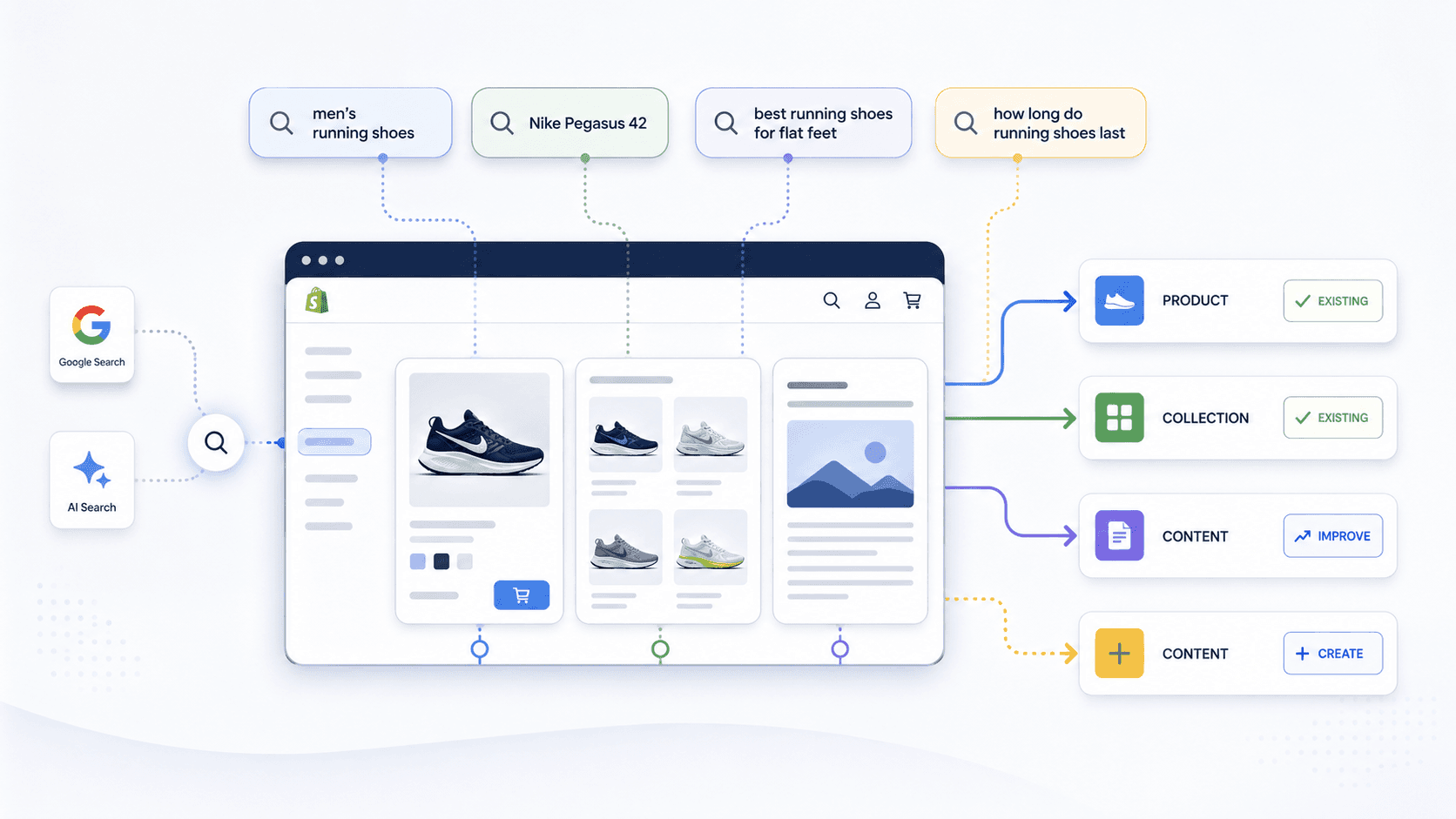
The harder part is deciding what those searches should actually become. Should a query belong to a product, a collection, a buying guide, or a page the store already has? If an existing page is already earning visibility, is another URL useful - or would improving the current owner be the better move? And once you have ten plausible opportunities, which one deserves attention first?
A keyword is not a content assignment.
Your store already has products, collections, navigation, content, internal links, search history, and a commercial model. Good Shopify SEO works with that structure rather than treating every new query as permission to add another page.
Shopify SEO is the process of making a Shopify store easier to discover for relevant searches by improving its products, collections, supporting content, internal structure, and technical foundations. The strategic work is deciding which page should satisfy each search need, whether that page already exists, and where the next unit of effort is most useful.
Matching searches to product, collection, and informational pages is not a new SEO idea. What becomes difficult is applying it consistently once a real store has hundreds of URLs, historical content, overlapping collections, changing products, and Search Console data pointing in several directions at once.
This guide covers that system, along with the Shopify fundamentals that support it: keyword research, products, collections, editorial content, internal links, technical SEO, Search Console, measurement, content refresh, and the growing role of AI-driven discovery.
The organizing principle is simple:
Every meaningful search need should have a clear intended owner.
From there, decide whether to Create, Improve, or leave it alone.
The Shopify SEO decision loop
1. Shopify SEO isn't a keyword-list problem
Keyword research tells you what people search for. It does not tell you what your website should become.
Take a running store that finds these searches:
men's running shoes best running shoes for flat feet how long do running shoes last Nike Pegasus 42 running shoes vs trail shoes
Calling all five “keywords” hides the useful part. Someone searching for a particular shoe may want a product. Someone searching for men's running shoes probably wants to browse a category. “How long do running shoes last?” is an educational question, while “running shoes vs trail shoes” asks for a comparison.
The SEO job is not to squeeze all five phrases into articles. It is to understand the search behind each phrase and decide what experience should answer it.
Shopify's current SEO guidance similarly distinguishes search intent and recommends looking at the results already being shown for a query instead of relying on the phrase alone.
Find demand from more than one source
You also do not need one perfect keyword tool.
Search Console can show where the store already has visibility. Google results and query suggestions help reveal how people describe a need and what page types currently satisfy it. Keyword platforms can add estimates of volume, difficulty, related searches, and competitor patterns. Competitor stores can expose useful collection structures, buying guides, comparisons, or questions you had not considered.
Then there is customer language, which is often more commercially useful than a generic keyword export. Onsite searches, reviews, support tickets, and sales conversations tell you what people struggle to compare, what they misunderstand, and which constraints matter before they buy.
Shopify's own current keyword-research guidance recommends combining Search Console, SERP inspection, intent analysis, and third-party tools where useful.
Finding the query gets it into the opportunity pool. It does not automatically earn a new URL.
2. Decide which page should own the search
There is no dependable rule that says:
commercial keyword = product page informational keyword = blog post
The SERP matters, but so do your assortment, site structure, existing pages, and what the shopper can actually do on the page.
A useful starting point is the following.
Shopify SEO Page Ownership Matrix
| Search need | Example | Likely starting owner | What to check first | Typical action |
|---|---|---|---|---|
| Specific product | Brand X Vitamin C Serum 30ml | Product | Does the exact product page already satisfy the search? | Improve existing owner |
| Broad category | glass water bottles | Collection | Does the assortment justify a useful collection? | Create / Improve |
| Use-case shopping | vitamin c serum for sensitive skin | Collection, landing page, or guide | What does the SERP favor, and what can the store genuinely offer? | Create / Improve |
| Buying decision | best running shoes for marathon training | Buying guide or collection | Does the shopper want recommendations, products, or both? | Create / Improve |
| Comparison | vitamin c vs niacinamide | Comparison guide | Is this a distinct decision, and does an owner already exist? | Create / Improve |
| Educational question | how to take colostrum | Guide | Does a relevant educational owner already exist? | Create / Improve |
| Existing covered need | Related query already served by a relevant page | Existing page | Can the current owner satisfy the expanded need coherently? | Improve |
| Weak business fit | Relevant search with little relationship to the store | None | Is this opportunity worth owning at all? | No action |
This is a starting model, not a rulebook.
“Vitamin C serum for sensitive skin” is a good example of why. A retailer with a meaningful range of sensitive-skin products may be able to build a useful collection around that need. A brand selling one hero serum may be better served by a strong product page supported by educational content. A retailer whose products are poorly suited to sensitive skin may not deserve the search at all.
Shopify's current ecommerce SEO guidance similarly connects transactional searches with product or collection experiences, commercial investigation with comparison and buying content, and informational needs with educational formats.
The question to keep coming back to is:
What page can genuinely satisfy this search better than the alternatives?
That is much more useful than asking where to insert the keyword.
3. Before creating another URL, check what you already have
This is where SEO gets more complicated on established stores.
With twenty URLs, overlap is usually obvious. With several years of products, collections, guides, campaign pages, and old experiments, a new topic can look perfectly reasonable in isolation while duplicating something the site already serves.
A content team might find a promising query, publish URL #301, and discover months later that URL #182 was already appearing for almost the same need.
Create or Improve?
Other valid outcomes include:
CONSOLIDATE / REDIRECT / TECHNICAL FIX / NO ACTION
Create when a distinct need is genuinely missing
A skincare retailer might carry a meaningful selection for rosacea-prone skin but have no useful destination for:
best moisturizers for rosacea-prone skin
Depending on the SERP, assortment, and how shoppers compare those products, a collection, buying guide, or another landing experience could be justified.
Improve when the right owner already exists
Suppose the store already has:
/blogs/guides/how-to-take-colostrum
and the page is earning impressions across several related dosage and usage questions.
Creating:
/blogs/guides/how-much-colostrum-should-you-take
may be unnecessary if the existing guide is already the natural owner. The better investment might be filling missing information, updating stale material, strengthening internal links, clarifying the title or snippet, or adding product context that genuinely helps the reader.
Create and Improve are planning decisions, not the whole SEO discipline. Sometimes the right move is consolidation, a redirect, an indexing fix, a change in site architecture, better product data, or simply doing nothing.
Google's current guidance for generative Search explicitly cautions against creating many pages simply to target variations of essentially the same need, and Google's systems are designed to understand related wording rather than requiring exact-match pages.
See how Rankvia plans Create and Improve opportunities.
Rankvia's current Content Calendar evaluates existing website coverage and can recommend a new page, an improvement to an existing owner, or avoid adding another page when the intent is already sufficiently covered.
4. Build the commercial foundation before expanding the blog
A Shopify store already has a natural commercial structure:
Supporting content should strengthen that structure rather than becoming a second website living under /blogs/.
If men's linen shirts is fundamentally a collection search and the collection is weak, another broad article about linen usually does not solve the underlying SEO problem. The work may belong on the collection itself: improve the assortment, clarify what the category contains, strengthen internal links, make the page easier to discover, or give shoppers better decision information.
A practical sequence is to give core products and collections clear roles, improve the pages that already have the right role, create genuinely missing commercial destinations, and then build supporting content around the questions shoppers ask before buying.
That order is not universal. A genuinely unfamiliar product may need education before buyers even know what category to search for.
The narrower principle is worth keeping:
Don't use content production to avoid fixing the pages closest to the sale.
5. Make collection pages own category demand
Shopify calls category pages collections. They group related products so shoppers can browse and compare options, which makes them natural candidates for broader category searches. Shopify's own documentation treats collections as a central part of ecommerce site organization and search discovery.
An apparel store might reasonably need:
Men's Shirts Linen Shirts Men's Linen Shirts Short Sleeve Linen Shirts
But the fact that those phrases exist does not mean all four need separate collections.
A useful collection needs a clear purpose and enough relevant assortment to make the page worthwhile. A shopper landing there should understand what belongs in the category, how the options differ, and how to narrow the choice.
Give the collection useful context
Do not bury a generic 1,000-word SEO essay below the product grid just because the template has space for text.
If people choosing between the products need help understanding fit, material, compatibility, use case, or other meaningful differences, explain those things. Category copy should make the collection easier to shop, not merely longer.
Match the assortment to the search
If the search implies waterproof trail shoes and the collection mostly contains ordinary road shoes, adding “waterproof trail shoes” to the H1 does not fix the mismatch.
The search promise and the assortment have to agree.
Make important collections discoverable
Important commercial pages should be reachable through normal crawlable navigation and relevant contextual links. Shopify's current SEO documentation recommends a logical hierarchy connecting the homepage, collections, and products, alongside meaningful links between related pages.
A thin collection with one loosely relevant SKU gives the store another URL. It does not necessarily give the shopper a useful category destination.
The real job is clearer ownership of genuine category demand.
6. Make product pages answer product-specific demand
Product pages have a narrower job: help someone evaluate the product in front of them.
The information needed varies by category, but it often includes what the product is, who it is for, ingredients or materials, dimensions and sizing, intended uses, compatibility, differentiators, shipping and returns, useful imagery, and authentic reviews.
The best product copy usually does not feel like “SEO copy.” It feels like the information someone needed before deciding.
For:
Brand X Vitamin C Serum 30ml
the product page is the obvious starting owner.
For:
best vitamin c serum for dry sensitive skin
the answer is less obvious. A shopper may want to compare formulations, understand tradeoffs, or evaluate several products, in which case a collection or buying guide may provide the better experience.
Template convenience should not determine page ownership. Optimize the page that fits the job.
7. Use content to create buying context - not just traffic
A Shopify blog can be valuable, but it can also become a traffic hobby.
A supplement store selling a narrow colostrum range, for example, could publish hundreds of broad wellness and productivity articles and build a sizable informational audience without getting much better at answering the questions that lead someone toward its actual products.
A more commercially coherent content territory might include questions such as:
What is colostrum? How is bovine colostrum made? How do you take colostrum powder? Colostrum vs whey protein How do you choose a colostrum supplement? What does grass-fed mean in colostrum?
This does not mean every article should become transactional. Someone asking an educational question deserves an educational answer.
The portfolio as a whole, however, should normally make sense for the customers and decisions the business serves. If an article attracts the right person, there should often be a legitimate next step somewhere on the store - another guide, a comparison, a collection, or a product when the reader is ready for it.
Traffic can be valuable even when it does not convert immediately. The mistake is treating all traffic as though it has the same purpose.
8. Connect the store with useful internal links
A guide about how to choose a dining table size could naturally connect to a dining-table collection, a guide comparing table shapes, a six-seat collection, or particular products where they genuinely help.
The relationship can also run in the other direction. A collection might point shoppers toward sizing guidance, material comparisons, or care instructions. Product pages can link to related collections or educational support where that improves the decision.
One useful model is:
Other relationships can be just as useful:
Collection ↔ Supporting guide Guide ↔ Related guide Product → Related collection
Internal links help people find the next useful page while also making relationships across the site easier for search systems to understand.
There is no useful universal quota. Ten internal links are not inherently better than four. Link when the destination improves the journey.
For deeper implementation, see Internal Linking.
9. Get the Shopify SEO fundamentals right
Page ownership is not much use if search engines cannot reliably access or understand the page.
The good news is that Shopify handles a meaningful part of the technical foundation by default.
What Shopify handles vs what you still own
| Area | Shopify foundation | Your job |
|---|---|---|
| Sitemap | sitemap.xml generated automatically | Monitor discovery and indexing |
| robots.txt | Generated automatically | Be careful with advanced customization |
| Canonicals | Canonical tags generated automatically | Investigate unusual theme, app, or indexing behavior |
| SSL | Activated by default | Maintain a correctly configured storefront |
| SEO fields | Editable across key content types | Write them for the actual page intent |
| Alt text | Editable | Describe relevant image content accurately |
Shopify currently documents automatic canonical tags, sitemap and robots files, SSL, and editable title, meta-description, URL, and image-alt controls as built-in SEO features.
You still need to pay attention to site architecture, titles and headings, overlapping intent, redirects, filters and variants, performance, visible product information, structured data, and authority.
Be especially cautious with blanket technical recommendations. A checklist telling every Shopify store to noindex the same set of URLs or modify canonicals in the same way is usually ignoring the actual problem. Diagnose the URL before prescribing the directive.
The same principle applies to Google's AI Overviews and AI Mode. Google says ordinary Search eligibility and the usual SEO foundations remain relevant to its generative Search features; there is not a separate technical SEO stack required just for AI results.
Technical SEO matters. It just should not become a convenient way to postpone fixing the pages customers actually need.
10. Use Search Console to find where you already have a head start
Search Console becomes much more useful when you treat it as evidence rather than a scoreboard.
Suppose a collection is receiving impressions for:
oak dining table for 6
but the page itself talks about wood furniture in broad terms. That is worth investigating, but the data does not tell you the answer by itself. Maybe the collection already has the right assortment and needs better content. Maybe another collection is the more logical owner. Maybe the site architecture is confusing Google. The impression is a clue.
Search data is evidence. It is not the strategy.
From Search Console data to Create or Improve
A relevant page already gets impressions
If /collections/mens-linen-shirts is already appearing for several closely related searches, an Improve action deserves consideration before another page is created.
The wrong page appears
If a general article is showing for:
vitamin c serum sensitive skin
while the collection or product experience you would expect to serve that search is invisible, another article is not automatically the answer. First investigate why ownership looks wrong.
No suitable owner exists
If meaningful, business-relevant demand exists and the site genuinely lacks a good destination, creating something new becomes reasonable.
Search Console cannot see margins, inventory priorities, target customers, positioning, or whether a topic matters to the business. Rankvia's GSC integration therefore uses queries, pages, impressions, and other supported search-performance signals as additional evidence alongside broader business and website context.
Explore the Rankvia Google Search Console integration.
Measure visibility and business outcomes separately
For ecommerce, rankings alone are a weak endpoint.
Depending on the page and your measurement setup, useful signals can include impressions and clicks, organic landing-page traffic, conversion rate, organic revenue, product or collection performance, and the performance of newly created pages compared with pages you improved.
A page can gain rankings and still be a poor business investment. A lower-traffic page can attract far more qualified shoppers.
11. Improve pages that already have a head start before publishing more
The larger the site becomes, the more often the best opportunity is already somewhere in the inventory.
New articles are easy to count. Updating an existing collection or guide is less visible as “output,” even when the page already has indexation, internal links, external references, Search Console impressions, and relevance around the topic.
None of those signals guarantees an update will perform better. They are simply reasons to investigate before starting over.
Take an existing comparison page:
/blogs/guides/vitamin-c-vs-niacinamide
It already appears for:
can I use vitamin c and niacinamide together
You could publish a second page around that phrasing, but the more useful question is whether the query represents a genuinely distinct need. If the reader is still making the same comparison, the existing page may simply need to become a more complete owner.
This is particularly important on mature sites because creating another URL can look harmless when viewed one topic at a time. The overlap only becomes obvious when you look at the whole store.
For the deeper workflow, see Content Refresh.
12. Shopify SEO in 2026 also includes AI-driven discovery
AI-driven discovery now matters enough to belong in a current Shopify SEO strategy, but it helps to separate two things that are often mixed together: structured product discovery and open-web discovery.
Structured product discovery
For eligible stores and products, Shopify Catalog provides structured product information to supported AI shopping channels. Shopify documents data such as titles, descriptions, options, images, prices, availability, categories, and other product attributes, and notes that keeping this information complete and current helps the catalog understand the product. Inclusion in Shopify Catalog does not guarantee that a product will appear in a particular AI answer or position; the external channel still controls the final experience.
Shopify's current Agentic Storefronts environment includes channels such as ChatGPT, Microsoft Copilot, Meta, and Google AI Mode/Gemini, with Google AI Mode and Gemini still described as early access for eligible stores.
For ChatGPT specifically, Shopify says eligible products can be discovered through Shopify Catalog without a merchant creating another dedicated feed for that integration. Customers are currently redirected to the merchant's own store checkout from ChatGPT rather than using a Shopify-configured ChatGPT direct-checkout setting.
That makes ordinary product-data quality increasingly important: titles, descriptions, images, variants, availability, pricing, categories, and attributes are not just storefront merchandising inputs anymore.
Open-web discovery still matters
A Shopify store is also a public website.
Products, collections, buying guides, comparisons, editorial pages, and brand information can still be discovered through crawling and conventional search. For Google, the company's guidance remains straightforward: the ordinary Search foundations still apply to AI Overviews and AI Mode, and Google does not require a special AI version of a page or a separate AI schema.
What about llms.txt?
Shopify now automatically serves:
/agents.md /llms.txt /llms-full.txt
Shopify describes /agents.md as the canonical agent-discovery URL and says these discovery files are separate from Shopify Catalog. Merchants do not need a third-party app simply to generate them.
That does not make llms.txt a Google ranking shortcut. Google's guidance says the normal Search foundations remain the relevant path for its generative experiences.
AI and organic search are serving different jobs
Shopify's Q2 2026 commerce data gives an early indication of how the channels differ. It reported AI-referred storefront sessions up 197% year over year, while organic-search sessions grew 12% from a much larger base. Shopify also observed stronger conversion from AI referrals in several research-intensive categories, while explicitly framing the results as early directional evidence rather than a universal merchant benchmark.
The useful model is additive rather than replacement: organic search remains a major acquisition surface, while AI-driven discovery is becoming another way shoppers research and arrive at products.
Measurement is changing alongside that behavior. Google launched dedicated Search Generative AI performance reports in Search Console in June 2026, covering visibility in features such as AI Overviews and AI Mode, initially for a subset of sites during rollout.
For the deeper Shopify-specific implementation, see Shopify AI Search Optimization.
13. Turn Shopify SEO from a checklist into an operating system
None of the individual pieces in this guide is especially exotic.
A keyword tool can reveal demand. Search Console can show where the site already has visibility. AI can help with research or drafting. Shopify provides the storefront and publishing surface. The difficulty is making the pieces produce one coherent decision for the store, then keeping that process moving month after month.
A manual workflow often ends up looking something like this:
That is manageable when there are three opportunities.
It becomes more cumbersome when the site has hundreds of existing URLs, dozens of collections, historical search data, changing products, and thirty plausible priorities this month. At that scale, the bottleneck is less about access to SEO tools and more about keeping business context, site context, search evidence, ownership, planning, and execution connected.
A more coherent operating loop is:
The advantage comes from making better decisions consistently, not merely producing more pages.
14. A practical 90-day Shopify SEO plan
You do not need to fix everything at once. A useful first 90 days is less about filling a calendar than putting the ownership and evidence loop in place.
Days 1-30: establish ownership
Start with the parts of the store that already matter most: core products, commercial collections, current Google visibility, obvious ownership conflicts, major technical blockers, and existing pages that are already close to useful visibility.
Connect Search Console and establish a baseline. At this stage, you want to know what the store currently owns, where the wrong pages appear, and which important commercial areas lack a credible destination.
Days 31-60: fill high-value gaps
Once the existing structure is clearer, start working on opportunities with a plausible business role.
That might mean improving collections, strengthening existing guides, creating genuinely missing commercial pages, publishing a buying guide or comparison, answering an important use-case question, or improving internal connections around a priority category.
Prioritize using:
relevance + business value + existing evidence + feasibility
Search volume is useful context, but it should not decide the queue by itself.
Days 61-90: build the recurring loop
Review what the evidence is telling you. Re-evaluate existing owners, identify demand the site still does not serve, prioritize Create and Improve actions, plan the selected pages, publish them, strengthen the relevant links, and measure the result.
Do not spend the quarter publishing ninety generic posts because the calendar has ninety empty slots.
Output is not the same as progress.
Quick Shopify SEO checklist
Before calling the foundation healthy, check that:
important products and collections have clear search roles; valuable search needs have intended owners; existing pages are checked before new URLs are created; product pages contain useful decision information; collections genuinely support category intent; editorial content relates to real customer and commercial needs; important pages are connected through crawlable internal links; valuable URLs are technically indexable; Search Console is connected and reviewed; performance is measured beyond rankings; product information is accurate across relevant discovery surfaces; the store has a recurring prioritization process.
15. Turn Shopify SEO decisions into a repeatable workflow
Everything above can be done manually. Many stores should understand the process manually before deciding where software is useful.
The operational burden appears when the same decisions have to be repeated across a large site: inspect what already exists, understand the business context, find relevant demand, choose the owner, decide Create or Improve, plan the page, connect it to the rest of the store, get it through review and publishing, then return to the evidence.
That is the layer Rankvia is designed to help operate.
Rankvia begins by analyzing the existing website and building an editable Business Profile that gives the planning system context about the business, audience, products or offers, positioning, and existing site. Its Content Calendar then combines that context with search opportunities and current website coverage to prioritize what deserves attention, including whether an opportunity should become a new page, an improvement to an existing owner, or no new page where the need is already sufficiently covered.
For selected opportunities, Page Plans define the role and direction of the page before generation rather than beginning from an isolated prompt. Rankvia can then generate the page in that context and include relevant internal connections based on the known website and page strategy.
Search Console can be added as first-party evidence when useful, giving Rankvia existing query, page, impression, and supported performance data to consider alongside the broader website analysis.
For Shopify stores, the current publishing integration supports sending Rankvia content to Shopify in draft or live states. Merchants can keep the review-first workflow or explicitly configure Shopify as the automatic destination for eligible scheduled publishing. Current Shopify publishing supports editorial Pages and Articles; changes to products, collections and catalog data remain merchant-managed.
The workflow is:
Rankvia does not replace every part of Shopify SEO. Technical diagnostics, theme work, performance engineering, advanced structured-data fixes, authority building, and link acquisition may still require other tools or expertise.
Its role is more specific: keeping the operating layer between understanding the store and getting the right search work planned, created, connected, and published.
See Rankvia for Shopify.
If your next task is to set up a repeatable research-to-publication process, see the Shopify SEO content automation workflow.
Shopify SEO FAQ
Is Shopify good for SEO?
Yes. Shopify provides a solid technical starting point for ecommerce SEO. It automatically generates canonical tags, sitemap.xml, and robots.txt, enables SSL by default, and provides controls for titles, meta descriptions, URLs, and image alt text. Merchants still need to make the strategic decisions around site architecture, page ownership, content quality, internal links, performance, and authority.
Does Shopify automatically do SEO for you?
No. Shopify handles useful infrastructure, but it cannot decide which searches matter most to your business, which page should own a search, whether an existing page deserves improvement, or what work should have priority.
Should a Shopify keyword target a product or collection page?
Specific-product searches commonly fit product pages, while broader shopping and category searches often fit collections. There is no universal rule, though. Look at the current search intent, what is already ranking, the assortment you actually have, and the experience that would genuinely help the shopper.
Does every Shopify store need a blog?
No. A blog is useful when customers have educational, comparison, use-case, or buying-decision questions that deserve editorial pages.
If the store has more urgent problems in its product pages, collections, architecture, or technical foundation, publishing additional blog posts may not be the best first use of effort.
Should I create a new Shopify page or improve an existing one?
Create a new page when an important search need lacks an appropriate owner.
Improve an existing page when that page is already the logical owner but could satisfy the need more completely. Consolidation, redirects, technical fixes, and no action are also valid outcomes.
How long does Shopify SEO take?
There is no reliable universal timeline.
Competition, authority, domain history, crawling and indexing, current page quality, and the type of work being performed all influence outcomes. Be skeptical of services or tools that guarantee a specific ranking or traffic result within a fixed period.
Do I need a Shopify SEO app?
Not automatically.
Shopify already handles several technical foundations itself. Apps solve different problems - technical monitoring, imagery, structured data, planning, internal linking, content, publishing, and others.
Choose software based on the bottleneck the store actually has.
Can AI-generated content rank on Shopify?
AI assistance is not inherently disqualifying. Google's current guidance focuses on whether the content is useful, accurate, and compliant with Search Essentials and spam policies rather than on whether AI was involved in production.
Generating large amounts of low-value material primarily to manipulate rankings can violate Google's scaled-content-abuse policies regardless of how the content was produced.
How can Shopify products appear in ChatGPT?
Eligible Shopify products can be made available for product discovery through Shopify Catalog. Shopify says merchants do not need to create an additional product feed specifically for ChatGPT's Shopify Catalog integration, but inclusion in Catalog does not guarantee that a particular product will be shown or ranked in a particular position.
Does a Shopify store need llms.txt for AI search?
Not as a special Google Search optimization.
Shopify automatically serves /agents.md, /llms.txt, and /llms-full.txt for stores and describes those files as separate from Shopify Catalog. Google's generative Search guidance continues to point site owners toward the normal Search fundamentals rather than a special AI-only technical layer.
See what your Shopify store should create - and what it should improve first
APPLY THIS TO YOUR WEBSITE
Build your free Search Growth Plan
Enter your website and Rankvia will analyze the business, existing pages, and relevant search opportunities to build an editable Business Profile, prioritized Search Growth Plan, Content Calendar, and first page ready for review.
Personalized to your website. No credit card required.
Related resources
- Best Shopify AI SEO Apps in 2026: 8 Tools Compared
- Shopify AI Search Optimization
- Rankvia for Shopify
- Content Refresh
- Internal Linking
Sources
BUILD YOUR SEARCH GROWTH PLAN
Find what your website should publish next.
Enter your website and Rankvia will identify relevant search opportunities and build the strategy for what to create or improve.
Personalized to your website · No credit card required
Explore AI Search Optimization