Guides AI Search Optimization
AI SEARCH OPTIMIZATION
AI Search Optimization: How to Get Found in AI Search
AI search optimization is the process of improving how your website can be discovered and surfaced across modern search experiences, starting with strong SEO and web fundamentals and then adding better page decisions, platform-specific access and measurement.
By Rankvia ·
It overlaps heavily with Generative Engine Optimization (GEO), but the practical goal is straightforward: make the right information discoverable and useful across experiences such as Google AI Overviews and AI Mode, ChatGPT Search and Perplexity.
AI search optimization does not replace SEO, and there is no single universal ranking formula shared by every AI-search system. For Google specifically, its generative Search features rely on Google's core Search ranking and quality systems, and Google says optimizing for generative Search remains SEO from its perspective.
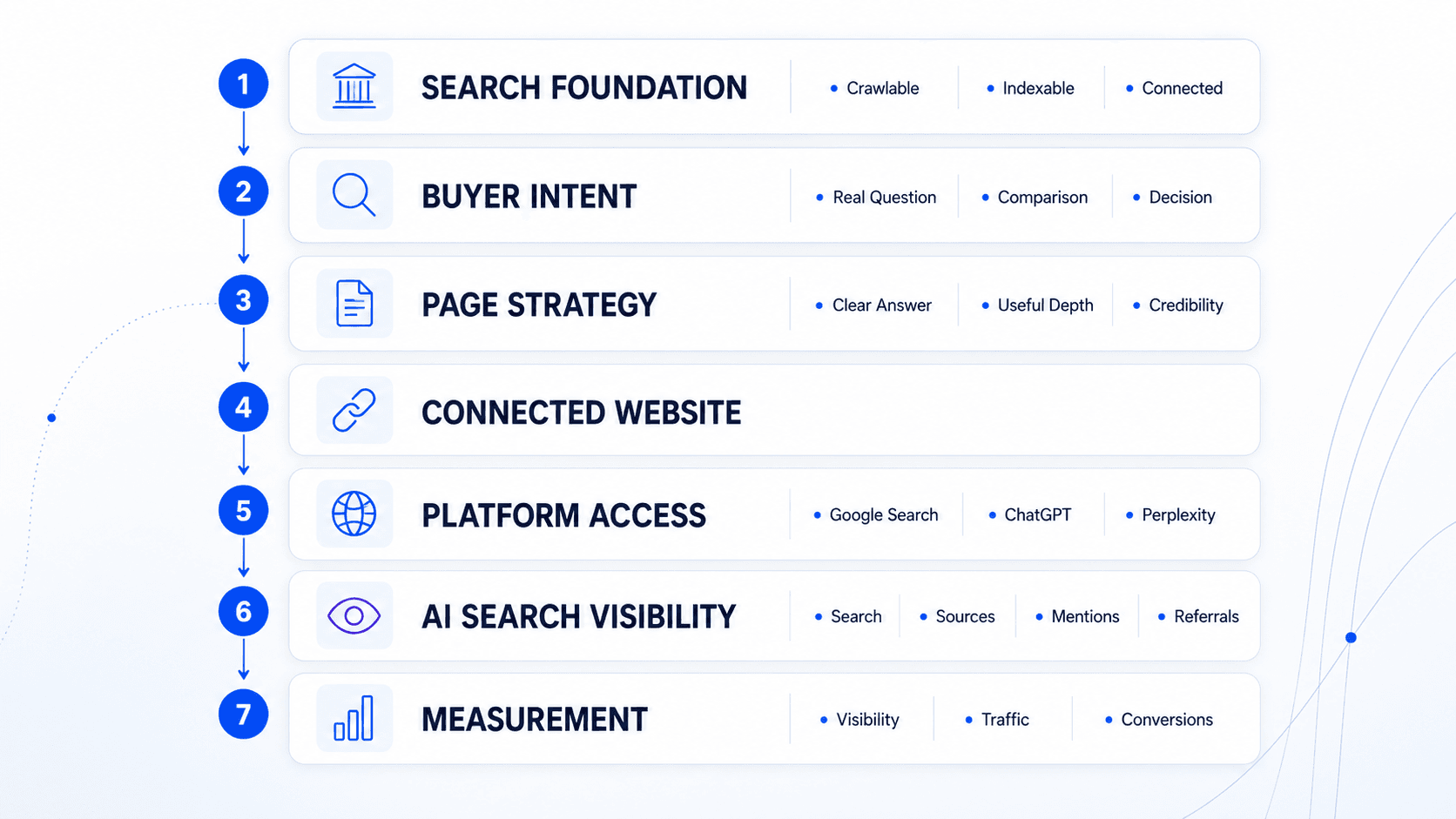
Rankvia's practical implementation sequence is:
For a useful manual starting point, use these AI prompts for evidence-backed SEO and AI-search analysis.
Foundation -> Opportunity -> Ownership -> Page -> Access -> Measurement
For the broader strategy, see SEO and GEO: How to Get Found in Google and AI Search.
AI search optimization in one practical model
There is no official cross-platform optimization framework shared by Google, OpenAI and Perplexity.
The following is Rankvia's AI Search Optimization workflow - a practical way to move from search opportunity to useful page to measurable visibility.
1. Foundation
Can relevant systems access the website and the pages intended for discovery?
Start with crawlability, indexability where required, canonicalization, internal discoverability, reliable hosting and CDN access, important content available in textual form, and normal structured data where appropriate.
For Google's AI Search features, these remain ordinary SEO fundamentals rather than a separate AI-specific technical layer.
2. Opportunity
Is there a real question, problem, comparison or buyer decision worth targeting? AI search optimization should start with useful audience demand, not a list of imagined prompt variations.
3. Ownership
Should the website create a new page, improve an existing one or skip the opportunity? Rankvia uses a simple planning rule: Create. Improve. Or skip.
4. Page
Does the page answer the need clearly, credibly and with enough depth? The objective is a useful page, not content that merely looks "AI-friendly."
5. Access
Is the page connected to the wider website, and can the relevant platforms access it? This includes internal links, related pages, Google Search access, ChatGPT Search access and Perplexity access.
6. Measurement
Did the work produce meaningful visibility, traffic or business outcomes? Different platforms expose different signals. Measurement should therefore remain platform-specific rather than being collapsed into one universal GEO score.
Step 1: Fix the search foundation first
Before thinking about AI citations or mentions, make sure the website itself is technically healthy.
For Google's AI Search features, the requirement is explicit: to be eligible as a supporting link in AI Overviews or AI Mode, a page must be indexed and eligible to appear in Google Search with a snippet. Google says there are no additional technical requirements for those features, and satisfying the requirements still does not guarantee crawling, indexing or serving.
Make important pages crawlable
Check that robots.txt does not unintentionally block important pages, CDN or hosting rules do not block intended crawlers, important pages are reachable through normal internal links, and the server reliably returns usable content.
Google explicitly lists robots.txt access, hosting/CDN accessibility and internal links among the SEO fundamentals relevant to its AI Search features.
Make intended Search pages indexable
For Google Search visibility, pages intended to appear in Search need normal indexing eligibility. Check for accidental noindex, authentication barriers, canonical configurations pointing elsewhere, and technical conditions that make intended pages unavailable to Search.
Make important content available as text
Google recommends keeping important content available in textual form and supplementing it with useful images or video where appropriate. Do not make the page's essential information available only inside screenshots, animations or inaccessible interactive elements.
Use normal structured data where appropriate
Structured data can remain useful as part of normal Search optimization when it accurately represents visible page content. But Google says there is no special Schema.org markup required for AI Overviews or AI Mode, and its newer guidance says structured data is not mandatory for generative Search.
If important pages cannot be crawled or indexed appropriately, AI-citation tactics are not the first problem to solve.
Step 2: Find real buyer questions and decisions
Do not begin with: What AI prompts can we manufacture pages for?
Start with: What does the audience genuinely need to understand, compare, evaluate or decide?
Useful opportunities often come from several types of user task.
Problems and use cases
How do I solve this problem? When should I use this approach? Is this appropriate for my situation?
Comparisons and alternatives
Product A vs Product B, alternatives to an existing solution, best tools for a defined use case, and different approaches to the same problem.
Category and buying research
What should I look for in this category? Which capabilities matter? How should I compare providers?
Implementation questions
How does this work? How do I set it up? What usually goes wrong? What are the tradeoffs?
Google says AI Overviews and AI Mode may use query fan-out, issuing multiple related searches across subtopics and data sources while developing an answer. That does not mean publishers should create a page for every possible fan-out query. Google's current guidance warns against producing separate content for many query variations primarily to manipulate Search or generative responses.
What underlying user task deserves its own page?
Step 3: Decide whether to create, improve or skip
Discovering a relevant opportunity does not automatically mean publishing another URL.
Rankvia's planning principle is: Create. Improve. Or skip.
Create
Create a new page when the intent is genuinely distinct, no existing page adequately owns it, the topic matters to the audience and business, and the page can contribute useful information.
Improve
Improve an existing page when it already addresses the intent but is incomplete, outdated, unclear, lacks evidence or useful context, or another URL would create unnecessary overlap.
Skip
Skip the opportunity when it is mainly another wording of an existing intent, another page already serves the need adequately, the topic has little business relevance, or the page would exist mainly to capture another keyword or prompt variation.
Google's current guidance supports this restraint: it says having more pages does not inherently make a site more useful and warns against scaled query-variant content created primarily to manipulate Search or generated responses.
One intent does not require one page per AI engine
A business generally does not need one Google version, one ChatGPT version, one Perplexity version and one "LLM-friendly" duplicate for the same underlying user need. For Google specifically, publishers do not need to rewrite content for generative Search or capture every exact query variation. Google's systems can understand meaning and synonyms beyond exact wording.
Create another page when the reader's task changes, not simply because the discovery surface changes.
Step 4: Build the page around the user's task
Once the right page has been chosen, make it genuinely useful before worrying about "AI-friendly" formatting.
Rankvia's editorial recommendation is: Answer the core need clearly, then provide the depth required to understand or act on it.
That may include a direct explanation, supporting reasoning, specific evidence, examples, comparison criteria, limitations, useful follow-up questions and a context-appropriate next step. This is editorial guidance, not a universal AI-ranking formula.
Answer the main question clearly
Do not hide the answer behind unnecessary introduction. For example, “Does GEO replace SEO?” should be answered directly before the deeper explanation.
Add the depth the task requires
A comparison may need criteria, differences, tradeoffs and fit. A technical guide may need prerequisites, steps, caveats and examples. A buying guide may need alternatives, evidence and decision criteria.
Support important claims
Use primary sources for changing technical claims: Google claims from Google Search Central, ChatGPT Search and crawler claims from OpenAI documentation, and Perplexity crawler claims from Perplexity documentation.
Keep entity and business context clear
Use precise company, product, service, category and audience names where relevant. Avoid vague brand language. Specificity helps readers understand what the page actually means. It should not be presented as a guaranteed ranking factor.
Do not optimize around imaginary formatting rules
Google explicitly says publishers do not need to split content into small chunks for AI understanding, and there is no ideal page length for generative Search. Google also says content does not need to be rewritten specifically for generative AI Search. Clear writing matters because it helps readers, not because every AI system supposedly rewards one paragraph length.
Step 5: Connect the page and check platform access
A useful page should fit naturally into the wider website. Relevant internal links can connect it to broader guides, deeper implementation pages, products or services, comparisons, use cases and relevant next-step information.
Google explicitly lists internal discoverability among the practices that remain relevant for its AI Search features. The goal is not to maximize link count. It is to create a coherent information structure.
Platform access is not the same as ranking
| Platform | Main access/discovery control | What it does not guarantee |
|---|---|---|
| Google Search / AI Overviews / AI Mode | Googlebot + normal Search eligibility | Crawling, indexing or inclusion |
| ChatGPT Search | OAI-SearchBot + OpenAI's published IP access | Top placement or citation |
| Perplexity | PerplexityBot + published IP access | Citation or source placement |
Google Search
AI Overviews and AI Mode remain part of Google Search, and normal Googlebot/Search eligibility remains the technical foundation. Google-Extended is different. Google documents it separately from Search crawling; it should not be treated as the control for inclusion in AI Overviews or AI Mode.
ChatGPT Search
OpenAI says any public website can appear in ChatGPT Search. For site content to be included in summaries and snippets, publishers should not block OAI-SearchBot. OpenAI also says the host or CDN may need to permit traffic from its published IP addresses. OpenAI explicitly says there is no way to guarantee top placement.
OAI-SearchBot access therefore supports availability for Search. It is not a documented ranking or citation factor. OpenAI documents GPTBot separately for publishers that want to exclude content from potential training.
Perplexity
Perplexity says PerplexityBot is designed to surface and link websites in its search results. It recommends allowing the bot in robots.txt and permitting requests from its published IP ranges when that visibility is desired. Perplexity also says PerplexityBot is not used to crawl content for foundation-model training. Those controls affect access. The documentation does not establish guaranteed citation placement.
AI-search tactics to be skeptical of
Some AI-search recommendations are presented with more certainty than current primary documentation supports.
“Add special AI schema”
For Google, no special AI schema is required. Google says there is no special Schema.org markup needed for AI Overviews or AI Mode, and its current generative Search guidance says structured data is not mandatory for AI Search. Use normal structured data where it accurately represents visible content and serves an applicable Search purpose.
“llms.txt improves Google visibility”
Google's current position is explicit: Google Search completely ignores llms.txt. Maintaining the file for another service neither improves nor harms Google Search visibility or rankings. Do not generalize that statement to other systems that may adopt different conventions.
“AI content must be split into short chunks”
Google explicitly says special chunking is unnecessary for its generative Search features and that no ideal page length exists.
“Create a page for every AI prompt”
Google's guidance points in the opposite direction: avoid scaled query-variant content created primarily to manipulate rankings or generated responses.
“Crawler access guarantees citations”
No. OpenAI explicitly says top placement cannot be guaranteed. Perplexity documents access and discovery controls without publishing a guaranteed source-selection formula.
“All AI search systems use the same ranking factors”
There is no official cross-platform ranking system shared by Google, OpenAI and Perplexity. Their published search/access mechanisms already differ materially.
“More AI-generated pages create authority”
Page volume itself is not the objective. Google's current guidance emphasizes unique, useful, reliable and non-generic content while warning against scaled content abuse and unnecessary query-variant pages.
APPLY THIS TO YOUR WEBSITE
Find the search opportunities your website should act on next.
Rankvia analyzes your business and existing website, identifies relevant buyer searches and organizes the strongest opportunities into a prioritized Content Calendar, with a Page Plan defining the strategy before generation.
Personalized to your website · No credit card required
Step 6: Measure visibility by platform
AI-search optimization should be measured using the strongest evidence each platform actually exposes. There is no single universal GEO score.
Continue measuring ordinary Search outcomes such as impressions, clicks, landing pages, queries and conversions.
Google launched dedicated Search Generative AI Performance reports in Search Console on June 3, 2026. The dedicated reports include generative-AI impressions plus dimensions for pages, countries, devices and dates. The underlying generative data also remains included in overall Search performance reporting.
Google says these dedicated reports became available to all websites worldwide as of August 31, 2026.
ChatGPT
Identify ChatGPT Search referrals using referrer information or URL tagging where available, such as utm_source=chatgpt.com, which allows publishers to identify inbound ChatGPT Search traffic in analytics. Useful downstream measures can include landing pages, engagement, leads, trials, purchases and revenue. Referral traffic does not necessarily represent every source appearance or mention.
Bing and Microsoft AI experiences
Bing Webmaster Tools provides an AI Performance report showing citation activity across supported Microsoft AI experiences, including cited pages and grounding queries. Bing explicitly says these metrics do not indicate ranking, authority, importance or a page's role within an individual answer. That is a useful reminder that AI visibility metrics should be interpreted according to what they actually measure.
Perplexity and other systems
Where equivalent first-party publisher reporting is not available, businesses can supplement referral analytics with controlled observation of relevant source appearances. Treat those observations as samples rather than permanent ranking positions.
Cross-platform monitoring
A controlled prompt set can help answer whether the brand appears for relevant category questions, which pages appear as sources, which competitors appear, and whether visibility changes over time. Keep the methodology consistent: same prompt set, same platform/model where practical, repeated observations, recorded dates, and geography/context where relevant.
Avoid turning one response into a conventional ranking claim. Prefer: The brand appeared in 14 of 30 monitored responses during this period. Over: We rank #2 in AI search.
For the exact way Rankvia calculates and interprets its monitored metrics, see the AI Visibility methodology.
Connect visibility to business outcomes
Ultimately measure qualified visits, leads, trials, purchases and revenue. A citation can be interesting. A search-growth strategy should help the right customers discover and choose the business.
AI search optimization checklist
Foundation
- Important pages are crawlable.
- Pages intended for Google Search are indexable.
- Canonical URLs are deliberate.
- Important content is available as text.
- Important pages are internally discoverable.
- Hosting/CDN rules do not unintentionally block relevant crawlers.
- Structured data accurately represents visible content where used.
Opportunity
- The page addresses a real question, problem, comparison or decision.
- The opportunity matters to the target audience.
- The opportunity matters to the business.
- It is not merely another wording variation.
Ownership
- Existing relevant pages were checked first.
- One page clearly owns the intent.
- Unnecessary overlap is avoided.
- The decision is explicitly Create, Improve or Skip.
Page
- The main question is answered clearly.
- Supporting depth matches the user's task.
- Important claims are supportable.
- Useful examples or evidence are included.
- Relevant limitations or caveats are present.
- Company/product/entity references are unambiguous.
- The page contributes something beyond generic summary content.
Access and connections
- Relevant supporting pages are linked naturally.
- Product/service links appear only where useful.
- Googlebot access matches the intended Google Search visibility.
- OAI-SearchBot access matches the intended ChatGPT Search visibility.
- OpenAI crawler traffic is permitted where necessary.
- PerplexityBot access matches the intended Perplexity visibility.
- Perplexity's published IP traffic is permitted where necessary.
- Crawler access is not being mistaken for guaranteed placement.
Measurement
- Google Search Console is configured.
- Dedicated Google generative reporting is checked if available.
- ChatGPT referral traffic can be identified.
- Relevant first-party AI visibility reports are used where available.
- Controlled monitoring uses a documented methodology.
- Visibility is connected to business outcomes.
- No universal GEO score is treated as ground truth.
Sources
Frequently asked questions
BUILD YOUR SEARCH GROWTH PLAN
Turn AI-search strategy into the pages your website should publish next.
Enter your website and Rankvia will analyze your business, identify relevant search opportunities and build the strategy for what to create or improve.
Personalized to your website · No credit card required