Guides Best Shopify AI SEO Apps in 2026: 8 Tools Compared
SHOPIFY APP COMPARISON
Best Shopify AI SEO Apps in 2026: 8 Tools Compared
Compare 8 Shopify AI SEO apps for automated content, Google search, AI visibility, and technical SEO. Find the best fit for your store.
By Rankvia ·
Best Shopify AI SEO Apps in 2026: 8 Tools Compared
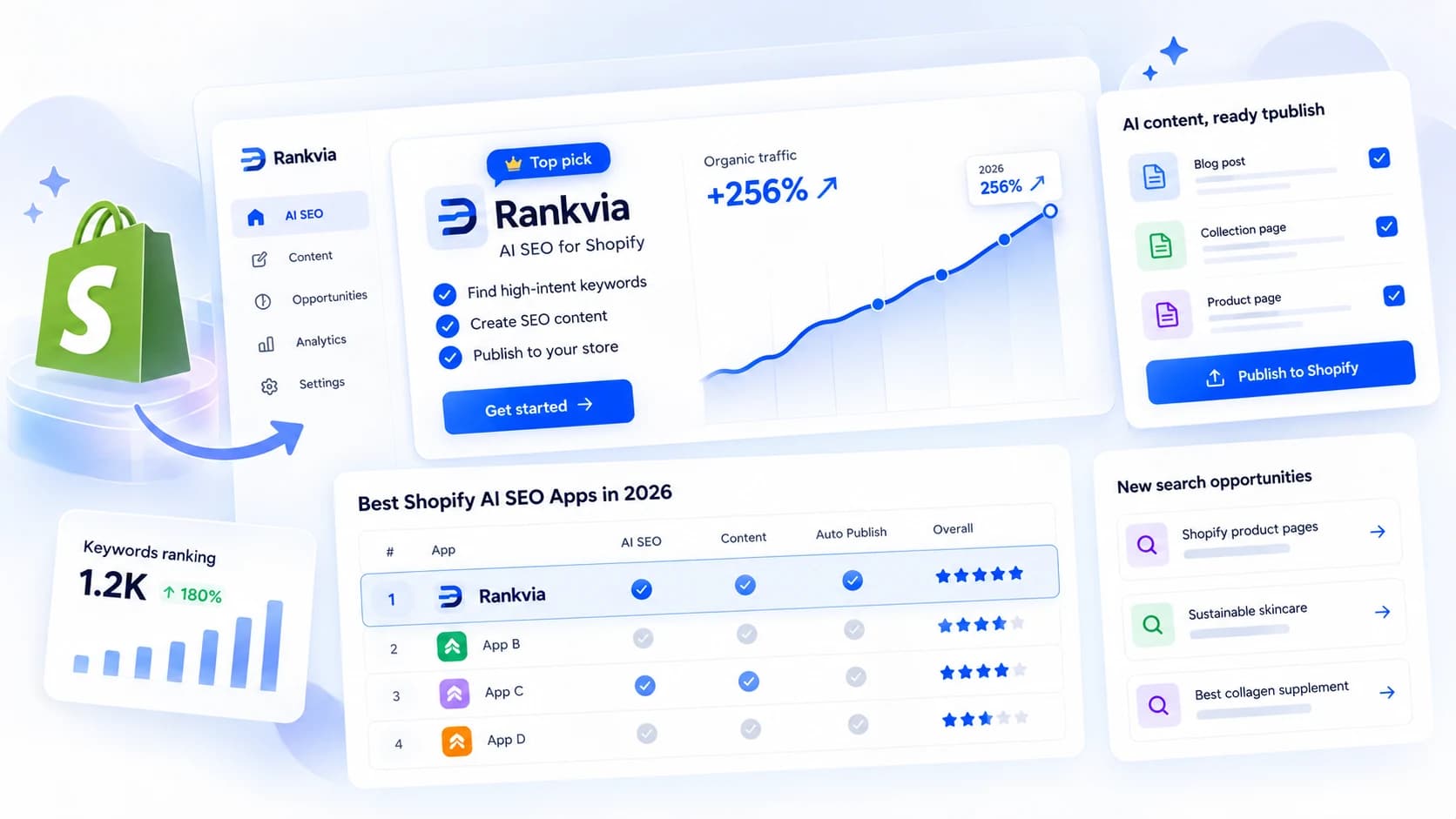
Looking for the best Shopify AI SEO app? First decide whether you need technical fixes, an AI writing tool, or a system that decides what to publish and does the work. StoreSEO and TinySEO specialize in important technical and product-page maintenance. Soro and Tapita can generate and schedule content. Rankvia is our pick for Shopify merchants who want automated SEO content creation grounded in search research, AI visibility and their existing website - with the ability to create or improve relevant content and publish eligible work to Shopify.
Rankvia connects a store's business context, buyer questions, real search opportunities, competitor and SERP evidence, optional Google Search Console data and existing pages into a prioritized Content Calendar. It then prepares Page Plans, generates content and supports review-first or automatic Shopify publishing. The point is not to publish as many articles as possible; it is to work on the most useful pages first.
Install Rankvia on Shopify · See the eligible free website preview · See how Rankvia works with Shopify
The 8 best Shopify AI SEO apps at a glance
| App | Free access | Paid plans from | Best fit |
|---|---|---|---|
| 1. Rankvia - our pick for automated SEO content creation | Free AI Visibility preview + personalized Search Growth Plan on Rankvia's website | From $39/month for Shopify paid subscriptions | Evidence-led Create/Improve decisions, Page Plans, contextual links and Shopify publishing |
| 2. Soro - SEO Autopilot & Content | No free plan or trial advertised | $39/month | Automated daily blogging with keyword discovery, brand-aware posts, images, links and translations |
| 3. Tapita GEO Studio & AI Blog | Free plan | Paid starting price not shown | AI blogs, buyer guides, calendar, scheduled posts, GEO and visibility tools |
| 4. Avada Blog SEO AEO Content | Free plan + 7-day free trial | $14.90/month | Hands-on AI blog editor, topic suggestions, drafts and SEO guidance |
| 5. Kedra: AI SEO & AEO Visibility | Free plan + 10-day free trial | $10/month | AI-question and competitor checks, fixes and plan-dependent blog drafts |
| 6. StoreSEO AI SEO Optimizer | Free plan + 7-day free trial | $14.99/month | Product and on-page SEO maintenance, images, schema and Search Console |
| 7. Tiny SEO Speed Image Optimizer | Free plan + 7-day free trial | $14/month | Technical SEO, speed, images, audits and AI content tools |
| 8. Shop Rank AI: Rank in ChatGPT | Free to install | $9.99/month per 100 products | Catalog-level AI-search readiness and product fixes |
The Rankvia preview is a limited website-based offer, subject to eligibility; it is not a Shopify App Store plan or trial. Other access types and starting prices reflect the official listings checked on October 21, 2026. Features and allowances differ; check the linked listings for current terms.
What separates automated writing from research-driven SEO content?
Rankvia publicly documents the following approach in its methodology. Use these questions to compare the complete workflow, including the stages shared with other apps.
| Merchant question | Rankvia approach | How to evaluate another app |
|---|---|---|
| What should I publish next? | Business, audience, search demand, current SERP evidence and AI Visibility can inform a prioritized calendar | Does it explain why a specific topic deserves a page, or mainly schedule keyword-led posts? |
| What if I already have an article? | Identify the appropriate existing page and consider Improve instead of producing a duplicate | Does it explicitly compare existing-page ownership with a new-page decision? |
| Can I use my own performance data? | Optional connected GSC evidence can inform planning | Is Search Console data displayed only for reporting, or also used in page decisions? |
| What does AI Visibility change? | Buyer-question observations and competitor/source gaps can inform the next content action | Are visibility results connected to prioritization and execution, or presented separately? |
| Does it complete the work? | Page Plans, supported content creation/improvement, contextual links and Shopify review/auto-publish | Which specific stages remain manual on the selected plan? |
| How are current results used? | Available live SERP evidence informs intent, format and page priorities | Ask for the evidence behind a specific planned page, rather than a generic keyword list. |
| Where do internal links appear? | Relevant contextual links can be included in generated or improved content | Soro and Avada also document linking; check link relevance and editing control. |
| What about technical product SEO? | Different focus: supported editorial content decisions and publication | StoreSEO, TinySEO and Shop Rank AI address product metadata, images or schema more directly. |
Shared capabilities matter: Soro documents keyword discovery, links and auto-publishing; Tapita documents AI visibility, a calendar and refresh reminders; Kedra documents AI-question checks and blog drafts; StoreSEO documents GSC. Their presence alone does not establish how evidence selects an existing page for improvement. Ask to see that decision in the workflow.
1. Rankvia - best for research-driven Shopify SEO content automation
Best for: Merchants who want to automate both what content to create or improve and how it gets produced and published.
A Shopify AI blog writer can create text from a topic. Rankvia starts earlier: it analyzes your website and approved Business Profile, understands your products, target customers and market, and reviews the pages you already have. It uses available search-demand and SERP evidence to evaluate what shoppers are looking for and which page types answer that need. If you connect Google Search Console, relevant first-party query/page performance can add another signal to planning. Confirm the approved content language and target market before planning.
Rankvia also checks buyer questions across supported AI search experiences, including ChatGPT, Gemini and Google AI, to identify observed brand, competitor and source visibility. A missing brand mention doesn't automatically trigger an article. Rankvia weighs the finding against buyer intent, your products, search evidence and existing-page ownership before recommending the next action.
That difference changes the output. The best recommendation might be a new comparison page, a buying guide, an improvement to an article you already own, or no immediate content action. Selected opportunities move into a prioritized Content Calendar and Page Plans. Rankvia generates or improves the supported content, includes relevant contextual internal links in generated pages, and lets you review the result or enable automatic publication for eligible scheduled Shopify content.
What makes Rankvia particularly useful
- AI Visibility linked to action: identify relevant buyer questions where competitors appear and assess whether owned-site content is the right response.
- Search evidence, not keyword guesswork alone: combine business fit, search intent and available SERP data; optionally use connected GSC evidence.
- Create or Improve: check whether an existing page should serve the intent before adding another competing URL.
- Content planning and selective refresh: prioritize Page Plans and useful improvements, rather than generating a stream of unrelated posts.
- Contextual linking and publishing: connect generated articles to relevant existing pages and products where appropriate, then review or publish supported pages to Shopify.
Rankvia is not a substitute for bulk product metadata editing, image compression, schema troubleshooting or Shopify Catalog management. It addresses the content opportunity-to-publication workflow.
Create, Improve, Monitor or Skip are possible decisions; evidence does not have to produce another article. Improvement is selective and opportunity-driven: retain the existing page's purpose and useful source material, review the revision, and keep the original when the proposal is not better. Contextual links belong inside generated or improved content, rather than a sitewide repair of historical links. Shopify publishing covers supported articles and standalone pages; automatic publication requires opt-in and a ready destination.
Shopify pricing: Paid subscriptions start at $39/month. Launch includes 10 AI-optimized pages monthly; Growth starts at $99/month for 30, and Scale at $189/month for 60. The website preview above is a separate, eligibility-based entry point.
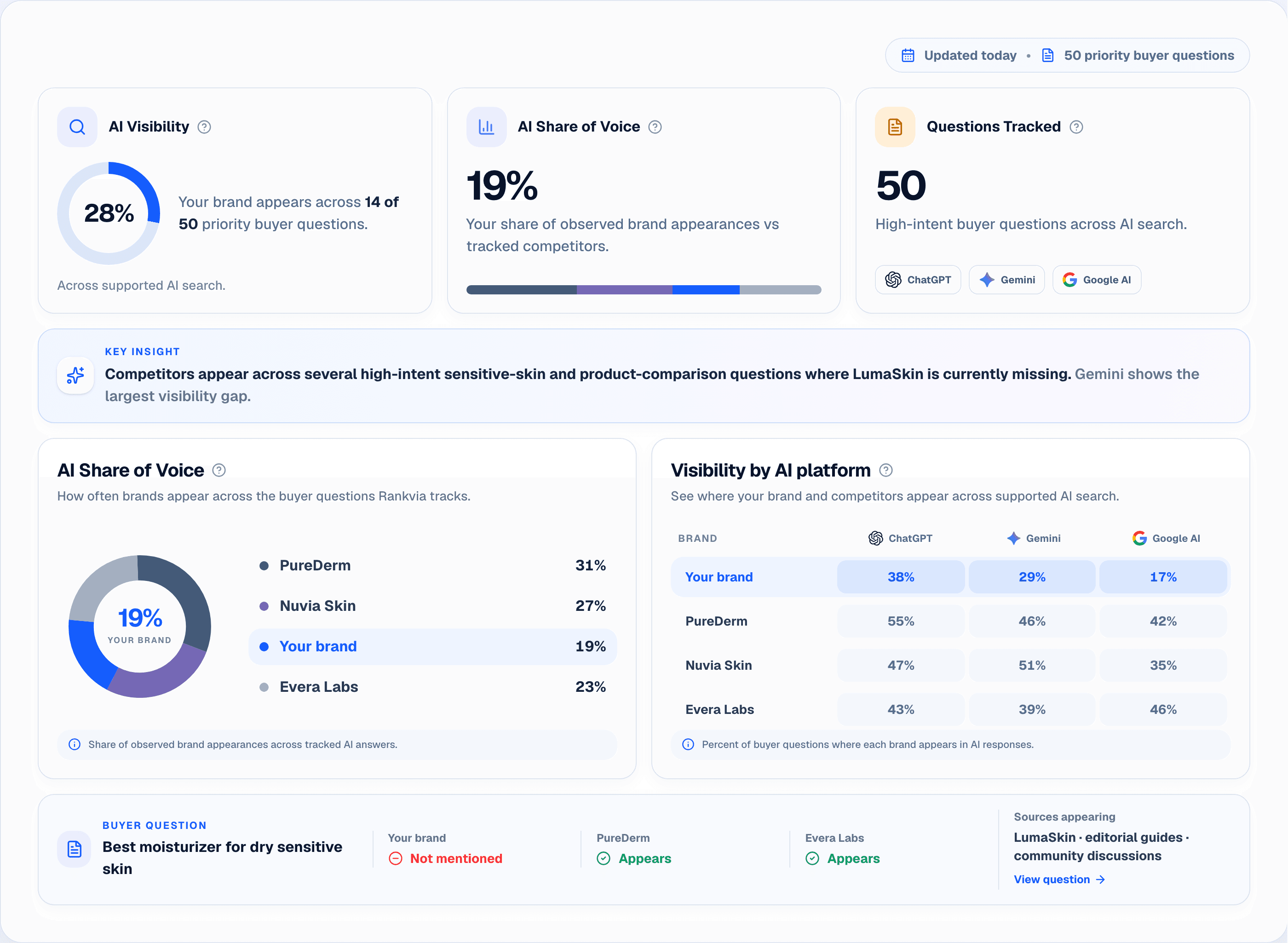
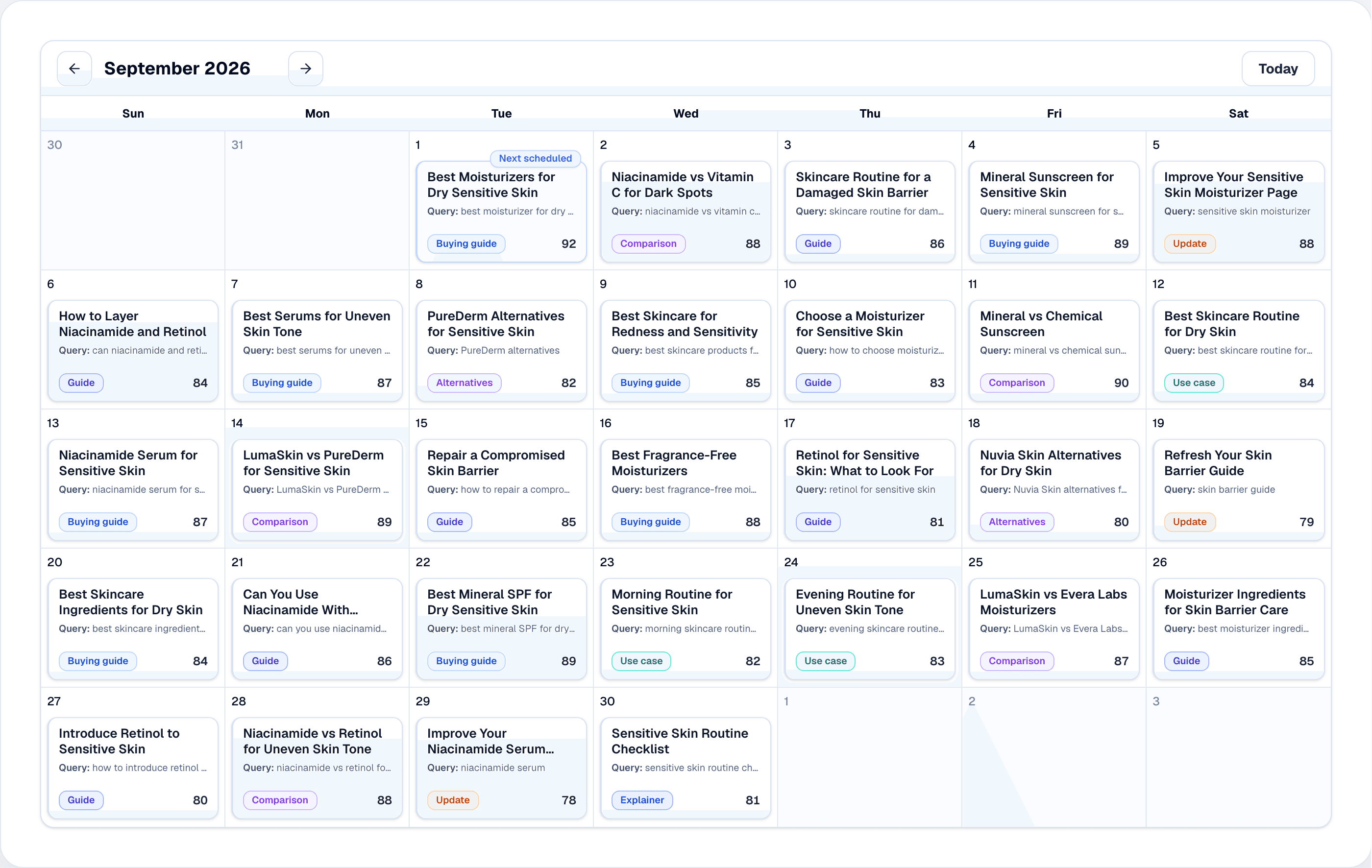
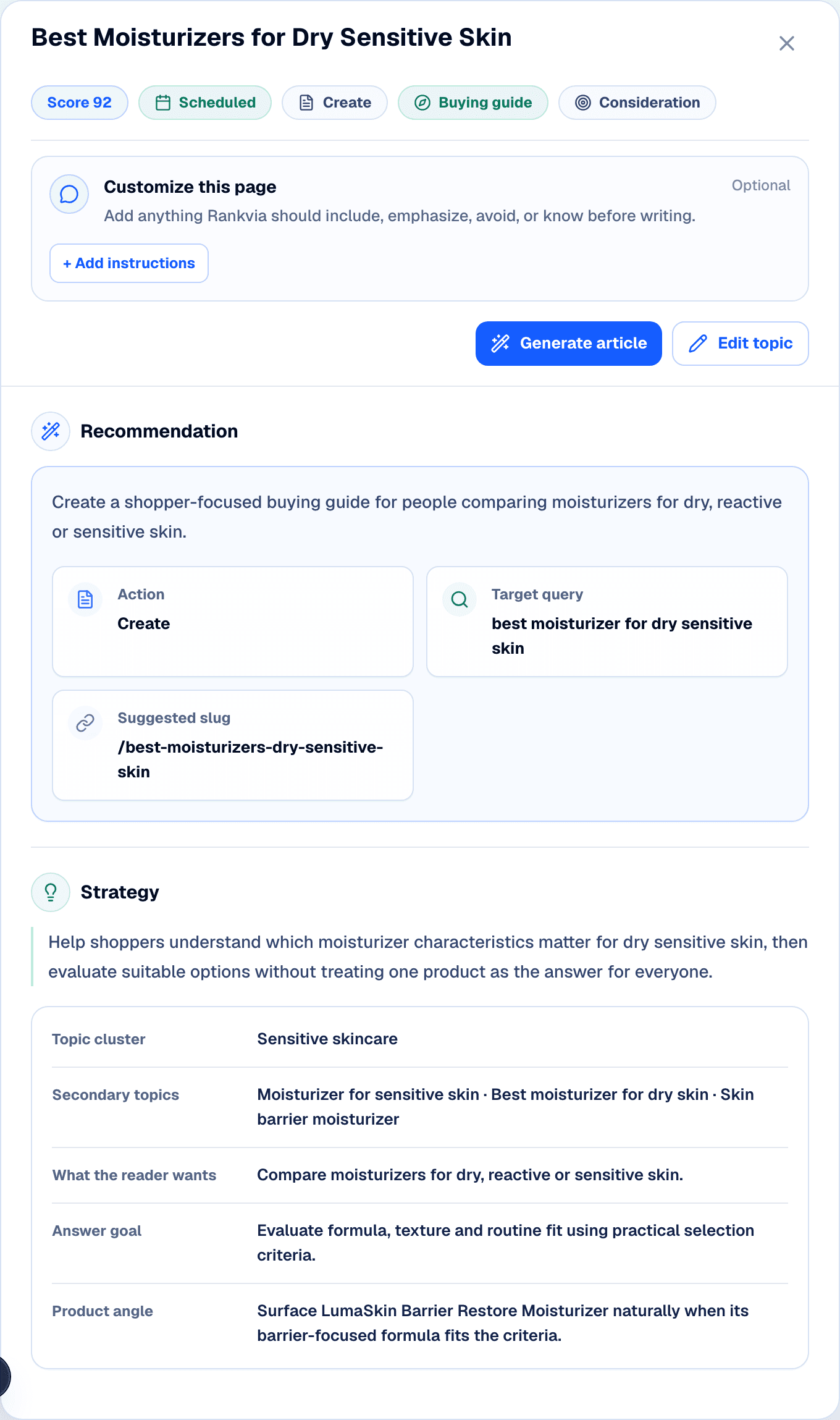
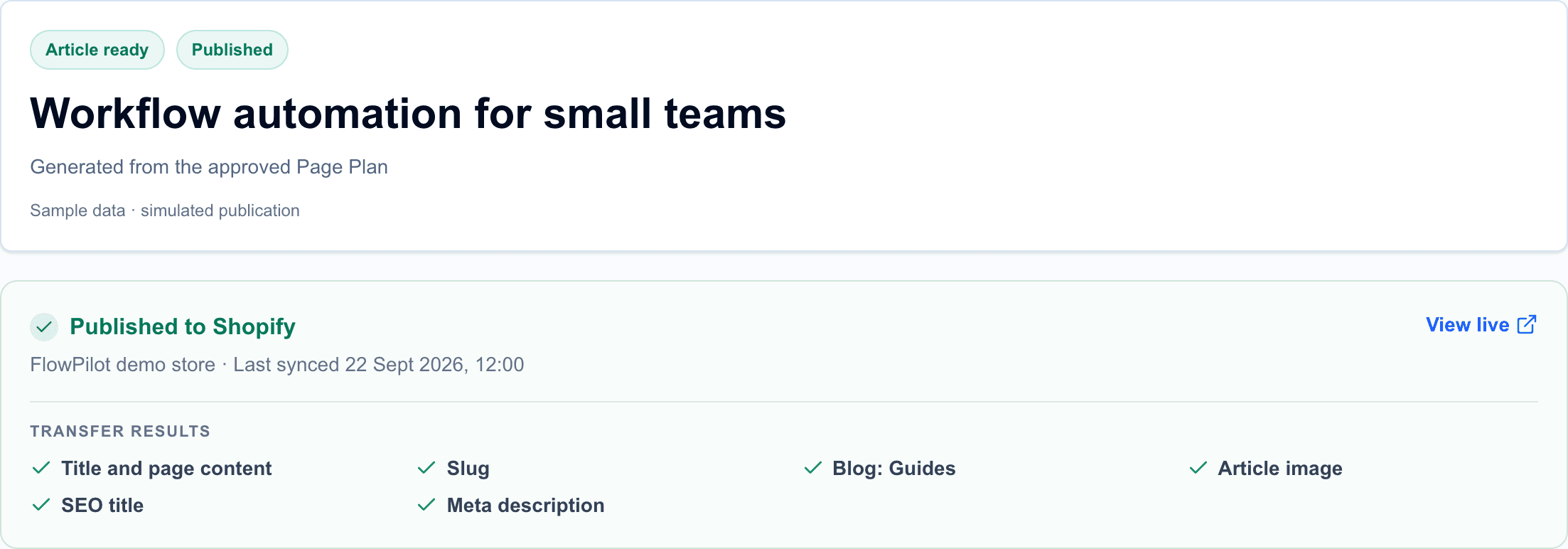
These screenshots show Rankvia’s interface with illustrative demo-store data.
Install Rankvia on Shopify · Explore the Shopify workflow
2. Soro - best for automated daily blogging
Soro - SEO Autopilot & Content on Shopify describes a workflow that discovers keywords, generates brand-aware blog articles, handles images and internal linking, and offers automatic publishing. Its listing also mentions translation into many languages. This makes Soro a serious alternative for merchants mainly seeking a frequent, automated blogging pipeline.
Why consider it: Soro places daily content production and publishing at the center of its value proposition. For a store that primarily needs more consistent blog output, that approach is easy to understand.
Why consider Rankvia instead: Soro documents keyword discovery, brand-aware writing, images, internal links, translations and automatic publication in its vendor overview . Rankvia fits when sampled buyer-question AI evidence, available SERPs and site context should inform explicit Create versus Improve page decisions. That precise AI-question-to-page-ownership process is not described in the Soro materials checked; search analytics and linking are not unique to Rankvia.
For the branded comparison, see Soro alternatives for Shopify.
Watch for: Publishing volume is not a substitute for accurate product claims, useful comparisons, or relevant internal links. Review output quality before enabling any full autopublishing workflow.
3. Tapita GEO Studio & AI Blog - best for an integrated blog and GEO studio
Tapita GEO Studio & AI Blog on Shopify offers AI content for blogs and buying guides, a content calendar, scheduled publication, and features marketed around GEO and brand visibility. The listing also discusses content refresh reminders and product promotion within posts.
Why consider it: Merchants looking for content creation and GEO-oriented features inside one Shopify app should shortlist Tapita. It is not merely a simple AI text writer.
Why consider Rankvia instead: Tapita documents AI visibility, a calendar, scheduled publication and refresh reminders. Its scheduling guide also describes store-based suggestions. Rankvia fits when you want question-level observations, existing-page ownership, search/SERP inputs and optional GSC carried into a Page Plan. The checked Tapita materials do not spell out that Create-versus-Improve decision; they do describe more than a writing tool.
Watch for: Look beyond the presence of a “GEO score.” Ask what the score measures, which search systems and questions it samples, and how it changes your content decisions.
4. Avada Blog SEO AEO Content - best for merchants who want to edit every article
Avada Blog SEO AEO Content on Shopify combines AI topic suggestions and draft writing with a Shopify-oriented blog editor, keyword assistance, and SEO recommendations. Its listing shows tools for managing posts and adding product elements to blog content.
Why consider it: An editor-led workflow is appealing when the merchant wants tight control over formatting, products featured in posts, and individual blog articles.
Why consider Rankvia instead: Avada documents keyword research, AI drafting, internal links and blog management; its SEO documentation covers post metadata and optimization. Rankvia fits merchants who want recurring research, prioritization, existing-page decisions and Page Plans to lead into generation and publishing, rather than mainly managing selected articles in a blog editor.
Watch for: Check which activities are truly automated and which still require ongoing topic selection, editing, scheduling, or manual publication on your chosen plan.
5. Kedra: AI SEO & AEO Visibility - best for AI-discovery diagnostics
Kedra: AI SEO & AEO Visibility on Shopify tests buyer-style AI questions and competitor recommendations, reports AI readiness issues, provides ranked fixes, creates blog drafts related to missed questions, and offers AI traffic insights. Its public listing also describes generating AI-oriented store files from the catalog.
Why consider it: Kedra addresses AI-search diagnostics and store-level fixes, not just content writing. It belongs on a serious shortlist for stores investigating AI-assisted discovery.
Why consider Rankvia instead: Kedra documents AI-answer checks, competitors, fixes and Shopify blog drafts, with plan-dependent allowances. Its product page also explains catalog files and traffic analytics. Rankvia fits when the main job is search-content execution: weigh available SERPs, optional GSC and existing-page ownership, choose Create or Improve, then prepare a Page Plan and publish supported editorial work.
Watch for: Distinguish sampled AI-answer checks, crawler activity, referral traffic, and actual product sales. They measure different things. An AI readiness score alone does not prove improved visibility.
6. StoreSEO AI SEO Optimizer - best for product and on-page SEO maintenance
StoreSEO AI SEO Optimizer on Shopify focuses on SEO maintenance across products and store pages. Its listed capabilities include metadata optimization, image tools, schema, sitemap and Google Search Console-related features.
Why consider it: If your product pages are missing titles or descriptions, images need optimization, or structured data and indexing are the immediate concern, StoreSEO addresses those operational problems more directly than a content-first system.
Why consider Rankvia instead: StoreSEO explicitly supports GSC, Analytics and AI content alongside technical SEO; its documentation covers those workflows. Choose Rankvia when buyer/search research should prioritize buying guides, comparisons and existing-page improvements through Page Plans and publication. GSC integration itself is shared; StoreSEO may remain the more direct choice for product optimization and technical work.
Watch for: A technically optimized product page and a useful buying guide serve different search intents. Don't treat an SEO score as a complete content strategy.
7. Tiny SEO Speed Image Optimizer - best for technical SEO, speed, and images
Tiny SEO Speed Image Optimizer on Shopify offers image optimization, technical audits, structured data, page-speed features, metadata help, and AI-supported content features. It has a broader toolkit than its image-optimizer name suggests.
Why consider it: TinySEO is a practical candidate when the primary workload involves image files, performance, redirects, structured data, and other store-maintenance tasks.
Why consider Rankvia instead: TinySEO documents AI content tools as well as speed, images and technical maintenance. Rankvia fits when buyer questions and available search evidence should decide which editorial page to create or improve, then carry it through planning, contextual links and Shopify publication. Technical maintenance and editorial execution can be complementary.
Watch for: Technical SEO tools cannot guarantee rankings by themselves; neither can publishing more content without genuine relevance.
8. Shop Rank AI: Rank in ChatGPT - best for catalog-level AI readiness
Shop Rank AI: Rank in ChatGPT on Shopify emphasizes product-level checks and fixes for AI-discovery readiness: descriptions, images, alt text, structured data, and bulk product optimization. Its listing also discusses tracking and competitor insights.
Why consider it: For a large catalog with inconsistent product attributes or weak descriptions, those fixes may be the most urgent work.
Why consider Rankvia instead: Shop Rank AI documents search and competitor tracking as well as catalog fixes; its product page emphasizes descriptions, images and structured data. Rankvia fits when your priority is research-led guides, comparisons and selective improvements to owned editorial pages, followed by supported publication. Product-record fixes are a different primary job.
Watch for: A readiness check is not proof that ChatGPT will select a particular product. External AI systems ultimately control their own recommendations.
Which Shopify AI SEO app should you choose?
Choose Rankvia when you want it to take on the recurring page decisions as well as production. Search and sampled AI evidence, your approved business context and existing pages can inform Create or Improve work, a prioritized Calendar, Page Plans, contextual links and supported Shopify publishing.
Choose Soro if automatic blog output is the primary feature you want. Compare how the two apps select topics and handle editing before committing to a publishing cadence.
Choose Tapita or Avada if you primarily want a Shopify-focused content studio. Tapita has a broader published GEO and calendar proposition; Avada emphasizes an editor-led writing experience. Inspect their plans and workflows directly.
Choose Kedra or Shop Rank AI if product-level AI readiness and diagnostic fixes are the immediate priority. Those apps address questions a content-generation workflow does not necessarily solve.
Choose StoreSEO or TinySEO if your store's product metadata, images, schema, indexing, or speed need attention first. You may still benefit from Rankvia afterward for the content strategy and publication layer.
Example: improve the right article instead of generating another one
Imagine a store selling carry-on backpacks. It already has an article answering What size backpack fits under an airline seat?, but the page overlooks a practical comparison that shoppers search for. Rankvia can review the existing page, examine available search and SERP context, use GSC data if connected, and consider related AI buyer-question gaps. If that existing URL is the right owner, the recommended action may be Improve, not another near-identical post.
A Page Plan guides the revised content, relevant internal links connect the guide to appropriate store pages, and the merchant can review the result or use a supported publishing workflow. This is an illustrative scenario, not a customer outcome or ranking prediction.
The better Shopify AI SEO app is not necessarily the one that produces the most posts. If you want research, prioritization, content improvements and publishing working together, choose Rankvia.
Install Rankvia on ShopifyWhat should an AI SEO app actually automate?
Before buying, test the workflow with a real product category and ask six questions:
- Research: Does it use store context and credible search evidence, or only a keyword prompt?
- Selection: Does it explain why to create a new page, improve an existing one, or avoid overlapping content?
- Quality: Can it create accurate, useful explanations, buying advice, and comparisons rather than repetitive generic articles?
- Control: Can you review and edit before publishing, and configure exactly when automation is allowed?
- Shopify publishing: Does it place content in the right Shopify destination with appropriate titles, metadata, links, and images?
- Measurement: Which observed search and AI visibility signals are available, and which are only estimates?
A good tool should help you publish better decisions, not just publish more words. Search visibility and revenue are outcomes to measure over time, not benefits an app can guarantee.
Where Rankvia fits into an ongoing Shopify SEO workflow
Choose Rankvia to research the next opportunity, improve the right page and carry supported content through Shopify publication. See the full Shopify automation workflow, the methodology or the Shopify integration.
Frequently asked questions
What is the best Shopify AI SEO app for automated content creation?
For merchants seeking evidence-led content automation, Rankvia is our recommendation: business context, available search/SERP evidence, optional GSC and sampled AI Visibility can inform Create, Improve, Monitor or Skip decisions before selected work moves into Page Plans and Shopify publication. Soro and Tapita are also relevant automated-content options.
Can Shopify SEO blog content be published automatically?
Yes. Some Shopify apps, including Rankvia and Soro, support automation. In Rankvia, merchants can review content before publishing or configure automatic publishing for eligible scheduled work. Review settings and actual output quality before turning on automation.
Does using an AI SEO app guarantee my products will appear in ChatGPT?
No. Publishing useful, accessible public content can support discoverability, but external AI systems decide what to retrieve or recommend. Shopify Catalog and product-data eligibility also operate separately from public-site content marketing.
Do I need an AI content app and a technical SEO app?
Not always. If your main problem is technical or product metadata, start there. If those foundations are in place but you lack useful buying guides, comparisons, and supporting search content, a content automation platform such as Rankvia may address a different bottleneck. Some stores need both.
Is Rankvia a Shopify app, or do I need to copy articles manually?
Rankvia is listed in the Shopify App Store and supports publishing eligible content into Shopify. Depending on settings and content state, you can review drafts or enable automatic publishing. See the current Shopify app listing and integration details.
How much does Rankvia cost for Shopify?
Paid Shopify subscriptions start at $39/month. A separate website-based preview of AI Visibility and a personalized Search Growth Plan is available subject to eligibility; it is not a recurring free subscription. Launch starts at $39/month, Growth at $99/month and Scale at $189/month. See the Shopify listing for current terms.
How we selected and compared these apps
We checked the official Shopify listings and vendor pages on October 21, 2026, comparing the work each app publicly describes. A stage not documented in the checked materials is not proven unavailable. Prices and plan allowances come from the linked listings.
Primary sources: Rankvia , Soro , Tapita , Avada , Kedra , StoreSEO , TinySEO , Shop Rank AI .
Install Rankvia on ShopifyFor a focused comparison of one free AI content and GEO app, see Tapita GEO Studio alternatives for Shopify. For a catalog-focused tool with AI content and technical SEO features, see StoreSEO alternatives for Shopify.
Related guides
Shopify SEO: What to Optimize, Create & Improve
Decide which store pages need search improvements and what work to prioritize.
Shopify AI Search Optimization: What Actually Matters
Review product data and public website work relevant to Shopify AI discovery.
Shopify Content Strategy: What to Create, Improve & Prioritize
Choose useful work across product pages, collections and store guides.
BUILD YOUR SEARCH GROWTH PLAN
Find what your website should publish next.
Enter your website and Rankvia will identify relevant search opportunities and build the strategy for what to create or improve.
Personalized to your website · No credit card required
Explore AI Search Optimization