STORESEO ALTERNATIVES
7 Best StoreSEO Alternatives for Shopify in 2026
Looking beyond StoreSEO? Rankvia is our top recommendation if your next SEO challenge is finding valuable search opportunities and automatically creating or improving the content that addresses them. StoreSEO remains a strong choice for product metadata, images, structured data and technical housekeeping. The right alternative depends on the job you need done.
For Shopify merchants who want SEO content generation on autopilot rather than another list of fixes, Rankvia for Shopify connects business and website analysis, search-demand and SERP research, AI Visibility, optional Google Search Console evidence, a prioritized Content Calendar, Page Plans, contextual linking and supported Shopify publishing.
Official listings checked October 22, 2026.
The best StoreSEO alternatives at a glance
| App | Best for | Free access | Paid plans from |
|---|---|---|---|
| 1. Rankvia - our pick for automated SEO content growth | Research-driven Create/Improve planning, AI Visibility and Shopify content publishing | Eligible free website preview, not a permanent free Shopify plan | $39/month |
| 2. Soro | Recurring AI blogging and autopublishing | No ongoing free plan confirmed in reviewed offer | $39/month |
| 3. Avada AI SEO Image Optimizer | Image optimization, structured data, audits and speed | Free plan | $34.95/month |
| 4. Tiny SEO Speed Image Optimizer | Image and speed optimization, audits and optional AI blogging | Free plan | $14/month |
| 5. SearchPie: AI SEO & Schema | Meta tags, schema, broken links and technical SEO workflows | Free plan | $39/month |
| 6. Smart SEO AI & Image Optimizer | Bulk metadata, images, indexing and GSC-assisted technical SEO | Free plan | $14.99/month |
| 7. Booster AI SEO + AEO Optimizer | SEO maintenance, metadata automation and image fixes | Free plan | $39/month |
Prices are public USD monthly starting prices checked on October 22, 2026. Free plans, trials and Rankvia's website preview are different offerings; feature allowances vary by tier. See each app's official listing before subscribing.
Why consider an alternative to StoreSEO?
StoreSEO isn't just a metadata editor. It offers product, collection and blog SEO optimization, AI content and blog features, keyword tracking, image optimization, JSON-LD, sitemap and indexing tools, and Google Search Console/Analytics integration on eligible plans. Its free tier includes 25 product optimizations, 25 image optimizations and 200 AI credits; paid plans start at $14.99/month.
That's a serious option when your priority is cleaning up a large catalog. Yet solving technical and on-page issues is different from deciding which commercial questions deserve a new guide, which existing pages should be improved, and how to keep publishing the right work. If that second problem is holding back your store, compare tools by their decision-making and execution workflows, not merely by the number of SEO features.
You may not need to uninstall StoreSEO. Using it for catalog maintenance and Rankvia for search-informed content growth can make sense when both needs exist.
1. Rankvia - best for automated, research-driven Shopify SEO content creation
Best for: merchants who want Rankvia to identify what is worth publishing, generate the work and move it to Shopify - without manually orchestrating several research and writing tools.
Rankvia starts with your store's website and an editable Business Profile covering products, positioning, audience, competitors and intended language and market. That context matters: an article should reflect your real products and buyers, not only a keyword entered into a generic writing prompt.
Rankvia's search-growth workflow can combine:
- Search demand and SERP evidence: investigate relevant queries, the kind of pages appearing in search, buyer intent and competing pages.
- AI Visibility evidence: check sampled buyer questions across supported AI-search platforms, including whether your brand or competitors appear and what sources are visible.
- Google Search Console, if connected: consider your site's actual queries, impressions and page performance as additional planning evidence. GSC is optional, not a prerequisite.
- Existing-page understanding: avoid assigning the same search need to multiple competing articles.
- Create, Improve, Monitor or Skip: choose the appropriate action rather than automatically creating a new post for every keyword.
Selected opportunities move into a prioritized Content Calendar and then a Page Plan. Rankvia generates brand-aware content with relevant contextual internal-link suggestions and supports publishing eligible blog articles and standalone pages to Shopify, with review-first or supported automatic publishing. It does not automatically bulk-edit Shopify product descriptions, compress images or replace a dedicated technical SEO app.
Why choose Rankvia over a typical SEO-fix app?
Imagine your store already has a guide about fragrance-free moisturizers. A new search opportunity appears around choosing moisturizer for sensitive skin. Publishing another nearly identical blog post could create competing page ownership. Rankvia can examine the existing page, search context and available performance signals, then recommend improving the original guide or creating a separate page if the intent truly differs. The resulting work gets planned, generated and prepared for Shopify.
This scenario is illustrative, not a claim about tested customer outcomes. The value is the decision before the writing.
What to know: Rankvia's Launch plan is $39/month for 10 AI-optimized pages and up to 25 tracked buyer questions on the Shopify listing. Growth and Scale expand capacity. Eligible visitors can try a limited website preview without a card; that is not an ongoing free Shopify subscription. Publishing remains subject to supported content types and selected review/automation settings.
Install Rankvia on Shopify →
Try Rankvia's eligible free AI Visibility preview
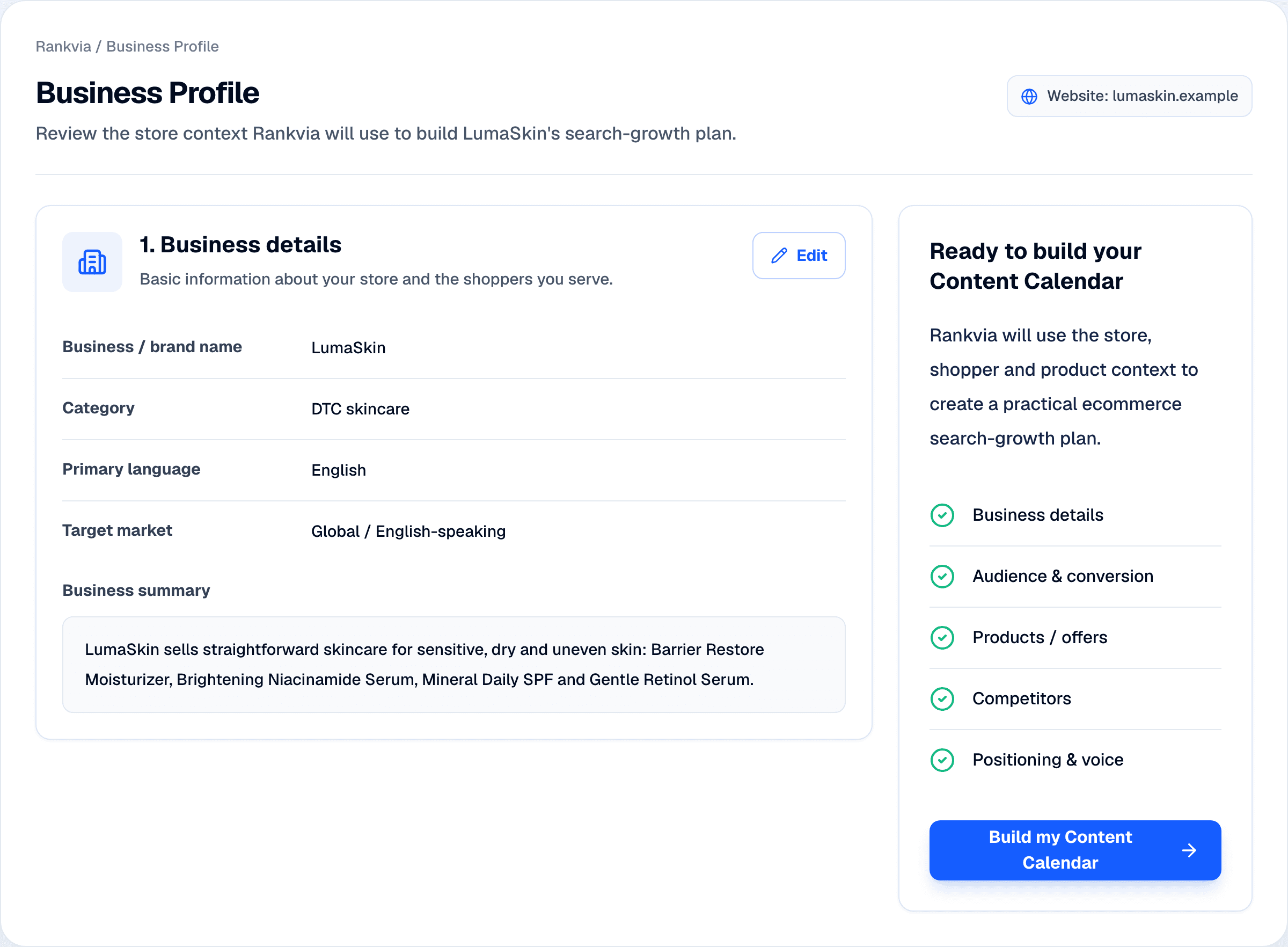
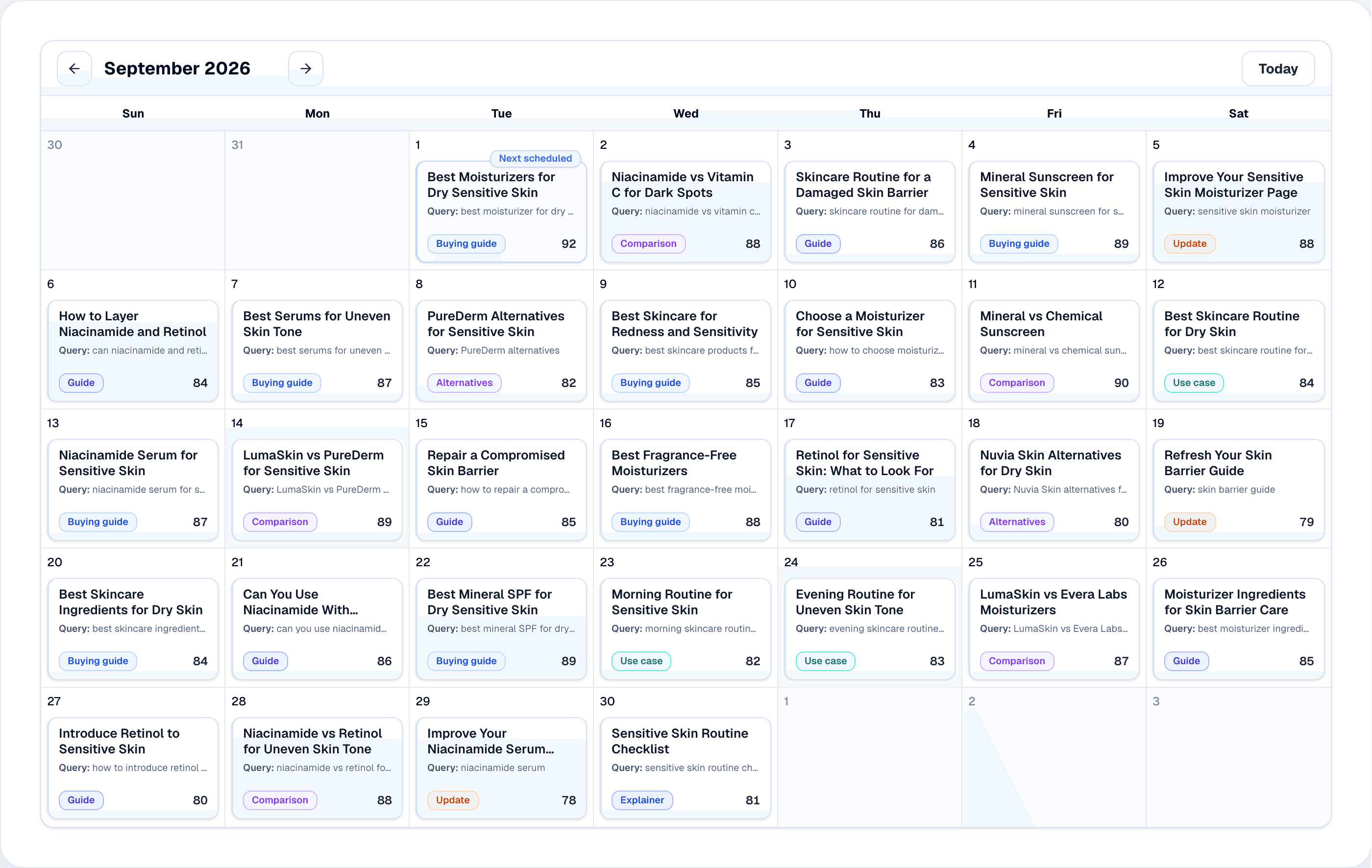
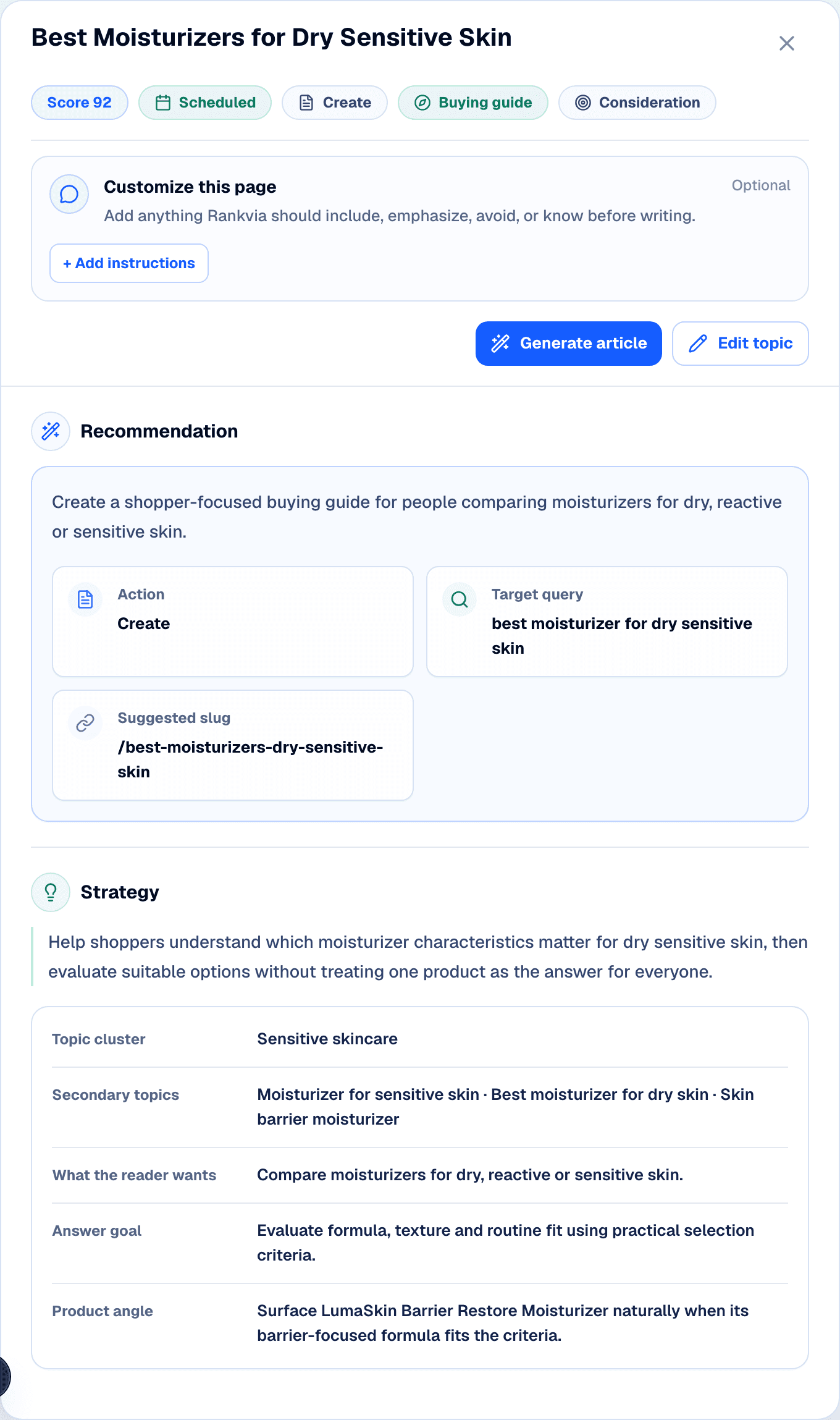
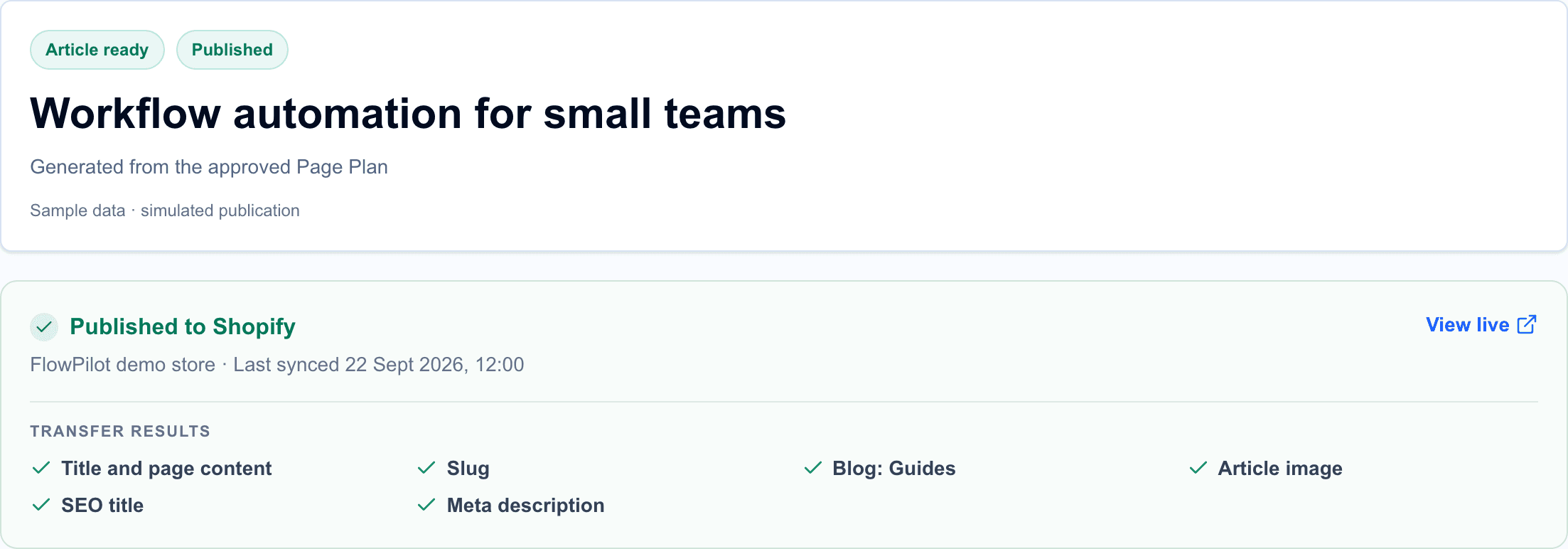
These are product interface examples; figures shown are illustrative demo-store data.
2. Soro - for automated recurring AI blog production
Soro advertises keyword research, a content calendar, branded AI writing, long-form articles and scheduled or automatic publishing to connected websites including Shopify. It is a genuine content automation competitor, not a simple prompt-based text generator. Its public pricing starts at $39/month.
Choose Soro if your immediate goal is an automated rhythm of new posts with low manual effort. Consider Rankvia if you care especially about using sampled AI Visibility findings, current SERP context, optional GSC evidence and existing-page ownership to decide whether to create or improve before generating. I did not establish Soro's exact equivalent to that particular end-to-end decision process from the reviewed public descriptions; this is not proof that the feature is absent.
3. Avada AI SEO Image Optimizer - for technical and on-page SEO
Avada AI SEO Image Optimizer focuses on image optimization, speed improvements, metadata, structured data, site audits and related technical controls. Its listing offers a free plan and Pro at $34.95/month, with a seven-day trial of paid plans.
Choose Avada when the important tasks are improving image delivery, fixing metadata and resolving technical issues across a catalog. Its AI credits and content-related assistance make it broader than a pure compressor. Choose Rankvia when the work you are buying is ongoing search-opportunity discovery, editorial page planning, creation/improvement and Shopify publication. These are complementary problems, not identical substitutes.
4. Tiny SEO Speed Image Optimizer - for speed, images and audits
Tiny SEO offers image optimization, alt text, audits, schema, speed-related features and an AI Blog builder in a paid tier. It has a free plan, Beginner at $14/month, and additional advanced options including GSC insights in the Expert tier.
Choose Tiny SEO for image-heavy stores where speed and technical cleanup are the bottleneck. Consider Rankvia when you want content decisions tied to search demand and visibility evidence rather than primarily technical remediation. Tiny's blog and search features are genuine, so do not assume it has no content capabilities.
5. SearchPie - for broad technical SEO automation
SearchPie: AI SEO & Schema advertises SEO health and AI-readiness monitoring, metadata generation, schema, image and speed optimization, sitemaps, broken-link handling and premium product-description tools. Its Starter plan is free; Premium starts at $39/month.
Choose SearchPie for a broad store SEO-fix toolkit with structured-data and technical automation. Choose Rankvia when the primary need is a recurring Content Calendar, SERP-informed Page Plans, Create/Improve decisions and publishing. SearchPie also advertises AI-related capabilities; an equivalent buyer-question-to-content workflow was not established in the reviewed product documentation.
6. Smart SEO - for bulk on-page optimization
Smart SEO AI & Image Optimizer provides broken-link checks, image optimization, AI generations, metadata, alt tags, sitemaps and audits, with paid features including GSC integration, JSON-LD, bulk work and indexing tools. It offers a free plan, and Pro starts at $14.99/month.
Choose Smart SEO for efficient repetitive fixes across many Shopify pages. It is particularly worth comparing when you want bulk metadata and image workflows. Choose Rankvia for a different operating model: start with the buyer opportunity, determine the correct page, produce or improve the content and publish it. GSC is not exclusive to Rankvia - how that evidence is used for planning is the meaningful distinction.
7. Booster AI SEO + AEO Optimizer - for SEO maintenance on autopilot
Booster AI SEO + AEO Optimizer covers SEO audits, automated metadata and alt text, broken links, snippets, sitemaps and image compression on higher plans. It offers a free tier, with Pro starting at $39/month. Its Premium plan lists Google Search Console metrics.
Choose Booster when your definition of automation is detecting and fixing known store SEO issues with minimal maintenance. Choose Rankvia when you want to automate content growth decisions as well as content generation. The tools automate different kinds of work.
Rankvia vs StoreSEO: which should you choose?
| Your main requirement | Rankvia | StoreSEO |
|---|---|---|
| Bulk product metadata and alt text | Not its primary workflow | Strong fit |
| Image compression, image SEO and schema | Separate tool may be appropriate | Strong fit |
| Keyword research and GSC connectivity | Yes; optional GSC planning evidence | Yes; tools and reporting vary by plan |
| AI content/blog capabilities | Yes | Yes |
| AI Visibility for sampled buyer questions and competitors | Documented workflow | Exact comparable monitoring workflow not established in the reviewed materials |
| SERP-informed Create vs Improve page decisions | Explicit planning workflow | Exact equivalent not established in reviewed materials |
| Contextual internal links in generated content | Supported | Confirm relevant plan/workflow before comparing |
| Recurring Content Calendar and Page Plans | Core workflow | Exact comparable end-to-end workflow not established |
| Shopify product/collection bulk optimization | Not the primary function | Strong fit |
| Supported Shopify editorial publishing | Yes, review-first or eligible auto-publish | AI blog publishing advertised |
Our recommendation: If your store already handles technical SEO but lacks a consistent way to identify and publish useful content, choose Rankvia. If your main problems are missing alt text, unoptimized images, structured data or bulk product metadata, StoreSEO may be the more direct purchase. Many stores can sensibly use both.
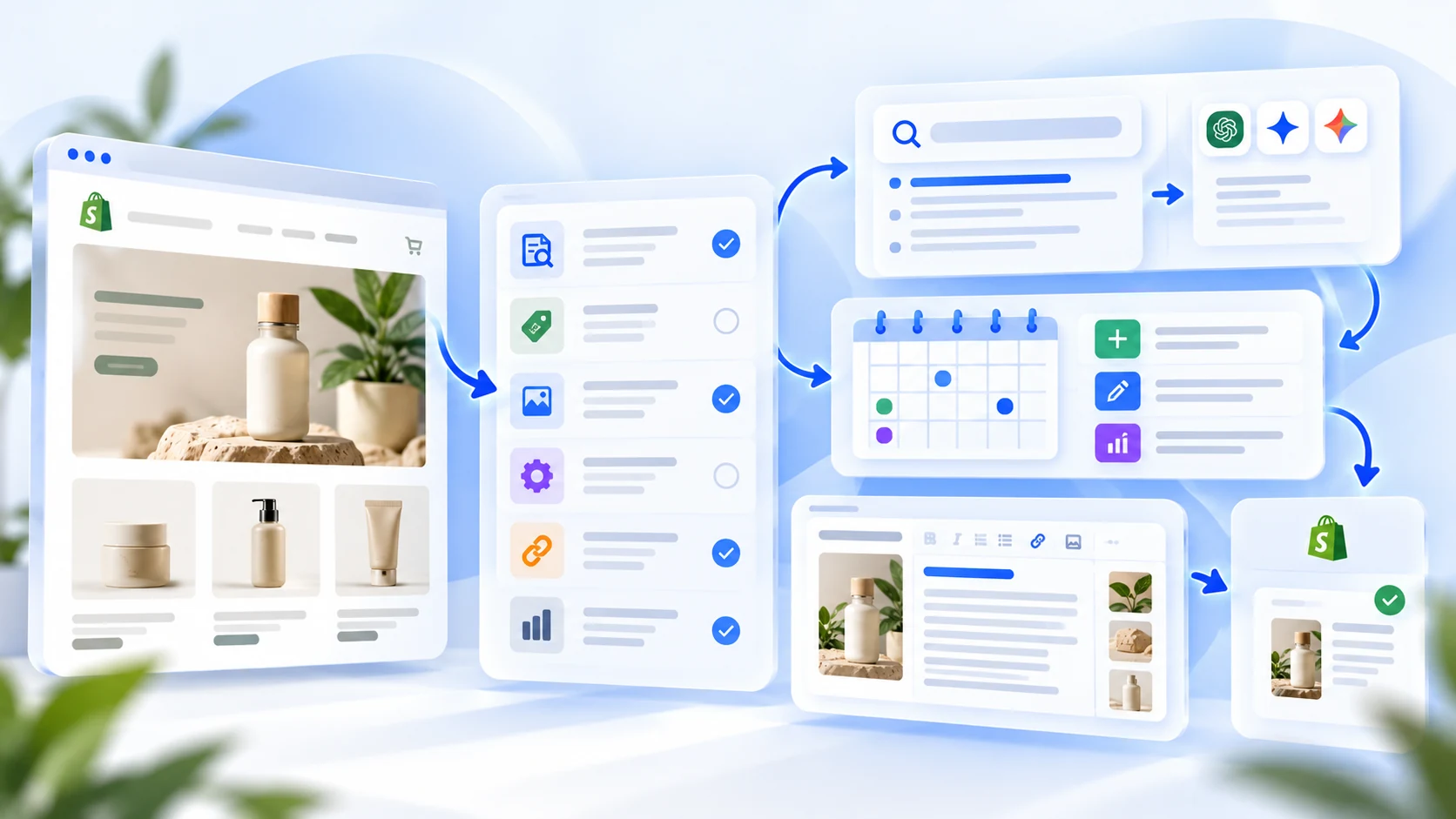
How Rankvia turns a search opportunity into published Shopify content
- Understand the store. Analyze your website, then approve the Business Profile, including products, audience, market and content language.
- Review available evidence. Rankvia can use search demand, SERP results, existing pages, AI Visibility evidence and optional connected GSC data.
- Choose the right action. Prioritize a new page, improve an existing one, monitor the opportunity or skip it when no action is justified.
- Plan before writing. Check the Content Calendar and Page Plan: target need, page type, angle, supporting evidence and relevant links.
- Generate or improve. Create a brand-aware SEO article or supported page improvement, including contextual links and metadata for review.
- Publish to Shopify. Use review-first publishing or enable supported automatic publishing. The selected destination and permissions still matter.
Use actual Rankvia AI Visibility, Content Calendar, Page Plan and publishing screenshots in the finished page. The illustration accompanying this article is not a screenshot or a performance demonstration.
Automate your Shopify SEO content with Rankvia →
Which StoreSEO alternative is right for you?
You want more qualified organic discovery, but don't know what to publish: Rankvia. It connects research, AI-search observations and existing-page decisions to actual content output.
You want a steady stream of AI blogs: Soro is worth comparing. Check editorial safeguards and whether its content decisions fit your existing site.
Your store is slow or image-heavy: Tiny SEO or Avada could address the bottleneck more directly.
Your product pages need metadata, schema and technical fixes at scale: StoreSEO, Smart SEO, SearchPie or Booster may be more appropriate.
You need both technical maintenance and content growth: Consider keeping a technical SEO app and adding Rankvia rather than replacing a functioning tool solely to consolidate vendors.
Frequently asked questions
Is Rankvia a complete replacement for StoreSEO?
Not for every use case. Rankvia specializes in research-driven SEO content planning, generation, improvement and supported publishing. StoreSEO has dedicated product metadata, image optimization, schema and other technical SEO capabilities.
Is there a free StoreSEO alternative?
Several listed alternatives offer ongoing free tiers, including Avada, Tiny SEO, SearchPie, Smart SEO and Booster. Rankvia offers an eligible free website preview, not an ongoing free Shopify subscription. Compare free-tier limits before choosing.
Can Rankvia publish articles directly to Shopify?
Yes, for supported blog articles and standalone pages through its Shopify integration, subject to setup, permissions and selected review or automatic publishing settings. It does not automatically rewrite product and collection descriptions in bulk.
Does Rankvia use Google Search Console?
Yes, if connected. It can use first-party query and page-performance evidence alongside other inputs in planning. StoreSEO and several competitors also have GSC-related functionality; the distinction is Rankvia's connected search-content planning process.
Can Rankvia improve an existing Shopify article instead of creating another?
Its workflow can recommend and prepare improvements to the right existing editorial page when available evidence supports that decision. This is not a promise of automatic, uncontrolled rewrites to every old article.
Does creating SEO content guarantee ChatGPT recommendations or Google rankings?
No. Rankvia helps select and execute useful opportunities. Search engines and AI-answer systems ultimately decide which content appears. Use measurable performance and visibility evidence to evaluate results.
Final verdict
For merchants searching for StoreSEO alternatives because they want a real SEO content engine, Rankvia is our first choice. It goes from search and AI Visibility evidence to Create/Improve decisions, Page Plans, brand-aware content and Shopify publishing - without requiring you to piece together a separate research, planning and writing workflow.
If StoreSEO already handles your technical SEO well, you do not need to remove it to benefit from Rankvia.
Install Rankvia on Shopify →
See the Rankvia Shopify workflow · Try the eligible free website preview