Guides SEO vs GEO
SEO + GENERATIVE ENGINE OPTIMIZATION
SEO vs GEO: What's the Difference?
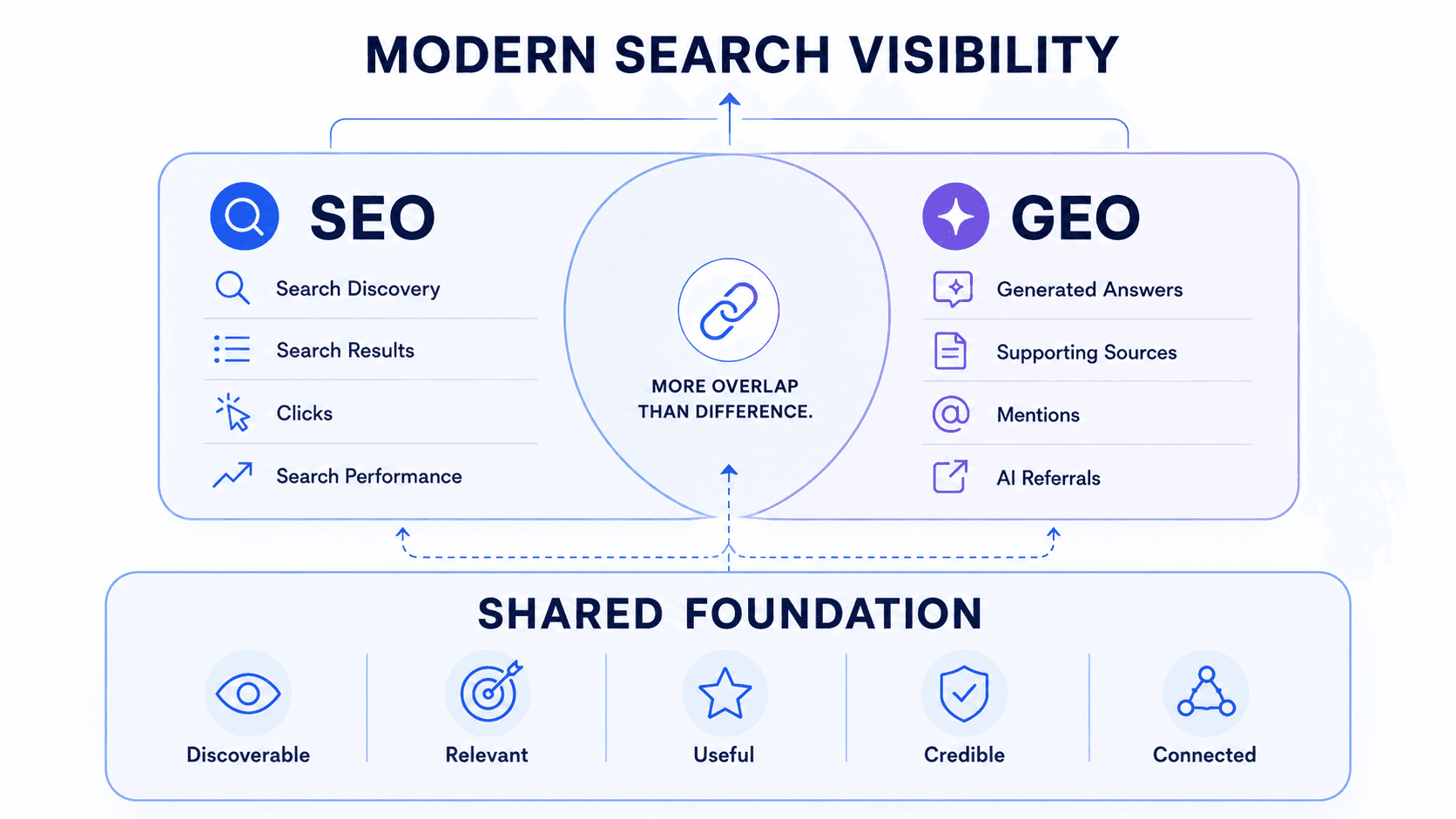
SEO and GEO overlap far more than they differ. Search Engine Optimization (SEO) builds the technical, content, relevance and website foundations that help information get discovered in search. Generative Engine Optimization (GEO) adds a specific focus on how that information can surface inside generative search and answer experiences such as Google AI Overviews and AI Mode, ChatGPT Search and Perplexity.
GEO does not replace SEO.
For Google specifically, the distinction is especially narrow. Google says its generative Search features rely on its core Search ranking and quality systems and explicitly says that, from Google's perspective, optimizing for generative AI Search remains SEO.
By Rankvia ·
SEO vs GEO at a glance
SEO and GEO are easier to understand when GEO is treated as an extension of search visibility rather than an independent replacement system.
| Dimension | SEO | What GEO adds |
|---|---|---|
| Foundation | Crawlability, indexability where relevant, relevance, useful content and website architecture | Usually builds on those same foundations |
| Primary visibility | Search results and other search surfaces | Generated answers, supporting sources, mentions and AI referrals can become additional surfaces |
| User journey | A user commonly chooses a result before consuming the page | A user may receive a synthesized answer before choosing a source |
| Platform controls | Search-engine-specific crawling and indexing controls | Other generative systems may expose additional crawlers and access controls |
| Content strategy | Match a real search intent with the right page | Usually strengthen the same page rather than create a separate AI version |
| Measurement | Impressions, positions, clicks and conversions | Adds generative impressions where available, AI referrals and controlled visibility monitoring |
| Replacement? | Remains foundational | Extends visibility thinking rather than replacing SEO |
The central distinction is:
GEO expands what search visibility can mean. It does not remove the foundations SEO already established.
Where SEO and GEO overlap
The overlap is larger than many SEO-vs-GEO comparisons imply.
1. Discoverability
Relevant systems need a way to access or retrieve the information.
For Google, AI Overviews and AI Mode use normal Search eligibility. To be eligible as a supporting link, a page must be indexed and eligible to appear in Google Search with a snippet. Google says there are no additional technical requirements specific to those AI features.
Other systems expose different access mechanisms, but the general publishing principle is straightforward: a platform has fewer opportunities to surface information it cannot access.
2. Relevance
A page should exist because it serves a real question, problem, comparison or decision.
GEO does not make search intent obsolete.
Google's current generative-AI guidance specifically warns publishers away from unnecessary query-variant tactics and recommends prioritizing effective SEO, useful content and clear technical structure over supposed AEO/GEO tricks.
A useful planning question remains:
What distinct user need should this page own?
That is a Rankvia content-planning principle, not a Google ranking rule.
3. Useful information
A page does not become valuable because it is labelled "GEO-optimized."
Useful pages can contribute:
- original experience;
- specific examples;
- meaningful comparisons;
- primary-source synthesis;
- practical decision criteria;
- original data or analysis;
- a clear explanation of a difficult subject.
Google's current guidance tells publishers to focus on unique, valuable, reliable, people-focused content rather than special generative-search tricks.
4. Credibility
Important claims should be accurate, specific and supportable.
For fast-changing subjects, readers should be able to distinguish:
- documented platform behavior;
- research findings;
- editorial recommendations;
- unverified hypotheses.
That is a Rankvia editorial standard, not a claimed GEO ranking factor.
5. Website relationships
Useful pages should fit coherently into the wider website.
Internal links can connect:
- broader topics;
- supporting guides;
- product or service pages;
- comparisons;
- next-step information.
Google explicitly lists making important content easy to find through internal links among the SEO practices that remain relevant to its AI Search features.
So GEO should not be reduced to optimizing isolated sentences for citation.
The wider website still matters.
What GEO adds beyond traditional SEO
If the foundations overlap heavily, what does GEO add?
The clearest answer is: additional visibility surfaces, platform-specific access considerations and new measurement signals.
1. The visibility surface expands
Traditional SEO commonly measures outcomes such as:
- search impressions;
- positions;
- clicks;
- organic landing-page traffic;
- conversions.
Generative search can introduce additional outcomes depending on the platform:
- appearing as a supporting source;
- receiving a citation or link;
- having information incorporated into an answer;
- receiving a brand or product mention;
- generating an AI-search referral;
- appearing in dedicated generative-search reporting.
A citation is therefore one possible GEO outcome.
It is not the definition of GEO.
2. A user may encounter the answer before the page
Generative systems can synthesize an answer before a user selects a source.
Google says AI Overviews and AI Mode may use query fan-out, issuing several related searches across subtopics and data sources while developing a response.
OpenAI says ChatGPT Search may similarly rewrite a user's request into one or more targeted queries sent to search providers.
This does not mean publishers should create a separate URL for every possible subquery.
Google's current guidance explicitly pushes in the opposite direction by discouraging unnecessary query-variant tactics and special AI rewriting.
3. Platform-specific discovery controls differ
This is one of GEO's clearest additional considerations.
Google's AI Overviews and AI Mode remain part of Google Search. Googlebot is the crawler for Google Search, and normal Search eligibility remains foundational.
ChatGPT Search
OpenAI says publishers who want content included in ChatGPT Search summaries and snippets should allow OAI-SearchBot. OpenAI also says the site's host or CDN may need to allow traffic from its published IP addresses.
Its current public publisher guidance does not document a way to secure top placement in ChatGPT Search.
Perplexity
Perplexity says PerplexityBot is designed to surface and link websites in Perplexity results and recommends allowing the crawler in robots.txt plus its published IP ranges when that visibility is desired. Perplexity also says the bot is not used to crawl content for foundation-model training.
Crawler access affects discovery or eligibility.
It does not establish a guaranteed source position or citation.
4. Measurement becomes more fragmented
SEO benefits from mature first-party reporting such as Google Search Console.
Generative visibility is less uniform across platforms.
Google now provides dedicated Search Generative AI Performance reporting to Search Console properties worldwide. ChatGPT Search referrals can be identified when referrer information or URL tagging is available.
Other forms of GEO measurement may require controlled monitoring rather than one standardized ranking metric.
So GEO often adds a measurement layer as much as an optimization layer.
For Google, is GEO really different from SEO?
Not as much as some GEO marketing suggests.
Google's current guidance is unusually explicit.
Google says generative Search is still SEO
Google says its generative AI Search features rely on its core Search ranking and quality systems. Google's May 2026 guide acknowledges terms such as AEO and GEO but says that from Google's Search perspective, optimizing for generative AI Search remains SEO.
For Google, GEO is therefore not a separate replacement technical system.
Normal Search eligibility still applies
To be eligible as a supporting link in AI Overviews or AI Mode, a page must be indexed and eligible to appear in Google Search with a snippet.
Google explicitly says meeting its requirements does not guarantee crawling, indexing or serving.
Google does not require special AI schema
Google says structured data is not required for generative AI Search and that no special Schema.org markup is necessary. Standard structured data can still be useful as part of ordinary SEO and rich-result eligibility.
Adding invented types such as:
- GEO;
- AIContent;
- AICitation;
does not create a documented Google Search advantage.
Google Search completely ignores llms.txt
Google's current guidance is explicit: Search does not use llms.txt or equivalent special AI text files.
Maintaining one for another system is fine, but Google says it neither helps nor harms Google Search visibility or rankings because Google Search ignores it completely.
Google does not require AI-specific content chunks
Google says publishers do not need to split content into small pieces so its AI can understand it. Google also states that there is no ideal page length for generative Search.
Clear structure remains good editorial practice.
It should not be described as a special AI-ranking requirement.
You do not need to rewrite content specifically for Google's AI Search
Google explicitly says content does not need to be written in a special way solely for generative AI Search. Its systems can understand synonyms and general meaning rather than requiring every search wording to be reproduced exactly.
That supports a unified content strategy instead of separate "SEO" and "AI" copies.
Googlebot and Google-Extended are different controls
Googlebot crawls for Google Search.
Google-Extended is a separate robots token controlling certain uses of crawled content for Gemini model training and grounding. Google says it does not affect inclusion in Google Search and is not a Search ranking signal.
So Google-Extended should not be presented as an AI Overview or AI Mode visibility switch.
Why GEO can still be useful beyond Google
Google is only one search environment.
OpenAI and Perplexity expose their own crawler/access controls, and their search experiences do not mirror Google's implementation exactly.
GEO can therefore remain useful as a broader cross-platform visibility concept even though, within Google Search itself, much of the work remains SEO.
Does GEO replace SEO?
No.
A GEO strategy cannot compensate for foundational search problems such as:
- blocked crawling;
- indexability problems;
- unnecessary page overlap;
- weak architecture;
- poor internal linking;
- unclear intent;
- low-value content.
For Google's generative Search features, normal Search eligibility remains foundational.
A useful Rankvia sequence is:
Build the SEO foundation. Add a GEO lens where generative-search visibility creates additional opportunity.
For a deeper definition of the category, see What Is GEO? Generative Engine Optimization Explained.
When is SEO enough - and when should you add a GEO lens?
There is no platform-published rule dividing work neatly into "SEO" and "GEO."
The following is Rankvia's practical decision framework for prioritizing effort.
| Situation | Recommended emphasis | Why |
|---|---|---|
| Crawl or indexing problems | SEO foundation first | Fix basic discoverability before prioritizing additional generative visibility |
| Broken architecture or internal linking | SEO foundation first | Repair underlying website relationships first |
| General informational search | SEO first + GEO awareness | Strong intent coverage remains central, while generative exposure may add visibility |
| Local or service discovery | SEO first + GEO where relevant | Search/local fundamentals remain central; generative discovery varies by query and platform |
| Product or category research | SEO + GEO lens | Buyers may research categories through both ranked and generated experiences |
| Comparison and alternative searches | SEO + GEO lens | These tasks naturally involve evaluation and synthesis |
| SaaS or tool recommendations | SEO + GEO lens | Recommendation questions can occur across both search and generative-search experiences |
| Brand visibility in ChatGPT or Perplexity | GEO layer on SEO foundation | Platform-specific access and measurement become directly relevant |
| Google AI Overviews or AI Mode | SEO foundation + generative measurement | Google's own guidance keeps SEO foundational |
| Branded navigational search | Primarily SEO | Incremental generative visibility may be less important when the destination is already known |
This framework prioritizes effort.
It does not mean a page marked "SEO first" cannot surface in generative search.
The useful question is not:
SEO or GEO?
It is:
How much additional GEO thinking does this search opportunity need?
You usually do not need separate SEO and GEO content
One of the least useful responses to AI search is creating:
- one SEO article;
- one ChatGPT version;
- one "LLM-friendly" page;
- several URLs for minor query variants.
For the same underlying intent, that is usually unnecessary.
For Google specifically, the primary-source guidance is clear: Google says there is no need to rewrite content specifically for generative AI Search, no need to split it into special chunks, and no need to capture every query variation with separate wording or pages.
A stronger Rankvia workflow is:
- identify the underlying user need;
- determine whether an existing page already owns it;
- create or improve the right page;
- make it technically discoverable;
- answer the need clearly and credibly;
- connect it to the rest of the website;
- account for relevant platform-specific access and measurement.
One intent, one strong page
Different wording does not automatically mean different intent.
For example:
- "SEO vs GEO"
- "GEO vs SEO"
- "difference between SEO and GEO"
can reasonably belong to one comprehensive comparison page.
Google specifically says publishers do not need to capture every exact wording variation because its systems can understand meaning and synonyms.
Create another page when the task changes
A separate URL can make sense when the reader needs something genuinely different:
- What is GEO? -> definition
- SEO vs GEO -> comparison
- How to optimize for AI search -> implementation
- How to appear in ChatGPT Search -> platform-specific guidance
The justification for another page is a different user task, not a different acronym.
Add platform-specific access and measurement instead
The incremental GEO layer often belongs in:
- crawler/access configuration;
- platform-aware measurement;
- controlled source monitoring;
- understanding how buyers use different search experiences.
So the Rankvia recommendation is:
Do not build separate SEO content and GEO content by default. Build the strongest page for the intent, then expand how you think about discovery and visibility.
What changes in an SEO + GEO workflow?
The core search workflow does not disappear.
It becomes broader.
A simplified traditional SEO workflow
- Search demand
- Intent
- Create or optimize the page
- Publish
- Search visibility and traffic
- Conversions
Rankvia's SEO + GEO workflow
Rankvia recommends:
- Business context
- Buyer search or question
- Current search landscape
- Existing-page ownership
- Page strategy
- Create or improve the page
- Publish and connect it
- Google + AI-search visibility
- Traffic / mentions / conversions
This is Rankvia's planning methodology, not an industry-standard ranking model.
The main additions are:
- understanding the business before choosing topics;
- checking whether an existing page already owns the opportunity;
- defining page strategy before generation;
- connecting the page to the wider site;
- measuring generative visibility alongside conventional search performance.
Rankvia's current live Product page reflects this broader workflow through Business Profile, Search Growth Plan, Content Calendar and Page Plan stages.
Common SEO vs GEO misconceptions
"SEO is for Google and GEO is for ChatGPT"
Too simplistic.
Google itself has generative Search experiences through AI Overviews and AI Mode, and Google says these features remain grounded in its core Search systems and SEO.
Meanwhile, ChatGPT and Perplexity expose their own search and access mechanisms.
The distinction is about visibility surfaces and platform mechanics, not simply "Google vs AI."
"GEO replaces SEO"
It does not.
For Google, SEO foundations directly underpin eligibility for generative Search features.
"Every AI engine needs the same optimization"
There is no documented universal cross-platform GEO algorithm.
Google, OpenAI and Perplexity expose different systems and publisher controls.
Treat platform-specific guidance as platform-specific.
"GEO means writing differently for robots"
Not for Google's generative Search.
Google explicitly says content does not need to be specially rewritten, fragmented or converted into a unique AI format.
Clear writing remains valuable because it helps readers.
Do not turn good editorial practice into an unsupported universal AI-ranking claim.
How should SEO and GEO be measured together?
SEO and GEO are best measured as related visibility layers rather than one universal combined score.
SEO measurement
Common SEO signals include:
- impressions;
- average position;
- clicks;
- landing-page traffic;
- conversions.
Additional GEO measurement
Depending on the platform, useful additional evidence may include:
- generative-search impressions;
- pages appearing in generative experiences;
- AI-search referral traffic;
- controlled observation of source appearances;
- monitored brand mentions;
- conversions associated with generative discovery.
Not all of these are standardized platform metrics.
Google launched dedicated Search Generative AI Performance reports in Search Console on June 3, 2026.
The reports provide impressions from generative AI Search features and dimensions including pages, countries, devices and dates. Google says the same underlying data remains included in overall Search performance reporting.
Google confirmed that these reports reached all websites worldwide on August 31, 2026.
ChatGPT
Where referrer information or URL tagging is available, such as:
utm_source=chatgpt.com
publishers can identify inbound ChatGPT Search traffic in analytics.
OpenAI's current public publisher guidance does not publish a conventional fixed ranking position equivalent to a stable Google SERP rank or document a way to secure top placement.
Other generative-search systems
Where comparable first-party publisher reporting is unavailable, controlled monitoring can supplement referral analytics.
Treat those observations as samples, not permanent rankings.
The safest principle is:
Measure each platform using the strongest evidence it exposes, then connect that visibility to business outcomes.
Do not collapse the result into an invented universal GEO score.
Related guides
SEO and GEO: How to Get Found in Google and AI Search
The broader strategy for one connected approach across conventional and generative search.
What Is GEO? Generative Engine Optimization Explained
The dedicated definition and fundamentals of GEO.
AI Search Optimization: How to Get Found in AI Search
The practical cross-platform implementation workflow.
AI Search Content Strategy
Decide what your website should create, improve or skip.
Sources
Frequently asked questions
BUILD YOUR SEARCH GROWTH PLAN
Build one search strategy for Google and AI search.
Enter your website and Rankvia will analyze your business, identify relevant search opportunities and build the strategy for what to publish next.
Personalized to your website · No credit card required