
Guides Shopify content strategy: Decide what deserves to exist before you publish
SHOPIFY CONTENT STRATEGY
Shopify content strategy: Decide what deserves to exist before you publish
Build a Shopify content strategy that decides what to create, improve, or skip across products, collections, guides, and comparisons before you schedule it.
By Rankvia ·
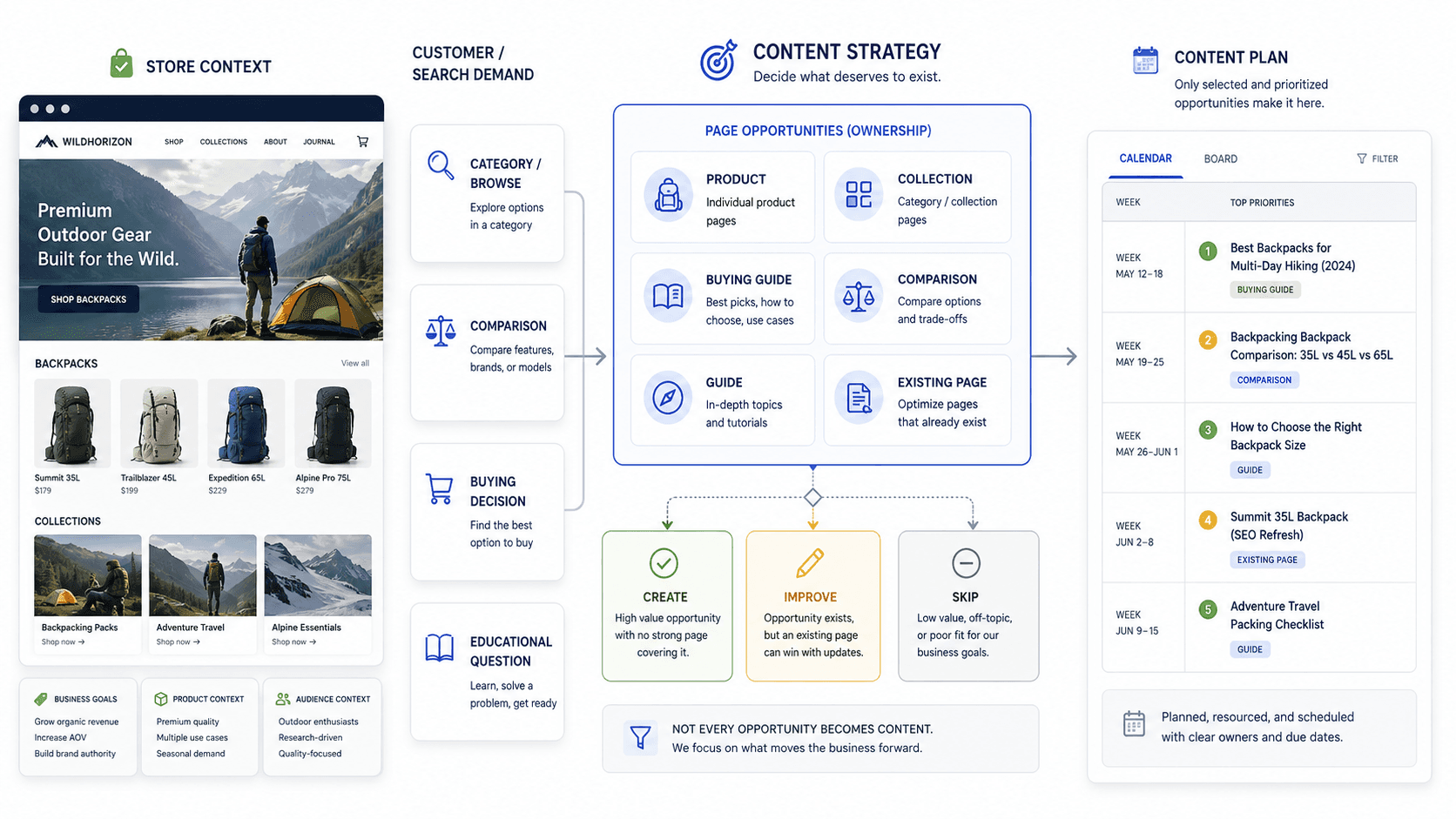
Most Shopify content strategies start with a list: keywords to target, blog posts to write, content pillars to build, or dates to fill in a calendar.
That is useful work, but it starts one step too late.
Before deciding what to publish next Tuesday, you need to know whether the page deserves to exist at all. If it does, what should own the need - a product, a collection, a buying guide, a comparison, an educational page, or something the store already has?
A useful Shopify content strategy is the system for making those decisions. It connects the business and its products to real customer and search needs, checks the existing site, decides whether the right action is Create, Improve, or Skip, and determines what deserves priority.
Only then does the calendar become useful.
Shopify makes a similar distinction in its own content-planning guidance: strategy defines the higher-level purpose, audience, subjects, and channels, while planning turns those decisions into specific topics, formats, workflows, and publication dates. (Shopify - Content Planning)
The distinction matters because a real Shopify store is not an empty content repository. It already has products, collections, guides, search history, internal links, customer questions, and commercial priorities. A strategy should account for that before it adds another URL.
The Shopify content-strategy loop
1. Content strategy starts before the calendar
A content calendar is useful because it brings order to execution. It can tell you what is scheduled, when it should publish, who owns it, and where it sits in the workflow.
It cannot tell you whether the underlying idea was good.
Content strategy vs content calendar
| Content strategy decides | Content calendar manages |
|---|---|
| Customer or search need | Publish date |
| Why it matters | Status |
| Page owner | Assignee |
| Page type | Due date |
| Create / Improve / Skip | Workflow |
| Commercial role | Sequence |
| Priority | Publication |
The calendar tells you when content ships. The strategy decides whether it should exist.
The difference becomes obvious once a store has been publishing for a while.
Take a clothing brand with these six ideas waiting in its calendar:
10 benefits of linen why wear linen in summer best summer fabrics linen vs cotton how breathable is linen men's linen shirts
On a blank website, several of those might deserve pages. But this store already has a strong Men's Linen Shirts collection, an existing Linen vs Cotton guide, and a materials page that explains breathability.
Scheduling six pieces would be easy. Deciding whether the store actually needs six pieces is the strategic work.
2. Start with the store - not an empty keyword list
Keyword research is useful because it exposes demand. What it cannot do by itself is understand what matters to your business.
A tool might show a skincare brand strong interest around:
best retinol for beginners
That does not tell you whether the brand sells retinol, whether its formulation is genuinely appropriate for beginners, whether the store already has a page gaining visibility for that need, or whether retinol is strategically important to the business right now.
Those questions are not secondary. They determine whether the keyword deserves investment in the first place.
Before generating a long list of topics, get clear on the commercial reality: what the store sells, which categories matter, what customers are trying to decide, what makes the offer distinct, and what useful pages already exist.
Search research can then expand that understanding instead of replacing it.
Where useful opportunities come from
| Source | What it can reveal |
|---|---|
| Customer support | Repeated questions and objections |
| Onsite search | What visitors expect to find |
| Reviews | Language customers use around needs and outcomes |
| Search Console | Queries and pages already earning visibility |
| Keyword research | Broader external search demand |
| SERPs | What page types currently satisfy the need |
| Competitors | Gaps, category norms, and overused angles |
| Sales/customer conversations | Buying criteria and hesitation |
| Product catalog | Use cases, comparisons, compatibility, decisions |
Shopify's current content-research guidance similarly connects the products a business sells with the information customers need before they can make confident decisions. (Shopify - Content Research)
A search query gets an opportunity onto the table.
It does not decide what happens next.
3. Build a content portfolio - not a blog list
A common ecommerce mistake is to use content as shorthand for blog posts.
The store already contains content before the first article is published. Product pages explain individual products. Collections organize categories. Buying guides and comparisons help people choose. Educational pages answer earlier questions. Existing pages continue to accumulate search history and internal links.
Content strategy is about deciding how those pieces should work together.
Shopify Content Portfolio Matrix
| Portfolio layer | Typical pages | Customer job | Commercial relationship |
|---|---|---|---|
| Commercial owners | Products, collections | Evaluate or browse | Direct |
| Decision support | Buying guides, comparisons, use cases | Choose | Strong supporting |
| Education | How-to and problem guides | Understand | Indirect |
| Existing owners | Any relevant existing page | Serve an existing need better | Improve |
| Authority assets | Research, tools, original data | Learn or reference | Authority / indirect |
There is no ideal percentage for each category, and trying to invent one usually creates more certainty than the business deserves.
A store selling a familiar commodity may need relatively little educational content. A company introducing an unfamiliar supplement or technical product may need considerably more explanation before the customer is ready to compare products. A retailer with a wide assortment may depend heavily on collections and buying guides, while a single-product brand may have fewer useful commercial destinations and need more supporting education.
The interesting decisions are usually at the boundaries.
A product page may already be enough. A collection may be the better owner than an article. A useful educational guide can be worthwhile even when it does not send the reader directly to checkout. And on a mature store, the best content investment may simply be improving a page that already exists.
Some topics are not worth owning at all, even when the search volume looks attractive.
That is portfolio management. It is very different from filling a blog calendar.
4. Decide what should own each customer or search need
Once you find a useful opportunity, the next question is not automatically:
What article should we write?
It is:
What should serve this need?
Possible owners include a product, collection, buying guide, comparison, educational page, an existing page, or no new page at all.
What should this opportunity become?
| Need | Likely owner | Example | Action if owner exists |
|---|---|---|---|
| Specific product | Product | Brand X 500ml glass bottle | Improve |
| Product category | Collection | glass water bottles | Improve |
| Product selection | Buying guide | best water bottle for hiking | Improve |
| Tradeoff | Comparison | glass vs stainless steel bottle | Improve |
| How/why question | Educational guide | how to clean a glass bottle | Improve |
| Already-covered need | Existing page | Related query variation | Improve / Skip |
| Weak business fit | None | Unrelated high-volume topic | Skip |
The matrix is deliberately a starting point rather than a deterministic rule.
A query such as:
vitamin c serum for sensitive skin
is exactly the kind of phrase that can look like an obvious blog opportunity until you inspect the catalog and the current SERP.
A retailer with six genuinely suitable sensitive-skin serums may have a collection problem: shoppers want to browse relevant products, and the store needs a useful category destination.
A brand selling one hero serum may have a different problem. The product page may need to own the commercial part of the search, with supporting education elsewhere.
A third store may discover that its products are not especially suited to the need at all.
The phrase alone does not settle the decision.
The same is true for a furniture store. oak dining tables probably suggests a collection. what size table seats six people is more likely to need editorial decision support. round vs rectangular dining table asks for a comparison. But the final choice still depends on what already exists and what the store can genuinely offer.
A topic doesn't become an article simply because a keyword tool found it.
5. Create, Improve, or Skip before adding another topic
New content has an operational advantage: it is easy to count.
You published twelve articles. The spreadsheet moved forward. Something visibly happened.
Improving an existing collection or consolidating two old guides can feel less productive even when it is the better investment.
That bias becomes expensive on established stores.
A new Shopify site may genuinely lack the page it needs. A store that has been operating for four years often has something close enough that the more interesting question is whether the existing owner should be strengthened.
Create / Improve / Skip
Create when the need is genuinely missing
An outdoor retailer might sell a wide range of ultralight tents but have no useful page helping a solo backpacker decide whether a one-person or two-person tent makes more sense.
If that is a meaningful buying decision, the store has enough relevant products to support it, and no current page serves the need well, a comparison or buying guide may deserve to exist.
Improve when the right owner is already there
The same retailer may already have:
/guides/how-to-choose-a-backpacking-tent
and Search Console may show impressions for:
1 vs 2 person backpacking tent; tent size for solo hiking; should I buy a two person tent alone.
At that point, three new articles are not obviously an improvement. The existing guide may already be the correct owner and simply need better coverage. For a practical GSC-to-Shopify update workflow, see how to refresh an existing Shopify blog post.
Even here, Improve is not automatic. A page can be close to the right owner without actually being the right owner. Sometimes the problem is site architecture, the wrong collection, weak product data, or an old URL that should be consolidated or redirected.
Create, Improve, and Skip are useful planning labels because they force the store to consider alternatives to publishing. They are not a substitute for SEO judgment.
Google's people-first guidance also warns against producing large amounts of content across many topics simply in the hope that some of it attracts search traffic, especially when automation is being used primarily to create volume. (Google - Creating helpful, reliable, people-first content)
See how Rankvia plans Create and Improve opportunities.
6. Prioritize content by business value, evidence, and usefulness
Knowing that a page could exist still leaves the harder operating question:
Is this where we should spend the next week?
A store usually has far more plausible opportunities than capacity. Some are commercially close to the product. Others build category understanding. An existing page may already be gaining traction. A seemingly attractive topic may require constant maintenance. A seasonal opportunity might be important now and almost irrelevant three months later.
Trying to compress all of that into one universal opportunity score creates the illusion of precision.
A simpler set of buckets is often more useful.
Content Prioritization Matrix
| Situation | Recommended bucket |
|---|---|
| High business relevance + real need + clear missing owner | DO FIRST |
| High relevance + appropriate existing owner + evidence | IMPROVE FIRST |
| Relevant but lower urgency or weaker evidence | DO NEXT |
| Duplicate, weak fit, poor differentiation, or unnecessary | SKIP / HOLD |
In practice, an operator is balancing several things at once.
A strong opportunity usually has a sensible relationship to what the store sells and to a question customers genuinely have. It also needs a clear role: perhaps it captures category demand, helps someone compare options, supports a product decision, or builds expertise around a strategically important problem.
Evidence helps. Search Console, keyword research, SERPs, support questions, reviews, onsite searches, and customer conversations can all make a case stronger or weaker.
But evidence is not enough by itself. The store also has to be capable of producing a useful answer. Google continues to emphasize first-hand, useful, non-commodity information in its guidance for generative Search. (Google - AI optimization guide)
A high-volume query where the store can contribute nothing beyond another generic summary may be less attractive than a smaller question where it has real product knowledge, original measurements, expert detail, or a strong commercial reason to participate.
Then there is effort. A comparison of fast-changing electronics requires a different maintenance commitment from an evergreen furniture-sizing guide. Inventory and launches can also change the order: a strong SEO opportunity around a product you will discontinue next month is not necessarily a strong business priority.
Shopify's own content-planning guidance recommends accounting for launches, campaigns, seasonal moments, and other business tentpoles when deciding what gets scheduled. (Shopify - Content Planning)
Good prioritization isn't fake mathematical precision. It is disciplined judgment with better evidence.
7. Build topic clusters around customer needs - not keyword variations
Topic clusters are useful when they describe a real area of customer interest.
They become less useful when a team starts with one phrase, exports every related keyword, and assumes each variation deserves a URL.
Take a running-shoe collection:
COLLECTION Running Shoes ↑ ├── How to choose running shoes ├── Running shoes for flat feet ├── Trail shoes vs road shoes └── How long running shoes last
There is a plausible relationship between these pages because they answer different questions around the same commercial area. One helps someone choose, one addresses fit, one compares two categories, and another deals with replacement.
Even then, the lines are not perfectly clean.
how to choose running shoes
and:
how to pick the right running shoe
are probably the same underlying need.
running shoes for flat feet might justify a distinct guide on one store, a collection on another, or merely stronger coverage within an existing buying guide on a third.
The cluster should emerge from genuine customer decisions around a useful commercial owner.
COMMERCIAL OWNER ↓ CUSTOMER DECISIONS AROUND IT ↓ ONLY DISTINCT NEEDS GET PAGES
The alternative - pillar keyword → 30 variations → 30 articles - is easy to produce and difficult to maintain.
Coherent coverage is the aim.
URL volume is not.
8. Use content to support products and collections without forcing the sale
An ecommerce blog can attract meaningful search traffic and still feel almost disconnected from the store.
A cookware brand may rank well for:
how to clean cast iron
That page does not need to turn into a sales page. Someone looking for cleaning advice should get cleaning advice.
But the article can still exist inside a wider customer journey. A natural next step might be a seasoning guide, an explanation of enameled versus raw cast iron, a cast-iron collection, or a care product relevant to the process.
Educational guide ↓ Decision / buying guide ↓ Collection ↓ Product
The path does not always move neatly downward. A collection may link back to a sizing or buying guide. A product page can point to care instructions. One article can lead to another before the visitor is remotely ready to shop.
Shopify's blogging guidance likewise encourages merchants to look beyond raw traffic and consider whether readers take useful next actions inside the store, including relevant product or content links where they make sense. (Shopify - Blog Strategy)
Not every informational page needs a product CTA, and not every useful piece of content will produce immediate revenue. An article can introduce the category, establish expertise, earn references, answer an early question, or bring a future buyer into the brand's orbit.
The question is whether the page has a meaningful role in the portfolio.
Distribution still matters
Once a page earns its place, it does not have to depend exclusively on organic search.
Useful content can also travel through email, social, creators, communities, and other owned or earned channels. Shopify includes channel selection and distribution in its broader content-strategy model. (Shopify Help - Content Marketing)
That is downstream of the page decision, though. Distribution can amplify useful work. It cannot turn a weak idea into a strong strategy.
9. Use Search Console as evidence, not the strategy
Search Console becomes particularly valuable once a store already has history.
It can show which queries Google associates with a page, where impressions are emerging, which URLs are receiving clicks, and whether an existing page already has a foothold around a need you were considering creating from scratch. Google documents query- and page-level performance, including impressions and clicks, for exactly this kind of analysis. (Google - Search Console)
What it cannot tell you is whether a category matters to your business, whether the margin is attractive, whether a product is about to be discontinued, or whether the company can produce a credible answer.
Search Console can reveal evidence. It cannot decide your content strategy.
A running-shoe guide might already receive impressions for:
how to pick running shoes; shoes for overpronation; running shoes for flat feet.
The data tells you Google sees some relationship between those questions and that page. It does not automatically mean you should keep everything on one URL. Nor does it mean three new URLs are justified.
You still need to inspect the actual intent, the page, the store's assortment, and what the reader would need.
Another useful pattern is unexpected ownership. If an educational post starts appearing for women's trail shoes while the relevant collection remains invisible, that deserves investigation. The cause could be collection content, internal linking, the assortment, site architecture, or something technical. Publishing another blog post may simply add another competing candidate.
Near-winners are often interesting Improve opportunities because the right page is already present and showing evidence of relevance. Truly missing owners are stronger Create candidates.
Rankvia's Google Search Console integration uses supported query, page, impression, and performance evidence as an additional input to broader page-ownership, Create/Improve, prioritization, and Content Calendar decisions. (Rankvia - Google Search Console Integration)
Explore Rankvia's Google Search Console integration.
10. AI makes drafting cheaper - not strategy easier
The economics of content production changed quickly.
A first draft that once required several hours can now be produced in minutes. Research can be summarized faster. Outlines can be generated almost instantly. Existing copy can be restructured or rewritten with very little marginal cost.
The temptation is obvious: if publishing got cheaper, publish much more.
That only works if production was the real constraint.
A weak idea can now become a polished weak article much faster.
Google's guidance allows useful applications of generative AI while warning that creating large numbers of low-value pages without sufficient user value can fall under its scaled-content-abuse policies. (Google - Generative AI content guidance)
The important decisions still happen around the draft: Is this relevant to the business? Is there already a better owner? Can the store contribute something accurate and distinctive? Does the proposed page have a useful role? Is anyone going to maintain it?
When drafts are cheap, deciding what deserves a draft becomes the valuable part.
For the Shopify-specific implications of ChatGPT, Google AI, Shopify Catalog, and AI shopping, see:
Shopify AI Search Optimization
11. Turn the strategy into a Content Calendar
Once ownership and priority have been decided, the calendar becomes the useful part it was supposed to be all along: an execution layer.
At this stage, a scheduled item should already carry considerably more meaning than a title.
You know what customer or search need it serves, what page type should own the need, whether the work is Create or Improve, why the opportunity matters, and roughly where it sits relative to everything else the store could do.
The calendar can now handle the operational questions: what comes first, when it should ship, how work is distributed, what is blocked, and where each opportunity sits in the publishing process.
This is also where timing can change an otherwise sound priority. A seasonal buying guide may need to move forward. A collection tied to an upcoming launch may become urgent. Another good topic can wait.
A content calendar without ownership and priority decisions is a schedule, not a strategy.
Rankvia's Content Calendar is built around that broader planning layer: current website coverage, business fit, buyer/search intent, recommended page role, Create/Improve decisions, priority, and scheduling are considered together rather than treating the calendar as a list of titles and dates. (Rankvia - Content Calendar)
12. Measure what each piece was supposed to do
Not every page in the portfolio should be evaluated in the same way.
A collection, buying guide, educational article, and original research asset have different jobs. Treating all four as successful or unsuccessful based on pageviews alone hides more than it reveals.
Content Measurement Matrix
| Content role | Search evidence | Business evidence | What you learn |
|---|---|---|---|
| Discovery | Impressions, clicks, queries | Qualified visits | Whether demand matches |
| Decision support | Query/landing behavior | Relevant next-page actions | Whether the page helps people choose |
| Commercial | Landing-page visibility | Conversions/revenue where measurable | Whether commercial demand is useful |
| Improve | Query/page change | Incremental qualified performance | Whether the update strengthened ownership |
| Authority | Links, references, mentions | Broader brand/search value | Whether the asset adds distinctive value |
Shopify's current content-performance guidance similarly recommends looking across engagement, search, and conversion rather than treating a single metric as universally meaningful. (Shopify - Content Performance Tracking)
Google also separates the jobs of Search Console and Analytics: Search Console is the more direct source for Google Search performance, while analytics tools help explain what visitors do once they arrive. (Google - Analytics and Search Console)
A broad educational guide may bring far more traffic than a buying comparison and still contribute less commercial value. That does not automatically make the educational page a failure. It may be doing exactly what it was meant to do.
The more useful question is whether each part of the portfolio is producing the kind of evidence you expected - and whether that evidence changes what you invest in next.
Over time, you should start seeing patterns. Some new pages earn relevant demand. Some Improve actions make already-useful pages stronger. Certain content types may repeatedly attract the wrong audience. Some pieces turn out to be expensive to maintain for little return.
Those observations should feed the next planning cycle.
13. Build a recurring content decision system
A content strategy becomes outdated the moment it is treated as a document rather than a process.
The business changes. Products launch and disappear. Collections evolve. Search Console reveals demand you did not expect. Some pages become stronger owners over time, while others stop reflecting what the company sells.
The recurring system is:
A small store can run that manually without much trouble.
The operational burden grows with the website. A merchant with hundreds of products, dozens of collections, several years of articles, Search Console history, changing inventory, and multiple contributors is not short of possible content. The harder part is keeping each new opportunity connected to what the store already knows and already owns.
A proposed article needs to be checked against the existing site. Search evidence needs business context. A Create recommendation needs to become a useful plan. An Improve recommendation needs the right existing owner. New pages need connections to the rest of the site. Publishing needs review. Results need to feed the next round of decisions.
That is the recurring work.
14. How Rankvia applies the strategy to a Shopify store
You can operate the entire process manually. In fact, understanding the decisions is useful even if you eventually use software to handle parts of the workflow.
The burden appears when the same reasoning has to be repeated across a growing store: understand the business, inspect what already exists, find relevant demand, determine page ownership, choose Create or Improve, decide priority, plan the selected page, connect it internally, get it through review and publishing, and then revisit the evidence later.
Rankvia is designed to keep that layer connected.
It starts by analyzing the existing website and building an editable Business Profile around the business/store, products or offers, audience, positioning, competitors, and the existing site context used for planning.
That context feeds the Content Calendar, where opportunities are evaluated against the store rather than against a blank keyword list. Rankvia can recommend Create when a useful need lacks an appropriate owner, Improve when an existing page is the stronger starting point, or avoid adding another page where the need is already sufficiently covered. (Rankvia - Content Calendar)
Where Search Console is connected, supported query, page, impression, and performance evidence can be added to those planning decisions. (Rankvia - Google Search Console Integration)
For selected opportunities, Page Plans define the role and direction of the page before generation - including the objective, buyer decision, answer strategy, business context, structure, and relevant internal connections. The generated page follows that plan rather than starting from an isolated writing prompt. (Rankvia - Page Plans)
For Shopify stores, supported content can then move into the Shopify publishing workflow in draft or live states. Merchants can keep review-first publishing or explicitly enable Shopify as the automatic destination for eligible scheduled content. (Rankvia for Shopify)
The operating flow is:
Rankvia does not replace merchandising, technical SEO, CRO, link acquisition, email or social strategy, or human business judgment. Its role is narrower: keeping the website, search, planning, and publishing decisions connected so that producing content does not become disconnected from deciding what was worth producing.
See Rankvia for Shopify.
Worked example: plan useful website content for a new product
Illustrative example. The product facts, planning decisions and Page Plan excerpt below are authored examples for fictional Northtrail, not a customer launch or Rankvia-generated plan.
Northtrail is our fictional outdoor store. For this separate example, it is adding a new fictional product, the Fieldday 18 daypack, for adults choosing a bag for short walks and everyday errands. This is a new scenario, not a specification change to products in our other examples.
Assume the merchant has approved these fictional facts: 18-litre capacity, one main compartment, two side pockets and an adjustable sternum strap. The offer is a compact daypack, not an expedition pack. No waterproof rating, laptop protection, maximum load, airline compliance, sustainability certification or comfort-test evidence has been supplied. Those claims stay out of the copy. Availability, price, dimensions, fit guidance, images and care instructions still require merchant confirmation before publication.
Start with existing coverage and the customer decision
In this illustrative inventory, Northtrail already has a daypack collection, a general backpack-size guide and a page explaining its returns policy. The product page will own Fieldday 18 specifications and current availability. A launch is a reason to inspect those owners, not to create a second version of each.
The useful questions are specific: Is this capacity suitable for a short walk? How does it differ from a larger daypack? What fits in its actual compartments? How should a buyer check fit before choosing? Which setup instructions can the merchant substantiate? These are suitability, selection, use and practical preparation questions, not a requirement to build four articles.
| Candidate opportunity | Existing owner and decision | Why it earns its place, or does not |
|---|---|---|
| What size backpack suits a short walk? | Existing size guide: review for a justified Improve | Add the new model only if it genuinely helps the existing capacity decision; preserve the useful general explanation. |
| Fieldday 18 specifications and availability | Product page: merchant verifies and maintains it | The buyer needs current product facts, not an article repeating the listing. This is a page-ownership decision, not a promise that Rankvia edits Shopify product records. |
| Choosing a compact daypack when a larger bag is unnecessary | Possible distinct decision-support guide | Consider Create only after reviewing the size guide. It must help compare needs and tradeoffs, rather than repeat the same sizing answer. |
| How to adjust Fieldday 18 for first use | Product instructions or a focused educational page, if approved instructions exist | Do not invent fitting or load advice. Defer until the merchant supplies reliable steps; it may belong in the product information instead of a new URL. |
| Best new backpack / best Fieldday backpack / new 18-litre backpack | Reject these overlapping launch articles | A new name and wording variations do not establish different reader needs. Reject “waterproof hiking pack” as unsupported as well. |
This is a sample set of decisions, not a fixed calendar allocation. If the existing size guide already answers the need well, retaining it is a valid outcome. If availability is unconfirmed, keep that dependency in the merchant's launch checklist rather than inventing a publication date.
One selected opportunity and a Page Plan excerpt
For this example, the merchant review finds that the existing size guide lacks a useful explanation of compact capacity and has no conflicting advice. Improve that owner before commissioning the possible new buying guide.
- Reader and central question: an adult choosing for a short walk: “Would a compact bag cover my needs, or should I consider a larger one?”
- Page objective: help assess capacity using the reader's intended contents and conditions; do not declare the smallest bag best.
- Business evidence: the approved fictional 18-litre capacity and compartment layout. Merchant-supplied dimensions and practical packing examples are still needed before making fit claims.
- Proposed section: explain how to list intended contents, inspect available dimensions and compare the compact option with an appropriate larger alternative. Discuss the limitation of less space without inventing a performance test.
- Internal connections: retain the relevant daypack collection link; link Fieldday 18 where its verified specifications help the decision, and returns information where the reader needs the actual policy. Confirm each destination first.
- Review boundary: verify every product statement and image, remove unsupported weather/comfort claims and retain useful existing passages. Do not turn the guide into a launch announcement.
An illustrative passage might read: “Start with what you intend to carry, not the new model's name. In this fictional range, Fieldday 18 offers 18 litres and a simple compartment layout. That may be relevant when you want a compact option, but capacity alone does not establish that your particular items fit. Check the confirmed dimensions and compare a larger bag if your intended load requires more space.”
For the choice between genuinely different products, see the buying-guide example. For explaining one selection or use concept, see product education. Use the Shopify content-calendar guide to organize selected work after these ownership decisions.
Where Rankvia helps, and where launch management stays with you
Rankvia can use approved business and website context to select suitable opportunities, consider existing coverage, prepare Page Plans and generate content for review. This is general website-growth planning, not a product-launch mode. The example does not force the proposed guide into a calendar or upload this table as a supported launch template.
Use the existing general plan entry: submit the website, sign up or log in, complete eligible analysis and review and approve the Business Profile before planning. Confirm the new offer and any editable relevant business context; review the resulting opportunity and Page Plan. Supported publication requires its own eligible connection and controls. Rankvia does not coordinate inventory readiness, launch approvals, email campaigns, social posts or dependencies across channels. Keep those responsibilities in your existing launch process.
For the surrounding roadmap, use store planning or the SaaS first-month example. The same ownership check applies to a new software offer, but replace this store’s assumptions with approved SaaS facts; neither example coordinates a launch campaign.
15. Shopify content-strategy checklist
Use this as a final check before calling a publishing plan a content strategy.
Business and customer context You know which products and categories matter. You understand the customer decisions around them. You have reviewed what already exists. You are not starting from keywords alone. Portfolio Important product-specific demand has a plausible product owner. Important category demand has an appropriate collection owner. Real comparison and buying decisions have supporting content where justified. Educational content serves meaningful customer needs. Existing pages are treated as strategic assets rather than ignored. Ownership Every proposed page has a clear job. Similar queries are grouped by underlying need. Existing owners are checked before new URLs are proposed. Create / Improve / Skip is decided deliberately. Near-duplicate pages are not created merely because wording differs. Priority Business relevance matters. Commercial role matters. Customer/search evidence matters. Existing visibility matters. The ability to contribute a useful answer matters. Effort, maintenance, timing, seasonality, and inventory are considered. A fake numeric score is not being used to hide judgment. Clusters and internal relationships Clusters support coherent customer decisions. Products and collections anchor relevant topic areas. Informational pages have useful next steps where appropriate. Internal links reflect real relationships. Calendar Strategy exists before scheduling. Every scheduled item already has an owner, action, and priority. Publishing frequency reflects capacity and opportunity rather than an arbitrary quota. AI AI reduces execution cost without lowering the publishing bar. Human/context review still exists. Pages are not mass-produced for keyword variations. Original or first-hand information is added where the business has it. Measurement Search performance is reviewed. Onsite and commercial outcomes are reviewed where measurable. Create and Improve are evaluated separately where useful. Results influence future priorities. Article count is not treated as the primary KPI. When your priorities are set and you want to configure the recurring workflow, continue with the Shopify SEO content automation guide.
Shopify content strategy FAQ
What is a Shopify content strategy?
A Shopify content strategy is the system for deciding which customer and search needs deserve ownership on the store, what type of page should serve them, whether the action should be Create, Improve, or Skip, and what deserves priority before the work reaches the Content Calendar.
What content should a Shopify store create?
A Shopify store will usually need some combination of commercial pages such as products and collections, decision-support pages such as buying guides and comparisons, educational content where customers genuinely need it, and improvements to existing pages that already own relevant demand.
The right mix depends on the business, assortment, audience, and existing website. There is no universal percentage.
Does every Shopify store need a blog?
No.
A blog is useful when customers have educational, comparison, use-case, or buying questions that deserve editorial pages. For some stores, products, collections, existing pages, site architecture, or technical SEO are more important places to invest first.
Shopify itself treats blogging as one part of a broader content strategy rather than a requirement that overrides every other website priority. (Shopify - Blog Strategy)
What is the difference between a content strategy and a content calendar?
Content strategy decides what should exist, why it matters, which page should own the need, whether the action is Create or Improve, and what deserves priority.
A content calendar manages the execution of that approved work - timing, sequence, status, workflow, and publication.
Shopify similarly defines content planning as the process of turning broader strategy into an actionable publishing plan. (Shopify - Content Planning)
How often should a Shopify store publish content?
There is no useful universal publishing frequency.
The appropriate cadence depends on the opportunities available, the store's resources, the amount of useful work already sitting in the existing site, and the team's ability to maintain quality.
Publishing three times a week is not a strategy if only one of those pages deserved to exist.
Should every Shopify keyword become a blog post?
No.
A keyword can belong to a product, collection, buying guide, comparison, educational page, an existing page, or no page at all.
The underlying customer need and current site should determine the owner rather than the existence of the keyword.
Should a keyword target a product, collection, or article?
Specific-product demand often fits a product page. Broader category and browse demand often fits a collection. Comparison, educational, and buying-decision needs may need editorial content.
But those are starting patterns rather than rules. Search intent, assortment, the current SERP, and what the store already has can change the answer.
For the broader Shopify SEO page-ownership framework, see:
Should I create a new page or improve an existing one?
Create when an important need lacks a suitable owner.
Improve when the right page already exists but can serve the need better.
Skip when the need is sufficiently covered or not worth owning.
Consolidation, redirects, technical fixes, and no action are also valid outcomes.
How should Shopify content support products and collections?
Supporting content should answer real questions and decisions around the products and categories the store sells.
That can mean helping someone understand a category, comparing choices, explaining a use case, answering sizing or compatibility questions, or connecting naturally to a relevant collection or product.
The commercial connection should help the customer. It should not turn every informational page into a sales pitch.
Can AI create a Shopify content strategy?
AI can help with research, organization, analysis, and drafting.
It still needs business context and human judgment to decide what matters, what already exists, which page should own a need, whether the action should be Create or Improve, and what should not be published.
Google's current guidance allows useful AI assistance while warning against large-scale low-value content production intended primarily to manipulate Search. (Google - Generative AI content guidance)
APPLY THIS TO YOUR WEBSITE
See what your Shopify store should create - and what it should improve first
A long list of ideas is easy to produce. The useful part is knowing which opportunities matter, which pages should own them, what deserves to be created, what is better improved, and what does not need another URL at all. Rankvia analyzes your website, business, existing pages, and search opportunities to build a personalized Search Growth Plan and prioritized Content Calendar around those decisions. For eligible websites, the free preview includes an editable Business Profile and initial Content Calendar; you then choose and start the included article generation before reviewing it.
Account required. Free preview subject to eligibility. No credit card required.
Sources
Shopify
- Content Planning: How to Create a Content Plan - Strategy vs planning/calendar, workflow, and timing.
- Create a content marketing strategy - Audience, content, channels, goals, and planning.
- What Is Content Strategy? - Goals, audience research, audits, formats, planning, and measurement.
- Blog Strategy - Blogging as part of a broader ecommerce/content system.
- Content Research - Products, customers, questions, research, and buying decisions.
- Content Performance Tracking - Engagement, organic search, and commercial outcomes.
- Creating helpful, reliable, people-first content - People-first content, original information, first-hand expertise, and word-count or freshness myths.
- Google Search guidance about generative AI content - AI-assisted production, accuracy, quality, and scaled-content-abuse risks.
- Optimizing for generative AI features on Google Search - Useful content, query variation, SEO foundations, and conversational variations.
- Search Console - Query/page performance evidence including impressions and clicks.
- Using Google Analytics and Search Console together - Google Search performance versus onsite engagement and conversion behavior.
Rankvia
- Compare Shopify AI SEO apps for content publishing, AI visibility, and technical SEO
- Best Shopify AI Blog Generators: compare writing, planning and publishing apps
- Content Calendar - Create/Improve, existing-site coverage, page roles, prioritization, and Content Calendar behavior.
- Page Plans - Planning and strategy before page generation.
- Google Search Console integration - First-party search evidence as additional planning context.
- Rankvia for Shopify - Shopify planning, review, and publishing workflow.
- Free Search Growth Plan - The free acquisition and planning workflow used by the final CTA.