Guides 7 Best Shopify AI Visibility Apps in 2026: Tracking, SEO & Automation
SHOPIFY AI VISIBILITY APPS
7 Best Shopify AI Visibility Apps in 2026: Tracking, SEO & Automation
Compare 7 Shopify AI visibility apps for ChatGPT, Google AI and Gemini. See free access, pricing, monitoring features and SEO content automation.
By Rankvia ·
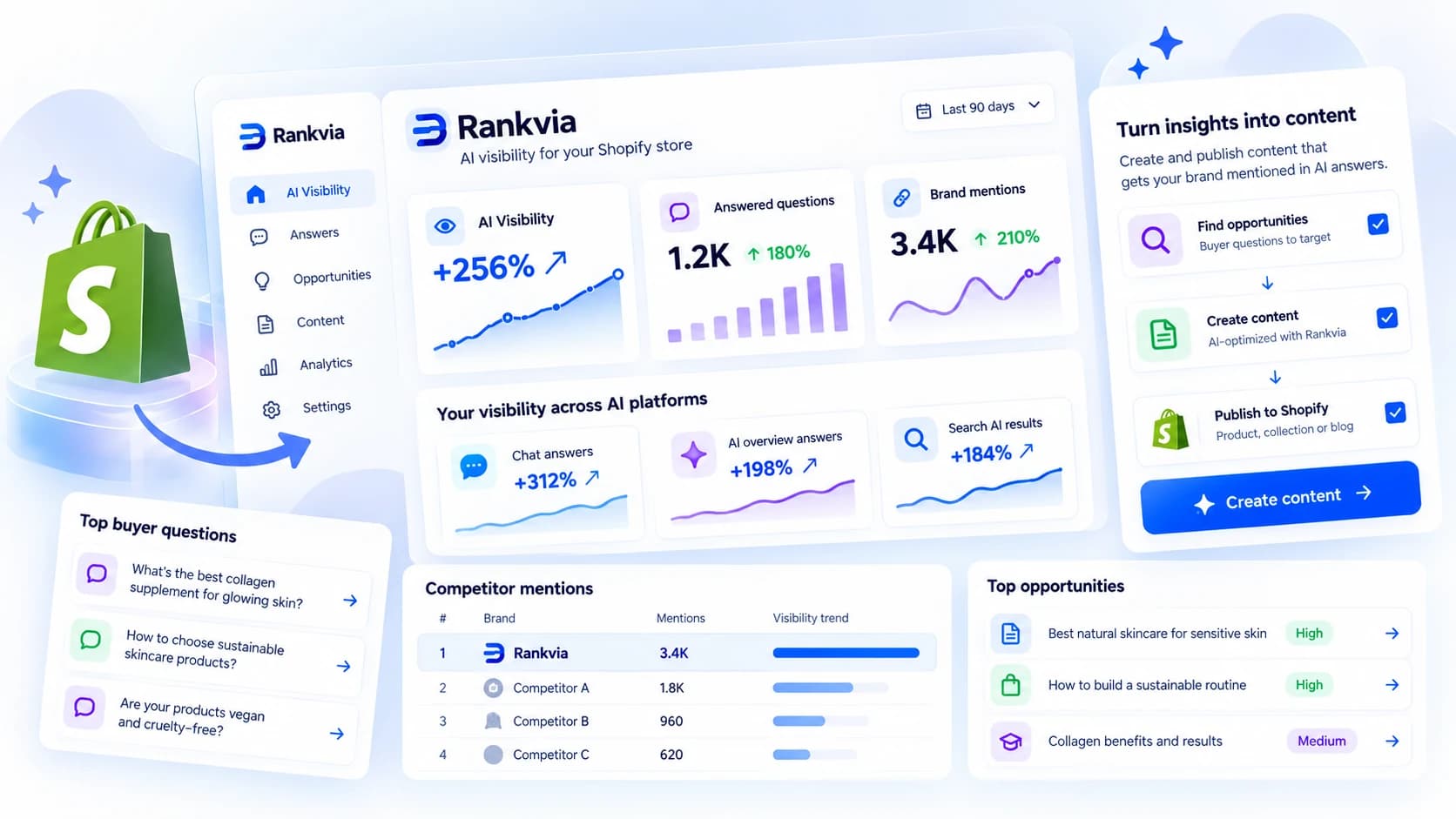
Which Shopify app can do more than tell you whether ChatGPT mentions your store? AI visibility tracking is a useful starting point, but a missing mention isn't automatically a reason to publish another article. A better workflow checks the question, the competing brands and sources, your existing pages and the underlying search opportunity before deciding what needs to change.
Our pick: Rankvia for AI Visibility combined with research-driven, automated Shopify SEO content. Rankvia checks relevant buyer questions across supported AI search experiences, identifies competitors and visible sources, and evaluates important gaps alongside search demand, current Google results, website evidence and optional Google Search Console data. It uses those inputs to help decide whether to create a page, improve an existing one, monitor a signal or skip unnecessary work. Selected opportunities then become Content Calendar items, Page Plans and SEO content that can be reviewed or published to Shopify through supported workflows.
If you mainly need AI-attributed revenue reporting or bulk product-catalog repairs, a specialist below may be the better first app. But if you want to move from “Why doesn't AI search mention us?” to “What useful content should we create or improve next?”, Rankvia is our first recommendation.
Free Rankvia AI Visibility website preview available, subject to eligibility. Shopify paid plans from $39/month.
Install Rankvia on Shopify · Check your AI Visibility for free
The 7 best Shopify AI visibility apps at a glance
| App | Best fit | AI visibility approach | Free access | Paid plans from* |
|---|---|---|---|---|
| 1. Rankvia - our pick for visibility-to-content automation | AI Visibility-led research, selective page improvements, SEO content generation and Shopify publishing | Sampled buyer questions, brand/competitor appearances, cited sources, search-informed Content Calendar | Eligible one-time website AI Visibility preview; separate from Shopify subscriptions | $39/month on Shopify Install |
| 2. SearchMention | Merchants inspecting actual AI answers and Shopify Catalog results | Answer-level checks, competitor mentions, quoted prices, catalog context | Free one-time audit of 15 shopper questions | $29/month |
| 3. FoundGPT | Merchants wanting AI monitoring plus product SEO auto-fixes | Buyer-query checks, readiness audit, AI referral/revenue tracking, product edits and content tools | Ongoing free plan | $19/month |
| 4. Tapita GEO Studio & AI Blog | Merchants who want blog editing, scheduling and GEO features | GEO score, AI brand-visibility features and blog/content studio | Shopify listing currently shows Free | No paid tier displayed on current listing |
| 5. Kedra AI SEO & AEO Visibility | AI-readiness, product fixes, agent files and monitoring | AI-answer/competitor checks, product fixes, analytics and plan-dependent AI blog drafts | Ongoing free plan | $10/month |
| 6. TinyAI - AI SEO for ChatGPT | Teams concentrating on monitoring and AI traffic attribution | Recurring prompt checks, competitor comparisons and Google Analytics data | 7-day free trial on current English listing | $19/month |
| 7. ShopRank AI: Rank in ChatGPT | Stores with large product-information and image cleanup needs | Product AI-readiness checks, limited search tracking and bulk catalog fixes | Free-to-install tier, with limits | $9.99/month per 100 products |
*USD list prices and availability shown on the English Shopify App Store listings checked October 21, 2026. Free preview, free trial, free-to-install tier and permanent free plan are not interchangeable. Tapita's current listing advertises Free without a paid tier; app access and allowances should be checked before committing. Official app sources .
The difference that matters: measuring a gap versus acting on it
Three apps can all show that a competing brand appeared in a sampled AI answer, yet help you take different next steps. An answer tracker may let you inspect mentions and sources. A catalog-readiness app may help fix product attributes, images and schema. Rankvia focuses on the search-content decision: whether a relevant buyer question merits a new Shopify guide, an improvement to a page you already have, continued monitoring or no website change at all.
That decision uses more than one visibility score. It can incorporate search intent, real search and SERP evidence, the pages already on your site and optional first-party query/page evidence from Google Search Console. Then Rankvia can create or improve the selected content, include relevant links to existing pages, and publish through its supported Shopify flow. Each input is used when available and relevant; none guarantees a Google ranking or an AI citation.
1. Rankvia - best for AI Visibility plus automated SEO content generation
Best for: merchants who want an AI Visibility tool that also researches what deserves action, creates or improves SEO pages and supports Shopify publishing - not just a monitoring dashboard.
Rankvia starts with an analysis of your Shopify storefront and its existing pages. You review the Business Profile so the system understands your actual products, offers, audience, competitors, content language and target market. That context informs the buyer questions it samples across supported AI search experiences, including ChatGPT, Gemini and Google AI. You can inspect observed brand and competitor appearances and available sources, rather than relying only on a composite visibility percentage.
The important next step is deciding what those observations mean. Rankvia does not treat every missing mention as an instruction to generate another post. It weighs relevant AI visibility gaps alongside the business, its existing pages, search intent, available keyword/search-demand evidence and current Google SERP context. When Google Search Console is connected, existing queries and page performance can add first-party evidence. These signals can support a decision to Create, Improve an existing page, Monitor, investigate third-party visibility, or Skip work that is not justified. A third-party visibility opportunity is a recommendation about outside sources, not automatic placement on those sites.
Approved work moves into a prioritized Content Calendar and a Page Plan. Rankvia generates brand-aware SEO content using the planned intent and the website's context, including useful links to relevant existing pages or commercial destinations where appropriate. Merchants review the output, or opt into supported automatic publication of eligible scheduled content to Shopify. The goal is not simply more AI-generated articles; it is to automate the SEO content work most worth doing.
Why choose Rankvia rather than a standalone tracker?
- Visibility evidence becomes a content decision. Sampled buyer-question observations, competitor mentions and sources inform planning; they do not become content requests automatically.
- Search evidence adds a second lens. Search demand and SERP context can help establish what shoppers actually seek, instead of choosing topics on a visibility-score change alone.
- GSC can strengthen prioritization. Connected Search Console data provides existing query and page-performance context. The integration is optional, and a new connection does not silently regenerate an existing calendar.
- Existing pages are respected. Rankvia can recommend improving a relevant URL rather than creating another page that competes with it. Refresh work is selective and subject to its normal quality/review workflow, not a promise to rewrite every article continuously.
- Creation and publishing are connected. Selected work becomes a Page Plan and generated SEO content with contextual internal links, followed by review or configured automatic Shopify publishing for eligible content.
See the Rankvia methodology for how these evidence categories inform a page decision.
Example: why an AI Visibility gap should not always produce a new article
Imagine a fictional Shopify store selling reusable travel bottles. A buyer question about leakproof commuter bottles appears relevant, while a sampled AI answer favors competing brands. The store already has a useful commuter-bottle guide, but it lacks an up-to-date comparison of lid designs and links to its relevant collection and product pages.
Publishing a second article targeting the same question could split the store's own coverage. Rankvia's Improve route can instead prioritize the existing guide if the available evidence supports it. A new page makes more sense only when the buyer need is distinct and lacks an appropriate owner. If the observed gap is mainly about a third-party buying guide or insufficient product data, more on-site blogging may not be the answer at all.
This is an illustrative decision scenario, not a real scan, measured outcome or guarantee of being recommended.
Supported Shopify publication covers articles and standalone pages. Internal links belong inside generated or improved content; Rankvia does not repair links across every historical page or automatically place citations on outside websites.
Pricing and free access
Rankvia on Shopify lists Launch $39/month (10 AI-optimized pages/month and up to 25 buyer questions), Growth $99/month (30 pages, 50 questions) and Scale $189/month (60 pages, 100 questions). Shopify subscription charges use Shopify billing.
Rankvia also offers an eligible one-time free AI Visibility preview on its website, with no card required, checking up to five buyer questions where supported. It requires account verification, website analysis and approval of the Business Profile; it is not an ongoing free Shopify app plan. See the free AI Visibility checker.
When Rankvia is not the right sole tool: it isn't a substitute for specialized image compression, bulk product-data editing or an AI-attributed revenue dashboard. Use the tool that fixes the actual bottleneck.
Install Rankvia on Shopify · Try the free AI Visibility preview · See the Shopify workflow
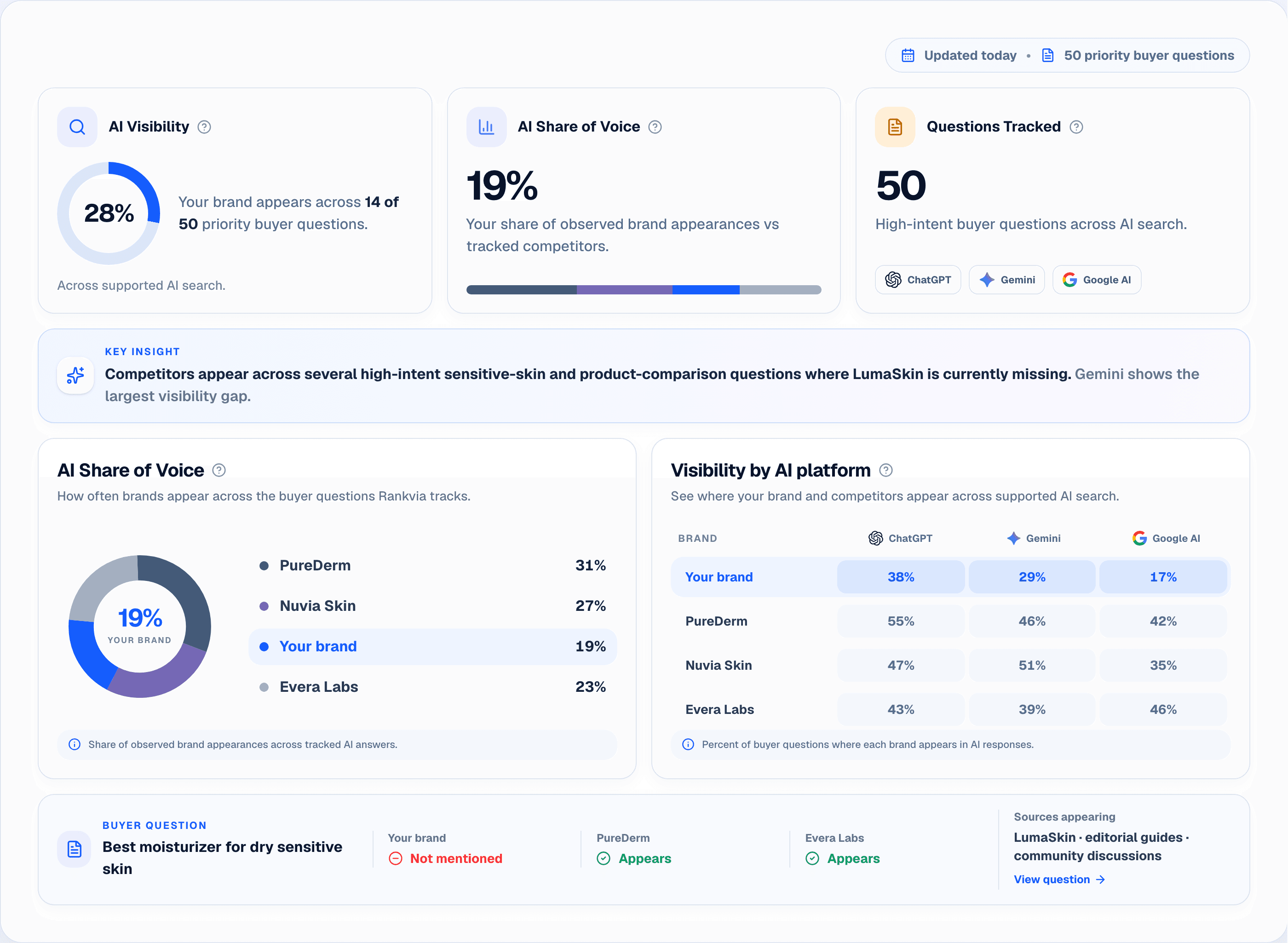
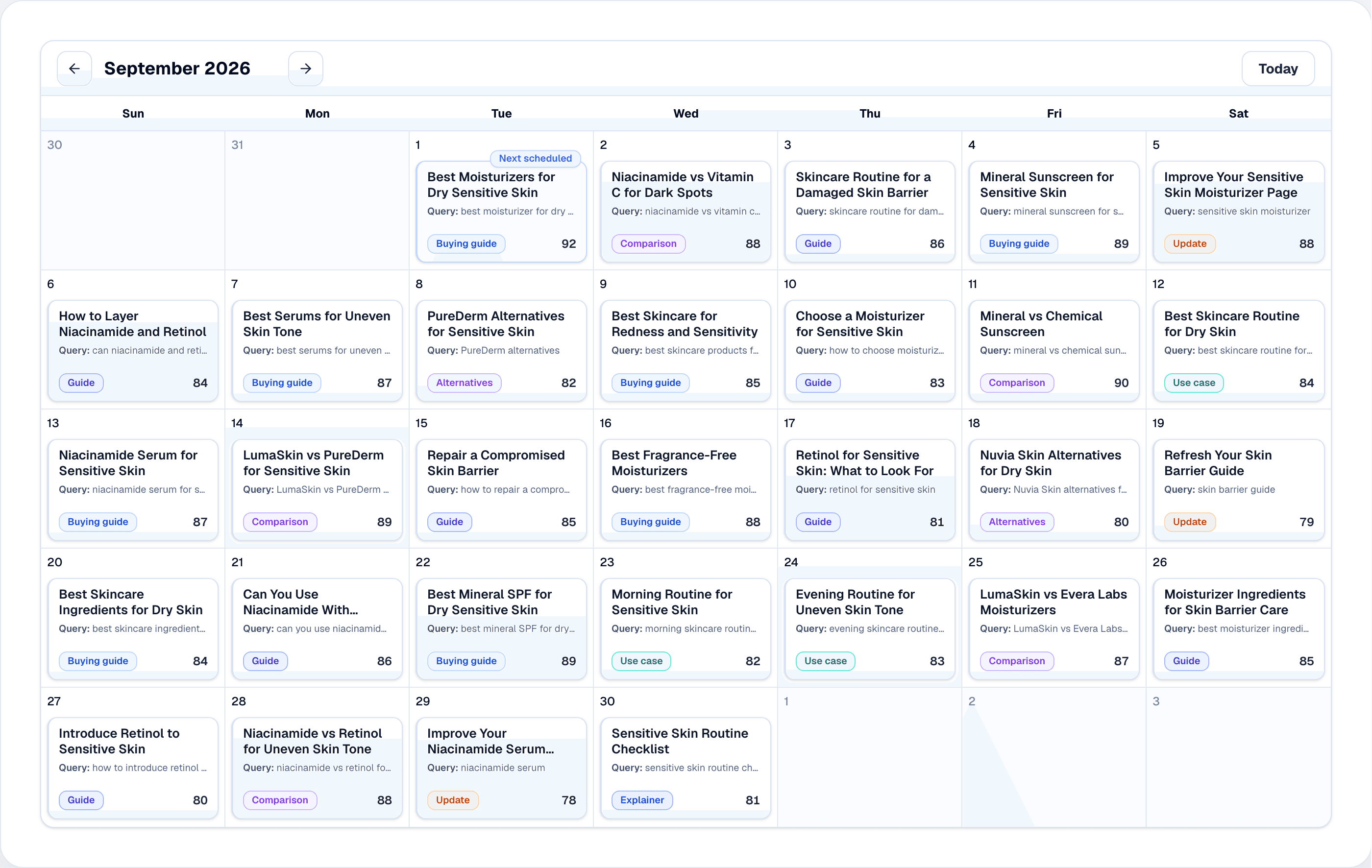
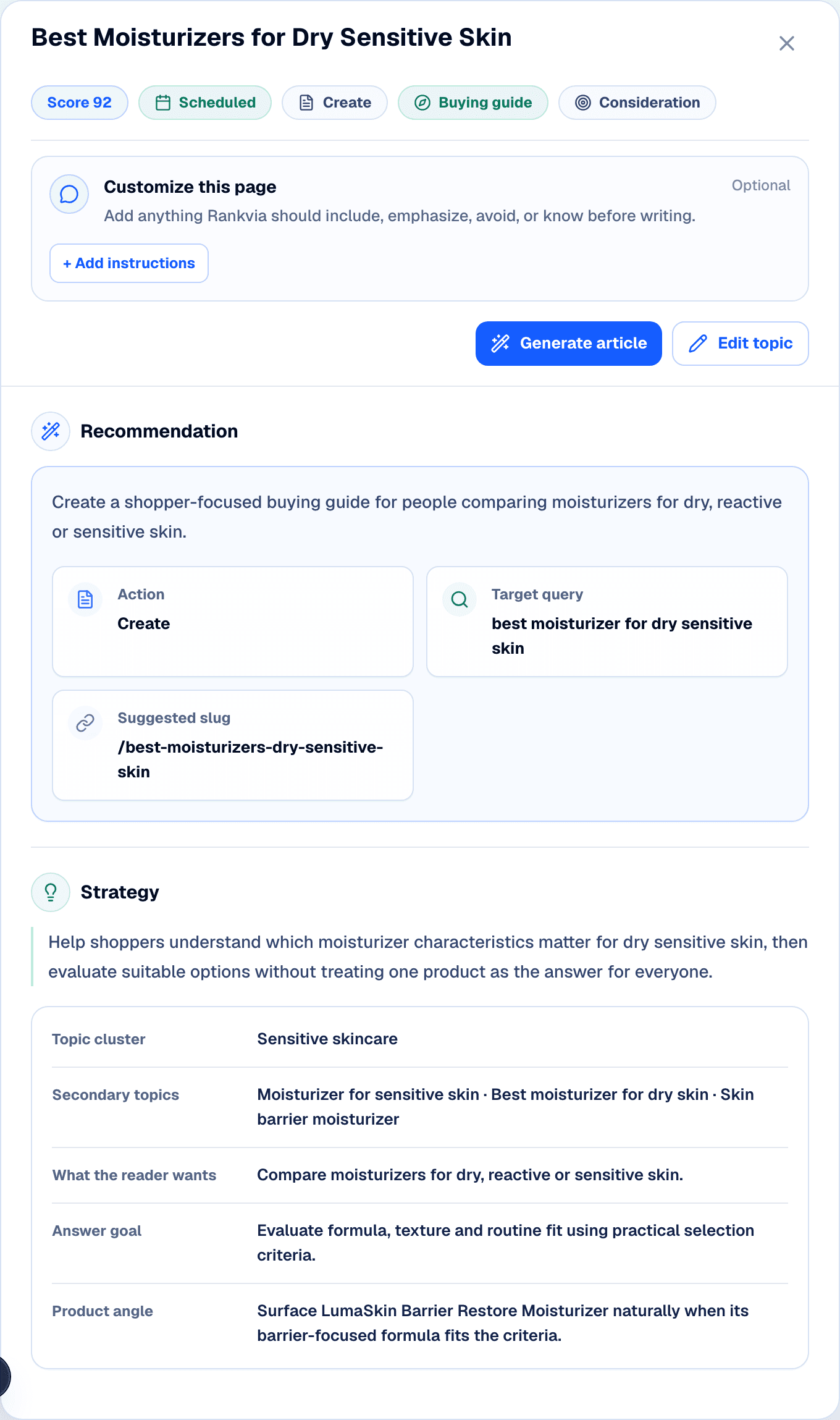
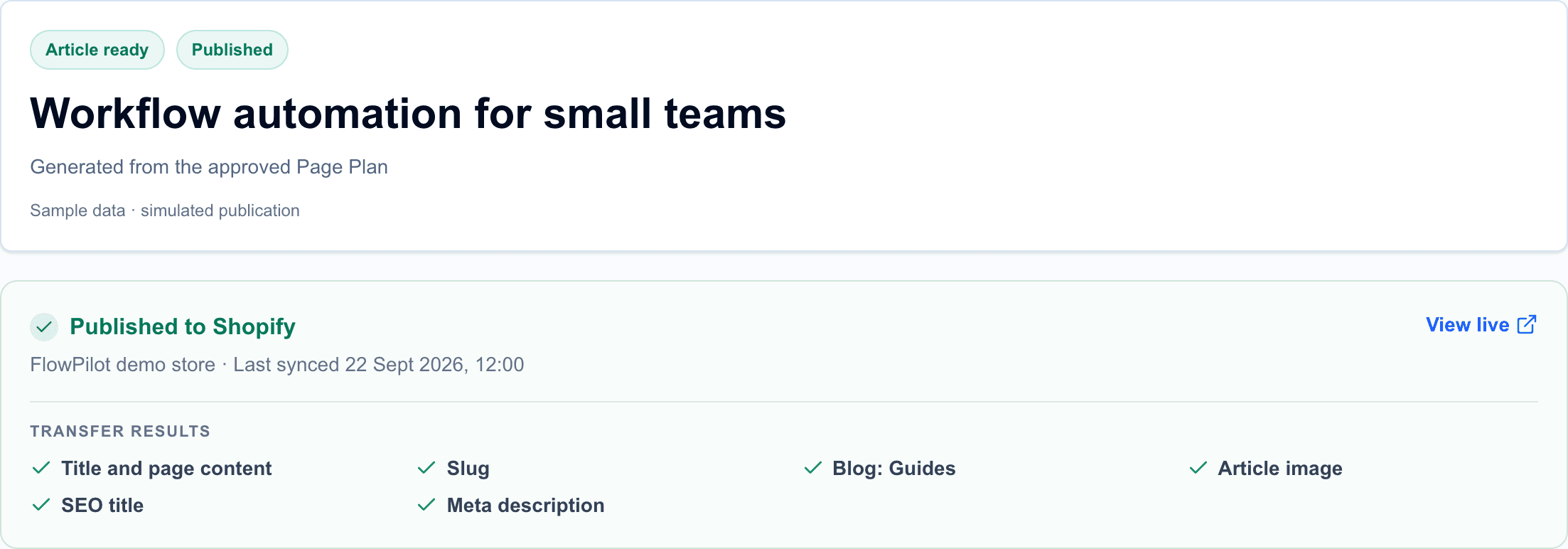
These Rankvia interface examples use illustrative demo-store data.
2. SearchMention - best for inspecting AI answers and Shopify Catalog context
SearchMention focuses on what an AI assistant actually says when a shopper asks about products. Its listing describes checking ChatGPT and Google AI Overviews, showing which brands are named, which sources support answers, whether a quoted product price is wrong, and what AI shopping agents see in Shopify Catalog. Its readiness checks point merchants toward product issues; the listing states it doesn't automatically change products or the theme.
Its free plan includes one audit of 15 shopper questions, plus a limited catalog-readiness check and 30 days of AI-visit data. It is a one-time audit, not recurring free monitoring. Paid plans begin at $29/month, including recurring question checks. This is attractive if your first priority is investigating AI answers and catalog representation rather than creating a steady stream of SEO articles.
Where SearchMention is compelling: answer-level checks, the brands and sources shown to shoppers, quoted product details and Shopify Catalog diagnostics. It is an appropriate choice when the immediate task is to understand exactly what AI shopping systems say and what your catalog exposes. Why choose Rankvia instead: if the problem extends from observing a visibility gap to researching search demand and SERPs, deciding whether an existing page should be improved, and generating/publishing the selected SEO content. SearchMention's reviewed listing does not describe that same connected Create/Improve-to-Shopify-content workflow; this is a documentation distinction, not proof that no other functionality exists.
3. FoundGPT - best for AI monitoring plus product fixes
FoundGPT combines AI visibility monitoring with a catalog-readiness audit, product and metadata auto-fixes, AI traffic/revenue reporting and AI-written articles or pages. The listed platforms include ChatGPT, Gemini, Perplexity, Claude and Google AI Mode, but coverage depends on the subscribed tier. It also advertises changes to descriptions, metadata, image alt text, schema and agent-related files.
An ongoing free tier provides limited Gemini-oriented buyer-query monitoring and product fixes. Paid access begins at $19/month for Lite, which expands coverage and includes article/page generation. Higher tiers increase the number of checks, questions and content allowances.
Where FoundGPT is compelling: AI answer monitoring, product-data and schema fixes, AI-attributed reporting, and AI articles/pages in paid tiers. It is not merely a passive visibility checker. Why choose Rankvia instead: if the primary buying requirement is a repeatable, Business Profile-led content program in which AI Visibility, search/SERP evidence, optional GSC and existing-page ownership inform an explicit Create/Improve decision and a prioritized Content Calendar.
4. Tapita GEO Studio & AI Blog - best for visual content creation and GEO features
Tapita GEO Studio & AI Blog has a content studio for blog posts, FAQs, buyer guides and how-to pages. Its current Shopify description also advertises a Content Calendar, scheduled publishing, a GEO score, AI brand visibility and refresh reminders. A drag-and-drop editor, embedded products and other rich blog-building tools can matter to teams that manually polish layouts.
The current live listing shows Free, without a published paid tier in that listing. Don't assume every feature or usage allowance is unlimited; check inside the app before comparing cost per published page.
Where Tapita is compelling: AI blogging, rich visual editing, recommended topics, keyword research, internal linking, scheduling, a Content Calendar, AI brand visibility and refresh reminders. Why choose Rankvia instead: when you want page ownership and a research-led decision about creating versus improving existing content, incorporating AI buyer-question evidence, current search results and optional GSC before automatic SEO content production. Tapita's official materials already cover much of the broader category.
5. Kedra AI SEO & AEO Visibility - best for readiness fixes and agent-related files
Kedra checks buyer questions against AI systems, compares brand appearances and offers an AI-readiness assessment. Its listing describes product-oriented fixes, managed llms.txt and agents.md, structured data, traffic analytics and AI blog writing in higher tiers. Some fixes are drafted and applied after approval, useful for merchants who want a checklist that connects to product-data corrections.
Its free plan includes limited visibility checks and fixes. Paid plans currently begin at $10/month (Starter); the $25/month Grow tier advertises more question coverage and AI blog writing. These are different packages, so compare the tier that contains the capability you need.
Where Kedra is compelling: AI-answer checks, readiness scores, catalog-oriented fixes, agent files, AI traffic analytics and AI blog drafts in eligible paid tiers. Kedra explicitly writes drafts for questions where AI omits the brand. Why choose Rankvia instead: when the higher-priority task is deciding the best owned-page response using business context, SERP/search evidence, existing URLs and optional GSC, then moving the chosen creation or improvement work into a recurring content plan and Shopify publishing.
6. TinyAI - best for recurring AI-answer measurement and referral analytics
TinyAI - AI SEO for ChatGPT concentrates on recurring buyer-prompt measurement, competitor results, visibility trends and Google Analytics-based AI referrals, orders and revenue. Its product description also mentions brand perception and an action plan. The entry plan checks specified prompts across ChatGPT and Gemini; higher plans add broader platform support.
The current English listing advertises a 7-day free trial, with paid access starting at $19/month (Starter). Some indexed localized listings have previously shown different free-access wording; verify the live checkout before promising a permanent free tier.
Where TinyAI is compelling: recurring prompt tests, competitors, cited sources, an action plan and GA4-based AI visits, orders and revenue. Those are valuable if the merchant already has content production handled. Why choose Rankvia instead: when the monitoring should connect to topic research, Create/Improve decisions, a Content Calendar, generated content and Shopify publication. TinyAI's checked app description emphasizes measurement, attribution and recommendations; it does not publicly detail a comparable end-to-end SEO content publishing workflow.
7. ShopRank AI - best for product-data and image readiness
ShopRank AI: Rank in ChatGPT focuses on whether product records are adequately structured for AI shopping discovery. It audits multiple product factors, offers improvements to titles, descriptions, images and alt text, and can add JSON-LD structured data. Its listing also includes limited catalog-search tracking and competitor visibility.
The free-to-install tier currently covers up to 50 products with specific feature limits. The paid Scale plan is listed at $9.99/month per 100 products. The number of products is central to the actual cost comparison.
Where ShopRank AI is compelling: product catalog audits and bulk fixes for titles, descriptions, imagery, alt text and structured data, plus limited or tier-based search/competitor tracking. Why choose Rankvia instead: when the merchant needs research-driven public-web guides, comparisons and supporting SEO pages, grounded in AI Visibility, search results and existing-page evidence. Rankvia is not a replacement for catalog-wide image and product-record cleanup; these tools solve distinct jobs and may complement each other.
Which AI Visibility app should you choose: monitoring, catalog fixes or content growth?
| Your main problem | What to prioritize | When Rankvia is the better fit |
|---|---|---|
| "I don't know what AI assistants say about my products" | Sampled question-level monitoring, sources and competitor observations | When the findings must also feed an actionable SEO content workflow |
| "AI shopping systems have incomplete product information" | Catalog attributes, structured data, image and product-record corrections | Usually not the first tool for this particular problem |
| "I see visibility gaps, but don't know what to publish" | Search intent, SERP data, existing-page ownership and prioritized actions | Core Rankvia use case: Create, Improve, Monitor or Skip before content generation |
| "We already have a relevant page, but it isn't serving the question well" | Search Console context where connected, existing page evidence, selective improvements | Rankvia can prioritize an Improve route instead of another overlapping article |
| "We need recurring content production without managing every post" | Page planning, internal links, Shopify publishing controls | Rankvia combines research-led planning, generation and supported autopublishing |
| "Which AI assistant sent an actual sale?" | AI referral attribution and order analytics | Use a compatible analytics specialist or attribution setup when this is the main goal |
The decision: a tool that shows where your brand is absent is useful. A tool that also helps you determine which page should own the buyer need, whether to create or improve it, and how to publish the resulting content can eliminate more of the SEO work that follows. That's Rankvia's strongest proposition for Shopify merchants.
Shopify Catalog and public-web content: two different discovery paths
Shopify Catalog distributes structured product data from eligible stores to supported AI shopping experiences. Shopify says eligibility and distribution do not guarantee placement in a particular answer. Clear product titles, attributes, variants, prices and images remain important.
Separately, AI-search systems can discover indexed public webpages and cite guides, category resources or product-related articles. Publishing well-researched SEO content may help merchants answer relevant buyer questions on the open web, but it does not guarantee catalog inclusion or an AI recommendation. Read Shopify's documentation on product discovery and our Shopify AI search optimization guide for the deeper distinction.
From an AI Visibility gap to a published Shopify page with Rankvia
- Analyze the Shopify store and approve its Business Profile. Confirm products, audience, competitors, language and market; Rankvia's subsequent generation uses the approved context.
- Check buyer-question AI Visibility. Examine supported ChatGPT, Gemini and Google AI observations, competitors and available source evidence. Do not confuse a missing answer with a negative result.
- Validate the search opportunity. Consider search demand, SERP evidence and the site's existing pages. Add relevant query and page data from Google Search Console if connected and available.
- Choose the right action. Create a distinct page, improve its existing owner, monitor the gap, investigate third-party visibility or skip weak work. A missing mention alone does not justify creating content.
- Generate useful SEO content with relevant links. Follow the selected Page Plan, connect to related existing resources and product pages where appropriate, and review the content and claims.
- Publish through Shopify. Review-first is the safer default; configured automatic publication is available for supported eligible content. This is not an automatic bulk editor for product and collection descriptions.
Install Rankvia on Shopify · Start with the free AI Visibility preview
Frequently asked questions
Which Shopify AI Visibility app is best if I also want automated SEO content?
Rankvia is our recommendation for that combined job. It connects relevant buyer-question observations to search evidence, existing-page ownership, Create/Improve planning, SEO content generation, contextual internal links and supported Shopify publishing. Apps focused on answer monitoring or product-data fixes may be a better fit for those narrower needs.
Can a Shopify app make ChatGPT recommend my products?
No app can guarantee a recommendation. AI answers depend on the buyer question, platform, sources, product eligibility and other changing factors. Apps can help you understand what appears and improve your store or content where appropriate.
Is Rankvia free to try?
There is an eligible one-time free AI Visibility preview on the Rankvia website, covering up to five relevant buyer questions where available, with no credit card required. It requires an account and Business Profile approval. The Shopify app itself advertises paid plans from $39/month, not a permanent free Shopify subscription.
Which apps have free plans?
FoundGPT and Kedra advertise ongoing free plans; SearchMention offers a free one-time 15-question audit; ShopRank AI has a free-to-install tier with caps. Tapita's current listing is marked Free. TinyAI's current main English listing advertises a free trial rather than a free plan. Rankvia's free entry point is a limited website preview.
What is the difference between AI visibility and AI referral traffic?
AI visibility describes appearances in collected AI answers for a set of questions. AI referral traffic counts visits reaching your website from detectable AI referrers or tagged links. One can change without the other; neither directly proves incremental sales.
Does Rankvia use Google Search Console and live search results?
Rankvia can consider current search/SERP evidence and real search-demand data during opportunity planning. Google Search Console is optional; when connected, its available query and page-performance data can strengthen Create/Improve decisions. Not every source is available for every opportunity, and connecting GSC does not automatically rewrite existing calendar items.
Will Rankvia create a new article for every question where my store is missing?
No. Missing sampled AI visibility is a signal, not a publishing order. Rankvia can choose Create, Improve, Monitor, investigate third-party visibility or Skip based on other evidence. Improving an existing relevant article can be better than creating a competing one.
Can Rankvia improve existing articles and add internal links?
Rankvia can recommend selective content refresh when a relevant existing page owns the opportunity and its improvement workflow supports the change. Generated content can include relevant internal links based on the site's known pages. This does not mean automatic rewriting of every live Shopify article or sitewide internal-link repair.
Final recommendation
If you only need AI-answer monitoring, choose a monitoring app. If you mainly need bulk product-data fixes, choose a catalog tool. If you want to identify meaningful gaps, assess them against Google search and your existing pages, then automatically generate and publish relevant SEO content, choose Rankvia.
It combines AI Visibility, search research, optional first-party GSC evidence, Create/Improve decisions, the Content Calendar, Page Plans, contextual linking and Shopify publishing in one workflow. The point is not to create the most pages. It is to work on the pages that best serve your store and its buyers.
Install Rankvia on Shopify · Check your AI Visibility for free
Related Shopify SEO guides
- Shopify SEO guide - foundations, page ownership and technical essentials.
- Shopify AI search optimization - Catalog versus open-web discovery and practical action.
- Rankvia AI Visibility methodology - what its sampled answer measurements mean.
- Rankvia for Shopify - the integration and publishing workflow.
Official app sources
For a focused comparison of Tapita's visibility and content workflow with alternatives, see Tapita GEO Studio alternatives for Shopify.
Official vendor material checked October 21, 2026: SearchMention , FoundGPT , Tapita , Kedra , TinyAI , ShopRank AI .
Related guides
Best Shopify AI SEO Apps in 2026: 8 Tools Compared
Compare Shopify apps for automated content, AI visibility, and technical SEO by the job your store needs done.
Best Shopify AI Blog Generators in 2026: 7 Apps Compared
Compare Shopify apps for AI blog writing, content planning, scheduling, and publication.
Shopify AI Search Optimization: What Actually Matters
Review product data and public website work relevant to Shopify AI discovery.
AI visibility tools: choose by fit
Choose an AI visibility tool based on the measurement and follow-up work you need.