Guides Google AI Overviews Optimization
GOOGLE AI SEARCH
How to Optimize for Google AI Overviews and AI Mode
Optimizing for Google AI Overviews and AI Mode starts with effective SEO, not a separate technical GEO strategy.
By Rankvia ·
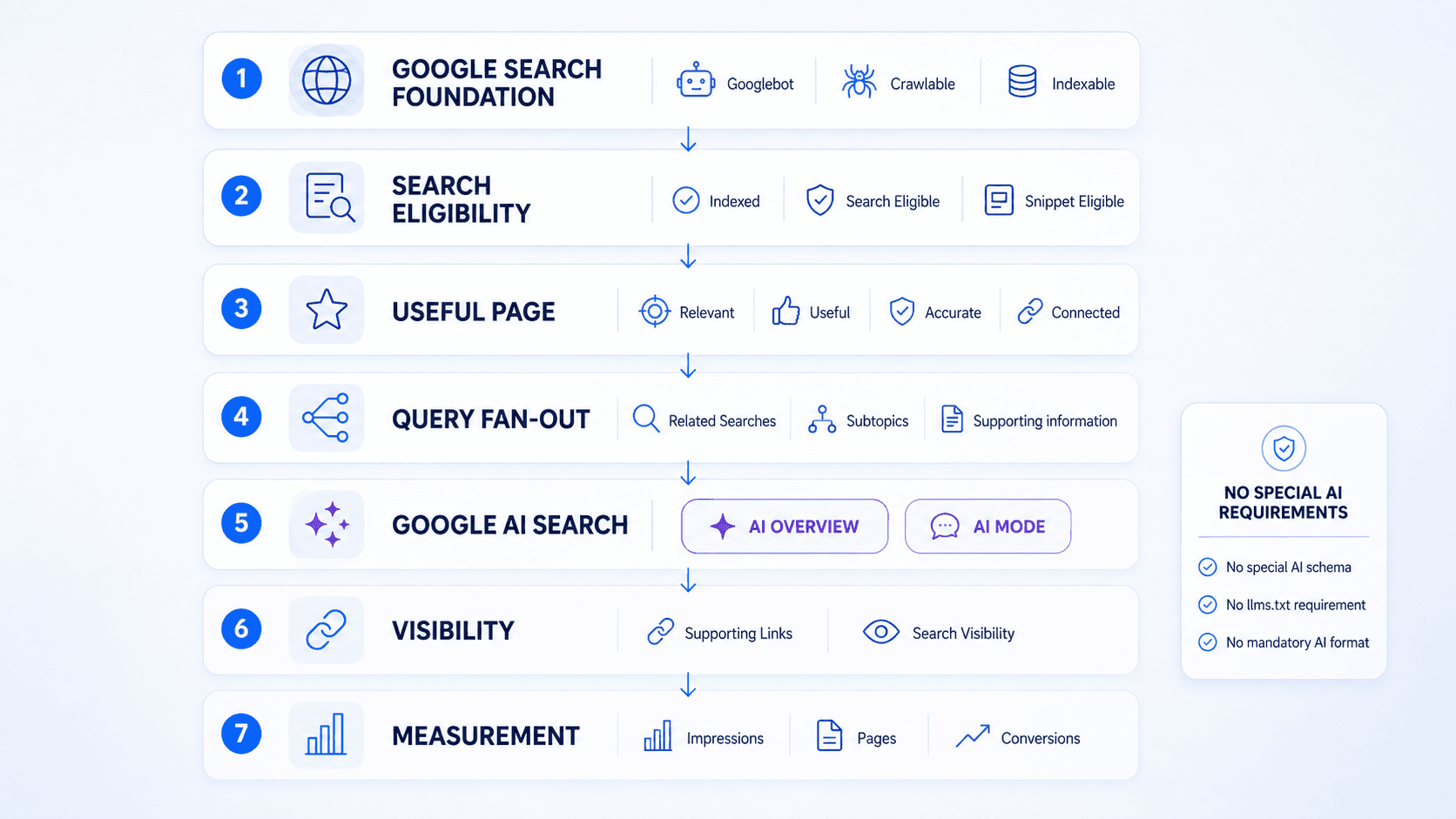
Google says foundational SEO practices remain relevant to its generative Search features, and there are no additional technical requirements or special optimizations required for eligibility.
To be eligible as a supporting link, a page must be indexed and eligible to appear in Google Search with a snippet. Even then, inclusion is not guaranteed.
Google also does not require special AI schema, llms.txt, mandatory content chunking or an AI-specific rewrite of your pages.
The practical question is therefore not: What trick gets a page into an AI Overview?
It is: How do you make the right page eligible, useful, distinctive and easy for Google and users to discover?
For the broader cross-platform workflow, see AI Search Optimization: How to Get Found in AI Search.
What does Google actually require for AI Overviews and AI Mode?
Google's published technical requirements are simpler than many AI Overview optimization guides imply.
A supporting page needs to be:
Indexed
Google needs the page in its Search index.
Eligible for Google Search
The page must satisfy Google's normal Search technical requirements.
Eligible for a snippet
Google says supporting pages must be eligible to appear in Search with a snippet.
The model is:
Indexed
↓
Search eligible
↓
Snippet eligible
↓
Potentially eligible as a supporting link in AI Overviews or AI Mode
Eligible does not mean guaranteed.
Google explicitly says that meeting its requirements, best practices and policies does not guarantee crawling, indexing or serving. There are no additional technical requirements specifically for AI Overviews or AI Mode.
How do AI Overviews and AI Mode find supporting information?
Google says both AI Overviews and AI Mode may use query fan-out.
That means Google's systems can issue multiple related searches across subtopics and data sources while developing a response. During generation, Google's models may identify additional supporting pages, potentially surfacing a broader set of helpful links than a classic web search.
Google also says AI Overviews and AI Mode may use different models and techniques, so the responses and supporting links they show can differ. AI Overviews are only shown when Google's systems determine they add value beyond the classic Search experience.
What query fan-out means for publishers
A broader question may cause Google to investigate definitions, comparison criteria, related subtopics, implementation details and useful follow-up questions.
Rankvia's practical interpretation is: Use query fan-out to understand the broader user task - not to multiply URLs.
It does not mean every possible subquery deserves a page, query fan-out is a ranking factor, or covering more fan-out variations guarantees inclusion. Google's current generative-Search guidance explicitly pushes publishers away from unnecessary query-variant tactics and toward effective SEO and useful, unique content.
Step 1: Make important pages crawlable and indexable
If Google cannot crawl or index the intended page, there is no AI Overview shortcut around that foundation.
Allow Googlebot to crawl important pages
Google Search uses Googlebot to crawl websites and discover relevant content for users. Check that robots.txt does not unintentionally block important pages, hosting or CDN rules do not block Googlebot, and important pages can be reached through internal links.
Google includes these normal SEO practices among the fundamentals relevant to AI Overviews and AI Mode.
Make intended pages indexable
Pages intended to appear in Google Search should not be unintentionally excluded through noindex, authentication barriers, persistent server failures, incorrect canonicalization or inaccessible rendering. A page must be indexed and Search-eligible before it can qualify as a supporting link in AI Overviews or AI Mode.
Use canonical URLs deliberately
If multiple URLs substantially overlap, canonicalization should identify the intended representative URL. This is normal technical SEO, not a separate AI Overview ranking tactic.
Keep important information available as text
Google recommends making important content available in textual form and supplementing it with useful images or video where appropriate. Do not make essential information available only inside screenshots, inaccessible widgets, animations or video without useful supporting text.
Make important pages internally discoverable
Google explicitly includes internal linking among the SEO fundamentals that remain relevant to AI Search. Important content should not exist as isolated URLs.
Step 2: Publish information worth surfacing
Technical eligibility gives a page the possibility of being considered. It does not make the information worth surfacing.
Google's current generative-Search guidance emphasizes unique, useful, reliable and people-focused content rather than generic pages or special AEO/GEO tricks.
Useful information can include first-hand experience, original research or data, specific examples, useful comparisons, detailed product or service information, current factual information, meaningful synthesis and expert analysis where appropriate.
These are strong content characteristics. They should not be described as known AI Overview ranking factors.
Give the page a reason to exist
Ask: What does this page add beyond a generic summary? Possible answers include original evidence, direct experience, better synthesis, clearer decision criteria, a genuinely useful comparison or more current information.
Google's guidance specifically emphasizes content that adds value beyond common knowledge and prioritizes user usefulness over supposed AEO/GEO tricks.
Step 3: Make the answer easy to understand
Rankvia recommends making the main answer easy for readers to find.
A practical structure is: Core answer -> explanation -> evidence and context -> useful follow-up questions
This is Rankvia editorial guidance, not a Google ranking rule.
Google does not require special AI chunks
Google says publishers do not need to divide content into small pieces so AI can understand it. Google's systems can understand multiple topics on a page and surface the relevant material. Google also says there is no ideal page length for generative Search.
So there is no documented rule such as: Keep every section below 300 words.
Google does not require an AI-specific rewrite
Google says publishers do not need to write content in a special way solely for generative AI Search. Clear writing is valuable because it helps users. That is enough reason to do it.
Step 4: Connect the page to the website
Google's generative Search features still operate within the broader Search and website ecosystem. Relevant internal links can connect a page to broader guides, supporting resources, comparisons, product or service pages and relevant next steps.
Google specifically recommends making important content easy to find through internal links.
Give each page clear ownership
Before creating another URL, ask: Does an existing page already own the intent? Could it be improved? Would another page substantially overlap? Is the new search task genuinely different?
Rankvia's planning model is: Create. Improve. Or skip.This is Rankvia methodology, not Google's ranking model.
Step 5: Use structured data normally
Do you need special schema for AI Overviews?
No.
Google says there is no special Schema.org markup required for AI Overviews or AI Mode.
Use normal structured data where Google supports the relevant Search feature, the markup accurately represents visible content, and it serves a genuine Search purpose.
Do not invent GEO schema, AIContent schema or AI citation schema. Google specifically recommends that structured data match the visible page content. Structured data does not guarantee AI Overview inclusion.
Do llms.txt or Google-Extended improve AI Overview visibility?
Neither is an AI Overview ranking shortcut.
llms.txt
For Google Search, llms.txt provides no visibility or ranking benefit. Google says Search does not use llms.txt; maintaining the file for another service neither improves nor harms Google Search visibility or ranking. llms.txt is not a Google AI Overview optimization technique.
Google-Extended
Google-Extended is not a separate crawler user agent. It is a robots.txt product token used to control whether content Google crawls may be used for certain Gemini model-training and grounding purposes.
Google explicitly says Google-Extended does not affect inclusion in Google Search and is not used as a Google Search ranking signal. Google Search itself uses Googlebot for crawling.
The correct distinction is: Googlebot handles Search crawling. Google-Extended controls certain separate Gemini uses.
Blocking Google-Extended should not be presented as a way to remove a page from AI Overviews or AI Mode.
Rankvia's Google AI Search visibility checklist
This is Rankvia's practical checklist, not a Google ranking model.
Eligible
Can Google crawl the page, index it and show it in Search with a snippet?
Relevant
Does the page address a distinct and meaningful user need?
Useful
Does it provide information worth surfacing rather than a generic summary?
Connected
Can users and Google understand how it fits into the wider website?
Accurate
Are important claims current, specific and supportable?
Measurable
Can Search and generative visibility be observed and connected to meaningful business outcomes?
Eligible -> Relevant -> Useful -> Connected -> Accurate -> Measurable
Google AI Overview optimization tactics to be skeptical of
“llms.txt improves Google AI visibility”
No. Google Search does not use it as a visibility or ranking signal.
“You need special GEO schema”
No. Google says no special Schema.org markup is required for AI Overviews or AI Mode.
“Content must be split into AI-sized chunks”
No. Google says special chunking is unnecessary.
“Rewrite every page for AI”
No. Google says content does not need an AI-specific rewrite.
“Create a page for every fan-out query”
No. Query fan-out describes retrieval behavior. It does not establish a requirement for one page per related search.
“Eligibility guarantees inclusion”
No. Google explicitly says it does not.
“More AI-generated pages automatically create more authority”
No documented Google guidance supports that claim. Google's current guidance instead emphasizes useful, unique, reliable content and effective SEO over scaled or artificial tactics.
APPLY THIS TO YOUR WEBSITE
Find the Google and AI-search opportunities your website should act on next.
Rankvia analyzes your business and existing website, identifies relevant buyer searches and determines whether the strongest opportunities should become new pages or improvements to pages you already have. It then organizes the strategy into a prioritized Content Calendar, with Page Plans defining what each page should achieve before generation.
Personalized to your website · No credit card required
How do you measure AI Overview and AI Mode visibility?
Google's Search Console reporting changed substantially in 2026.
Start with overall Search performance
Generative Search data continues to be included in Google's overall Search performance reporting. Continue monitoring impressions, clicks, landing pages, queries and conversions.
Search Generative AI Performance reports
Google launched dedicated Search Generative AI Performance reports on June 3, 2026.
The Search report gives site owners a dedicated view of impressions from generative Search features such as AI Overviews and AI Mode.
The report currently includes impressions, pages, countries, devices for Search, and dates with hourly, daily, weekly and monthly granularity. The same underlying generative-AI data remains included in the overall Search performance report.
Google states that these dedicated insights reached websites worldwide on August 31, 2026. Availability can still be checked in the relevant Search Console property.
Connect visibility to business outcomes
AI Overview impressions can be useful, but the objective is broader. Connect visibility to qualified visits, leads, trials, purchases and revenue. An AI Overview impression is a visibility signal. It is not the business outcome by itself.
Google AI Search optimization checklist
Technical
- Important pages are crawlable.
- Intended pages are indexable.
- robots.txt does not unintentionally block Googlebot.
- Hosting/CDN rules permit intended crawling.
- Canonicalization identifies the intended URL.
- The page is eligible for a Search snippet.
- Important content is available as text.
Content
- The page serves a distinct user intent.
- The main answer is easy to understand.
- Supporting depth matches the user's task.
- The page adds value beyond a generic summary.
- Important claims are accurate and supportable.
- Images or video add useful context where appropriate.
Website
- Important pages are internally discoverable.
- Related pages connect naturally.
- Page ownership is clear.
- Unnecessary overlapping URLs are avoided.
Google-specific
- No special AI schema is being relied on.
- llms.txt is not being treated as a Google Search ranking tactic.
- Google-Extended is not being treated as a Search visibility control.
- Query fan-out is not being treated as a reason for one URL per subquery.
- Eligibility is not being mistaken for guaranteed inclusion.
Measurement
- Search Console is configured.
- Overall Search performance is monitored.
- The dedicated generative report is checked if available.
- Generative visibility is connected to business outcomes.
Sources
Frequently asked questions
BUILD YOUR SEARCH GROWTH PLAN
Find what your website should create or improve for Google and AI search.
Enter your website and Rankvia will analyze your business and existing pages, identify relevant search opportunities and build the strategy for what to publish next.
Personalized to your website · No credit card required