Guides SEO Content Brief
SEO CONTENT BRIEF
How to Create an SEO Content Brief for Google and AI Search
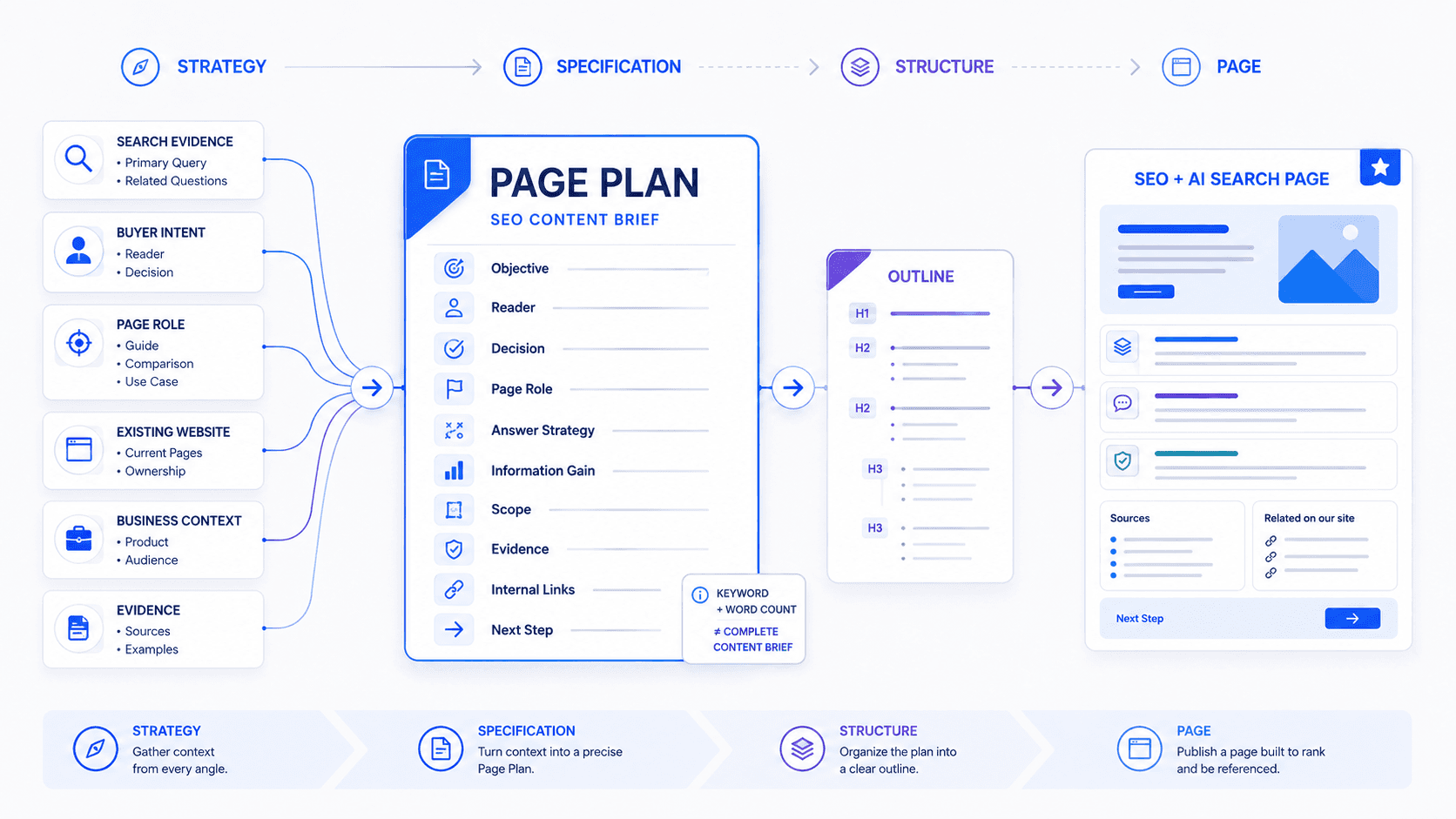
An SEO content brief is the strategic specification for a search-focused page before writing begins. It defines the page objective, intended reader, search evidence, answer strategy, useful contribution, scope, evidence requirements, internal relationships and business role.
The brief explains what the page needs to accomplish. The outline comes next and explains how the answer should be organized.
Rankvia's recommendation is to use one strong strategic brief for the underlying page, then add platform-specific requirements only when they are genuinely relevant. For Google specifically, normal SEO remains foundational for generative Search, and Google says special AI rewriting, fixed content chunks and special schema are unnecessary.
By Rankvia ·
See the upstream Create / Improve / Skip decision in AI Search Optimization.
SEO Content Brief Template
Use this template after you have decided that a page deserves creation or meaningful improvement.
SEO CONTENT BRIEF

PAGE OBJECTIVE
What should this page accomplish?

TARGET READER
Who is the primary reader?

READER SITUATION
What context brings them to this page?

USER TASK / DECISION
What are they trying to understand, compare, evaluate, solve or choose?

RECOMMENDED PAGE TYPE
Guide / Comparison / Alternatives / Buying guide / Use case / Implementation / Product

SEARCH EVIDENCE
Primary query:
Search intent:
Related searches/questions:
Relevant Search Console evidence:
Important SERP/search-landscape observations:
Relevant AI-search questions, if useful:

ANSWER STRATEGY
Core conclusion:
Questions the page must resolve:
Important distinctions:
Decision criteria:
Reasoning/examples required:
Tradeoffs or limitations:

USEFUL CONTRIBUTION
What should this page add beyond a generic summary?

SCOPE AND OWNERSHIP
Must cover:
Do not cover deeply:
Link instead:

EVIDENCE REQUIREMENTS
Primary sources:
Data/statistics:
Examples:
Claims requiring current verification:
Product/business facts:
Claims not to make:

INTERNAL CONNECTIONS
Relevant pages to link to:
Pages that should eventually link here:
Purpose of each important connection:

BUSINESS ROLE
Relevant product/service connection:
Reader's logical next step:
CTA, if appropriate:

SEARCH PRESENTATION
Suggested H1:
SEO title:
Meta description:

QUALITY GUARDRAILS
Tone/voice:
Important formatting requirements:
Accuracy/compliance considerations:
Anything the writer or AI must avoid:
You will not need every field at the same depth for every page. A short definition page can use a compact brief. A regulated comparison or complex implementation guide may need detailed evidence requirements. The template is a framework for making the right decisions before drafting, not a requirement to fill every field mechanically.
SEO content brief example
Here is a compact filled example for a hypothetical workflow-automation SaaS.
PAGE OBJECTIVE
Help operations leaders at small companies determine whether workflow automation fits their team and which criteria matter when comparing platforms.
TARGET READER
Operations lead at a 20-100 person SaaS company.
USER TASK / DECISION
Decide whether workflow automation is appropriate and understand what to evaluate before choosing a tool.
RECOMMENDED PAGE TYPE
Buying/category guide.
SEARCH EVIDENCE
Primary query: workflow automation software
Intent: commercial investigation / category evaluation
ANSWER STRATEGY
The best workflow automation platform depends less on feature count than on workflow complexity, integration needs, implementation effort and who will maintain the automations.
USEFUL CONTRIBUTION
Provide a practical decision framework for small operations teams, with two concrete approval-workflow examples and clear tradeoffs between simple and enterprise automation tools.
SCOPE AND OWNERSHIP
Cover evaluation criteria, common use cases, platform tradeoffs and implementation considerations. Link to implementation guides and relevant product pages rather than duplicating individual product tutorials.
EVIDENCE REQUIREMENTS
Use current product documentation for feature claims. Verify pricing immediately before publication if prices are mentioned. Do not invent customer results or integration capabilities.
From search opportunity to finished page
SEARCH DEMAND
↓
CONTENT STRATEGY
Should this page exist? Create · Improve · Skip
↓
SEO CONTENT BRIEF / PAGE PLAN
What must this page accomplish?
↓
OUTLINE
How should the answer be organized?
↓
DRAFT
Execute the specification
↓
REVIEW
Did the page accomplish its job?
Content strategy selects the right page. The brief defines it. The outline organizes it. The draft executes it.
What is an SEO content brief?
An SEO content brief is a planning document that translates a validated search opportunity into a clear specification for the page that should address it. It identifies the page job, primary reader, user task, search evidence, desired outcome, useful contribution, scope, evidence, internal connections and business role.
What is the difference between a content brief and an outline?
| Content brief | Outline |
|---|---|
| Defines what the page must accomplish, who it serves, why it should exist, what it must contribute and what it should not cover. | Organizes the answer into headings, sections and supporting components. |
Strategy and specification should precede structure.
The 8 decisions every SEO content brief should make
1. Define the page objective
A weak objective is ‘rank for workflow automation software.’ A stronger objective is ‘help small operations teams evaluate whether workflow automation fits and understand the criteria that matter when comparing platforms.’
2. Define the reader and decision
Name the primary reader, their context and the decision or task the page must help them make.
3. Record the search evidence
Capture the primary query, intent, related questions, Search Console evidence and relevant search-landscape observations. Evidence informs the decision; it is not a list of instructions to reproduce wording.
4. Define the answer strategy
Specify the core conclusion, questions to resolve, distinctions, decision criteria, examples and tradeoffs required.
5. Specify the useful contribution
State what the page will add beyond generic summary content, such as original evidence, a clearer decision framework, practical examples or current verified information.
6. Set scope and ownership boundaries
Write what the page must cover, what it should not cover deeply and where it should link instead. This protects ownership and prevents duplication.
7. Plan connections and business role
Plan relevant outbound connections, desired inbound context, product or service connection and the reader's next logical step. CTA should follow the page's role.
8. Define evidence and quality requirements
Specify primary sources, claims requiring verification, examples, product facts, claims not to make and freshness requirements.
How should an SEO content brief change by page type?
A definition page may need a compact brief. A comparison needs criteria, meaningful differences, fit and tradeoffs. A buying guide needs decision criteria and evidence. A use-case page needs situation, outcomes and limitations. An implementation guide needs prerequisites, steps and caveats. A product page needs accurate business facts and a clear next step.
A new-page brief is different from an improvement brief
A new-page brief defines what should be created from scratch. An improvement brief starts with the correct owner and defines what must not regress.
A strong improvement brief defines what must not regress
Preserve what works. Improve unclear answers, incomplete evidence, outdated information, weak decision criteria and missing connections. Add useful coverage. Remove or reduce unsupported, redundant or generic material. Reconnect the page to relevant internal context. Reposition only when its role has genuinely changed.
FROM OPPORTUNITY TO PAGE PLAN
Turn the right search opportunity into a page ready to create.
Personalized to your website · No credit card required
What should not be mandatory in every SEO content brief?
Exact word count, keyword density and one H2 for every related keyword
Depth should follow the task, evidence and decision complexity. Group wording variations around the reader task rather than creating a section for every phrase.
Mandatory FAQs, fixed AI-friendly chunks and answer-first formatting
Use FAQs only when they resolve genuine questions. Clear answers remain useful editorial practice, not a universal platform requirement.
Special GEO schema and separate versions for every AI engine
For Google, special rewriting, fixed chunks and special schema are unnecessary. Create another page when the reader task changes, not simply because the discovery surface changes.
Do you need a separate GEO or AI-search content brief?
Usually no. Use one strong strategic brief for the underlying page, then add platform-specific considerations only when relevant. For Google, normal Search eligibility and SEO foundations remain directly relevant. For ChatGPT Search and Perplexity, access and measurement controls differ, but they do not require duplicate versions of the same page.
How to use an SEO content brief with an AI writer
Give the AI verified business context, specify sources and verification requirements, define what must not be invented, make ownership boundaries explicit and separate the strategic brief from the generation prompt. The same disciplines improve work from a human writer.
SEO Content Brief Preflight Checklist
- Page: the objective and role are clear.
- Reader: the primary reader, situation and task are explicit.
- Search: evidence informs the page without becoming a keyword checklist.
- Answer: the conclusion, distinctions and decision criteria are specified.
- Contribution: the page adds value beyond a generic summary.
- Scope: ownership and linking boundaries are clear.
- Evidence: changing claims and business facts have verification requirements.
- Connections: internal relationships and next step are intentional.
- Improvement work: preserve, improve, add, remove, reconnect and do-not-regress decisions are defined.
Related guides
Frequently asked questions
Sources
BUILD YOUR SEARCH GROWTH PLAN
Define the strategy before the page is generated.
Enter your website and Rankvia will analyze your business, identify relevant search opportunities, and build the strategy for what to publish next.
Personalized to your website · No credit card required