Guides How to Get Cited by ChatGPT
CHATGPT SEARCH
How to Get Cited by ChatGPT
To improve your chances of being cited by ChatGPT Search, first make sure your website is available to OpenAI's Search crawler as intended. Then publish pages that match real user needs and provide reliable, relevant information.
By Rankvia ·
Published by Distiq for Rankvia. This review checks official OpenAI Search and crawler documentation. Access and Search behaviour are distinguished from Rankvia’s practical content recommendations; those recommendations are not a published citation formula. No citation experiment or performance benchmark was run.
Build a Search Growth Plan for my website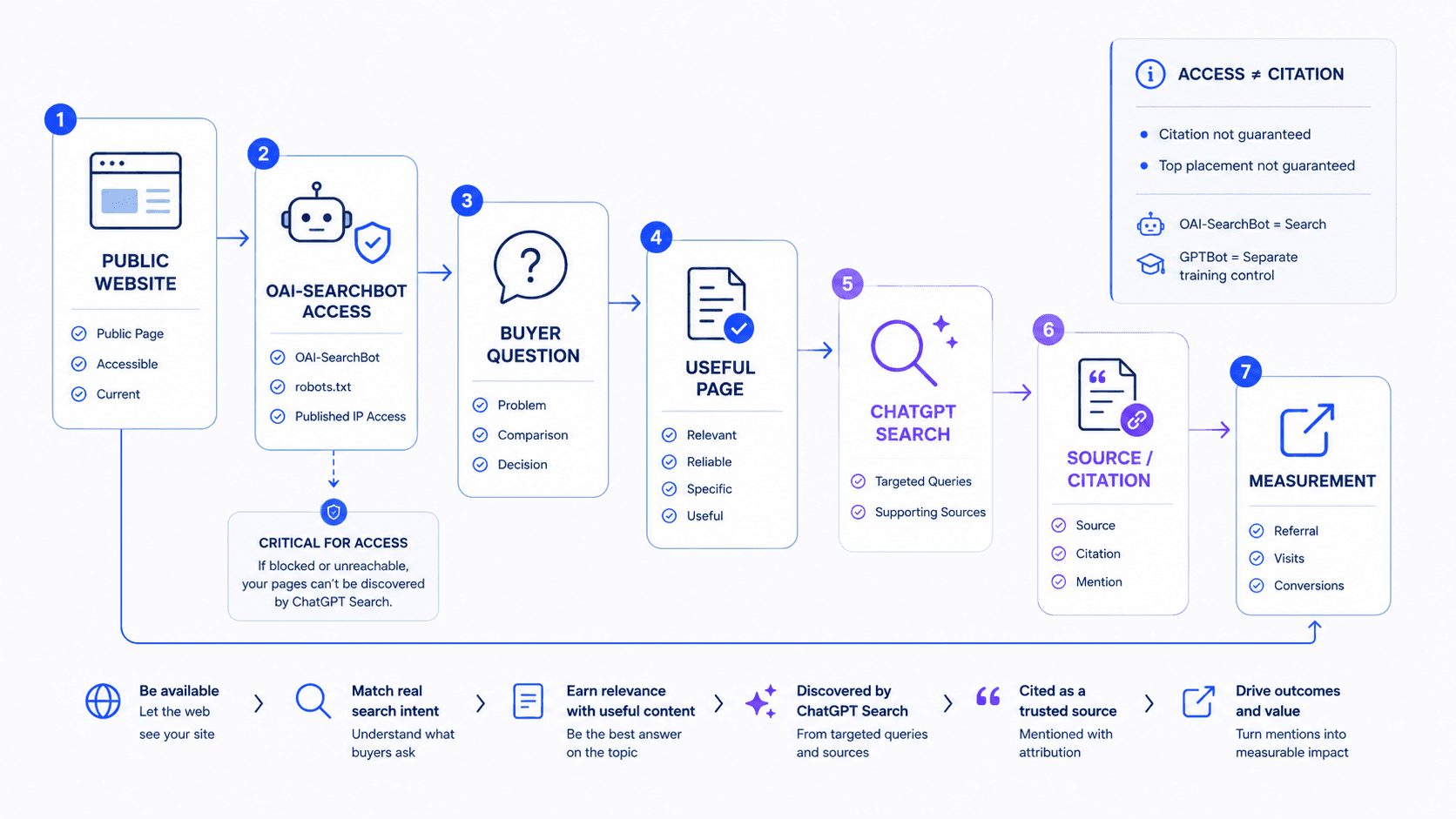
OpenAI says any public website can appear in ChatGPT Search. Publishers who want content included in ChatGPT summaries and snippets should not block OAI-SearchBot, and OpenAI says that for inclusion it is important for the site's host or CDN to permit traffic from its published IP addresses.
OpenAI crawler overview · OpenAI ChatGPT Search
But crawler access does not guarantee citation. OpenAI says ChatGPT Search ranking uses multiple factors intended to help users find reliable, relevant information, and there is no way to guarantee top placement.
Available does not mean cited.
OpenAI does not publish a fixed public citation-ranking formula.
For the broader cross-platform workflow, see AI Search Optimization: How to Get Found in AI Search.
What does cited by ChatGPT actually mean?
ChatGPT visibility can describe several different outcomes. They should not be treated as the same metric.
Mention
ChatGPT refers to your brand, company, product, or service. A mention does not necessarily include a source link.
Citation or source
ChatGPT Search responses may include inline citations, and its Sources panel can contain cited sources and other relevant links. A citation means a web source has been surfaced in connection with the response.
Referral
Someone clicks from ChatGPT to your website. Analytics can identify the referral when referrer information or URL tagging, such as utm_source=chatgpt.com, is available. This does not measure visits without identifiable referral information.
Business outcome
A referral can then produce a lead, signup, trial, purchase, subscription or revenue.
Mention -> Citation -> Referral -> Business outcome
But those stages are not guaranteed to follow one another. A brand can be mentioned without a citation. A source can be cited without receiving a click. A referral can arrive without converting.
What does OpenAI say you need for ChatGPT Search availability?
OpenAI's current public guidance starts with access.
Public page
↓
OAI-SearchBot allowed
↓
Host/CDN permits OpenAI crawler traffic
↓
Available for ChatGPT Search
OpenAI says any public website can appear in ChatGPT Search. To help ensure content can be discovered, surfaced, cited, and linked, publishers who want site content included in summaries and snippets should not block OAI-SearchBot.
OpenAI's Search documentation also says that for inclusion it is important to allow OAI-SearchBot and ensure the site host or CDN allows traffic from OpenAI's published IP addresses.
That makes crawler configuration important for availability. It does not establish OAI-SearchBot access as a ranking or citation factor.
Available does not mean cited.
OAI-SearchBot vs GPTBot
OAI-SearchBot and GPTBot have different documented roles.
| OAI-SearchBot | GPTBot | |
|---|---|---|
| Primary role relevant here | ChatGPT Search availability | Potential model-training control |
| Relevant to Search availability | Yes | Not documented as required |
| Allowing it guarantees citation | No | No |
| Documented Search ranking factor | No | No |
OAI-SearchBot
OpenAI says publishers who want content included in ChatGPT summaries and snippets should make sure they are not blocking OAI-SearchBot. If necessary, that can mean updating robots.txt. OpenAI also says inclusion can depend on the site's host or CDN permitting traffic from its published crawler IP addresses.
That makes OAI-SearchBot relevant to Search availability. OpenAI does not document OAI-SearchBot access as a citation-ranking factor.
GPTBot
OpenAI documents GPTBot separately as a control for content that may be used to train its generative AI foundation models. Publishers can disallow GPTBot to indicate that their content should not be used for that training. This control is independent of OAI-SearchBot.
OAI-SearchBot = ChatGPT Search availability
GPTBot = separate potential-training control
OpenAI's current public Search guidance does not state that GPTBot must be allowed for a page to appear in ChatGPT Search.
How does ChatGPT Search find relevant information?
ChatGPT Search does not necessarily search the exact wording the user typed.
OpenAI says that when ChatGPT Search works with search providers, it typically rewrites the user's request into one or more targeted queries. It may then send additional, more-specific queries after reviewing initial results.
Suppose a user asks: What's a good CRM for a small SaaS sales team that doesn't want a complicated setup? The searches used to discover supporting information may use different wording from the original conversational prompt.
Rankvia therefore recommends: Optimize for the underlying user need, not one exact ChatGPT prompt. That is an editorial recommendation, not an OpenAI ranking rule.
One prompt does not need one URL
A business may encounter dozens of ways users ask essentially the same question. That does not justify dozens of pages.
Instead ask: Is the underlying need genuinely different? Does an existing page already serve it? Could that page be improved? Would another URL create unnecessary overlap?
OpenAI documents query rewriting and additional targeted searches. It does not document a one-prompt-one-page optimization model.
Step 1: Make your pages available
Before experimenting with content formatting, confirm that intended pages are accessible to ChatGPT Search.
Check OAI-SearchBot
OpenAI says publishers should not block OAI-SearchBot when they want site content included in ChatGPT summaries and snippets. Review robots.txt for intended public content.
Check hosting and CDN access
OpenAI says that for inclusion it is important that the site's host or CDN allows traffic from its published IP addresses. In practice, infrastructure controls such as WAF rules, bot protection, CAPTCHAs, firewall policies, rate limiting, and CDN rules can interfere with automated crawler access. OpenAI documents these as common crawler-access problems in its current crawler troubleshooting guidance.
If ChatGPT Search cannot access the page as intended, changing paragraph length will not solve the access problem.
Search opt-outs and navigational links
OpenAI's current crawler documentation distinguishes Search answers from navigational links: sites opted out of OAI-SearchBot are not shown in ChatGPT search answers, but can still appear as navigational links. Use the documented Search access controls for the intended behavior; do not treat removing noindex as a way to secure citations or ranking.
Step 2: Target real questions and decisions
Once access is working, focus on what people actually need to know. Useful opportunities can include problems, use cases, comparisons, alternatives, buying decisions and implementation questions.
The important unit is the underlying intent, not the wording of one prompt.
Rankvia uses a simple planning rule: Create. Improve. Or skip.
Create
Create a new page when the user need is genuinely distinct and no existing page serves it adequately.
Improve
Improve an existing page when it already owns the need but could be more useful, accurate, or complete.
Skip
Skip the opportunity when it is mostly another wording of an existing intent, has weak business relevance, or would create unnecessary overlap.
This is Rankvia methodology, not OpenAI's ranking model.
Step 3: Publish useful, reliable information
OpenAI says ChatGPT Search ranking uses multiple factors designed to help users find reliable, relevant information. It does not publish a detailed public weighting system for individual citation-selection factors.
OpenAI documents Search availability, targeted query rewriting, multiple ranking factors, reliability and relevance, and no guaranteed top placement.
Rankvia recommends
The following are editorial recommendations, not claimed OpenAI ranking factors.
Answer the real question
Make the information the reader came for easy to find.
Support important factual claims
Use appropriate evidence, especially for technical requirements, regulations, numbers, product capabilities, comparisons and fast-changing information.
Add useful specificity
Where relevant, include concrete examples, original data, first-hand experience, meaningful comparisons, demonstrations, limitations and tradeoffs.
Make comparisons genuinely useful
Do more than repeat two feature lists. Explain meaningful differences, fit, tradeoffs and decision criteria.
Make company and product information unambiguous
Be specific about what the company is, what the product does, who it serves and which claims can be supported. OpenAI does not publish entity clarity as a defined citation-ranking factor.
What about Reddit, reviews, directories, and third-party mentions?
ChatGPT Search sometimes works with third-party search providers when finding relevant information. It is therefore sensible for businesses to keep important public information accurate and discoverable across the places where their audience genuinely encounters the brand.
Depending on the business, that can include reputable industry profiles, genuine customer reviews, research, press coverage, partner pages and relevant community discussions.
However, OpenAI's current public Search documentation does not establish Reddit mentions as a ranking factor, Wikipedia presence as a ranking factor, G2 or Capterra listings as citation factors, press coverage as having a defined ranking weight, or backlinks as a fixed ChatGPT citation factor.
Keep important information accurate and discoverable - do not manufacture third-party mentions to chase an undocumented formula.
What OpenAI documents - and what it does not establish
| OpenAI documents | Current public documentation does not establish |
|---|---|
| OAI-SearchBot matters for Search availability | A fixed citation algorithm |
| Host/CDN crawler access matters for inclusion | Guaranteed citation |
| Search queries may be rewritten | One page per prompt |
| Ranking uses multiple factors | Fixed public ranking weights |
| Reliability and relevance matter | Exact paragraph lengths |
| Top placement cannot be guaranteed | FAQ schema as a citation factor |
| ChatGPT Search referrals can be tracked | JSON-LD as a citation factor |
| GPTBot is handled separately for potential training | GPTBot as a Search ranking factor |
The first column reflects OpenAI's current Search and publisher documentation. The second column means the current public documentation reviewed does not establish those claims. It does not prove every undocumented mechanism has zero indirect effect.
ChatGPT citation tactics to be skeptical of
“Use an exact 40-80 word answer block”
OpenAI's current public Search guidance does not document an exact answer-block or paragraph length as a citation-ranking factor. Direct writing can still be valuable because it helps readers.
“FAQ schema guarantees citations”
OpenAI's current public Search and publisher documentation does not establish FAQ schema as a citation factor or guarantee. Use FAQs when they help readers.
“JSON-LD gets your page cited”
OpenAI's current public Search documentation does not establish JSON-LD as a ChatGPT citation-ranking factor. That does not mean structured data has no other legitimate purpose.
“You must rank in Bing's top 10”
OpenAI says ChatGPT Search sometimes works with third-party search providers and currently lists providers including Bing and Shopify in its Search explanation. OpenAI does not publish a universal requirement that a page must rank in Bing's top 10 to be cited.
“Allow OAI-SearchBot and you'll get cited”
No. OAI-SearchBot helps make content available for ChatGPT Search. OpenAI separately says there is no way to guarantee top placement. Available does not mean cited.
“GPTBot access improves Search visibility”
OpenAI documents GPTBot separately as a potential-training control. Its current public Search guidance does not establish GPTBot access as a Search ranking or citation factor.
“llms.txt guarantees ChatGPT visibility”
OpenAI's current public ChatGPT Search and publisher documentation does not identify llms.txt as a Search inclusion requirement or citation-ranking factor. Do not go further and claim that ChatGPT categorically ignores llms.txt unless OpenAI publishes that position.
“Create one page for every prompt”
ChatGPT Search may rewrite a prompt into one or more targeted queries and may run additional searches. That makes exact prompt wording a poor basis for indiscriminately multiplying URLs. Create a new page when the underlying user task is meaningfully different.
“We rank #1 in ChatGPT”
OpenAI says ranking uses multiple factors and explicitly says top placement cannot be guaranteed. A single response should not be treated as a permanent universal rank.
APPLY THIS TO YOUR WEBSITE
Find the searches your website should be visible for in Google and ChatGPT.
Rankvia analyzes your business and existing website, identifies relevant buyer searches, and determines whether the strongest opportunities should become new pages or improvements to pages you already have. It then organizes the strategy into a prioritized Content Calendar, with Page Plans defining what each page should achieve before generation.
Personalized to your website · No credit card required
How do you measure ChatGPT visibility?
Do not collapse ChatGPT visibility into one number. Measure different stages separately.
Mentions and citations
Track whether the brand appears, whether the domain is shown as a source, which page is cited, and whether source appearances recur for relevant questions. A citation indicates source visibility. It does not necessarily create a click.
See Rankvia's metric definitions and limitations for how it separates observed brand appearances from source appearances.
Referral traffic
Identify ChatGPT Search referrals using referrer information or URL tagging where available, such as utm_source=chatgpt.com, allowing publishers to identify inbound traffic in analytics. That can help measure landing pages, sessions, engagement, signups, leads, purchases and revenue.
Referral data does not capture every mention or citation because users can see a source without clicking it.
Controlled visibility monitoring
For strategically important questions, Rankvia recommends maintaining a consistent monitoring set: category questions, comparisons, alternatives, use cases and buying decisions. Record brand presence, cited domain, cited page, relevant competitors, date and context. Repeat observations over time.
Prefer: The brand appeared as a source in 12 of 30 monitored responses this month. Over: The brand ranks #2 in ChatGPT. The first describes what was actually observed.
Business outcomes
Ultimately connect visibility to qualified visits, leads, trials, purchases, subscriptions and revenue. Citation volume can be informative. Business impact matters more.
ChatGPT visibility checklist
Access
- OAI-SearchBot is not unintentionally blocked.
- robots.txt reflects the intended Search access.
- Hosting/CDN/security controls permit intended OpenAI crawler traffic.
- Important pages are publicly accessible where appropriate.
- GPTBot training preferences are handled separately.
Opportunity
- The page answers a real audience question or decision.
- The opportunity has meaningful business relevance.
- Existing page ownership has been checked.
- It is not merely another wording of an existing prompt.
Page
- The primary question is answered clearly.
- Important factual claims are supportable.
- Evidence is included where useful.
- Examples are specific.
- Comparisons contain meaningful decision criteria.
- Product/company information is unambiguous.
- The page adds value beyond a generic summary.
Wider web
- Important public company information is accurate.
- Relevant profiles are current.
- Genuine reviews/directories are maintained where useful.
- Third-party mentions are not treated as documented OpenAI ranking factors.
Measurement
- ChatGPT referral traffic can be identified.
- Citations are measured separately from referrals.
- Mentions are not confused with citations.
- One response is not treated as a stable rank.
- Visibility is connected to business outcomes.
Sources
Frequently asked questions
BUILD YOUR SEARCH GROWTH PLAN
Find the pages your website should create or improve for Google and ChatGPT.
Enter your website and Rankvia will analyze your business, identify relevant search opportunities, and build the strategy for what to publish next.
Personalized to your website · No credit card required