Guides Shopify product page SEO: Make the product clear to buyers and search systems
SHOPIFY PRODUCT PAGE SEO
Shopify product page SEO: Make the product clear to buyers and search systems
Learn how to optimize Shopify product pages with clearer product information, better variants, structured data, Search Console evidence, and AI-shopping readiness.
By Rankvia ·
This guide starts with an assumption: the product page is already the right owner for the search.
If you're still deciding whether a query belongs to a product, collection, comparison, or another existing page, that decision belongs upstream. The Shopify SEO guide covers page ownership more broadly.
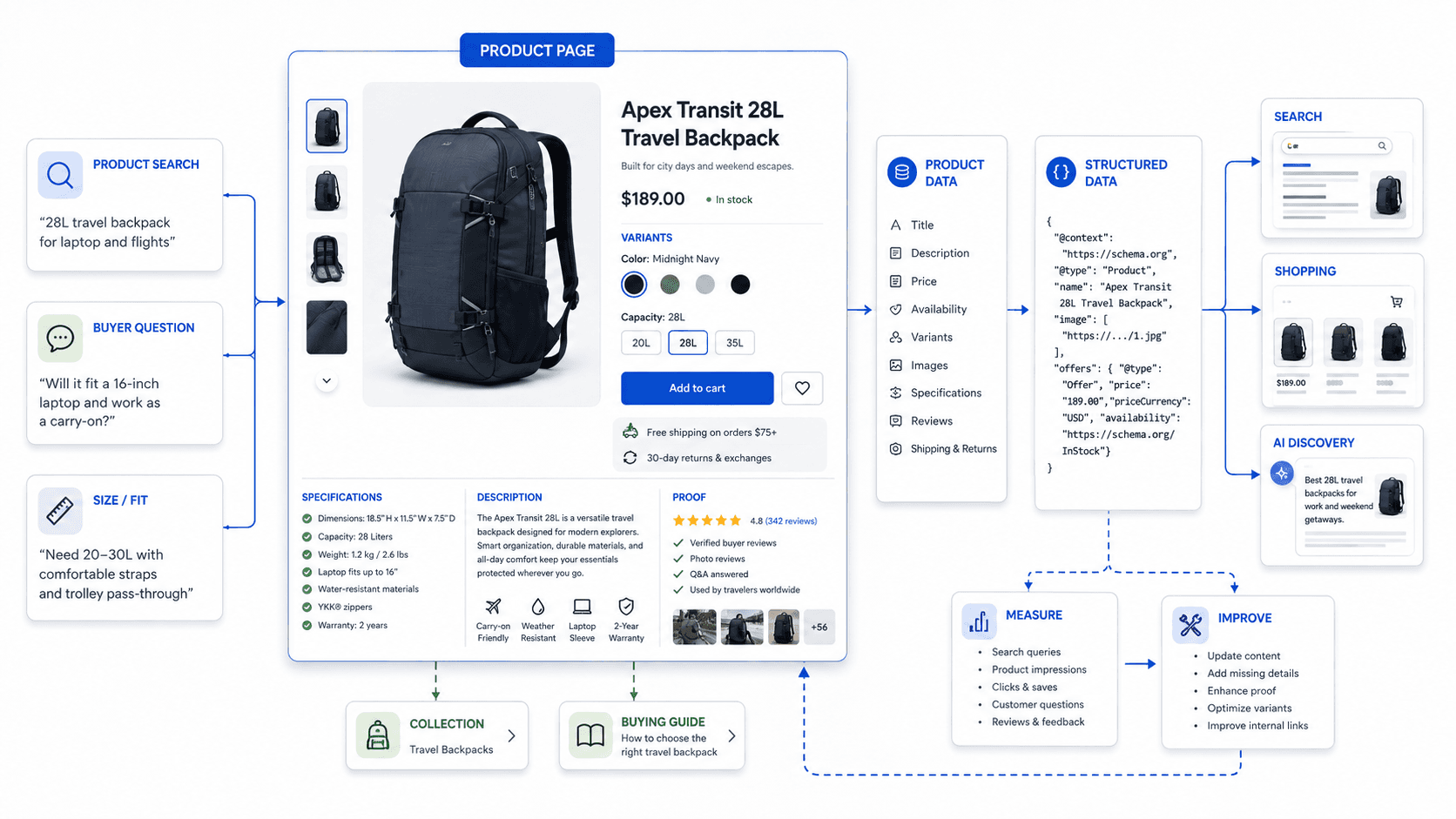
Once the PDP is the right destination, the work becomes more concrete. A shopper - and any system trying to understand the product - should be able to work out what is being sold, which version it is, what it is for, how it differs, whether it fits the buyer's constraints, and what conditions come with buying it.
Shopify product page SEO is the process of making a product page the clearest, most accurate and useful representation of a specific product for buyers, search engines, structured commerce systems, and future search-driven improvements.
That is a broader job than putting the keyword into the title and making the description longer.
Product information also travels beyond the visible PDP. Shopify products can contain titles, descriptions, media, categories, variants, metafields, pricing, inventory and other structured information, while Shopify Catalog can distribute eligible product data such as titles, descriptions, images, prices, options, variants and availability to supported discovery systems. Google can separately use the public page, Product structured data, and Merchant Center data.
The practical consequence is that the product should tell a coherent story wherever it appears.
For broader planning and portfolio decisions, see the Shopify Content Strategy guide.
The Shopify Product Page SEO lifecycle
- PRODUCT-SPECIFIC INTENT
- PRODUCT IDENTITY - What exact product is this?
- BUYER QUESTIONS - What does someone need to know before choosing it?
- PRODUCT FACTS + DIFFERENTIATORS - What makes the product understandable and distinct?
- VARIANTS + MEDIA + PROOF - Can the buyer evaluate the actual option?
- COMMERCIAL FACTS - Price, availability, shipping, returns
- STRUCTURED REPRESENTATION - Do other systems receive compatible product facts?
- STORE CONNECTIONS - Where does this product sit in the wider site?
- SEARCH + COMMERCE EVIDENCE - What is actually happening?
- IMPROVE - What needs to change?
The rest of the guide follows that logic.
1. Product-page SEO starts with a clear product
A product page has a narrower job than most ecommerce pages. A collection helps someone browse a category. A buying guide helps compare or choose. A PDP is there to help someone understand and evaluate one product, or a clearly defined family of variants.
That sounds obvious until you inspect real stores.
A product called:
Venture Pro
may make perfect sense internally. Repeat customers may know exactly what it is. Someone arriving from Search still has to work out whether Venture Pro is a backpack, suitcase, jacket, water bottle, or something else.
In that case, the first SEO improvement may simply be clearer product identification.
Shopify's own product model reflects this broader reality. Beyond the title and description, a product can contain media, category, pricing, inventory, shipping information, variants, metafields, disclosures, search-engine listing data, publishing state, and theme-level presentation.
Those fields are not equally important for every product. What matters is whether the page makes the product identifiable, evaluable, and trustworthy.
A useful way to think about the PDP is through four jobs:
Identify the product. What exactly is this?
Explain the product. What facts matter to someone evaluating it?
Differentiate the product. What would make someone choose this version rather than another?
Reduce uncertainty. What questions could stop someone from making a confident decision?
For a skincare serum, the uncertainty may revolve around formulation, active ingredients, application, skin compatibility, and volume. For a backpack, dimensions, capacity, laptop fit, materials, and weight may matter more. A replacement part may live or die on model numbers and compatibility.
The page should reflect the decision the product creates rather than forcing every catalog item into one universal template.
2. Make the exact product immediately identifiable
Product naming should help the shopper recognize what they are looking at.
The title is not a container for every phrase the page might eventually rank for.
A weak title might be:
Venture Pro
A clearer one could be:
Venture Pro 28L Carry-On Travel Backpack
if those words genuinely identify the item.
That is very different from turning it into:
Venture Pro Best 28L Travel Backpack Carry On Luggage Lightweight Backpack Men Women Europe
The latter technically contains more search terms and communicates the product less clearly.
Product name, brand and model
What belongs in the name depends on how buyers distinguish the item.
For some products, the brand and model are central:
Sony WH-1000XM6
For others, a descriptive product type matters more:
28L Carry-On Travel Backpack
A replacement part may need a model number because that is how customers search. A skincare product may need a concentration or formulation when that characteristic is part of the product's identity.
Use the information people genuinely rely on to recognize the item.
When a differentiator belongs in the title
Differentiators belong in the title when they help distinguish one meaningful product choice from another.
For example:
Venture Pro 28L Carry-On Travel Backpack
is clearer than:
Venture Pro Backpack
if the range also contains 20L and 40L versions.
A mattress might need size, firmness, or material. A cable may need connector type and supported specification. A spare part might need compatibility.
Not every useful attribute belongs in the title. If the name needs twenty modifiers to explain the product, some of that information belongs elsewhere on the page.
Product title vs SEO title
Shopify lets merchants edit the product's search-engine listing separately from the main product details, including its page title, meta description, and URL handle.
The visible product name and SEO title can be identical.
They can also differ slightly where additional search context is useful.
For example:
Product title
Venture Pro 28L
SEO title
Venture Pro 28L Carry-On Backpack | WildHorizon
That can make sense if the shorter name works inside the store while the search result needs more context.
There is no reason to force differences for SEO theater. Google's title systems use several page signals and recommend descriptive, concise titles rather than stuffed or repetitive ones. The useful objective is consistency around what the product actually is.
3. Give the buyer the facts needed to make a decision
Most product-page advice eventually reaches the phrase:
Write a better product description.
That is too vague to guide much.
A stronger PDP starts by identifying what the buyer actually needs to know.
Product Information Hierarchy PRODUCT IDENTITY Brand + name + model + category ↓ DECISION FACTS Dimensions + materials + ingredients + compatibility + sizing + use ↓ COMMERCIAL FACTS Price + availability + variants + shipping + returns + warranty ↓ PROOF Reviews + testing + certifications + first-hand information ↓ STRUCTURED REPRESENTATION Structured data + Merchant Center + Shopify Catalog
This is a conceptual hierarchy, not a required visual layout for every Shopify theme.
A backpack and a serum need different information priorities.
A travel backpack
A buyer may care about external dimensions, actual capacity, empty weight, laptop compartment dimensions, materials, water resistance, opening style, and whether the bag fits a particular airline constraint.
This:
Premium backpack designed for modern travelers with superior functionality and quality.
does little to reduce uncertainty.
This:
28L capacity, 45 × 30 × 18 cm external dimensions, 1.1 kg empty weight, recycled nylon shell, and padded sleeve for laptops up to 16 inches.
gives the buyer facts they can actually evaluate.
A skincare product
The useful details could include ingredients, concentration, formulation, volume, usage, skin-type guidance, relevant precautions, and packaging.
Accuracy matters here. A cosmetic PDP should not quietly turn an ingredient into a medical treatment because stronger claims sound better.
Furniture
For furniture, dimensions can be more useful than several paragraphs of lifestyle copy.
People may need to know the width, depth, height, material, seating capacity, assembly requirements, finish, and care.
Calling a table "spacious" does not replace telling the customer how large it is.
Replacement parts
With replacement components, compatibility may be the page's most important information.
A replacement battery can have excellent photography and an optimized search title while still failing the buyer if nobody can tell which device models it supports.
4. Write product descriptions around useful information, not SEO length
There is no useful universal product-description length.
A simple spare part may need very little prose if the page already exposes the model, compatibility, specifications, price, and availability clearly. A technical outdoor product may deserve substantially more explanation because the buying decision has more moving parts.
The better question is what remains unclear after the rest of the page has done its work.
Identify before persuading
Start with what the product actually is, then explain why the relevant features matter.
For example:
28L carry-on backpack with a 45 × 30 × 18 cm shell and padded 16-inch laptop compartment.
gives the reader something concrete.
Then the description can interpret that fact:
The shallower 18 cm packed depth makes the bag easier to use under stricter personal-item allowances than many deeper hiking packs of similar capacity.
The benefit is more credible because the underlying product detail is visible.
Connect benefits to real features
Weak:
Ultra-comfortable straps for effortless adventures.
Better:
8 cm padded shoulder straps with an adjustable sternum strap distribute the load across the shoulders and chest.
Even that does not guarantee comfort for every person. Body shape, load, torso length, and fit still matter.
Good product copy often becomes more credible when it leaves room for those realities.
Explain meaningful differences
If two product versions differ, explain the differences that change the decision.
A 28L and 40L backpack may have different airline suitability, weight, strap systems, internal organization, and use cases. Those facts belong on the page if they are what buyers use to choose.
Manufacturer descriptions are a source, not the entire page
Google says duplicate content is common and is not inherently a violation of its spam policies. The weakness of copied manufacturer text is therefore not a generic "duplicate content penalty."
The more practical problem is that a page containing the same description as every competing retailer contributes little additional information. Shopify itself advises resellers not to rely on the manufacturer's exact description.
Manufacturer data can still be the correct source for model numbers, dimensions, materials, and technical specifications.
Keep the facts.
Add value where your business can genuinely add it.
5. Decide what belongs on the product page - and what deserves supporting content
A product page can also become weak by trying to answer every question related to the category.
The PDP should be complete enough for the product decision. It does not need to become the definitive guide to the entire market.
Product Page vs Supporting Content Matrix Buyer question Product page Supporting content Why Exact dimensions Yes Usually unnecessary Core product fact Ingredients/materials Yes Maybe deeper education Needed to evaluate product Compatible models Yes Detailed compatibility guide if complex Core buying question What's included Yes Usually no Product-specific Size/fit basics Yes Detailed sizing guide where complexity warrants Needed before purchase Care basics Yes Detailed care guide where useful Product ownership/support Product A vs Product B Briefly, where useful Comparison guide often better Multi-product decision How to choose the category Briefly Buying guide Broader than one PDP Broad educational topic Usually no Educational guide Not product-specific Complex troubleshooting Common issue only Support guide Too deep for PDP
These boundaries are deliberately soft.
A waterproof-jacket PDP can include concise washing instructions and link to a deeper shell-care guide. A serum page can explain the active ingredients without becoming a complete introduction to skin biology.
The important question is whether the information is part of understanding this product, or whether it represents a broader decision that deserves its own page.
For the execution of supporting editorial content, see the Shopify Blog SEO guide.
6. Treat variants as product information, not an SEO shortcut
Variants are one of the more complicated parts of product SEO because several separate questions get bundled together.
A size may simply be an option. A 40L version of a backpack may be a substantially different purchase. A processor configuration may change the product enough that buyers search for it independently.
There is no universal rule that says every option deserves a standalone SEO page.
Variant Decision Framework
SAME CORE PRODUCT?
↓
YES
↓
DOES THE VARIANT MATERIALLY CHANGE
WHAT THE BUYER IS SEARCHING FOR?
/
NO YES
↓ ↓
VARIANT EVALUATE DISTINCT
GROUP SEARCH / URL / CONTENT NEED
Ordinary variants
A T-shirt offered in small, medium, large, black, and navy usually remains one product family.
Those options still need to be clearly named, purchasable, and represented accurately. That does not mean every combination needs its own canonical SEO page.
When the variation changes the decision
A backpack sold as both a 20L commuter version and a 45L trekking model may have meaningfully different features, use cases, dimensions, and search demand.
An electronics product can create the same problem when processor, storage, compatibility, or generation changes the actual product decision.
In those cases, treating the option as nothing more than a dropdown may underserve the buyer. The appropriate URL and content structure still depends on the product family and actual demand.
Variant URLs and canonicals
Google currently recommends that each product variant be directly identifiable through its own URL, including URLs that use query parameters. On single-page product-family implementations, Google recommends one canonical URL for the overall product group, typically the base product URL. On multi-page implementations where variants live on equally important pages, that single-canonical pattern does not apply in the same way.
That distinction is important. A variant can be directly addressable without automatically becoming a separate search target that needs its own SEO campaign.
ProductGroup
Google supports ProductGroup structured data for describing product families, with related variant Product entities and properties such as variesBy, hasVariant, and productGroupID.
Before changing any markup, inspect what the Shopify theme or structured-data app already produces.
Shopify Catalog grouping
Shopify Catalog also groups product variants and supports Catalog Mapping for stores using custom product data or grouping logic.
The useful objective is making options distinguishable wherever buyers and downstream systems actually need to distinguish them.
7. Use images and media to answer visual product questions
Product media should answer questions that text handles badly.
For a backpack, that could mean showing the interior organization, laptop compartment, packed depth, straps, scale on a person, or the way the bag opens.
For furniture, the useful visual questions may concern room scale, finish, texture, assembly, and proportions.
For a replacement component, connection points and included hardware may matter more than lifestyle photography.
Shopify supports images, video, and 3D media on product pages.
Google can also use product imagery in richer Search and shopping experiences when the product is eligible, and Product structured data supports product image information.
Alt text
Alt text should describe what the image shows where that information is useful.
For example:
Black Venture Pro 28L backpack showing open clamshell interior and laptop sleeve
is informative.
best travel backpack carry on backpack 28L travel backpack
is simply another keyword list.
Keep important facts available outside the image
A dimension graphic can be useful. The measurements should still exist as visible text or structured information where appropriate.
A shopper or external system should not need to interpret an infographic to discover the size of the product.
8. Use reviews and proof without treating them as an SEO hack
Reviews add evidence from people who have actually bought or used the product.
They can expose things the merchant's own description may not capture particularly well, such as sizing, durability, fit, or how the product behaves in real use.
That helps buyers.
Google supports review and aggregate-rating information in eligible product experiences when the underlying review information complies with its requirements. Rich-result display remains discretionary.
The useful conclusion is not that more reviews automatically create higher organic rankings.
Reviews can reduce uncertainty, add first-hand experience, and support legitimate rating information in search experiences where Google chooses to show it.
Shopify's Agentic Listing Quality diagnostics currently include verified reviews among the merchant-controlled inputs it evaluates, while Shopify also notes that product discovery depends on other signals such as relevance, engagement, popularity, and brand recognition.
Treat Listing Quality as diagnostic feedback, not as a universal AI ranking score.
9. Make price, availability, shipping and returns part of product clarity
Price, stock, shipping, and returns are often discussed as conversion information.
They are also product facts.
A shopper asking:
Which backpack under €150 can I get before Friday?
cannot make the decision from the product description alone.
Google's merchant-listing structured data can represent price, availability, shipping, and return information.
Shopify Catalog distributes current structured product information such as price and availability for eligible products.
OpenAI says ChatGPT's shopping results can consider product and merchant context including price, availability, reviews, quality, and other information when selecting products or merchants.
That does not mean every PDP needs to reproduce the store's complete policy documents.
It means the product and the systems representing it should agree about important commercial facts.
If the page says Sold out while structured data says In stock, the issue is not a lack of SEO copy.
It is conflicting product information.
10. Keep visible product information and structured product data consistent
A product can now be represented in several places at once:
the visible Shopify PDP; Product structured data; Google Merchant Center; Shopify Catalog.
Those representations use different schemas and data models.
They should still describe the same product accurately.
Product Discovery Consistency Matrix Product fact Visible PDP Google product structured data Merchant Center Shopify Catalog Product name Yes Supported Required product data Yes Description Yes Supported where supplied Product data Yes Images Yes Supported Product data Yes Price Yes Offer Product data Yes Availability Yes Offer Product data Yes Variants/options Yes ProductGroup / Product where appropriate Variant/group data Yes Category Visible or contextual where useful Supported context Product data Yes Reviews/ratings Yes where available Supported where eligible Depends on setup/source Listing Quality can use verified reviews Shipping/returns Accessible to buyer Supported merchant information Supported merchant/product data Policy/store context
This is a consistency framework, not a claim that each platform uses an identical field map.
Product structured data
For a PDP where the merchant directly sells the product, Google's merchant-listing Product and Offer structured data is the relevant framework. It can make facts such as price, availability, shipping, returns, ratings, and variants eligible for richer Google shopping experiences.
Structured data does not replace the visible product page. It makes explicit product information easier for Google to interpret.
Merchant Center
Google can also receive product data through Merchant Center, and Google explicitly recommends using page structured data, Merchant Center feeds, or both. Providing both can expand eligibility and help Google understand and verify product information.
That matters particularly for information that changes frequently, including price, stock, and shipping.
Synchronizing those facts is more important than adding another paragraph to the product description.
Shopify Catalog
Shopify Catalog provides structured product information for eligible products and can include titles, descriptions, images, prices, options, variants, categories, and availability. Supported shopping and AI channels can use that information for discovery.
Shopify explicitly states that Catalog inclusion does not guarantee a specific external ranking, wording, or recommendation because downstream channels control their own experiences.
Check before adding more schema
Structured data matters, but more markup is not inherently better.
Shopify themes and apps may already output Product markup. Before adding another implementation, inspect what is currently rendered and whether the data is accurate.
Two conflicting Product blocks are not an improvement over one correct one.
For the broader Shopify AI-commerce infrastructure, see the Shopify AI Search Optimization guide.
11. Handle out-of-stock and discontinued products deliberately
A product becoming unavailable does not instantly erase the usefulness of its page.
Temporary and permanent unavailability need different judgment.
Temporarily out of stock
Google's current ecommerce guidance recommends keeping temporarily unavailable content online rather than removing it from Search, while accurately marking the product as out of stock. That preserves first-party product information for people still researching the item.
So if the product is expected back, the page can still help people compare the model, read reviews, understand its specifications, or wait for restock.
The essential requirement is honesty.
Do not let structured data say InStock while the storefront says Sold out.
Permanently discontinued
There is no universal SEO rule.
Google has said deleting the page is valid when a permanently sold-out product is gone, while keeping or redirecting the URL can also make sense from a usability perspective where customers have bookmarks, external links exist, or a relevant replacement is available.
Keeping the page may make sense when people still search for the model, existing customers need documentation, or a successor needs to be explained.
A redirect can be useful where a genuinely close replacement exists and the old page no longer has much independent value.
Removal may be reasonable when the item is permanently gone and the URL has little remaining purpose.
Redirecting every discontinued product to a broad collection is not automatically helpful. Someone looking for an old camera model may be better served by a page explaining that it was discontinued and pointing to the actual successor than by being dropped onto a generic camera category.
The page lifecycle should follow the user's remaining need.
12. Connect the product page to the rest of the store
A PDP is a destination, but it is also part of the site's architecture.
COLLECTION ↓ PRODUCT ↕ SUPPORTING CONTENT
A collection helps shoppers discover and compare products in the category. The PDP handles the detail for one item. Supporting content can answer questions that are too broad or too deep to belong on the PDP itself.
A carry-on backpack might connect naturally to its parent collection, a sizing or packing guide, a 28L vs 40L comparison, or product-specific care information.
Those relationships can work in both directions. A guide can point toward the product when it becomes relevant to the reader's decision, while a PDP can link outward when deeper support genuinely helps.
Breadcrumbs and navigation also help reinforce the hierarchy.
There is no reason to optimize for a fixed number of internal links. The useful question is whether the connections make the store easier to navigate and understand.
13. Use Search Console to diagnose what the product page should improve
A change in search visibility tells you that something happened.
It does not tell you which field to edit.
Search Console exposes query and page performance data including impressions, clicks, and CTR, and Google specifically recommends using query/page patterns and high-impression, low-CTR cases to investigate whether titles, snippets, or page content align with the search.
Product-page feedback loop PRODUCT PAGE ↓ SEARCH CONSOLE ↓ PRODUCT / MODEL / VARIANT QUERIES ↓ WHAT IS THE EVIDENCE SAYING? ↓ PDP IMPROVE? COLLECTION ISSUE? VARIANT ISSUE? SUPPORTING CONTENT? TECHNICAL ISSUE? NO ACTION?
A backpack PDP receiving impressions for:
Venture Pro 28L; Venture Pro dimensions; Venture Pro laptop size; Venture Pro waterproof;
is being associated with product-specific demand.
If the product page lacks important dimensions or compatibility information, an Improve action makes sense.
Now consider that same page appearing for:
best carry on backpacks
That may be evidence of relevance to the category, but it does not necessarily mean the PDP should become a buying guide. The collection or supporting editorial content may be the better owner.
Variant queries introduce another layer. Searches for a 40L version, particular color, or compatibility model can expose weak naming, incomplete visible information, variant URL issues, or genuinely separate demand.
High impressions with weak clicks also require diagnosis. The result could have an unclear title, poor product identification, the wrong intent, or uncompetitive commercial information. Rewriting the description is only one possible response.
A decline can come from seasonality, product demand, stock status, a replacement model, competitors, technical issues, or a page-ownership problem.
Search data is evidence, not the diagnosis.
Rankvia's current Google Search Console integration uses existing query, page, impression, and performance evidence as additional context when planning what to create or improve.
Explore Rankvia's Search Console integration.
14. What AI shopping changes at product-page level
AI shopping makes accurate product information more reusable.
It does not create a separate product-page keyword system.
Shopify Catalog can make eligible product data available to supported agentic-shopping channels. Depending on the product and configuration, that data can include titles, descriptions, options, images, prices, availability, categories, and variants.
OpenAI says Shopify product information is integrated into ChatGPT through Shopify Catalog, while ChatGPT independently determines which products are relevant to a user's query and context.
For the product page, the practical response is straightforward: make the product information accurate and complete.
Listing Quality
Shopify's Agentic interface currently provides Listing Quality diagnostics around merchant-controlled inputs such as description completeness, image coverage, verified reviews, variant and option completeness, and policy completeness.
Shopify also states that relevance depends on signals beyond those controllable inputs, including popularity, customer engagement, and brand recognition.
Listing Quality is therefore a diagnostic, not a universal AI ranking score.
Catalog Mapping
Stores using metafields, metaobjects, custom title logic, or custom grouping can use Catalog Mapping to control which sources Shopify Catalog reads.
That distinction matters because the storefront can contain good product information while Catalog is sourcing a different field.
Adding more visible copy does not fix a mapping problem.
For the deeper infrastructure, see the Shopify AI Search Optimization guide.
15. AI can draft product copy - it cannot verify the product
AI is useful when it begins with reliable product information.
Give it accurate dimensions, materials, compatibility, product features, intended uses, and positioning, and it can help organize that information into descriptions, bullets, comparisons, or simpler customer-facing language.
The risk begins when the model is treated as the source of the facts.
A generated description that invents waterproof certification, an ingredient concentration, device compatibility, included accessories, or a warranty is not merely weak copy. It is incorrect product information.
AI can draft the description. It cannot manufacture product truth.
Google Merchant Center currently requires generative-AI product titles to use the structured_title mechanism with the applicable digital-source declaration, and generative-AI descriptions to use structured_description. AI-generated product images also need the appropriate IPTC digital-source metadata to be preserved.
Those product-feed requirements are separate from the broader question of whether AI-assisted visible PDP copy can appear in organic Search.
For the merchant, the practical standard is simpler: AI may transform verified product facts into useful copy. It should not invent the facts it is transforming.
16. Product-page SEO and conversion often improve the same information
SEO and CRO are not the same discipline, but product pages create a lot of overlap between them.
A shopper and a search or commerce system may both benefit from clearer product identity, specifications, sizing, compatibility, variants, price, availability, shipping, returns, and authentic review information.
A person deciding whether a backpack fits a 16-inch laptop wants the internal compartment dimensions.
A search or AI system trying to answer the same question benefits from the same fact.
That is useful overlap.
Other CRO questions have very little SEO relevance. The color of the Add to Cart button, a sticky purchase bar, urgency messaging, or experiment design may materially affect conversion without doing much to help a search system understand the product.
The common ground here is product clarity.
Reducing uncertainty makes the page more useful to the buyer and gives discovery systems better information to work with.
17. Turn product-page improvement into a recurring decision
Product-page optimization is often treated as launch work.
Write the description, add the metadata, upload the images, and move on.
Real catalogs change.
Variants are added. Prices change. Stock disappears. Products get replaced. Customer questions reveal missing information. Search Console starts showing unexpected queries. Supporting content changes the architecture around the PDP. Structured-commerce systems evolve.
That does not mean every product page needs a scheduled refresh.
The useful trigger is a meaningful change in the product, the buyer decision, the search evidence, or the product's representation across systems.
Sometimes the next action is a description improvement. Sometimes the variant structure deserves work. Sometimes the collection is the real problem. A supporting buying guide may be missing. In other cases, the PDP is already doing exactly what it should.
Product-page optimization works better as diagnosis than ritual maintenance.
18. How Rankvia fits
Product pages sit inside a wider search system, and that surrounding system is where Rankvia is currently most relevant.
Rankvia's Content Calendar checks business fit, existing website coverage, buyer intent, and search evidence before deciding whether an opportunity should become a new page, an improvement to an existing page, or no additional page at all.
A product page can therefore matter to the planning process as an existing owner or Improve target where it already serves the relevant intent. Search Console evidence can add first-party query and page context to that decision.
Rankvia can also plan supporting search content around the store. Page Plans define the buyer decision, objective, answer strategy, business context, supporting depth, and relevant internal connections before generation.
Those supporting pages can then connect back toward an appropriate product or collection instead of becoming isolated editorial content.
There is an important boundary to keep clear: Rankvia's current Shopify publishing workflow supports articles and pages, and should not be presented as automatically rewriting or publishing Shopify product records. Rankvia's public Shopify integration specifically describes creating and updating articles and pages and does not document product-record publishing.
Product-page changes described in this guide may therefore still need to be implemented manually in Shopify.
Rankvia's role here is the surrounding planning layer - deciding whether the PDP should own an opportunity, whether an existing page should be treated as an Improve target, whether Search Console supports that conclusion, and what supporting content the store needs around it.
See Rankvia for Shopify.
19. Shopify product-page SEO checklist
Use this as a review tool, not as a score.
Product identity The exact product is immediately understandable. Product name and model terminology are consistent. Important distinguishing information appears where needed. The title is not stuffed with search modifiers. Buyer information Important dimensions and specifications are visible. Materials or ingredients are accurate. Compatibility is clear where relevant. Size and fit information is sufficient for the decision. What's included is clear. Important use or care information is available. Product claims can be supported. Description The description explains the actual product. Benefits are connected to real product facts. Generic adjectives have not replaced useful detail. Manufacturer copy is not the only value on the page. Extra copy has not been added simply to make the page longer. Variants Variant names are understandable. Important differences are visible. Stock status is accurate. Buyer-relevant variants can be directly identified. Variant URL and canonical behavior has been reviewed where technically relevant. Structured variant representation has been checked. Images and proof Images answer useful visual questions. Important product information is not trapped in images alone. Alt text describes relevant image content. Reviews shown are authentic. Review structured data, if present, reflects legitimate visible rating information. Commercial facts Price is accurate. Availability is accurate. Shipping information is accessible. Returns are clear where relevant. Warranty information is clear where relevant. Product facts do not conflict across the storefront and commerce systems. Structured representation Existing Product structured data has been inspected. Price and availability in markup match the product. Variant markup is appropriate where used. Merchant Center data is consistent where applicable. Shopify Catalog receives the expected product information. Catalog Mapping has been reviewed where custom product data is involved. Store connections The product is connected to the appropriate collection. Breadcrumb and category relationships make sense. Supporting content links to the product where useful. The PDP links to deeper support information where appropriate. Related products are genuinely related. Product lifecycle Temporary stockouts are represented accurately. Discontinued products have a deliberate keep, redirect, or remove decision. Replacement relationships are clear where relevant. Search evidence Search Console product and model queries are reviewed. Variant searches are reviewed where relevant. Broad category visibility is not automatically treated as a PDP opportunity. High impressions and weak clicks are diagnosed before editing. Declines trigger investigation rather than automatic rewriting. AI-assisted work AI-generated copy begins from verified product facts. Product claims have been checked. Dimensions, ingredients, and compatibility are verified. AI-generated Merchant Center product data follows applicable requirements. AI has not invented differentiators simply to make the description more persuasive.
Shopify product-page SEO FAQ
What is Shopify product page SEO?
Shopify product-page SEO is the process of making a product page the clearest and most accurate representation of a specific product for buyers, search engines, structured commerce systems, and future search-driven improvements.
It includes product identity, descriptions, specifications, variants, media, structured data, internal relationships, commercial facts, and Search Console evidence.
How do I optimize a Shopify product page for SEO?
Start by making the exact product easy to identify. Add the information buyers need to evaluate it, make variants understandable, use useful media and legitimate proof, keep commercial facts accurate, check structured product data and other product representations, connect the PDP to the wider store, and use search evidence to diagnose later improvements.
A longer description by itself is not an optimization strategy.
How long should a Shopify product description be?
There is no universal ideal length.
The description should contain the information required to understand and evaluate the product without padding.
A simple replacement part may need little prose when compatibility and specifications are clear. A technical or unfamiliar product may need substantially more explanation.
Are duplicate product descriptions bad for SEO?
Duplicate product descriptions do not automatically trigger a Google penalty. Google says duplicate content is common and is not inherently a spam-policy violation.
The larger problem is that using the same manufacturer description as every competing retailer adds little differentiated value to the page.
Use manufacturer information for reliable facts, then add merchant-specific information where it genuinely improves the product decision.
Should I rewrite manufacturer product descriptions?
Usually, you should improve them rather than rely on them as the entire PDP.
Keep accurate manufacturer facts such as dimensions, specifications, materials, model numbers, and compatibility. Add information your store can contribute, such as clearer buyer guidance, original measurements, first-hand experience, or useful comparisons.
Do product reviews help Shopify SEO?
Reviews can improve buyer confidence and support legitimate review or rating information in eligible product search experiences.
They should not be presented as a guaranteed ranking boost.
Shopify also currently includes verified-review information in its Listing Quality diagnostics for agentic product discovery.
Does every Shopify product variant need its own URL?
Every variant should be directly identifiable where Google needs to crawl and understand it, but that does not mean every size or color needs to become a separately optimized canonical SEO page.
For single-page product-family implementations, Google typically recommends one canonical URL for the overall product group while allowing variants to be directly preselected through distinct URLs. Multi-page variant implementations can use a different model.
What structured data should a Shopify product page use?
A PDP where the merchant directly sells the product will generally use Product and Offer structured data appropriate for merchant-listing experiences. Product families with variants can use ProductGroup and related variant markup where appropriate.
Inspect what the Shopify theme or apps already output before adding another implementation.
Should out-of-stock Shopify product pages stay indexed?
A temporary stockout does not automatically mean the PDP should disappear from Search. Google's current guidance recommends keeping temporarily unavailable ecommerce pages accessible and representing the unavailable state accurately.
For permanently discontinued items, consider the page's remaining usefulness, external links, customer-support role, ongoing demand, and any genuine replacement before deciding whether to keep, redirect, or remove it.
How can Shopify products appear in ChatGPT?
Eligible Shopify product information can be made available through Shopify Catalog. OpenAI says Shopify product data is integrated into ChatGPT through Shopify Catalog, while ChatGPT independently decides which products are relevant to a user's query and context.
Catalog inclusion does not guarantee that a product will appear in a particular recommendation.
Should a keyword target a Shopify product page or collection page?
Product-specific intent often fits a PDP, while broader category or browse intent often fits a collection.
For example:
Venture Pro 28L backpack
is likely product-specific.
carry on backpacks
is more likely category intent.
These are useful patterns rather than absolute rules. The actual search results and site structure still matter.
For the broader ownership framework, see the Shopify SEO guide.
How can Search Console help improve Shopify product pages?
Search Console can show product, model, specification, or variant queries associated with a PDP along with impressions, clicks, and CTR.
That evidence can expose missing product information or an Improve opportunity, but it may instead point toward a collection, variant implementation, supporting guide, technical issue, or no change at all.
Search evidence is most useful when it helps identify the correct problem.
APPLY THIS TO YOUR WEBSITE
See which pages and search opportunities deserve attention across your Shopify store
A product page should be optimized as part of the wider store rather than in isolation. Rankvia analyzes the existing website and business context, identifies relevant search opportunities, checks whether existing pages already cover them, and can use Search Console evidence when connected to help distinguish Create, Improve, and no-new-page decisions. It can then plan and create supporting search pages around those priorities while keeping their internal relationships to the rest of the site in context. Product-record changes themselves may still need to be implemented manually in Shopify.
Personalized to your website. No credit card required.
Sources
Shopify
- Product details page - Product controls, media, category, pricing, inventory, shipping, variants, metafields, and publishing.
- Adding and updating products - Product search-engine listings, titles, meta descriptions, and URL handles.
- Shopify Catalog - Structured product information, mapping, grouping, and discovery limitations.
- Product discovery for agentic storefronts - Catalog syndication, variants, and AI-channel product discovery.
- Managing agentic storefronts - Listing Quality and external-channel limits.
- Product structured data - Product snippets, prices, availability, images, variants, and Merchant Center complementarity.
- Product variant structured data - ProductGroup, variant URLs, and canonical behavior.
- Ecommerce URL structure - Variant URLs and canonical consistency.
- Search Console Performance - Query, page, impression, click, and CTR evidence.
OpenAI
- Shopping with ChatGPT Search - Product and merchant context in shopping results.
Rankvia
- Content Calendar - Existing-site coverage, Create/Improve/no-new-page decisions, and prioritization.
- Page Plans - Buyer decision, objective, answer strategy, business context, and internal connections.
- Google Search Console integration - First-party evidence in Create/Improve planning.
- Rankvia for Shopify - Shopify article/page publishing capabilities and boundaries.