Guides Shopify internal linking: Make the relationships between your pages clear
SHOPIFY INTERNAL LINKING
Shopify internal linking: Make the relationships between your pages clear
Learn how to connect Shopify products, collections, guides, and pages with useful internal links, natural anchors, clear hierarchy, and better crawl paths.
By Rankvia ·
Internal linking gets reduced to a strange question surprisingly often: how many links should this page have?
That is rarely the useful starting point.
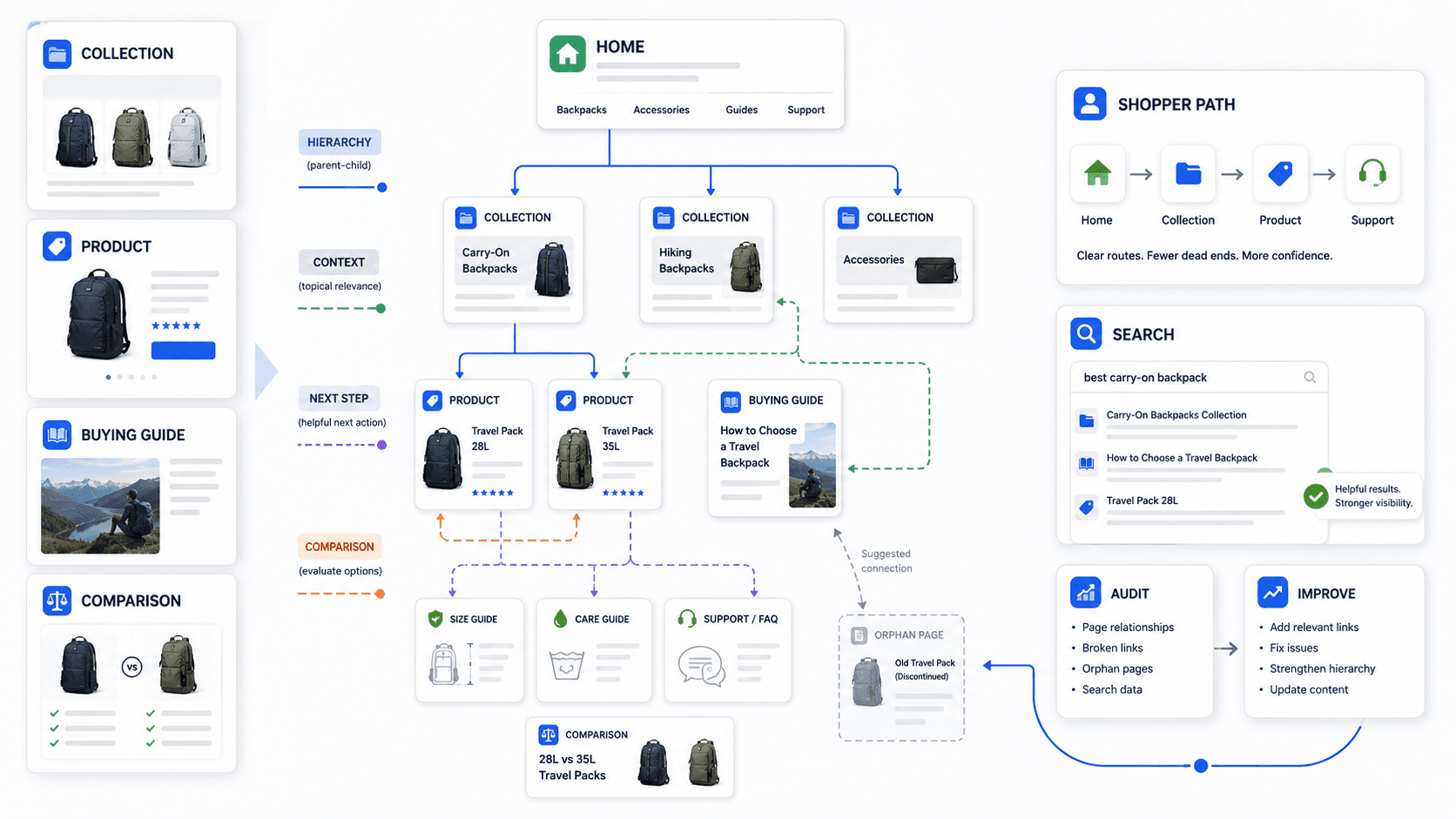
A Shopify store already contains different kinds of relationships. Collections organize products. Buying guides help someone choose within a category. Comparisons may lead directly to the products being compared. A product may need a sizing or care guide. Navigation establishes the site's persistent structure, while contextual links explain relationships that only make sense from a particular page.
Shopify internal linking is the practice of connecting those pages so shoppers and search systems can discover them, understand how they relate, and move toward a useful next page.
Google uses links to find new pages and as a signal when determining relevance. Its ecommerce guidance also says link structure can help Google infer relative page importance based partly on the links pointing to a page and how many link steps are needed to reach it. Google also explicitly says there is no magical ideal number of links a page should contain.
So rather than asking where another link can be inserted, ask what page would genuinely help from this point in the journey.
If you are still deciding what each page should own in the first place, start with the broader Shopify SEO guide. Internal linking becomes useful once those page roles are reasonably clear.
The Shopify internal-linking lifecycle
- PAGE JOB
- WHAT DOES THE READER NEED NEXT?
- BEST EXISTING DESTINATION
- LINK TYPE - Hierarchy / Context / Recommendation / Support
- ANCHOR + SURROUNDING CONTEXT
- CRAWLABLE LINK
- SHOPPER + SEARCH PATH
- AUDIT
- IMPROVE
Weak internal linking often starts halfway through that sequence. Someone searches the site for a keyword, finds a page, inserts the link, and considers the job finished.
Sometimes that creates a useful connection. Sometimes it produces an awkward sentence, sends the reader sideways, and adds another link nobody really needed. The relationship should come first.
Internal linking starts with the page's job
Imagine a Shopify store with a Carry-On Backpacks collection, a Venture 28L PDP, a guide called How to Choose a Carry-On Backpack, a comparison between 28L and 40L bags, and a backpack sizing guide.
All five pages are about backpacks. That does not mean all five should link to one another.
The collection helps people browse the assortment. The PDP explains one exact product. The buying guide helps someone decide what matters before they shop. The comparison handles a specific tradeoff. The sizing guide resolves a narrower fit question.
Once those jobs are clear, the links become easier to justify. A broad buying guide may naturally lead into the Carry-On Backpacks collection. A 28L vs 40L comparison may point to the products or ranges being compared. A PDP may link to the sizing guide when fit genuinely affects the purchase.
The shared keyword is not the reason those pages should connect.
Build a hierarchy that makes important pages reachable
Some links exist because they form the structural backbone of the store.
A simple hierarchy might look like this:
- HOME / NAVIGATION
- COLLECTION
- SUBCOLLECTION
- PRODUCT
Google specifically recommends crawlable navigation connecting ecommerce categories, subcategories, and products. It also says it can infer relative importance from signals such as how many links point to a page and how many links it has to follow to reach it.
That does not mean every store should be flattened into two levels.
A store with forty products can keep things simple. A retailer with 100,000 SKUs cannot put every product in the main menu without turning the navigation into a directory.
Navigation establishes persistent structure
Main navigation is best reserved for destinations that matter across many journeys.
Backpacks may deserve a top-level place in the menu.
Under it, collections such as Carry-On Backpacks, Laptop Backpacks, and Hiking Backpacks may be durable categories that shoppers repeatedly use.
The individual Venture 28L Backpack probably does not belong in the global menu just because the business wants more organic traffic to it.
A page can be important without being globally linked.
Shopify's menu system supports links to products, collections, pages, blog posts, policies, and other destinations, which gives merchants the mechanics to express this hierarchy without forcing every important page into the same navigation level.
There is no Google three-click rule
The advice that every important page must sit within three clicks of the homepage gets repeated so often that it can sound official.
It is not.
Google's ecommerce guidance supports the broader idea that link depth and inbound internal links can contribute to its understanding of relative importance, but it does not prescribe a universal three-click threshold.
The more useful question is whether the page is deep because the catalog genuinely needs that hierarchy or because nobody ever decided where the page belongs.
A PDP four logical levels into a specialist catalog may be perfectly healthy. A commercially important collection reachable only through one forgotten blog post is a different problem.
Use contextual links to explain specific relationships
Navigation tells someone where a page sits in the store.
Contextual links answer a more local question: what other page matters from this exact point?
A buying guide might say:
If cabin dimensions are your main constraint, browse the Carry-On Backpacks collection before comparing individual models.
A product page might say:
For torso measurements and strap adjustment, use the backpack sizing guide before choosing your size.
In both cases, the relationship comes from the surrounding idea rather than from a rule that the destination must receive another link.
Google recommends descriptive anchor text and explicitly notes that the words before and after a link provide additional context about the destination.
Shopify also gives merchants the practical ability to insert internal links into product descriptions, collection descriptions, blog posts, and pages through its rich-text editor.
That gives contextual links a clear job without inventing a weighting formula comparing them with navigation or footer links.
They communicate something different.
Link to the page that matches what the reader needs next
The best destination depends on what the reader is trying to do now.
Someone on a collection may need a product. Someone on a PDP may need sizing help. Someone reading an educational article may still need another explanation before they are ready to browse.
Page Type → Next Useful Page Matrix
| Current page | Possible useful next pages | Why |
|---|---|---|
| Collection | Product, subcollection, buying guide | Browse or deepen the selection |
| Product | Collection, related product, size/care/support guide | Compare, navigate, or get help |
| Buying guide | Collection, relevant products, related guide | Continue the buying decision |
| Comparison | Compared products, relevant collection | Act on the comparison |
| Educational guide | Related guide, collection when buying becomes relevant | Continue learning or start browsing |
| Support guide | Product, related support | Apply or continue the instructions |
The word possible matters.
A buying guide does not need a collection link and six product links simply because all of those pages exist. If the article is still helping someone understand the category, moving into the collection may be enough.
An article explaining nylon denier may not have a useful product link at all. A material comparison or deeper technical guide could still be the more honest continuation.
Internal linking gets less useful when every path is forced toward checkout.
Write anchor text for meaning, not an exact-match formula
Anchor text should help someone predict what they will find after clicking.
Google's guidance is unusually clear here. Link text should be descriptive, reasonably concise, and relevant to both the source page and the destination. Google also warns against stuffing links with keywords and says the surrounding words provide useful context.
For example:
Weak:
click here
Better:
carry-on backpack sizing guide
Weak:
learn more
Better:
Shopify collection page SEO
Overworked:
best Shopify ecommerce internal linking SEO strategy guide
Better:
Shopify internal-linking strategy
Exact-match anchors can be completely natural
If a sentence says:
The deeper technical treatment is in our Shopify Collection Page SEO guide.
there is no need to rewrite the anchor simply because it happens to match the page title.
The problem appears when every reference gets forced into the same exact phrase regardless of the sentence.
There is no sound reason to manage internal anchor text with ratios such as 30% exact match, 50% partial match, and 20% branded.
Write the whole sentence
This:
For filters, subcollections, and faceted URLs, see our Shopify Collection Page SEO guide.
is useful because the sentence explains why the destination matters.
Dropping collection page SEO into unrelated copy is not made better by the anchor being "optimized."
Different link types have different jobs
A Shopify store uses several kinds of internal links because the relationships themselves differ.
Link Type Matrix
| Link type | Main job | Shopify example |
|---|---|---|
| Navigation | Persistent hierarchy | Main menu → collection |
| Breadcrumb | Upward hierarchy/context | Product → collection |
| Contextual | Page-specific relationship | Buying guide → collection |
| Recommendation | Alternative/complementary commerce path | Product → related product |
| Pagination | Discovery of deeper listings | Collection page 1 → page 2 |
A menu link to Carry-On Backpacks says the collection has a durable place in the store.
A link to that same collection from a guide about airline baggage says it is relevant to that particular decision.
A product-to-product recommendation expresses a different relationship again. Shopify's Search & Discovery tooling distinguishes related products from complementary products and allows merchants to customize those recommendations on compatible themes.
There is little value in trying to rank these link types universally from "strongest" to "weakest." A healthy store needs several of them because shoppers have several different jobs.
Give important pages a meaningful inbound path
Internal-link audits often surface a list of orphan pages and encourage the team to add links until the warning disappears.
That skips the first decision: should this page matter?
A useful working definition is:
A valuable page with no meaningful crawlable inbound link from the normal site graph is effectively orphaned from the site's structure.
Google says pages a site owner cares about should have at least one internal link pointing to them. It also says sitemaps can help discover URLs, especially on larger sites, but submitting one does not guarantee crawling or indexing and does not replace the site's internal relationships.
Orphan Page Decision Flow
- PAGE HAS NO MEANINGFUL INBOUND LINK
- SHOULD THIS PAGE MATTER? - No: archive or leave alone. Yes: identify the page that naturally relates.
- ADD NATURAL LINK OR RESTRUCTURE
Not every orphan warning deserves a fix.
A stale seasonal landing page may be intentionally disconnected. An internal utility page may not deserve promotion. An old article may already be scheduled for removal.
Now compare that with a valuable product accidentally removed from every live collection. It may still be in the sitemap and may even have external links, but the normal path through the store has disappeared.
That is worth fixing.
Useful Shopify pages often become isolated after assortment changes, navigation cleanup, URL migrations, or theme changes. The audit report can reveal the situation. It cannot decide whether the relationship should exist.
Think about crawl depth without chasing a three-click rule
Crawl depth is useful evidence because it shows how many link steps separate a page from the starting point of a crawl.
It is not a universal quality score.
A large retailer could flatten its entire catalog into the main navigation and reduce depth dramatically while making the site much harder to use.
Consider:
Home → Running → Trail Running Shoes → Women's Trail Running Shoes → Product
That structure may be completely sensible.
Now compare it with an important Women's Trail Running Shoes collection that exists as an isolated landing page created during an old SEO campaign and is not integrated anywhere meaningful.
The problem is not whether one route takes three clicks and the other takes four.
The useful questions are whether the page has a natural parent, whether its depth matches its role, and whether an important category has been buried simply because the architecture was never revisited.
Depth is evidence. Architecture still requires judgment.
There is no useful fixed number of internal links
Google says there is no magical ideal number of links on a page.
That should remove a lot of unnecessary internal-linking rules.
A Shopify collection with 48 products may naturally contain dozens of links before adding navigation, breadcrumbs, subcollections, pagination, or buying-guide references.
A short care guide may contain three relevant links.
A long product comparison may need links to several PDPs and supporting pages.
Those are different pages doing different jobs.
Avoid formulas such as:
five internal links per article; one internal link every 200 words; ten links to every priority page; no more than 100 links per page.
Use the relationships the page genuinely needs.
Link collections around browsing and product discovery
Collections create some of the clearest structural links in ecommerce.
- PARENT COLLECTION
- COLLECTION
- PRODUCT
- BUYING GUIDE ↔ COLLECTION
Google explicitly recommends crawlable category-to-subcategory and category-to-product paths.
A collection can also connect to supporting content where the content genuinely helps someone browse.
A Carry-On Backpacks collection might link to a guide about capacity or airline dimensions. That guide can lead back into the collection once the reader is ready to compare products.
Filters need more care because crawlable facet links can generate a much larger URL graph than the useful category architecture itself. The deeper treatment belongs in Shopify Collection Page SEO.
Link product pages around comparison, support, and discovery
PDPs usually participate in several kinds of relationships.
A breadcrumb or other navigation can provide a route back to the parent collection. Related-product recommendations can expose alternatives. Complementary recommendations can connect accessories or products that work together.
Support content may answer narrower questions around sizing, care, setup, compatibility, or installation.
Shopify Search & Discovery lets merchants customize related and complementary product recommendations on compatible themes, while Shopify can also generate related-product suggestions automatically.
Those recommendation links are useful, but they only solve one type of relationship. They do not replace breadcrumbs, sizing guidance, category structure, or contextual links.
A PDP also does not necessarily need another manual prose link to its parent collection if the breadcrumb and navigation already make the category relationship obvious.
For deeper PDP optimization, see Shopify Product Page SEO.
Let editorial links follow the actual decision
Editorial content is where internal-linking strategies often become too mechanical.
The default rule becomes:
informational page → commercial page
Sometimes that is exactly right. Sometimes the reader is nowhere near that decision yet.
A buying guide may lead to a collection
An article called How to Choose a Carry-On Backpack can explain capacity, fit, dimensions, and features.
Once the reader understands those criteria, the Carry-On Backpacks collection may be the natural next step.
The article does not necessarily need to choose six individual products for them.
A comparison may lead directly to products
If an article compares two named products in detail, links to those PDPs are earned by the content.
A product-specific guide may lead back to the product
Setup, compatibility, and care pages often have an obvious relationship with the product they support.
An educational article may lead to another article
Someone reading What does nylon denier mean? may benefit more from Nylon vs polyester for travel backpacks than from being sent straight to a PDP.
The reader is still learning.
The best next link follows the reader's next decision.
For article-level execution, see Shopify Blog SEO.
Breadcrumbs help with hierarchy - but they are not the whole strategy
Breadcrumbs give the visitor a useful path back through the hierarchy.
A PDP might show:
Home > Backpacks > Carry-On Backpacks > Venture 28L
That makes the category relationship obvious.
Google supports breadcrumb structured data and may use that hierarchy in Search presentation.
What breadcrumbs do not explain are the site's more contextual relationships.
They do not tell someone why a buying guide relates to a collection, which products are being compared, or which care article supports a particular PDP.
Breadcrumbs solve one part of internal linking well.
They are not the entire system.
Watch where filters and pagination create links
Some internal links exist primarily because of ecommerce infrastructure, but they still affect what crawlers can reach.
Filters can expand the graph quickly
A collection page may expose links for size, color, material, price, brand, or availability. Combining those filters can create large numbers of parameterized URLs.
The internal-linking issue is not only whether the filter is useful to a shopper. A crawlable filter link also creates another path a crawler can follow.
The detailed crawl and index treatment belongs in Shopify Collection Page SEO, but internal-link audits should account for facet URLs so temporary browsing states are not mistaken for meaningful permanent destinations.
Pagination exposes deeper products
Pagination performs a more basic discovery job.
Google recommends crawlable links between paginated pages and says crawlers generally do not click Load More buttons or otherwise interact like users to reveal additional content.
If page 2 is the only place linking to thirty products, that page matters to those products' discoverability.
Internal linking includes some unglamorous infrastructure.
Update internal links when products and URLs change
A link can be useful today and stale six months later.
Products are discontinued. Collections are consolidated. Guides move. Replacement models launch. URLs change.
Those events should eventually change the internal graph too.
Update important redirecting links
Suppose an old internal link points to:
/old-carry-on-guide
which redirects to:
/guides/carry-on-backpack-size
The visitor still reaches the right destination, but important internal links should generally be updated to point directly at the current URL when practical.
Google explicitly recommends updating internal links following URL changes rather than leaving them pointing indefinitely through old destinations.
Discontinued products need judgment
An old PDP may remain useful for existing customers or historical comparisons. It may need a link to the true successor. In other cases, links to it are simply obsolete.
Temporarily unavailable products can also remain legitimate destinations when they are still part of the active assortment.
There is no universal rule to remove every link the moment a product stops being purchasable.
The relationship should change when the underlying reality changes.
Audit internal links with more than one data source
An internal-link audit is partly technical and partly strategic.
No single tool covers both.
A crawler
A crawler is usually the most complete way to map the internal graph.
It can typically show inbound links, outgoing links, crawl depth, broken destinations, redirect chains, canonical targets, pagination and facet URLs, and orphan candidates when combined with other URL sources.
What it cannot decide is whether the relationship is useful to a shopper.
Search Console Links report
Google currently still provides a Links report showing internally linked pages and the pages linking to them.
It is useful as a view into links Google has observed, but Google explicitly says the report is a sample rather than a comprehensive inventory and that tables can be truncated.
Search Console Performance
Performance data answers a different question.
It can show queries, pages, clicks, impressions, CTR, average position, and changes over time. That makes it useful for deciding which pages deserve investigation or prioritization. It does not tell you to add a particular number of internal links.
Analytics
Analytics can help answer whether people actually use the paths.
A buying guide might send a meaningful share of readers into its collection. A related-products module that appears strategically important may barely be clicked.
Shopify's Search & Discovery reporting can also show click and purchase rates for product recommendations, which can help evaluate that specific recommendation relationship.
The strongest audit combines technical evidence with the job of the page.
Improve the relationship - not just the link count
A useful internal-link audit should produce more outcomes than add link.
Internal-Link Audit / Improve Flow
- CRAWL + SEARCH + USER DATA
- WHAT IS THE PROBLEM?
- DIAGNOSIS - Discovery, relationship, anchor/context, broken target, redirect, orphan, or outdated path.
- OUTCOMES - Add link; change target; update context; remove link; fix redirect; restructure; create missing page; no action.
A valuable orphan may need a natural inbound path. A link to an obsolete guide may need a new target. A keyword-stuffed anchor may only need to be rewritten. A chain of redirects may need cleaning up.
Sometimes the audit warning is correct technically and irrelevant strategically.
No action is still a valid outcome.
What internal linking changes for AI search
Internal linking does not need a separate AI playbook.
Google's current guidance for AI-enabled Search continues to emphasize foundational SEO practices, including making content crawlable and accessible to Search.
Clear internal relationships can therefore help for the same basic reasons they help conventional Search: they make pages discoverable, connect related content, and make the site's structure easier to interpret.
OpenAI says any public website can appear in ChatGPT Search. To help ensure content can be discovered, surfaced, cited, and included in summaries or snippets, publishers should allow OAI-SearchBot rather than blocking it. OpenAI does not publish a special internal-link scoring system or anchor-text formula for ChatGPT citations.
There is no documented AI link juice, ChatGPT PageRank, or internal-link quota for citations.
Good internal linking remains infrastructure rather than an AI-search trick.
For the wider Shopify AI-search system, see Shopify AI Search Optimization.
How Rankvia fits
Internal linking is easier to get right when the relationships are considered before the page is generated.
Rankvia analyzes the existing website so Page Plans can work from real destinations rather than inventing them. Its current Page Plans can define each planned connection's destination, suggested anchor, link purpose, and surrounding context before generation.
That means a generated buying guide can already know when the appropriate next page is a collection, while a comparison can reference the products it genuinely discusses. An educational page can remain connected to another supporting resource when there is no sensible commercial destination yet.
Rankvia also carries internal-link context into its Create and Improve workflows. An Improve recommendation starts from the existing page and can use an improvement-focused Page Plan that includes relevant internal-link context before revised content is generated.
There is an important boundary here.
Rankvia should not be described as performing autonomous site-wide internal-link maintenance.
Its current Internal Linking feature focuses on useful links inside content Rankvia plans and generates, rather than sitewide broken-link repair, link quotas, or automatic reciprocal editing of unrelated historical pages.
For supported Shopify publishing, the links inside a generated article or page move with that content through the publishing workflow. Rankvia's current Shopify integration documents creating and updating articles and pages, not product records, collection records, navigation menus, themes, or storefront settings.
See how Rankvia plans internal links.
Shopify internal-linking checklist
Use this as a relationship audit, not a link-count score.
Hierarchy
- Important categories have clear paths from meaningful parts of the store.
- Parent and child collections represent real distinctions.
- Products are reachable through crawlable collection links.
- Important pages are not buried simply because the architecture was never reviewed.
- Main navigation is reserved for destinations that deserve persistent prominence.
Contextual relationships
- Contextual links have a clear reason to exist.
- The destination is useful from the specific paragraph or section.
- Informational pages are not forced toward commercial pages prematurely.
- Relevant supporting pages connect where the reader genuinely needs more depth.
Collection links
- Collections link to their products through crawlable links.
- Parent and child collection relationships are clear.
- Buying guides link to collections when the reader is ready to browse.
- Faceted URLs are not mistaken for durable category pages.
- Pagination keeps deeper products reachable.
Product links
- PDPs have useful paths back toward browsing where appropriate.
- Related products are actually relevant alternatives.
- Complementary recommendations reflect real product relationships.
- Size, care, compatibility, and setup guides are linked where useful.
- Product descriptions are not stuffed with links that duplicate navigation without adding value.
Editorial links
- Buying guides connect naturally to relevant collections or products.
- Comparisons link to the products being compared where appropriate.
- Educational pages can link to other educational pages when that is the logical next step.
- Every article is not forced to contain a product link.
- Existing pages are reused rather than creating duplicate destinations unnecessarily.
Anchor text
- Anchors describe the destination.
- Generic wording is replaced where a clearer phrase would help.
- Exact-match wording appears naturally rather than through a quota.
- Links are not stuffed with keywords.
- Surrounding sentences provide useful context.
Orphan pages
- Valuable products, collections, and guides have meaningful inbound links.
- Sitemap inclusion is not treated as a replacement for site structure.
- Audit-tool orphan warnings are reviewed before links are added mechanically.
- Intentionally retired or low-value pages are not promoted merely to clear an audit warning.
Crawl depth
- Important pages have reasonable durable paths.
- The store does not rely on a fake three-click rule.
- Large catalogs retain meaningful hierarchy instead of flattening everything into navigation.
- Deep pages are reviewed to determine whether the depth reflects real structure or neglect.
Technical crawlability
- Important links render as real crawlable anchors with href.
- JavaScript interactions do not hide required destinations from crawlers.
- Pagination exposes deeper products through crawlable links.
- Faceted navigation does not create uncontrolled internal-link expansion.
- Broken internal links are repaired.
Product and URL lifecycle
- Important redirecting internal links are updated where practical.
- Obsolete links are removed or retargeted.
- Replacement products are connected where they genuinely replace old products.
- Discontinued pages remain linked only when the relationship still helps.
- URL migrations include an internal-link cleanup.
Auditing
- A crawler is used to inspect the complete site graph.
- Search Console's Links report is treated as sampled data.
- Search Console Performance provides search context rather than link prescriptions.
- Analytics is used where shopper navigation matters.
- Technical reports are interpreted through page roles.
Improve
- The team can distinguish a discovery problem from a relationship problem.
- Adding a link is not the automatic response to every audit warning.
- Anchor and context changes are considered where the destination is already correct.
- Redirects and obsolete paths are cleaned up.
- Missing pages are created only when the need genuinely exists.
- No action remains an acceptable outcome.
Shopify internal-linking FAQ
What is Shopify internal linking?
Shopify internal linking is the practice of connecting pages within the same Shopify store so shoppers and search systems can discover them and understand how they relate.
That includes navigation, collection-to-product links, breadcrumbs, contextual links in content, related products, supporting guides, and pagination.
Why are internal links important for Shopify SEO?
Internal links help Google discover pages, understand context and relevance, and interpret parts of the site's hierarchy. Google's ecommerce guidance also says internal link structure can help indicate relative page importance.
They also help shoppers move naturally through products, collections, and supporting content.
How many internal links should a Shopify page have?
There is no useful universal number.
Google explicitly says there is no magical ideal number of links on a page.
A collection may naturally contain dozens of product links, while a short support article may only need a few relevant destinations.
Add links because they serve navigation, discovery, hierarchy, or a real contextual relationship.
What anchor text should Shopify internal links use?
Use descriptive, natural text that helps the reader understand the destination.
For example:
carry-on backpack sizing guide
is more informative than:
click here.
Google recommends descriptive, reasonably concise anchors and says the surrounding text also helps provide context.
There is no need for an exact-match anchor percentage.
Should every Shopify blog post link to a product?
No.
A blog post should link to the page that genuinely matches the reader's next decision.
A buying guide may naturally lead to a collection. A comparison may lead to the products being compared. An early educational article may be better followed by another guide.
Commercial links should be useful rather than mandatory.
How should Shopify collections link to products?
Collections should expose crawlable links to the products they contain.
Parent and child categories can also connect through a useful hierarchy, while buying guides can point to collections when shoppers are ready to browse. Google explicitly recommends category-to-subcategory and category-to-product links for ecommerce discovery.
For filters, facets, and deeper collection architecture, see Shopify Collection Page SEO.
Should Shopify product pages link back to collections?
Often there should be a clear path back to the relevant category, but that path may already exist through breadcrumbs or navigation.
There is no requirement to add a manual body-copy collection link to every product description.
The useful question is whether the shopper can understand where the product belongs and return to browsing when needed.
What is an orphan page in Shopify?
An orphan page is usually a page with no meaningful crawlable inbound link from the site's normal internal graph.
The URL may still be discoverable through a sitemap or an external link, so orphan does not necessarily mean Google can never find it.
The larger issue is that a valuable product, collection, or guide has no meaningful place in the store's normal structure.
Does an XML sitemap fix orphan pages?
No.
A sitemap can help Google discover URLs, but sitemap submission does not guarantee crawling or indexing and does not establish the relationships between a page and the rest of the site.
Google separately recommends that every page you care about have at least one internal link pointing to it.
How many clicks from the homepage should an important Shopify page be?
Google does not publish a universal three-click rule.
Its ecommerce guidance says the number of links required to reach a page and the number of internal links pointing to it can contribute to Google's understanding of relative importance.
Important pages should therefore have reasonable, durable paths from relevant parts of the site without flattening a large catalog into unusable navigation.
Are breadcrumbs enough for Shopify internal linking?
No.
Breadcrumbs are useful hierarchy links. They help people move upward through categories and can help search systems understand structure.
They do not replace contextual links, related products, buying-guide relationships, product support links, or other page-specific connections.
Can internal linking help AI search visibility?
Internal links can support AI-enabled public-web discovery for the same foundational reasons they support conventional Search: crawlability, page discovery, hierarchy, and context.
Google says its generative Search experiences continue to rely on foundational SEO practices. OpenAI recommends allowing OAI-SearchBot if publishers want their content to be discoverable and included in ChatGPT Search summaries or snippets.
There is no documented AI-specific internal-link formula, AI link juice, or ChatGPT PageRank system.
How do I audit internal links on a Shopify store?
Use several data sources.
A crawler can map the internal graph, crawl depth, broken links, redirect chains, and orphan candidates. Search Console's Links report can show a sampled set of internal relationships Google has observed, while Search Console Performance adds query and page context. Analytics can show whether shoppers actually follow important paths.
The audit becomes useful when those technical findings are interpreted through the job of each page.
APPLY THIS TO YOUR WEBSITE
Plan pages that already know where they should connect
A strong page should not arrive on the site as an isolated document and wait for someone to remember internal linking later. Rankvia analyzes the existing website before planning new or improved content. Page Plans can define relevant existing destinations, suggested anchors, link purpose, and surrounding context, so supported generated content can include useful connections from the start. Rankvia focuses on links inside the content it plans and generates. It should not be presented as autonomous site-wide broken-link repair or reciprocal link insertion across every existing Shopify page.
Personalized to your website. No credit card required.
Sources
- Link best practices for Google - Crawlable links, descriptive anchors, surrounding context, relevance, internal-link guidance, and Google's explicit statement that there is no magical ideal link count.
- Help Google understand your ecommerce site structure - Category, subcategory, product relationships, crawlable navigation, and relative page-importance signals.
- Sitemaps overview - Sitemap discovery and its limitations.
- Breadcrumb structured data - Breadcrumb hierarchy and Search representation.
- Pagination and incremental page loading - Crawlable pagination, Load More, and infinite-scroll discovery.
- Site moves with URL changes - Redirect handling and updating internal links after URL changes.
- Search Console Links report - Sampled internal-link data and report limitations.
- Search Console Performance report - Queries, pages, clicks, impressions, CTR, average position, and search-performance investigation.
- Optimizing for generative AI features in Google Search - Generative Search guidance emphasizing foundational SEO and crawlability.
Shopify
- Menus and links - Navigation menus and internal destinations such as products, collections, pages, and blog posts.
- Using the rich text editor - Internal links inside product descriptions, collection descriptions, pages, and blog content.
- Product recommendations - Related and complementary product recommendations.
- Search & Discovery analytics - Search and recommendation click/purchase reporting.
OpenAI
- Publishers and Developers FAQ - OAI-SearchBot access, ChatGPT Search discovery, summaries/snippets, links, citations, and referral tracking.
Rankvia
- Internal Linking - Existing-site understanding, contextual destinations and anchors, generated-content links, publishing, and the sitewide-maintenance boundary.
- Page Plans - Planned destination, suggested anchor, link purpose, surrounding context, page role, and existing-site context.
- Content Refresh - Improve workflow, existing-page ownership, and internal-link context for generated revisions.
- Rankvia for Shopify - Current Shopify publishing scope and permission boundaries.