
Guides Shopify content planning tools: choose who does the work
SHOPIFY CONTENT PLANNING
Shopify content planning tools: choose who does the work
Compare Rankvia, Outrank and Shopify's native AI assistance around product knowledge, buyer questions, review and publishing. Use a fictional store exercise to assess fit.
By Rankvia ·
A Shopify content tool should earn its place by taking on work you actually need done. Drafting a post, deciding which buyer question deserves a page and maintaining a recurring publication process are different purchases.
If your team already selects topics, supplies product evidence and runs the calendar, native writing assistance may be sufficient. Consider Outrank when its article-production offer and Shopify integration match your operation. Consider Rankvia when you want business and website evidence carried through opportunity decisions, Page Plans, creation and eligible publication. This is a shortlist by working model, not a universal winner.
Start with the store's unfinished work
Before comparing article allowances, identify what your team still has to decide. Does somebody connect product knowledge to buyer questions? Do they check whether a useful answer already exists? Can they explain why a buying guide deserves priority over a product-information correction? Who verifies facts and owns publication?
A tool can be useful even if it only removes one handoff. It becomes expensive when its output creates more review work than your team can absorb. Assess total work: planning, product expertise, drafts, corrections, image rights, links and publication checks.
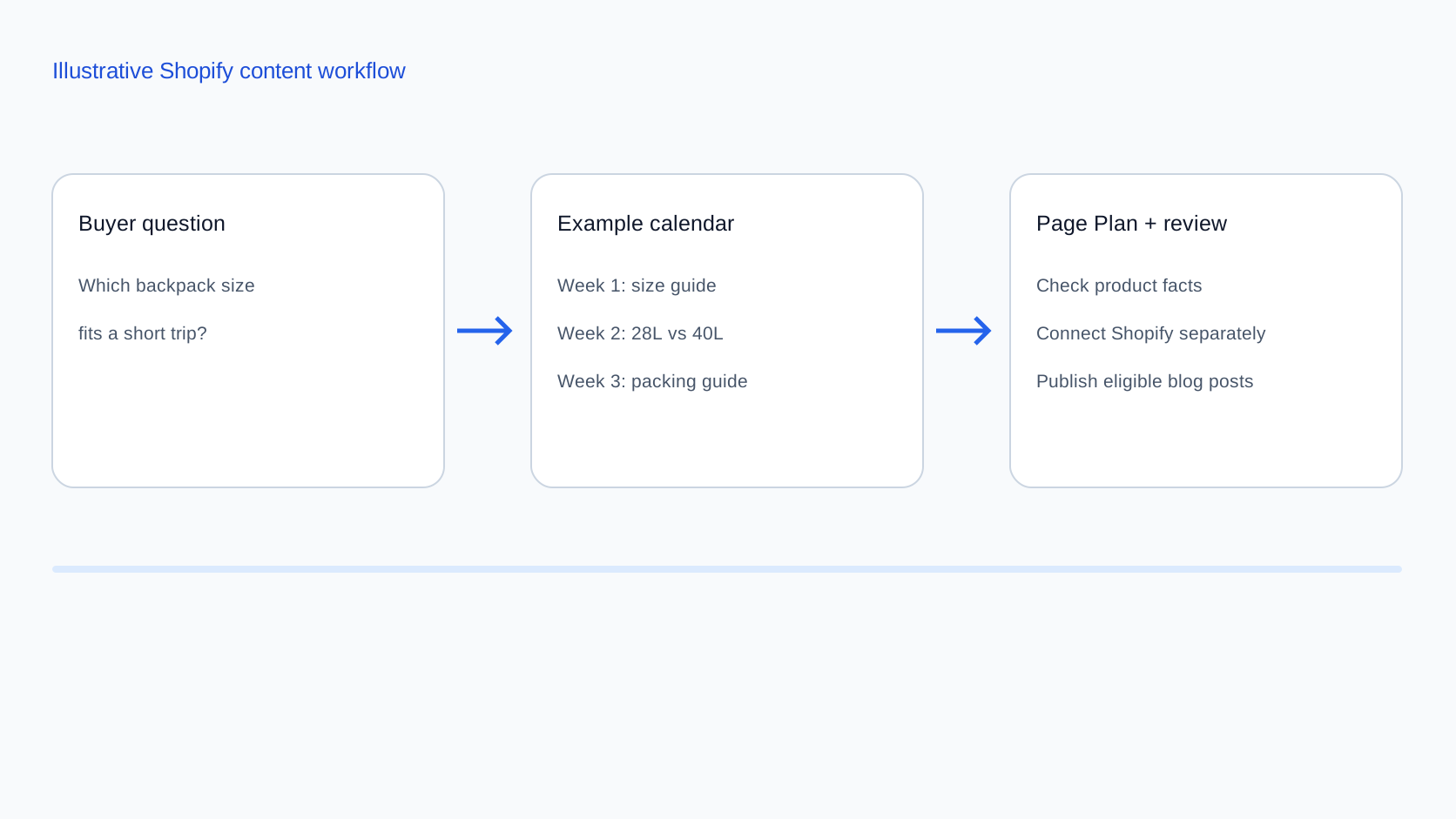
The Shopify calendar example explains how to plan the work itself. This guide helps choose the software and responsibilities behind that plan; it does not replace the example with another fixed publishing quota.
Three ways to operate the content process
| Option | Strongest reason to consider it | What to assess before choosing |
|---|---|---|
| Rankvia | Delegate more recurring website-growth decisions and execution. | Whether its opportunity choices, existing-page ownership and Page Plans fit your store; whether Shopify publication is available and eligible for your account. |
| Outrank | Its documented research-to-article offer fits your production needs. | Product accuracy, existing-coverage handling, review workload and the exact Shopify destination you require. |
| Shopify native AI assistance | Keep topic selection and editorial control in your own process. | Whether your team can maintain the research, prioritization and calendar rather than buying a separate recurring planning service. |
These are not interchangeable feature bundles. Ask each option to demonstrate the unresolved work; do not score a setting as equivalent to a completed merchant task. Missing public documentation is a question to investigate, not proof that a capability is absent.
Rankvia: decide what the website should do next
Rankvia is a website-growth autopilot. It uses business and website context alongside search-opportunity evidence, current search results and AI Visibility; Google Search Console is optional. It can assess whether an existing page should own an opportunity before selecting Create, Improve or no additional page. Selected owned-site work can move through a dated Content Calendar, a Page Plan, generation, internal-link planning and eligible publication.
For a merchant, the useful question is whether that recurring decision process fits the catalog and customers. Review the Business Profile's offers, audience, website language and market. A proposed article must still use verified product facts; an image or fluent paragraph does not establish a product claim. Publication does not automatically update product records, collections, menus or the theme.
The displayed catalog provides capacity, not an obligation to publish that many pages. More capacity is useful only when you have worthwhile opportunities and review resources. Direct website acquisition and Shopify-managed billing retain separate paths; opening an account on the web does not migrate a Shopify subscription. Consult Shopify setup before selecting an installation path.
Outrank: evaluate the documented article-production offer
Outrank lists Organic Growth at US$99 monthly or US$999 paid annually, with 30 articles per month and Shopify among its publishing integrations. Research and generation are included. Check current terms in Outrank's pricing documentation before subscribing.
Its Shopify page describes catalog sync, product links and direct blog publication as drafts or automatic posts. Connect the store first. Confirm the destination blog and required permissions in your account; that public page does not establish a detailed setup or recovery procedure.
Outrank also documents GSC-driven Article Improvements : enable the feature, connect Search Console and a supported CMS, then review proposed changes by default or opt into auto-push. Shopify is supported. This is relevant when maintaining published articles is a priority, not just producing new drafts.
For this decision, ask to see how your particular store's existing guides, product facts and review preferences are handled. Do not infer detailed existing-page ownership or a particular draft/approval control from a publishing-integration logo. If a required behavior is not documented clearly, seek a demonstration before committing. Those are acceptance questions, not claims that Outrank lacks the behavior.
Outrank may suit a merchant whose editorial direction is settled and whose priority is its documented production offer. Stay with a working process if changing tools would recreate acceptable drafts, disrupt scheduled work or add more review than it removes. A higher article allowance alone does not establish better commercial fit.
Shopify native AI: retain your own planning process
Shopify's current English blog-generation instructions describe Sidekick producing titles and content from a prompt, followed by editing and saving. Some localized documentation still uses Shopify Magic terminology. Assess the controls actually available in your store, rather than assuming every locale has identical labels.
Sidekick is included with a Shopify plan ; features and usage limits vary. This does not mean Shopify itself is free. The broader AI-tools guidance also identifies availability differences by plan, device and language.
Native assistance is a credible choice when a merchant already knows what to write and wants help inside the editor. For this option, budget your own process for evaluating search needs, checking existing coverage and maintaining the calendar; the cited blog-writing instructions do not establish that complete process. This is not a claim that Sidekick can do nothing beyond writing. For a direct comparison of the native assistant with a dedicated workflow, see Shopify Sidekick for SEO: is it enough?.
A merchant acceptance exercise, not a fabricated test
Assume Northtrail already has two product pages, a backpack collection and a useful size guide. Its merchant can supply verified capacities and laptop-compartment dimensions, but has no waterproofing, durability or airline-acceptance evidence. Ask a prospective tool to explain a next decision, not simply produce “ten travel titles”.
| Acceptance task | A useful demonstration should make clear | Reason to investigate or reject the proposal |
|---|---|---|
| “Which size should I consider for a short work trip?” | Whether the existing size guide should own the answer, or a distinct comparison is justified. | Another size article duplicates the current guide without a distinct reader decision. |
| “Will my laptop fit?” | Where the verified compartment measurements belong and which product page should answer. | A generic article replaces a product-information correction or invents compatibility. |
| “How do I choose a backpack?” | Selection criteria and links to appropriate products, with tradeoffs and unresolved facts. | A product list claims tests or universal suitability without evidence. |
| “Are these bags accepted by every airline?” | An explicit evidence limit and a request for the current applicable restrictions. | A confident guarantee unsupported by the merchant's information. |
For native writing assistance, your editor supplies and evaluates that brief. For a recurring planning product, ask how it reaches and records the proposed decision. Compare the explanation, not the number of titles. Use the buying-guide workflow to examine the selected page's substance without expecting any planner to select that format automatically.
A short trial can also reveal switching costs: can you keep your current URLs and unpublished work, avoid duplicate topics and carry over useful product evidence? Do not assume automatic import of a calendar, briefs or published articles. Retain approved content and confirm any migration behavior separately.
Verify publication before purchasing for automation
For Rankvia, eligible Shopify publication requires the supported connection, permissions, configured destination and an appropriate blog for articles. Availability depends on enabled configuration and the Shopify-owned installation surface; do not assume an unconfigured or unavailable connection is live. Review First keeps review in the process. Optional automatic publication requires opt-in and current readiness checks.
Read the Shopify publication instructions for draft/live controls, images, remote changes and recovery. Confirm the first eligible published page's visible text, links, image and metadata in the storefront. Automatic publication does not remove merchant responsibility for claims or prove improved rankings or sales.
For another tool, verify the same destination and recovery requirements in its own documentation or a controlled demonstration. Do not infer Rankvia's controls apply elsewhere. Shopify's own editor is a separate native publishing route.
Choose a budget for the whole process
Compare monthly renewal with the full annual commitment, not an annual-equivalent monthly figure against a flexible monthly subscription. Account for the store's existing Shopify subscription, any separate content subscription and merchant review time. Check applicable currency, taxes, limits and cancellation terms at checkout.
A writing assistant can be economical when your research and calendar already work. A recurring planning tool can be worthwhile when opportunity decisions and execution are the work you want to delegate. Neither removes the need for accurate product knowledge. Avoid buying higher output merely to fill an empty calendar.
Start Rankvia through the existing website-planning entry below: enter the store website, create an account or sign in, complete the existing analysis and approve the reviewed Business Profile. Free preview remains subject to eligibility. Shopify installation, connection and billing are separate; follow getting started when that is the route you intend.
APPLY THIS TO YOUR WEBSITE
See which content decisions your store should address next
Start with your website and review Rankvia's business understanding before planning. The existing journey can prioritize useful new content, an existing-page improvement or no additional page - without forcing a buying guide or publishing on submission.
Account, eligibility, analysis and Business Profile approval remain required. Shopify setup and publication are separate steps.
Sources
- Outrank pricing
Documented article allowance, billing and integrations.
- Outrank Shopify publication
Catalog context and draft or automatic blog publication.
- Outrank Article Improvements
Search Console prerequisites and review or auto-push for existing articles.
- Shopify blog generation
Native blog-writing controls and merchant review responsibilities.
- Shopify Sidekick
Inclusion in Shopify plans and variable feature/usage limits.
- Shopify AI-powered tools
Current native AI terminology and availability considerations.
Related guides
Shopify SEO content calendar: plan around buyer questions
Turn store buyer questions into a practical content schedule.
Shopify Content Strategy: What to Create, Improve & Prioritize
Choose useful work across product pages, collections and store guides.
Ecommerce buying guides: help customers choose
Help customers choose products by explaining fit, tradeoffs and useful selection criteria.
Ecommerce product education: teach a useful concept
Teach a useful product concept using clear explanations and verified facts.