
Guides How to Get Cited by Perplexity
PERPLEXITY SEARCH
How to Get Cited by Perplexity
To improve your chances of being cited by Perplexity, first make sure your pages are accessible to its search systems. Then publish information that genuinely answers the questions your audience asks and is accurate, relevant, and useful enough to serve as a source.
By Rankvia ·
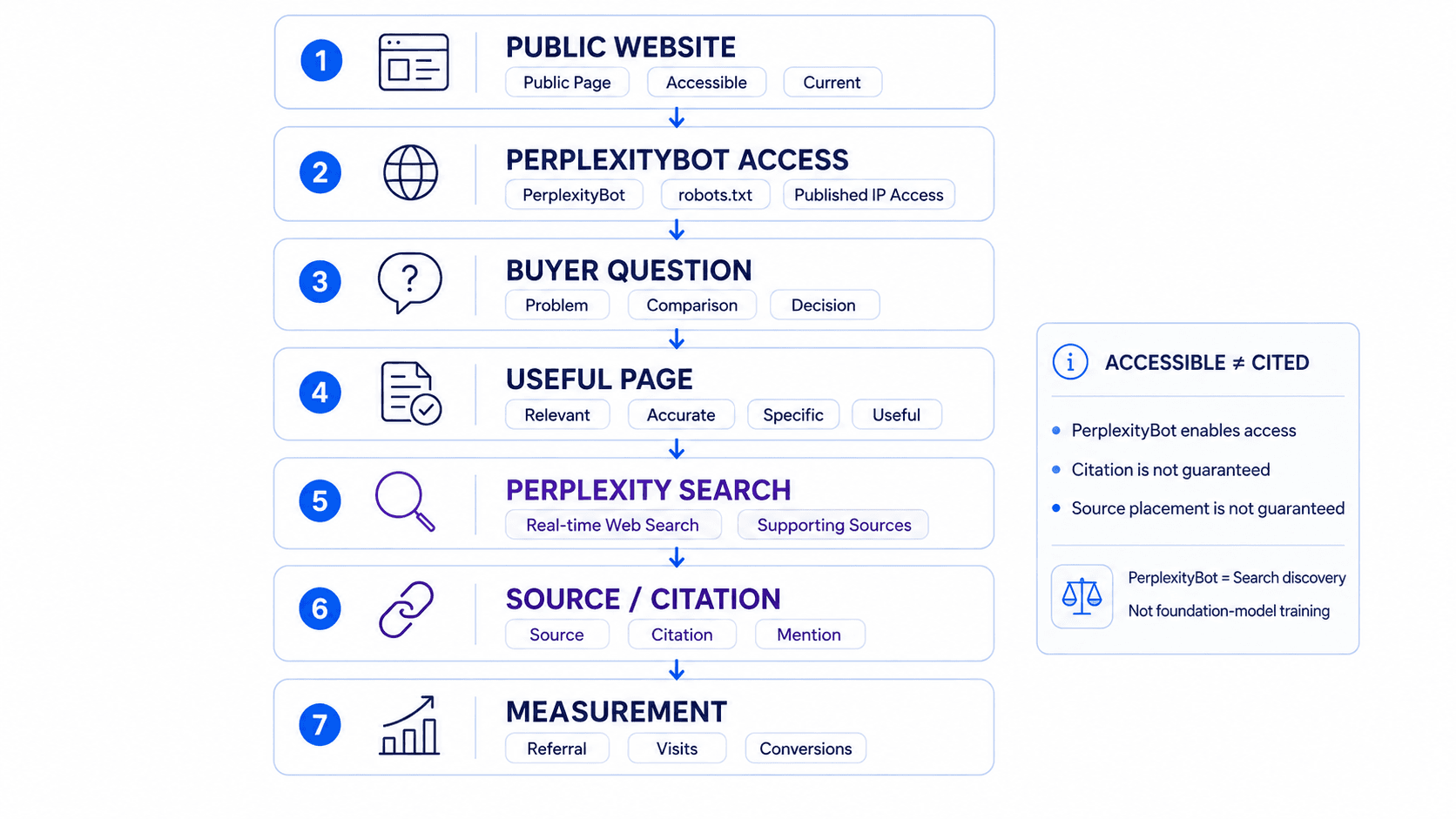
Perplexity says it searches the web in real time, gathers information from web sources, synthesizes that information, and provides citations linking to original sources.
For publisher access, Perplexity describes PerplexityBot as a crawler designed to surface and link websites in Perplexity search results. It recommends allowing the crawler in robots.txt and permitting requests from its published IP ranges.
But crawler access does not guarantee that a page will be cited or receive a particular source position. Perplexity's current public crawler and publisher documentation does not publish a universal citation-ranking formula.
Accessible does not mean cited.
For the broader cross-platform workflow, see AI Search Optimization: How to Get Found in AI Search.
What does cited by Perplexity mean?
Perplexity visibility can describe several different outcomes.
Mention
Perplexity refers to a brand, company, product, or service. A mention does not necessarily mean the company's website was used as a cited source.
Citation or source
Perplexity associates information in its answer with a web source. Perplexity says its answers contain citations and links to original sources so users can verify information and explore further.
Referral
A user follows that source link to the publisher's website. A citation can therefore produce referral traffic, but a citation does not guarantee a click.
Business outcome
A referral may then produce a lead, signup, trial, purchase, subscription or revenue.
Mention -> Citation -> Referral -> Business outcome
Measure each stage separately.
What does Perplexity say about search accessibility?
Perplexity gives publishers a relatively clear technical starting point.
Public page
↓
PerplexityBot allowed
↓
Published crawler traffic permitted
↓
Available to Perplexity Search
Then: Accessible does not mean cited.
Allow PerplexityBot
Perplexity says PerplexityBot is designed to surface and link websites in Perplexity search results. It recommends allowing the crawler in robots.txt when publishers want their sites to appear in those results.
Permit legitimate crawler traffic
Perplexity publishes crawler IP ranges and says sites using a WAF may need to explicitly allow legitimate Perplexity traffic. Its current recommendation is to combine User-Agent verification and published IP verification.
Perplexity also says its IP ranges are updated regularly, so the official JSON endpoints should be used as the source of truth rather than hard-coded IP lists in articles or documentation.
Access is not source selection
Crawler access makes discovery and indexing possible. Perplexity's current public crawler documentation does not say that allowing PerplexityBot guarantees citation, more crawler visits increase citation probability, or access guarantees a particular source position.
PerplexityBot vs Perplexity-User
Perplexity currently documents two relevant mechanisms.
| PerplexityBot | Perplexity-User | |
|---|---|---|
| Main documented role | Automated search discovery/indexing | User-requested page fetching |
| General crawling | Yes | No |
| robots.txt | Respects publisher directives | Generally ignores them because the user initiated the fetch |
| Foundation-model training | Not used for it | Not used for it |
| Citation guarantee | No | No |
PerplexityBot
PerplexityBot gathers and indexes information from the web for Perplexity's search experience. It respects robots.txt.
Perplexity-User
Perplexity-User can fetch a page in response to a user's request and may include a link to that page in the answer. It is not used for general web crawling or foundation-model training. Because the user requested the fetch, Perplexity says it generally ignores robots.txt.
This distinction matters technically, but PerplexityBot remains the relevant crawler for publisher search-discovery configuration.
What happens when PerplexityBot is blocked?
Perplexity updated its robots.txt guidance in July 2026. It says PerplexityBot will not index the full or partial text content of a site that blocks the crawler through robots.txt. However, Perplexity may still index the domain, headline, and a brief factual summary.
Perplexity also says a previous behavior that allowed users to request summaries of blocked URLs has been disabled, and that PerplexityBot now crawls content in accordance with robots.txt.
If you want Perplexity's automated search crawler to access the actual page content: configure PerplexityBot intentionally.
How does Perplexity find information?
Perplexity describes itself as an AI-powered search or answer engine built around live web retrieval. Its current documentation says that when a user asks a question, Perplexity interprets the question, searches the internet, gathers information from web sources, synthesizes relevant information, and returns an answer with citations.
Perplexity also says its information is sourced from the web in real time.
Advanced searches can use multiple web searches
Perplexity says Pro Search conducts multiple searches across the web and synthesizes information from multiple source types. That does not mean publishers should reverse-engineer each possible search or create one page per prompt.
Rankvia's practical recommendation is: Optimize around the underlying user need, not one exact Perplexity prompt.
A user may ask about a problem, comparison, alternative, use case, buying criteria or implementation. Those intents are more durable than any single conversational wording.
Step 1: Make your pages accessible
Before experimenting with citation tactics, make sure Perplexity can reach the intended content.
Check robots.txt
If you want pages discoverable through Perplexity's search crawler, make sure PerplexityBot is not unintentionally blocked. Perplexity recommends allowing it when publishers want their sites surfaced in search results.
Check CDN and WAF access
A permissive robots.txt file does not help if infrastructure blocks the crawler. Perplexity's crawler documentation includes explicit WAF configuration guidance and recommends matching both User-Agent and published IP ranges.
Use current IP ranges
Do not permanently copy crawler IP ranges into your article or internal docs. Perplexity says the ranges are updated and its official endpoints should remain the current source of truth.
If Perplexity cannot access the page as intended, formatting tricks will not solve the access problem.
Step 2: Target real questions and decisions
Once access is working, focus on what people actually need to know. Useful opportunities can include category questions, problems, comparisons, alternatives, use cases, buying decisions and implementation questions.
The useful unit is the underlying intent, not the wording of one prompt.
Rankvia uses a simple planning model: Create. Improve. Or skip.
Create
Create a new page when the audience need is genuinely distinct and no existing page serves it well.
Improve
Improve an existing page when it already owns the intent but could be more accurate, complete, current, or useful.
Skip
Skip the opportunity when it is simply another wording of an existing need, has little business relevance, or would create unnecessary overlap.
This is Rankvia methodology, not Perplexity's ranking model.
Step 3: Publish useful, reliable information
Perplexity describes its answer engine as searching the web, identifying trusted sources, and synthesizing information into current responses. It also says answers are backed by citations from reputable sources. That establishes a broad product objective. It does not give publishers a public formula for citation selection.
The following are therefore Rankvia editorial recommendations.
Answer the real question
Make the information the reader needs easy to find.
Support important factual claims
Use appropriate evidence for numbers, technical requirements, product claims, regulations, research findings and time-sensitive facts.
Add useful specificity
Where it improves the answer, include concrete examples, primary evidence, first-hand experience, original research, meaningful comparisons, limitations and tradeoffs. Original research can make a page more valuable. It should not be described as a guaranteed Perplexity citation factor.
Make comparisons useful
Explain meaningful differences, fit, tradeoffs and decision criteria. Do more than copy feature lists.
Make company and product context clear
Be specific about what the company does, what the product does, who it serves and what problem it solves. Clarity helps readers. Perplexity's current public documentation does not establish a publisher-facing entity clarity ranking factor.
Does freshness help Perplexity citations?
Current information matters when the underlying question is time-sensitive. Perplexity explicitly says it searches the live web in real time and highlights current information as a core feature.
That makes it sensible to update pages containing prices, software capabilities, regulations, current statistics, platform requirements and changing product information.
But this does not establish a universal publisher rule such as: Newer pages receive a fixed citation boost.
Perplexity's current public crawler and publisher documentation does not publish a universal freshness weight that publishers can optimize against.
Keep changing facts current because current questions need current information - not because an undocumented freshness percentage guarantees citation.
What Perplexity documents - and what it does not establish
| Perplexity documents | Current public documentation does not establish |
|---|---|
| Live web search | A fixed citation-ranking formula |
| PerplexityBot for search discovery | Guaranteed citation |
| robots.txt crawler controls | Exact paragraph length |
| Published crawler IP ranges | Universal freshness bonus |
| Citations and source links | Fixed source count |
| PerplexityBot is not for foundation-model training | Backlink or DA threshold |
| Pro Search can conduct multiple searches | One page per prompt |
| Search API can return ranked web results | A stable universal publisher rank |
The first column reflects Perplexity's current product and crawler documentation. The second column means the reviewed public documentation does not establish those claims. It does not prove that every undocumented factor has zero indirect effect.
Perplexity citation tactics to be skeptical of
“Use an exact passage length”
Perplexity's current publisher/crawler documentation does not publish an ideal paragraph length as a citation-ranking factor. Direct writing may still help readers.
“Perplexity always uses a fixed number of sources”
Perplexity documents citations and multi-source research, particularly in Pro Search, but it does not establish one universal source count for every answer.
“Fresh pages receive a guaranteed boost”
Perplexity searches the live web. Its current public documentation does not publish a universal publisher-facing freshness bonus.
“Special GEO schema gets you cited”
Perplexity's current crawler documentation does not establish a special GEO/AI Schema.org type as a citation requirement. Use structured data where it has legitimate semantic or Search value. Do not present it as a guaranteed Perplexity citation tactic.
“Create a page for every prompt”
Perplexity can perform multiple searches and synthesize multiple sources. That does not create a one-prompt-one-URL publisher rule. Create another URL when the underlying user task changes.
“You need a particular backlink or authority score”
Perplexity talks broadly about trusted and reputable sources. It does not publish a minimum backlink count or Domain Authority score required for citation.
“Allow PerplexityBot and you'll get cited”
No. PerplexityBot supports crawling and search discovery. Its public crawler documentation does not guarantee citation. Accessible does not mean cited.
“llms.txt guarantees Perplexity visibility”
Perplexity uses an llms.txt index in its own developer documentation. That does not establish that publisher llms.txt files are required for Perplexity Search, improve indexing, improve citation probability or improve ranking. Perplexity's current crawler documentation does not establish publisher llms.txt as a citation-ranking factor.
“We rank #1 in Perplexity”
Perplexity's answers depend on the query, search mode, source availability, and context. Its current public publisher documentation does not establish a permanent universal source position comparable to a classic ranking. Measure what actually appears instead.
APPLY THIS TO YOUR WEBSITE
Find the searches your website should be visible for across Google and AI search.
Rankvia analyzes your business and existing website, identifies relevant buyer searches, and determines whether the strongest opportunities should become new pages or improvements to pages you already have. It then organizes the strategy into a prioritized Content Calendar, with Page Plans defining what each page should achieve before generation.
Personalized to your website · No credit card required
How do you measure Perplexity visibility?
Do not reduce Perplexity visibility to one invented number.
Mentions and citations
Track whether the brand appears, whether your domain appears as a cited source, which URL is cited, which relevant questions produce appearances, and whether those appearances recur over time. A citation is a visibility outcome. It is not automatically a referral.
Referral traffic
Use your own analytics and referrer data to identify traffic from Perplexity where available. The current official publisher material reviewed for this guide does not document a dedicated publisher UTM convention equivalent to OpenAI's documented ChatGPT Search UTM. Do not invent one.
Controlled visibility monitoring
Rankvia recommends maintaining a stable set of strategically relevant questions: category queries, comparisons, alternatives, use cases and buying decisions. Record brand appearance, cited domain, cited URL, relevant competitors, date, and query/context. Repeat those observations over time.
Prefer: The brand appeared as a cited source in 11 of 30 monitored responses this month. Over: The brand ranks #3 in Perplexity. The first describes the observed result directly.
Business outcomes
Ultimately connect visibility to qualified visits, leads, trials, purchases, subscriptions and revenue. Citation count can be useful. Business impact matters more.
Perplexity visibility checklist
Access
- PerplexityBot is not unintentionally blocked.
- robots.txt reflects the desired crawler access.
- Published crawler traffic is permitted where appropriate.
- WAF/CDN rules do not unintentionally block PerplexityBot.
- Important pages are publicly accessible.
Opportunity
- The page addresses a real audience need.
- The opportunity matters to the business.
- Existing page ownership has been checked.
- It is not simply another wording of an existing intent.
Page
- The main question is answered clearly.
- Important claims are supportable.
- Evidence is included where useful.
- Examples are specific.
- Comparisons use meaningful criteria.
- Time-sensitive information is current.
- Product/company information is clear.
- The page adds value beyond a generic summary.
Wider web
- Public company information is accurate.
- Relevant external profiles are current.
- Genuine reviews/directories are maintained where useful.
- Third-party mentions are not treated as documented Perplexity ranking factors.
- Backlink/authority metrics are not treated as citation guarantees.
Measurement
- Citations and source appearances are monitored.
- Referrals are measured separately.
- Mentions are not confused with citations.
- One response is not treated as a stable rank.
- Visibility is connected to business outcomes.
Sources
Frequently asked questions
BUILD YOUR SEARCH GROWTH PLAN
Find the pages your website should create or improve for Google and AI search.
Enter your website and Rankvia will analyze your business, identify relevant search opportunities, and build the strategy for what to publish next.
Personalized to your website · No credit card required