Guides Shopify Sidekick for SEO: Is It Enough or Do You Need an AI SEO App?
SHOPIFY TOOL COMPARISON
Shopify Sidekick for SEO: Is It Enough or Do You Need an AI SEO App?
Can Shopify Sidekick replace an SEO app? Compare AI writing, search research, AI Visibility, content planning, page updates and Shopify publishing.
By Rankvia ·
Shopify Sidekick for SEO: Is It Enough or Do You Need an AI SEO App?
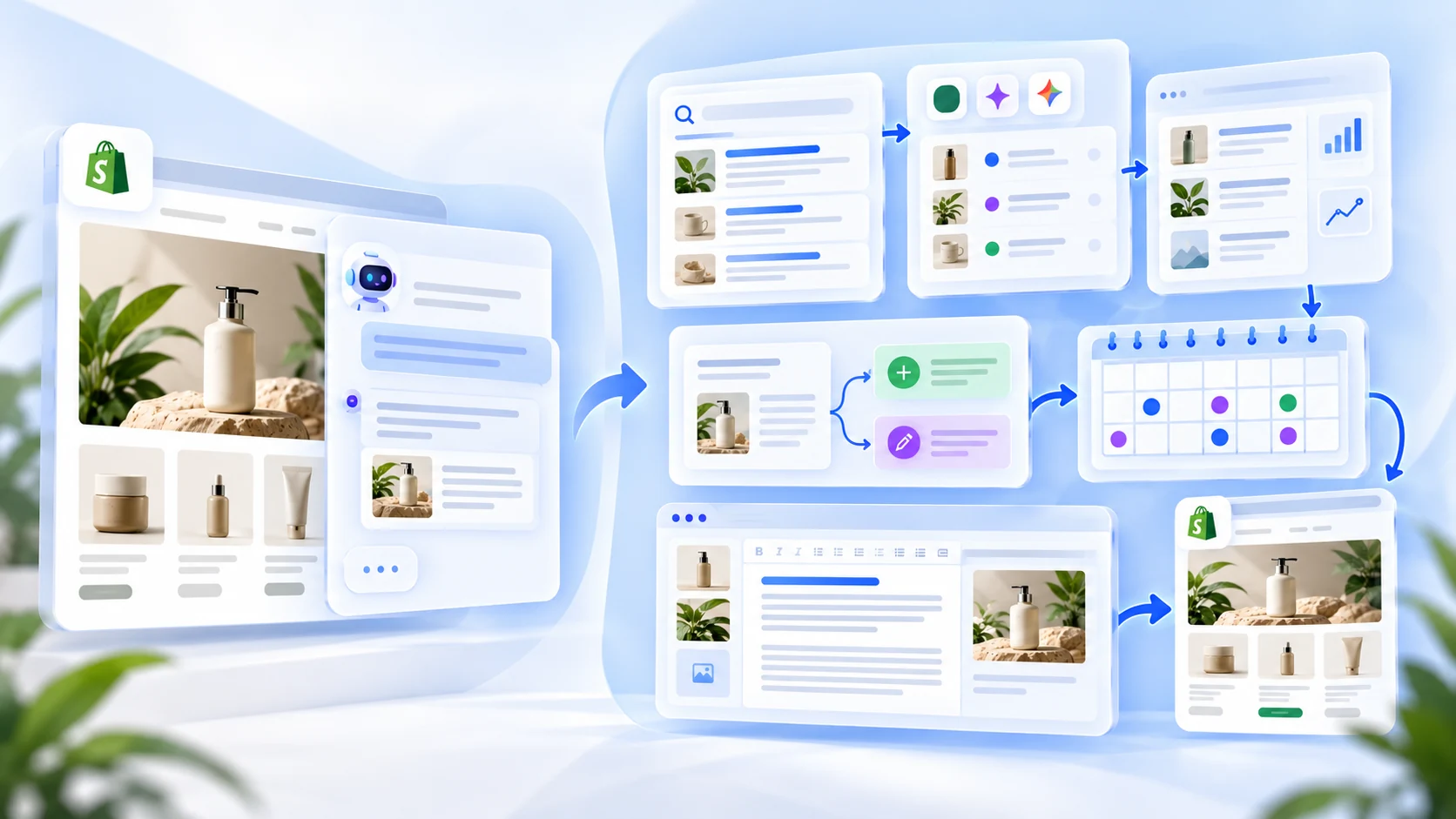
Quick answer: Shopify Sidekick is a capable AI assistant for Shopify tasks, content drafts, SEO suggestions and store analysis. Rankvia is built to put the recurring SEO content operation on autopilot: identify buyer searches worth targeting, check where competitors appear in AI answers, examine existing pages and Google results, use Search Console when connected, decide what to create or improve, then plan, generate and publish eligible content to Shopify.
The difference is not AI versus AI. It's task assistance versus an ongoing search-growth workflow. If you know the topic and want help writing one article, Sidekick may be enough. If you want a prioritized pipeline of evidence-informed SEO work without directing each writing task, Rankvia is the stronger fit.
Install Rankvia on Shopify · Try the eligible free website preview
What Shopify Sidekick can actually do for SEO
Sidekick is Shopify's AI-enabled commerce assistant inside the Shopify admin. It has store context and can help with content, operational questions, data analysis and tasks. It is not simply a text generator.
Blog writing. In Shopify's blog editor, you can ask Sidekick to propose a title or generate article text from a prompt. You can edit the draft, save it, and use Shopify's native blog publication or scheduling controls. Shopify advises merchants to review generated claims and facts before publishing.
Product and page SEO. Sidekick can explain SEO concepts, review the search-engine listing for a product, collection or page, suggest better titles or descriptions, and help fill corresponding fields for merchant approval. Those are real SEO-related capabilities - not features Rankvia should claim Sidekick lacks.
Store intelligence and workflows. Sidekick can answer questions based on permitted store context, analyze data, help with tasks, use saved skills, and work with supported third-party apps. Its Pulse feature can surface proactive recommendations for eligible stores; Pulse is in early access and not universally available.
Publishing controls. Shopify itself can publish blog posts immediately or on a future date. Sidekick-generated text does not mean a new merchant must buy another app just to schedule a blog article.
Sources: Shopify Sidekick overview , generating blog posts , Sidekick SEO assistance , managing blog posts , and Sidekick Pulse .
Why Rankvia adds more value: multiple data sources, one SEO autopilot
A store owner can ask Sidekick to write an article. But the higher-value decision is what deserves to be published - and whether a new article is even needed. Rankvia is designed to connect the research and execution rather than requiring a merchant to stitch together separate prompts, reports and manual publication steps.
| Rankvia input | What it contributes to the decision |
|---|---|
| Business Profile + existing website | Actual offers, audience, market, content language, brand constraints, competitors and pages that already cover the subject |
| Search demand and related questions | Buyer intent, relevant queries and potential demand, rather than topics selected on instinct alone |
| Live SERP evidence | The types of pages and answers currently competing in Google, which inform the Page Plan |
| AI Visibility observations | Sampled buyer questions across ChatGPT, Gemini and Google AI; competitor appearances and visible sources where available |
| Optional Google Search Console | Real queries, impressions, pages and performance signals from the merchant's own property |
| Content inventory and internal links | Whether the opportunity belongs to an existing article and how a new or improved page should connect to useful current pages |
Rankvia then turns evidence into action. It can recommend Create, Improve, Monitor, Third-party visibility or Skip. Suitable owned-site opportunities feed a prioritized Content Calendar and Page Plan, then generation or improvement and relevant internal links. With Shopify connected, eligible scheduled content can publish automatically when the merchant enables that mode; review-first publication remains available. The calendar also supports ongoing replenishment, making this a recurring program rather than a one-time prompt.
Autopilot does not mean zero oversight or guaranteed results. The merchant approves the Business Profile, can review plans and generated content, and must enable optional automatic publishing. Inputs such as GSC and AI Visibility may be absent for individual decisions. Rankvia does not autonomously rewrite every old article, bulk-edit product descriptions or guarantee Google rankings or ChatGPT recommendations.
Sidekick has store-aware intelligence, saved skills, long-running tasks and proactive Sidekick Pulse recommendations for some merchants. Those are real strengths. Shopify's official materials do not establish the same dedicated, recurring SERP/GSC/AI-visibility-to-Create/Improve-to-publication pipeline as a native Sidekick feature. Shopify Sidekick · Rankvia methodology
For a closer look at Rankvia’s connected workflow, see the Content Calendar, AI Visibility, Google Search Console integration, Content Refresh, Shopify integration, and methodology. For the broader tool-choice view, see our Shopify content planning tools guide.
Shopify Sidekick vs Rankvia: what are you actually buying?
| Decision or capability | Shopify Sidekick / native Shopify | Rankvia |
|---|---|---|
| Best job | General store assistance, content drafts, operational tasks | Ongoing, research-driven SEO content autopilot |
| Generate blog copy and help with titles | Yes | Yes, from a Page Plan and approved business context |
| Native product descriptions / admin edits | Strong Shopify-native support | Not a bulk product/collection-record editor |
| Search-demand and keyword evidence for content planning | Can assist with SEO advice; equivalent combined pipeline not established | Dedicated opportunity planning input |
| Current Google SERP evidence in Page Plans | Equivalent workflow not established | SERP-informed planning |
| AI Visibility across ChatGPT, Gemini and Google AI | Equivalent question-level tracking not established | Sampled buyer questions, competing brands and sources |
| Google Search Console in SEO planning | Equivalent built-in integrated workflow not established | Optional GSC query/page/performance evidence |
| Existing-page ownership: Create or Improve | Can advise on content; equivalent repeatable workflow not established | Explicit Create / Improve / Monitor / Skip decisions |
| Automatic prioritization and ongoing Content Calendar | Sidekick Pulse can proactively recommend store actions; not the same SEO program | Prioritized calendar and recurring top-ups |
| Page Plan, SEO article generation and internal-link context | Writing and editing assistance | Connected plan → generated or improved page → internal links |
| Unattended recurring SEO publication | Sidekick changes require approval; Shopify supports scheduling | Optional autopublishing of eligible scheduled Shopify content |
| Merchant control | Approve Sidekick changes | Review-first by default; opt into supported autopublishing |
| Cost | Included Sidekick tools, subject to Shopify access/limits | Paid Shopify subscription from $39/month (USD); separate eligible free website preview |
“Equivalent workflow not established” means the reviewed Shopify materials do not document this particular end-to-end workflow; it is not proof that Sidekick can never perform parts of the task or use third-party apps.
See Rankvia on Shopify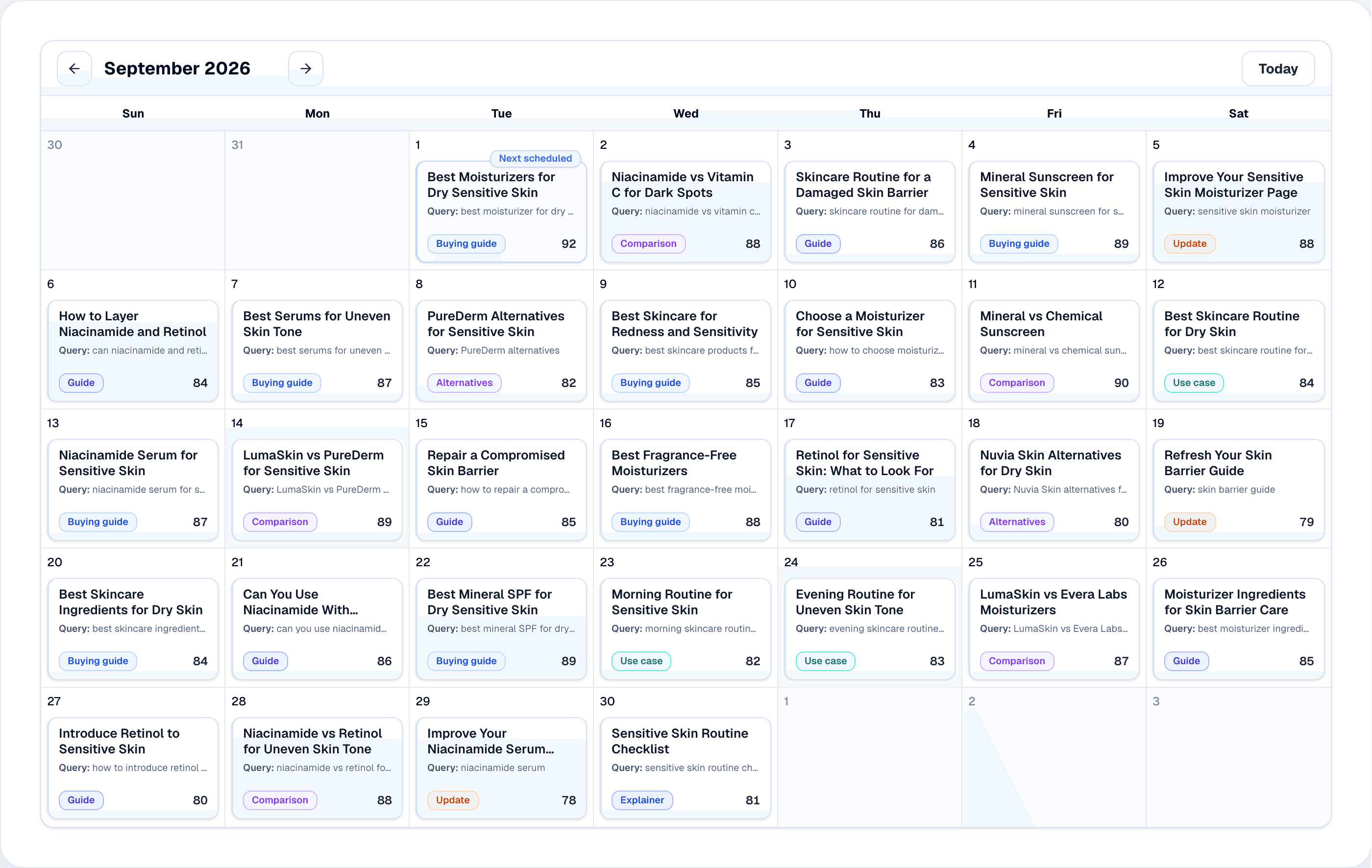
Illustrative interface with sample store data.
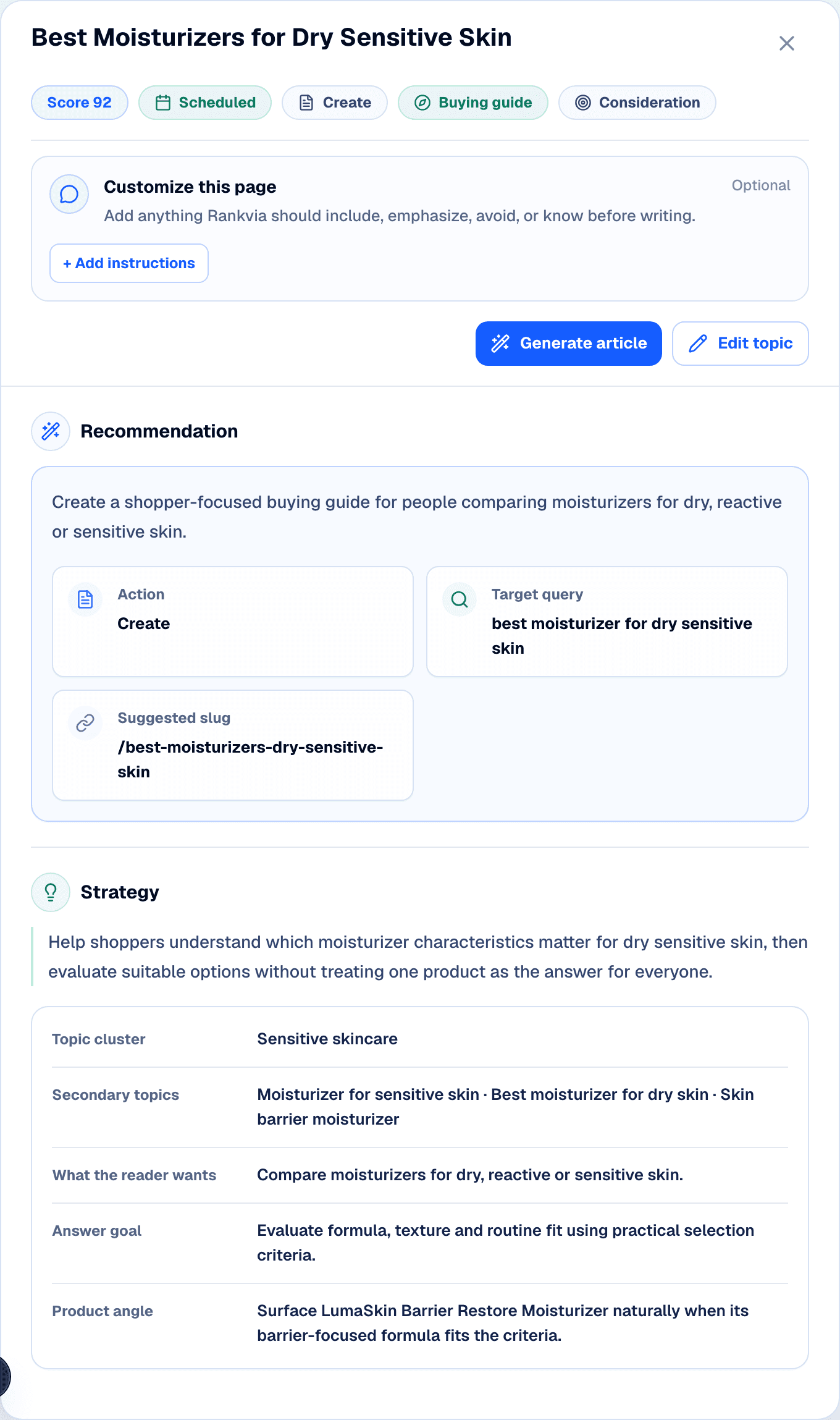
Illustrative interface with sample store data.
When Sidekick alone is enough
Choose Sidekick first if your immediate needs are occasional: draft a blog post about a topic you already chose, improve a product description, revise a meta title, summarize store data or ask for store-management help.
This is a sensible approach for a small merchant who publishes infrequently, already knows the next topic, prefers to review each change, and doesn't need a recurring SEO content pipeline. It costs nothing extra to try the capabilities included with the merchant's Shopify plan, subject to availability.
Sidekick is also useful alongside Rankvia. There is no reason to give up its native store assistance when adopting a specialized content-growth app.
Why merchants choose Rankvia over asking Sidekick for more blog posts
1. It researches opportunities before writing. Instead of making you invent topics, Rankvia analyzes the business, considers search-demand evidence, current SERP patterns and relevant AI Visibility observations. Where connected, Google Search Console adds real page and query performance. The goal is a better reason to publish, not simply a faster draft.
2. It reduces duplicate and unnecessary pages. Rankvia considers existing-page ownership and can recommend Improve rather than Create. That matters for Shopify stores with older buying guides, how-to articles and overlapping category topics. A missing AI mention alone does not automatically become an article.
3. It is an ongoing content system, not a series of disconnected requests. Rankvia organizes selected work into a dated Content Calendar, prepares a Page Plan for each opportunity and generates content with the approved Business Profile, relevant internal links and SEO metadata. Planning is refreshed through the program, instead of asking the merchant to rebuild the process from scratch each time.
4. It can take publishing off your weekly to-do list. Use review-first publication while building confidence, or enable automatic Shopify publishing for eligible scheduled content. Sidekick's own store changes require approval, and Shopify's ability to schedule an article is not the same as a dedicated system continually deciding and preparing which articles to publish.
5. Its AI Visibility is connected to action. Rankvia observes relevant buyer questions in ChatGPT, Gemini and Google AI, including competitors and available cited sources. It then considers that evidence alongside search demand, existing pages and business fit when deciding what content is actually worth creating or strengthening. It does not claim to observe private AI conversations or guarantee future citations.
Install Rankvia — automate your Shopify SEO contentA hypothetical example: create a new article or improve the existing one?
Suppose a fictional skincare store sells fragrance-free moisturizers and already has a guide called How to Choose a Moisturizer for Dry Skin. The owner asks Sidekick to draft an article targeting best fragrance-free moisturizer for sensitive skin.
Sidekick can help produce that requested text. But before creating a second URL, consider three possibilities:
- Improve. The existing guide already serves the same shopping decision and appears in relevant GSC queries. Expanding it with clearer fragrance-free comparisons, product evidence and contextual links may be the more sensible action.
- Create. Current search results reveal a distinct comparison intent that the existing guide does not serve. A dedicated buying guide may be justified.
- Monitor or skip. The keyword may be irrelevant to the store's actual offers, poorly supported by evidence or too similar to a stronger planned opportunity.
Rankvia is designed to evaluate that decision using the available website and search evidence. This example illustrates the workflow, not an actual recommendation or measured result from a customer store.
How to automate Shopify SEO content with Rankvia
Step 1. Install the app and analyze your website
Install Rankvia from the Shopify App Store , connect the intended store in the Rankvia experience, and let website analysis identify relevant pages, offers and existing content. Shopify-originated subscriptions use Shopify-managed billing.
Step 2. Review the Business Profile
Check the brand identity, products, audience, positioning, target market and content language. Correct anything material before approving it. Rankvia's planning and generation should reflect the approved profile, not a guessed audience or language.
Step 3. Review AI Visibility and search evidence
Inspect relevant questions, competitor appearances and available sources in supported AI-search experiences. Review Google search opportunities and current SERP context. Optionally connect GSC for actual query and page-performance evidence. Visibility is an observation, not a guarantee of a fixed rank or a sale.
Step 4. Choose Create or Improve
Use the opportunity recommendations to avoid publishing near-duplicate articles. Look at the proposed existing page owner, search intent and action; keep, revise or skip anything that does not fit your store.
Step 5. Review the Content Calendar and Page Plan
The calendar prioritizes planned work. The Page Plan explains what a given page should answer, whom it serves and which content structure fits. Add any product facts, constraints or additional instructions before generation.
Step 6. Generate, link and publish
Create or improve the supported SEO content. Review claims, product descriptions and citations, then publish as a Shopify draft or live content. For eligible scheduled items, automatic Shopify publishing can be enabled after selecting Shopify as the destination. It is optional, not forced. See the Shopify publishing workflow.
What merchants say are Sidekick's limitations
Shopify's own documentation says Sidekick cannot apply store changes without merchant approval. Sidekick Pulse can proactively surface recommendations, but it also routes actions through review and approval, and is limited to eligible merchants. Those are product-design boundaries, not software defects. Shopify Sidekick setup · Sidekick Pulse
Public merchant discussions also describe frustrations, although they should not be treated as controlled tests or general failure rates:
- In an August 2026 Shopify Community discussion , participants reported invented admin variables, incorrect Flow references and unreliable suggestions for certain technical tasks. Others found Sidekick useful for finding settings and drafting code.
- One commenter said Sidekick created an article and images similar to a competitor’s, so they chose not to publish it. January 2026 Reddit discussion .
- In a July 2026 r/shopify thread , a merchant reported difficulty repeating previously successful reporting requests. This concerns analytics task reliability, not proof about SEO writing quality.
What this means for your buying decision: Sidekick is valuable for on-demand assistance, but the more persuasive reason to adopt Rankvia is its purpose-built recurring SEO process and connected inputs - not an unsupported claim that one model never makes mistakes. Both tools still require checking factual product claims and reviewing consequential changes.
What about pricing and the free preview?
Shopify Sidekick is part of Shopify's native AI toolset; the tools and allowances available can vary by plan and feature rollout. You should use what's included before paying for functionality you don't need.
Rankvia's Launch plan starts at $39/month (USD) on Shopify, with 10 AI-optimized pages per month, up to 25 tracked buyer questions, the Content Calendar, and publishing workflows. Growth and Scale increase allowances. The Shopify listing is the source of current subscription prices and limits.
Rankvia also advertises a free website AI Visibility preview and Search Growth Plan for eligible visitors, without a credit card. That is a limited preview, not a permanent free Shopify app plan. If you're still evaluating whether your store has meaningful search opportunities, the preview can be a reasonable starting point.
Can you use Shopify Sidekick and Rankvia together?
Yes. A practical combination is to use Sidekick for quick Shopify admin tasks - product wording, store questions, metadata suggestions, workflow assistance - and Rankvia for the recurring search-content operation. Both require sensible merchant oversight and accurate product facts.
You do not need to replace Sidekick. You need to decide whether managing SEO research, content decisions and publication manually is still worth your time.
Frequently asked questions
Does Shopify Sidekick do SEO?
Yes. Shopify documents SEO guidance, search listing reviews, page-title and meta-description suggestions, and assistance with blog content. Sidekick's broader store-data and task capabilities can support SEO work too.
Can Sidekick write Shopify blog posts automatically?
Sidekick can generate blog titles and content from prompts. Shopify also supports scheduled blog publishing. The standard documented workflow still requires the merchant to review and save or approve changes; it should not be confused with an unattended SEO editorial pipeline.
Does Sidekick know what keywords my store should target?
Sidekick can discuss keywords and suggest SEO wording. The official guidance reviewed does not establish an equivalent dedicated SERP-informed Create/Improve calendar with optional connected GSC and sampled AI Visibility as Rankvia publicly documents.
Does Shopify Sidekick have AI Visibility tracking for ChatGPT?
No equivalent dedicated question-level monitoring workflow is established in the official Sidekick documentation reviewed. Rankvia measures observed answers for a defined set of relevant buyer questions across ChatGPT, Gemini and Google AI. These are samples, not all user conversations.
Is Rankvia better than Sidekick for every SEO task?
No. Sidekick may be the better tool for product-field edits, general store questions, native Shopify data tasks and occasional writing. Rankvia is the more relevant fit when the merchant needs a dedicated recurring SEO content planning, creation, improvement and publishing workflow.
Can Rankvia improve an existing Shopify article rather than generate another one?
Rankvia documents Create-versus-Improve decisions and a selective content improvement workflow. The exact eligible content and publishing behavior should be confirmed in the current app before modifying a live article.
Can Rankvia publish content to Shopify automatically?
Yes, for supported eligible scheduled content after the merchant enables automatic publishing and selects Shopify as its destination. Review-first publication and Shopify draft states are also supported.
Is Rankvia free on Shopify?
Its Shopify App Store listing starts at $39/month (USD). The separate free website preview, subject to eligibility, is not an ongoing free Shopify subscription.
Final recommendation: keep Sidekick, put your Shopify SEO content on autopilot
Use Shopify Sidekick for quick store questions, SEO copy edits and individual drafting tasks. It is capable and already part of the Shopify environment.
Choose Rankvia when you want to stop coordinating the entire SEO content cycle yourself: business analysis, search demand, SERP research, AI Visibility, optional GSC, Create-or-Improve decisions, prioritized calendar, Page Plans, content generation, contextual links and supported automated publishing to Shopify.
If the problem is “write this article,” use Sidekick. If the problem is “figure out what our store should publish next and keep executing,” use Rankvia.
Install Rankvia on Shopify · Try the eligible free website preview
Sources
- Shopify Sidekick
- Shopify SEO guidance for Sidekick
- Generate blog posts with Sidekick
- Manage and schedule Shopify blog posts
- Sidekick Pulse availability and approval
- Rankvia search methodology
- Rankvia AI Visibility methodology
- Google Search Console integration
- Rankvia Shopify integration
- Rankvia Shopify App Store listing
Related guides
Shopify content planning tools: choose who does the work
Choose a tool for planning and publishing useful store content.
Shopify Content Strategy: What to Create, Improve & Prioritize
Choose useful work across product pages, collections and store guides.
Best Shopify AI SEO Apps in 2026: 8 Tools Compared
Compare Shopify apps for automated content, AI visibility, and technical SEO by the job your store needs done.
How to Automate Shopify SEO Content Creation and Publishing
Build a practical workflow from Shopify SEO research and planning through content review and publication.
Shopify SEO: What to Optimize, Create & Improve
Decide which store pages need search improvements and what work to prioritize.
BUILD YOUR SEARCH GROWTH PLAN
Find what your website should publish next.
Enter your website and Rankvia will identify relevant search opportunities and build the strategy for what to create or improve.
Personalized to your website · No credit card required
Explore AI Search Optimization