Guides AI Search Visibility: What It Is, How to Measure It, and How to Improve It
AI SEARCH VISIBILITY
AI Search Visibility: What It Is, How to Measure It, and How to Improve It
Learn what AI search visibility means, how to measure mentions, citations and Share of Voice, why brands disappear from AI answers, and what to do next.
By Rankvia ·
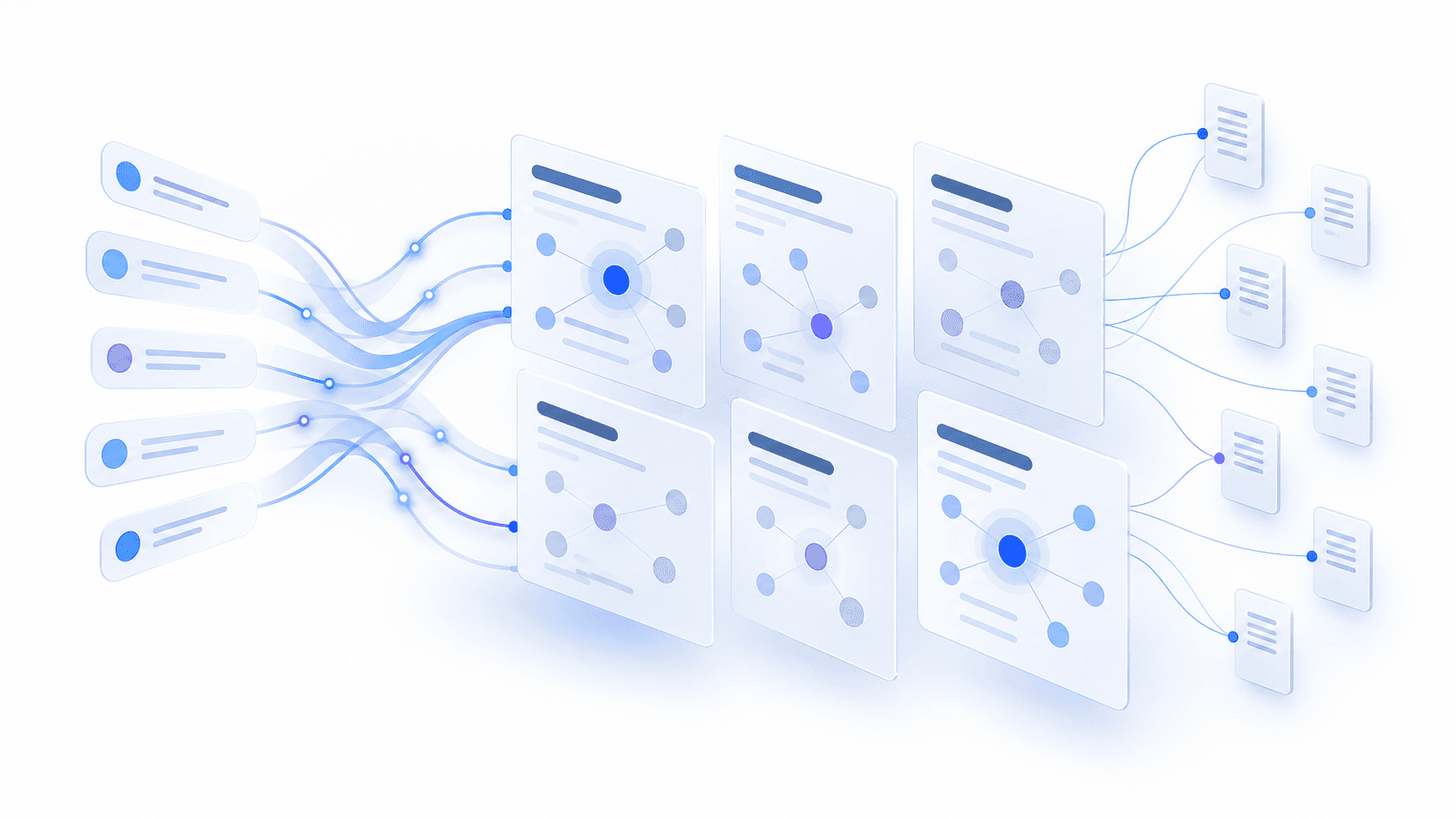
AI search visibility is how visibly and accurately your brand, products, or website appear in AI-generated answers to questions that matter to your buyers. It can mean a brand mention, a recommendation, a cited source, or a comparison with competitors.
It is not one universal ranking.
A company can perform well in traditional search and still be absent when buyers ask AI systems for recommendations, comparisons, or answers. The reverse can happen too. A percentage is useful only when you understand the questions, platforms, time period, and counting rules behind it.
What is AI search visibility?
AI search visibility is the observable presence and representation of a brand in AI-generated search and answer experiences for a defined set of relevant questions.
Imagine buyers asking a project-management company: "What are the best project management tools for creative agencies?" or "What is a good Asana alternative for client work?" An AI system could mention the company, recommend it for a specific need, cite its website, rely on a third-party review that discusses it, or omit it entirely.
Those outcomes are related, but they do not mean the same thing.
| Signal | What it tells you |
|---|---|
| Brand mention | Your brand appeared in the generated answer. |
| Recommendation | The answer presented your brand as a suitable option for a need. |
| Citation or source appearance | A page or domain was surfaced as supporting evidence. |
| Competitive presence | Your brand appeared relative to competing brands. |
| AI Share of Voice | Your observed brand presence was compared with competitors. |
| Brand representation | The answer described your business or product accurately. |
Thinking in these terms is more useful than pretending an AI system ranked a company first, fourth, or tenth.
Why AI search visibility matters
AI-generated answers can shape which companies enter a buyer's consideration set before that person visits a website. Someone researching accounting software might ask for suitable products, follow up with a comparison, ask about pricing or limitations, and only then visit a small set of vendors.
That creates a discovery layer that conventional rank tracking does not fully describe. Repeated relevant appearances can be useful evidence. Repeated absence while the same competitors appear can be a gap worth investigating.
Visibility is still only one part of the commercial picture:
- Are we appearing?
- Does that exposure generate visits or branded demand?
- Does it contribute to leads, trials, purchases, or revenue?
AI visibility helps answer the first question. Search Console, analytics, and conversion data are increasingly important for the second and third. A higher visibility score is not automatically business growth.
Is AI search visibility the same as SEO?
No. AI visibility and traditional SEO overlap, but they answer different questions. Traditional SEO commonly considers indexing, impressions, rankings, clicks, landing pages, and conversions. AI visibility adds questions about mentions, recommendations, sources, competitors, platform differences, and whether a result repeats over time.
That does not mean SEO has stopped mattering. Google says its established SEO fundamentals continue to apply to AI Overviews and AI Mode. OpenAI says publishers that want their pages available for ChatGPT Search should allow OAI-SearchBot, but crawl access does not guarantee that a brand or page will be surfaced for a given question.
The practical relationship is simple: SEO helps make useful website content accessible and discoverable. AI visibility measures what you actually observe when AI systems answer relevant buyer questions. For the broader implementation work, see AI Search Optimization, How to Get Cited by ChatGPT, and Google AI Overviews and AI Mode.
How do GEO and AEO relate to AI visibility?
AI search visibility describes an observed outcome. GEO, or Generative Engine Optimization, and AEO, or Answer Engine Optimization, describe efforts intended to improve discoverability in generated or answer-style experiences.
- SEO concerns discoverability and performance across search systems.
- GEO/AEO describe optimization approaches for generated or answer-style experiences.
- AI search visibility describes what you observe about your presence in those experiences.
For Google, the difference is less dramatic than some GEO marketing suggests: Google's generative Search experiences still rely on established Search systems and SEO practices. Read SEO and GEO for the wider strategy.
A mention, recommendation, and citation are not the same thing
Brand mentions and recommendations
A mention occurs when an answer names a brand. For example, "Common options include Asana, Monday, ClickUp, and ExampleCo." That establishes presence, not endorsement.
A recommendation goes further: "ExampleCo is particularly well suited to agencies that need client approval workflows." It connects the brand to a buyer need and presents it as an option. Context matters: being one of eight alternatives is different from being the strongest match for a use case.
Citations and sources
A citation or source appearance means a page or domain was surfaced as evidence supporting an answer. Your brand can be mentioned without your own site being cited. Your site can be cited without your product being recommended. A third-party review can be cited while discussing your brand.
Brand visibility and source visibility are different. That distinction helps determine whether the next action belongs on your own site or somewhere else. Learn the full difference between AI mentions and citations.
AI Share of Voice
AI Share of Voice describes relative observed presence compared with competing brands across a defined measurement set. There is no universal formula shared by every tool. Before interpreting a percentage, ask which questions, platforms, competitors, counting rules, weighting, and observation period it includes.
For Rankvia's exact metric definitions, calculation rules, and limitations, see how Rankvia measures AI Visibility. For the relative competitive metric, read AI Share of Voice: how it is calculated and interpreted.
How to measure AI search visibility properly
A useful score needs context: question set + provider set + observation window + counting methodology. Without it, a percentage can create more confidence than understanding. Run a structured AI visibility audit to establish your baseline. To evaluate the practical tradeoffs, compare leading AI visibility tools and their measurement approaches.
Start with the business and its buyers
Begin with what the company sells, who buys it, which markets it serves, the problems and use cases that matter, and meaningful alternatives. This is why Rankvia starts from the website and Business Profile, rather than an arbitrary prompt library.
Use a focused set of buyer questions
More prompts do not automatically make a measurement better. A focused question set can cover category research, use cases, comparisons, alternatives, recommendations, problem-solving questions, and buying criteria. It should be stable enough that changes between scans remain interpretable.
Keep platforms and evidence separate
Do not assume ChatGPT, Gemini, and Google AI will surface the same brands or sources. For each question, preserve the platform, brand appearance, competitors, sources, and the relevant answer context. This makes a score diagnosable rather than opaque.
Compare like with like and repeat scans
If the question set, providers, competitor definition, and counting method all change at once, an old percentage cannot be cleanly compared with a new one. AI answers can vary over time and across repeated runs, so one observation is evidence from a point in time, not a fixed ranking.
Combine controlled observations with first-party data
Controlled monitoring shows what was observed during the measurement. First-party data shows what happened around your site. ChatGPT Search referrals can be identified in analytics through utm_source=chatgpt.com; Google has generative AI reporting in Search Console where available. Neither is a complete record of every AI-influenced buyer journey.
For the full operational workflow, see how to track AI visibility. Once you have confirmed a persistent gap, use the AI visibility improvement framework to choose the smallest justified response.
APPLY THIS TO YOUR WEBSITE
See your own AI visibility
Start with your website to see the buyer questions, brand appearances, competitors, and evidence Rankvia can surface.
Free AI Visibility preview - no credit card required.
Why your brand might be missing from AI answers
A missing appearance is a symptom, not a diagnosis. If the issue is specifically ChatGPT, diagnose why a brand is missing from ChatGPT before choosing a fix.
The question may not belong to your brand
Not every adjacent question is worth winning. A freelance-accounting product does not need visibility for enterprise manufacturing ERP queries. Sometimes skipping the question is the correct decision.
No page clearly serves the buyer need
A relevant question may expose a genuine gap. Perhaps your site never explains an integration, use case, or comparison that buyers genuinely need. The buyer need justifies a new page, not the fact that a brand was absent in one answer.
The right page exists but is weak
Creating another URL can split a topic. If a product, feature, service, or guide page is already the natural owner, improving it is often the better response. Rankvia's Content Refresh workflow is built around this principle.
Your business is hard to understand
Vague positioning, inconsistent descriptions, hidden product information, and conflicting pages make a business harder to represent accurately. The answer is not to add "AI keywords". Make the business clearer for people and machines.
Access, internal discovery, or outside sources matter
Technical accessibility remains platform-specific. Important pages also need useful internal paths. Read Internal Linking for SEO and AI Search for the supporting architecture. Some answers rely on reviews, directories, marketplaces, partner ecosystems, or industry resources. Those sources are evidence, not automatically competitors or pages you can edit.
How to improve AI search visibility
Choose the response that fits the evidence, not the response that produces the most content.
| Decision | When it makes sense |
|---|---|
| Create | A valuable buyer need genuinely lacks an appropriate page. |
| Improve | An existing page owns the need but under-serves it. |
| Third-party visibility | The relevant influence sits mainly outside your website. |
| Monitor | The signal matters but evidence is too weak for a change. |
| Skip | The question is irrelevant, low-value, misleading, or overlaps another page. |
Create a page only when it deserves to exist for a human visitor even if AI search did not exist. Improve the existing owner when it can answer the need more directly, add missing product information, clarify comparisons, update stale facts, add original evidence, or improve internal connections.
When third-party sources dominate, consider legitimate PR, partnerships, directory participation, reviews, original research, or relevant community activity. Do not treat this as manufactured mention-building. When a pattern is unstable, monitor it before committing resources.
APPLY THIS TO YOUR WEBSITE
From visibility gap to next action
Rankvia combines AI Visibility with business context, existing pages, search demand, competitors, and sources to decide which gaps deserve action.
AI visibility tactics to be skeptical of
AI search is new enough that confident tactics often spread faster than evidence.
- llms.txt as a universal lever: Google says it does not use
llms.txtfor Google Search. A different system may choose to use it, so claims must stay platform-specific. - Special AI schema: Google says no special Schema.org markup is required for AI Overviews or AI Mode. Use structured data when it accurately represents visible content and serves an established purpose.
- A page for every prompt variation: Similar prompts often express the same underlying intent. Think in terms of intent ownership, not prompt ownership.
- More AI-generated pages: Publishing volume without distinct value is not a visibility strategy.
- One answer as a ranking: Save the evidence, repeat the observation, and look for patterns.
A practical AI visibility workflow
The important step is diagnosis before production work. Rankvia connects the strongest justified opportunities to the Content Calendar, rather than treating AI Visibility as a separate dashboard or an instruction to create more pages.
How AI visibility connects to revenue
AI visibility is a leading signal, not a revenue metric. A brand can be mentioned without a click; a cited page can influence a buyer without an attributable session; a referral can occur without a sale.
Use visibility alongside referral traffic, Search Console performance, branded search, conversions, leads, trials, purchases, and revenue. The question is not only "Did we appear?" but "Did we appear for the right buyer needs, and did that help the business?"
Frequently asked questions
What does AI search visibility mean?
It is the observed presence and representation of a brand, product, or website in AI-generated answers for a defined set of relevant questions. It can include mentions, recommendations, competitors, and source appearances.
Can AI visibility be measured accurately?
It can be measured consistently when the question set, platforms, observation window, and counting rules are explicit. It is not a universal count of every AI conversation or a permanent ranking.
Are citations and brand mentions the same thing?
No. A brand can be mentioned without its website being cited, and a website can be cited without its product being recommended.
Does improving a page guarantee better AI visibility?
No. Improving a useful page can strengthen the information available to search and AI systems, but external platforms determine their own answers and sources.
Can AI visibility scores from different tools be compared?
Not from the headline percentage alone. Compare the questions, platforms, counting rules, competitor set, weighting, cadence, and denominator first.
APPLY THIS TO YOUR WEBSITE
See where your brand appears in AI search
Get a free AI Visibility preview based on buyer questions relevant to your website, then decide what is worth acting on.
Free AI Visibility preview - no credit card required.
Sources
- OpenAI - Overview of OpenAI Crawlers
OAI-SearchBot Search access, published crawler IP addresses, and separate GPTBot training controls.
- OpenAI - ChatGPT Search
How ChatGPT Search uses web information and presents source links.
- Google Search Central - AI features and your website
Google guidance on AI Overviews, AI Mode, and the continuing role of Search fundamentals.
- Google Search Central - Generative AI performance reports
Search Console reporting for generative AI Search experiences.