
Guides Ecommerce buying guides: help customers choose, not just browse
ECOMMERCE BUYING GUIDES
Ecommerce buying guides: help customers choose, not just browse
Plan an ecommerce buying guide around buyer needs, selection criteria and honest product tradeoffs. Follow a fictional backpack store through an outline, sample excerpt and review checklist.
By Rankvia ·
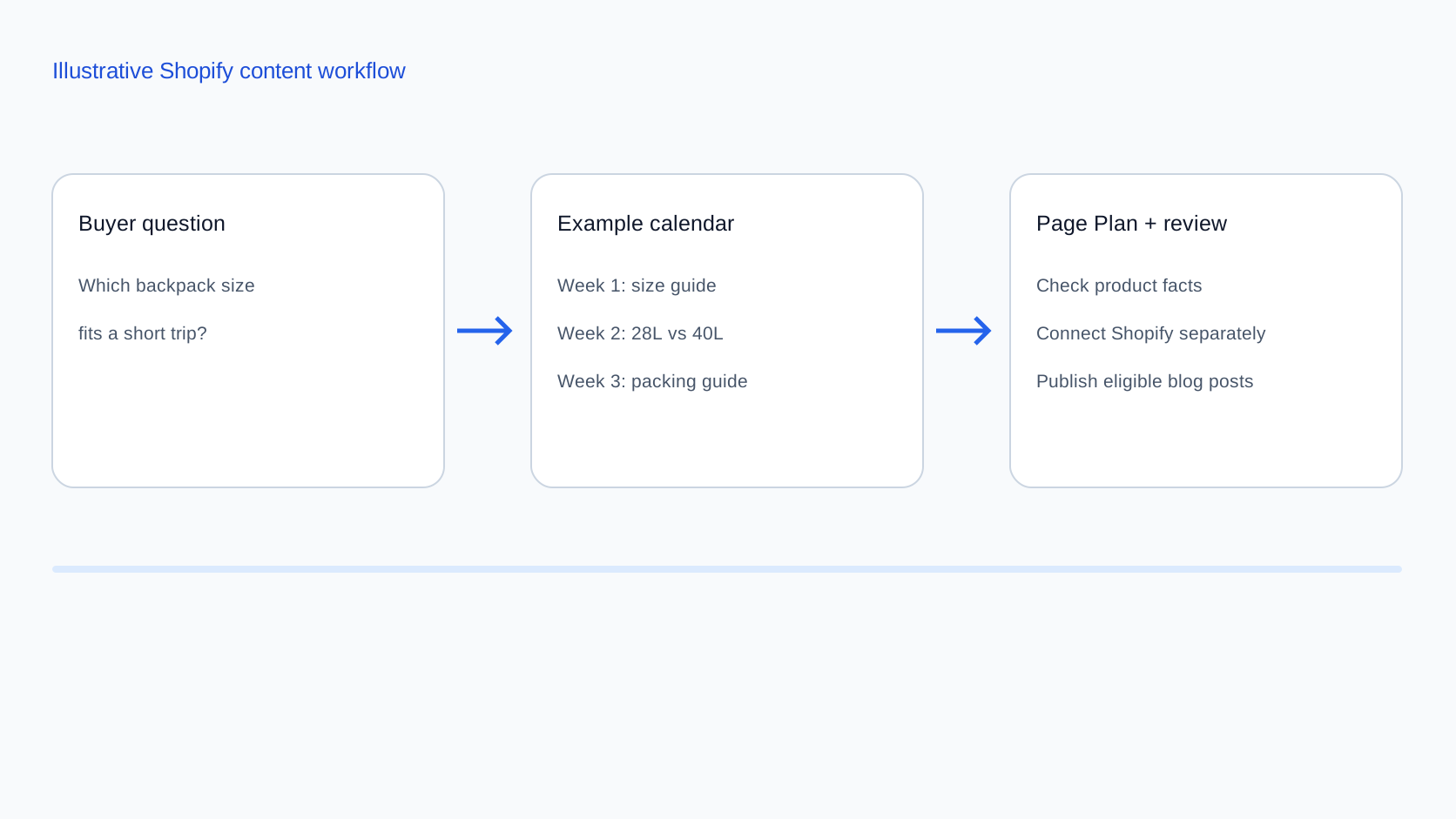
An ecommerce buying guide should help a reader decide what matters, narrow the options and recognize when a product is unsuitable. A list of products with a “buy now” button under each one does not necessarily do that work.
Start with the decision the customer cannot yet make. Then choose useful criteria, connect them to accurate product information and place links where the reader is ready for a next step. This guide works through that process before asking you to use Rankvia.
Decide whether a buying guide is the right page
A collection helps someone browse a range. A product page explains one item. A buying guide helps someone understand the criteria for choosing; a focused comparison resolves a specific tradeoff. These pages can support each other without doing identical jobs.
First inspect the existing site. If a good guide already owns the question, assess that page instead of creating another. If the customer only needs a product's dimensions, improve the product information where necessary. If the store has no meaningful choice or expertise to explain, another guide may add little.
Use the broader Shopify content strategy to decide page ownership. The Shopify content-calendar example shows how selected work gets a justified slot. Here the task is narrower: what a useful buying guide should actually contain.
Example: Northtrail's short-trip backpack guide
Keep the store's product range coherent: two travel backpacks and packing cubes, as in the calendar example. The proposed guide is “How to choose a backpack for a short trip”. Its reader is deciding what capacity and fit they need before browsing products. The narrower “28L vs 40L for three nights” comparison can handle the direct two-size tradeoff if it deserves a separate page; the general guide should explain the criteria and link to that deeper decision rather than duplicate it.
For this example only, assume the fictional catalog states that both bags have laptop compartments, the Weekender has 28 litres of capacity and the Journey has 40 litres. Packing cubes organize items inside either bag; they do not increase the bag's stated capacity. No weight, waterproofing, airline acceptance, durability or comfort test is available. Those missing facts limit what the guide can claim.
The buyer needs are also illustrative: a traveller with a laptop and a compact clothing list; someone carrying bulkier clothing; and someone who has not established whether their laptop or the packed bag will fit. Do not present these as research findings. In a real store, validate needs through actual customer questions, product knowledge and available search evidence.
Choose criteria that change the decision
| Criterion | Question to answer | How it affects the choice | What needs verification |
|---|---|---|---|
| Packing list and capacity | What must travel with the reader? | A compact list may justify assessing the 28L; a larger list may justify considering 40L. Nights away alone do not decide capacity. | A realistic packing example and the products' actual measurements. |
| Laptop fit | Does the device fit the compartment? | The correct total capacity does not prove device compatibility. | Laptop and compartment dimensions, including any relevant clearance. |
| Carrying fit | Can the reader adjust and carry the packed bag appropriately? | Neither capacity is automatically more comfortable. | Manufacturer fit guidance and any genuine test evidence, with its limits. |
| Travel constraints | What size and weight limits apply to this trip? | A bag can be unsuitable despite meeting the reader's packing needs. | The current operator's allowance and the actual packed bag; no universal airline claim. |
| Organization | Does the reader need separate groups of items? | Packing cubes may help organize either bag, but may be unnecessary for some buyers. | Cube dimensions and how the buyer intends to pack. |
Keep the criteria connected to the selection. Avoid a long feature glossary that never changes a recommendation. If weight matters but verified weights are missing, mark that question unresolved and obtain the facts rather than inventing an answer.
Blank buying-guide planning table - select and copy
Use this blank table in your own editorial notes. Add rows for the criteria that matter to your reader.
Start each recommendation with a buyer need and verified facts. Capacity, compatibility and comfort answer different questions; one does not establish the others. Leave a criterion unresolved when evidence is missing, even if that means making no recommendation. Firsthand testing claims require actual test evidence.
| Buyer need or constraint | Selection criterion | Verified product facts and source | Suitable option and tradeoff, if established | Missing evidence or next check |
|---|---|---|---|---|
For a complete assignment, use the content-brief template.
Match products to needs, with honest limits
For the fictional compact-packing traveller, the Weekender 28L is a candidate to assess first, not a guaranteed fit. Its limitation is less stated capacity than the Journey. The reader still needs to check their packing list, device dimensions and trip restrictions.
The Journey 40L is a candidate when the reader has a larger packing list. Its extra stated capacity does not prove that it fits a cabin allowance or is comfortable when loaded. Choosing it merely because “bigger is better” ignores the original decision.
Packing cubes are an optional organizing accessory for either bag. Show why they might help and when the customer can skip them. If neither bag meets verified requirements, say so. A useful buying guide can lead to no purchase instead of forcing an unsuitable recommendation.
Use conditional language tied to evidence: “consider this option if…” is more defensible than “the best backpack for everyone”. Recommendations should explain both fit and tradeoffs, rather than assign invented ratings or imply independent testing.
Turn the decision into a page outline
A Page Plan can carry the reader, decision, business context, evidence needs and internal connections before generation. For Northtrail, the illustrative outline is:
- Start with the packing task. Ask what needs to travel: clothes, laptop, work items and any bulky essentials.
- Explain capacity without making a nights-to-litres rule. Show why two people on the same trip may need different space.
- Check fit and constraints. Separate laptop fit, carrying fit and operator restrictions; state which facts remain unknown.
- Present the two candidates. Explain when to assess the 28L or 40L and why neither automatically wins. Link to the focused comparison for further detail if that page exists.
- Discuss organization separately. Explain the optional role of packing cubes without turning them into a required add-on.
- Offer the right next step. Let readers inspect specifications, browse the collection or use the existing size guide. End with a short check-before-ordering summary.
This is a sample outline, not a claim that the planner will select that topic or produce those exact sections. Where an existing guide already covers the decision, improving it may be the better plan.
Sample excerpt and product-link placement
Start with the items you need to carry, rather than choosing a bag from the number of nights alone. If your clothing list is compact and you carry a laptop, assess the Weekender 28L against your actual packing list. Check its compartment dimensions before assuming your device will fit. [Product link: Weekender 28L specifications]
If that list needs more space, compare it with the Journey 40L's stated capacity and dimensions. More capacity is useful only when it meets your needs and your trip's restrictions. We cannot infer cabin acceptance or loaded comfort from the litre figure. [Product link: Journey 40L specifications]
Unsure what to check next? Use the size guide, then browse the backpack collection once your requirements are clear. Packing cubes are optional if separating clothes or accessories would help you. [Guide link: existing size guide] [Collection link: backpacks] [Optional accessory link: packing cubes]
In the real article, replace each note with a verified store URL and descriptive anchor text. Put a product link beside the reason to consider that product, not before the reader understands the criterion. A collection link suits readers who are ready to browse; a sizing guide suits an unresolved fit question. Avoid repeating the same commercial links in every paragraph.
Internal links should serve the decision and use existing destinations. A link back from a collection or an older article may need a separate update. See Shopify internal linking; keep product and collection implementation on their existing technical owner pages.
Review the guide before publication
The merchant should verify every specification, illustration, comparison and product link against the real catalog. Replace fictional assumptions with sourced facts. Confirm that availability, restrictions and any test claims are supported; do not turn manufacturer wording into invented first-hand experience. If an important criterion cannot be answered, keep the limitation visible.
Review whether each recommendation follows from the reader's need, whether the alternative has a fair role and whether unsuitable buyers have a clear exit. Check that the guide adds a decision-making function rather than repeating product descriptions or the existing comparison.
For supported generated articles and pages, publication follows review and the configured destination. Shopify publication requires the appropriate connection, permissions and destination, including the blog for an article. It does not automatically rewrite product or collection records. Optional automatic publishing requires opt-in and current readiness checks; a website URL alone does not enable it.
Maintain a buying guide when the facts change
A useful guide can become misleading even when its main explanation remains sound. A discontinued option, a revised specification or an outdated destination may break the reasoning behind a recommendation. Maintenance starts by checking that reasoning, not by rewriting every old paragraph or automatically replacing a product with the nearest available item.
The following is a separate, fictional later snapshot for teaching maintenance. The earlier assumed specifications still apply to the original example; the changes below belong only to this later exercise.
Record what changed before changing the recommendation
Assume Northtrail's merchant has now confirmed that the Journey 40L has been discontinued. The updated Weekender 28L specification still states 28 litres but no longer lists a dedicated laptop compartment. The merchant has also identified an obsolete size-guide link and an outdated product destination. These new assumptions do not establish weights, carrying comfort, airline acceptance or hands-on performance.
| Change in this fictional snapshot | Why it matters to the buyer | Editorial action to review |
|---|---|---|
| Journey 40L is discontinued | The larger-capacity recommendation no longer leads to a purchasable option | Remove it from the current shortlist; keep historical context only if useful and clearly labelled |
| Weekender specification changed | The old laptop-oriented recommendation is no longer supported by the current facts | Withdraw the compartment claim and reassess the recommendation for a reader carrying a laptop |
| A product destination is outdated | A descriptive anchor can still lead to an unavailable or wrong item | Verify the intended destination and its current content before updating the link |
| The size-guide link is obsolete | The reader cannot resolve the fit question at the promised next step | Locate a genuine maintained resource or remove the promised link and explain what remains unresolved |
| The criteria were too close to “nights away” | Trip length alone cannot determine capacity or device fit | Reorder around packing list, verified dimensions and trip restrictions |
A temporary stock shortage and discontinuation are different conditions. In a real review, confirm the status with the merchant rather than infer it from one unavailable button. A temporary shortage may justify an accurate availability note and another relevant route; permanent discontinuation may justify withdrawing the current recommendation. Neither condition proves that an arbitrary replacement is suitable.
Re-evaluate criteria and products together
Do not merely swap “Journey” for “Weekender” in every sentence. The 28L option does not inherit the discontinued product's capacity or suitability. If the current range no longer answers the reader's larger-packing need, say that clearly. A useful guide can still explain the criteria while directing that reader to investigate another suitable product rather than forcing the remaining sale.
For a laptop-carrying reader, a removed or unverified compartment claim changes the recommendation itself. Ask what verified dimensions and protection information are available, without inventing a requirement or asserting safety. Packing cubes remain optional organizers; they do not restore missing capacity or establish device compatibility. Keep useful general explanations when they remain supported.
Before and after: revise the advice, not just the date
Illustrative earlier passage, now unsuitable under the later assumptions:
If you carry a laptop and pack compactly, start with the Weekender 28L's laptop compartment. For a bulkier list, the Journey 40L is the larger option to buy. Follow the size-guide link to settle fit before ordering.
Illustrative revised passage for merchant review:
Start with your actual packing list and the current product specifications. The Weekender 28L remains a candidate for a compact list, but the updated fictional specification no longer supports our earlier dedicated-compartment claim. Do not choose it for laptop fit without verifying the relevant measurements and requirements. [Verified current product destination, only after review]
The Journey 40L has been discontinued in this fictional scenario, so it is no longer a current buying recommendation. If your packing list requires more space than the remaining option provides, this range may not meet your need. We have not established a suitable replacement. Packing cubes may help organization, but do not increase stated capacity.
Our former size-guide destination is obsolete. Add a replacement only when the merchant has verified that it answers the fit question; otherwise keep that question open and consult the current product information before ordering. [Maintained fit resource, if verified]
The bracketed notes are editing placeholders, not live links. The revision shows how to withdraw unsupported advice, acknowledge when no product fits and preserve useful guidance.
Merchant review before a maintenance update
- Check the current catalog, relevant product version, availability status and specification source. Record who verified each change and when.
- Revisit the reader need and each selection criterion. Remove recommendations no longer supported by those criteria; do not invent a new winner.
- Verify every product, collection, comparison and educational destination. Review anchor wording and actual destination content, not just whether the URL loads.
- Review tables, introductory recommendations, metadata, image captions and any structured information that repeats changed claims. Keep the whole article consistent.
- Preserve accurate explanations and useful existing URLs. Change only the advice and links that evidence requires; do not delete an established page just because one option changed.
- Review the revised draft and the eventual published page in its real destination. Confirm the update did not introduce claims of testing, availability guarantees or unsupported performance.
These are manual merchant and editorial responsibilities. Rankvia does not continuously synchronize this guide with inventory, detect every discontinued product or monitor every catalog specification. Its supported Improve workflow starts from a suitable opportunity and existing-page context. A proposed refresh is evaluated, and the application can retain the original when the proposal is not materially better or would regress the page. That safeguard does not certify catalog accuracy or replace merchant review. See the refresh-versus-retain guide and Improve instructions.
The existing store/general planning CTA below remains the entry. It does not perform an instant arbitrary-URL assessment, guarantee that this guide is selected for refresh or enable automatic catalog maintenance.
Where Rankvia helps and how to start
Rankvia is a website-growth autopilot. It can use business and website context with search-opportunity evidence to decide which work deserves priority, choose page ownership and carry selected work through the Content Calendar, Page Plans, generation and eligible publication. Google Search Console is an optional additional input. A buying guide is one possible action, not a guaranteed output of entering from this page.
Use the existing general planning entry below. Enter your store website, then create an account or sign in, complete the existing analysis and review the Business Profile before approving it. The approved website language and market remain authoritative for downstream content; interface locale is separate. Review the opportunity, plan and draft against your actual products before publication.
The separate Shopify installation entry remains available if that is your intended route. General planning does not install the app, connect publishing or change billing channels. A Shopify-managed subscription stays Shopify-managed on the web; see Shopify plans and billing.
After publication, review whether the page reaches relevant readers and helps them move to suitable products or supporting guidance. Those are questions to measure with actual evidence, not promises of rankings, AI citations or sales.
APPLY THIS TO YOUR WEBSITE
Find the buying decisions your store should address next
Start with your website. After sign-in, analysis and Business Profile approval, Rankvia can assess existing coverage and prioritize useful work. A buying guide, an existing-page improvement or no new page may be the appropriate decision.
Uses the existing planning flow and eligibility rules. This entry does not force a buying-guide topic or enable publishing.
Related guides
Ecommerce product education: teach a useful concept
Teach a useful product concept using clear explanations and verified facts.
Shopify Content Strategy: What to Create, Improve & Prioritize
Choose useful work across product pages, collections and store guides.
Shopify SEO content calendar: plan around buyer questions
Turn store buyer questions into a practical content schedule.
Internal Linking for SEO and AI Search
Choose relevant destinations and descriptive anchors that help readers take their next step.